
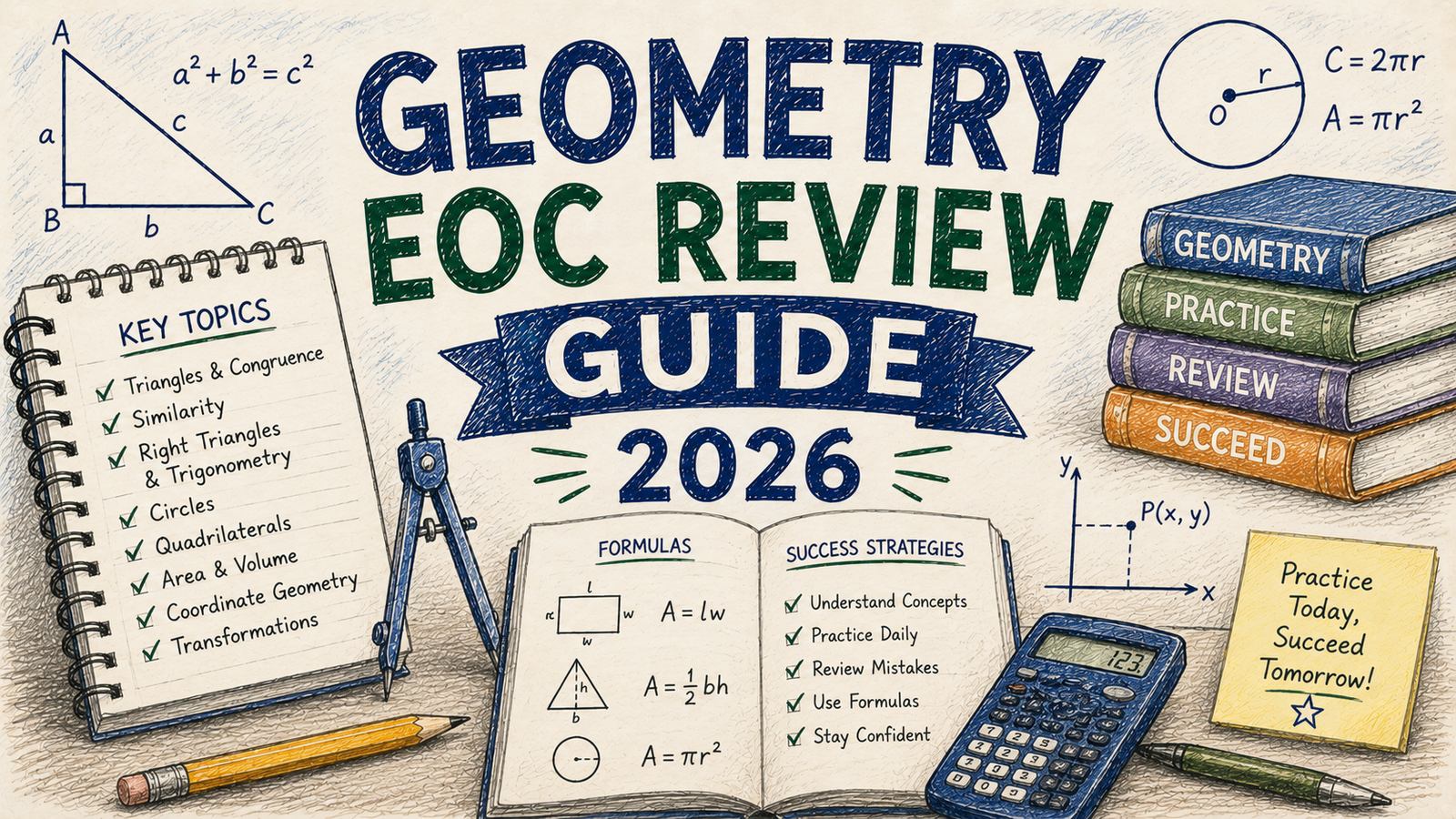
Complete Geometry EOC Review Guide: Formulas, Blueprint, Study Plan, and Practice Strategy
This Geometry EOC study guide is designed for students, parents, tutors, and teachers who want one clear place to review the Florida Geometry End-of-Course exam. It explains the exam format, latest 2025–2026 testing details, achievement levels, reporting categories, formulas, topic-by-topic review notes, common mistakes, and a practical study plan.
Need a score estimate? After you finish a practice set, use the internal Geometry EOC Score Calculator to estimate performance and decide which reporting category needs the most review.
What Is the Geometry EOC?
The Geometry EOC is an End-of-Course assessment taken by students who are enrolled in and completing Geometry or an equivalent course connected to Florida’s B.E.S.T. Mathematics standards. In simple language, the exam checks whether a student can reason with geometric definitions, use theorems, work with coordinate geometry, analyze transformations, solve measurement problems, and apply right triangle trigonometry. It is not only a formula test. A strong student must know when a theorem applies, why a relationship is true, and how to connect a diagram, an equation, a proof statement, and a real-world situation.
For the current Florida system, the B.E.S.T. Geometry EOC is aligned to the Benchmarks for Excellent Student Thinking. The exam is delivered primarily as a computer-based assessment, and the official materials describe the Algebra 1 and Geometry EOC assessments as computer-adaptive. That means students may not all receive the same exact set of questions. Items are selected to meet blueprint requirements and adjust difficulty based on how a student responds. This is why a good review plan should not depend on memorizing one released form. Instead, review the full blueprint and practice mixed problem types.
The Geometry EOC matters because it can affect the student’s course record, placement conversations, and diploma pathway. Students who need a standard diploma with a Scholar designation may need to earn a passing Geometry EOC score. Some students retake the assessment for graduation-related reasons, grade forgiveness, or credit acceleration. Local rules and district timelines can vary, so students should always confirm their exact testing date and school-specific instructions with their counselor, teacher, or district assessment calendar.
Who Usually Takes It?
Students enrolled in Florida Geometry, Geometry Honors, IB Middle Years Program Geometry Honors, or Pre-AICE Mathematics 2 generally participate in the corresponding Geometry EOC. Students may also participate if they need to retake an assessment, have not yet taken the assessment to be averaged into the course grade, are in grade forgiveness, need a Scholar designation score, or are using credit acceleration. Middle grades students enrolled in Geometry take the Geometry EOC instead of the grade-level mathematics assessment.
| Student situation | What it means for Geometry EOC review |
|---|---|
| Currently taking Geometry | Review all Geometry standards, not only the final unit. The EOC is cumulative. |
| Taking Geometry Honors | Expect the same assessed standard families, but your class may go deeper than the minimum EOC level. |
| Retaking the EOC | Start with the score report or teacher feedback. Focus first on the reporting category with the weakest performance. |
| Trying for Scholar designation | Focus on reaching at least Achievement Level 3, then push higher by strengthening proofs, circles, coordinate geometry, and multi-step measurement. |
| Middle school student in Geometry | Prepare for the Geometry EOC course assessment, not the grade-level math test, unless your school tells you otherwise. |
What Makes the Geometry EOC Different from a Normal Class Test?
A classroom test often covers one chapter. The EOC covers the course. A classroom test may use the exact notation and diagrams from recent homework. The EOC can present the same idea in unfamiliar wording, a different diagram style, a coordinate plane, a table, a construction prompt, or a word problem. A classroom test may reward remembering a formula. The EOC usually rewards selecting the correct method, using the method accurately, and interpreting the result in context.
The most successful students prepare in layers. First, they learn the blueprint. Second, they memorize and understand the formulas that appear on the reference sheet. Third, they practice problem families until they can recognize the method quickly. Fourth, they learn to justify answers using definitions and theorems. Finally, they take timed mixed practice so their brain becomes comfortable switching between proof logic, algebra, diagrams, coordinate geometry, and measurement.
Geometry EOC Dates, Timing, Calculator, and Score Ranges for 2026
The 2025–2026 Florida statewide assessment schedule lists district testing windows rather than one single statewide test day. Schools and districts select exact administration days within the state window. For Spring 2026, the EOC assessment window includes Geometry from May 1–29, 2026. Summer EOC assessment opportunities are listed for June 22–26, 2026 and July 13–17, 2026. Fall and winter windows also appear for students who need the assessment outside the main spring administration.
| Administration | State testing window | What students should do |
|---|---|---|
| Fall 2025 | September 8–October 3, 2025 | Usually relevant for retakes, special scheduling, or students completing the course outside the standard spring timeline. |
| Winter 2025 | December 1–19, 2025 | Useful for students completing or retaking an EOC in the winter cycle. |
| Spring 2026 | May 1–29, 2026 | Main review target for most students taking Geometry during the school year. |
| Summer 2026 | June 22–26, 2026 and July 13–17, 2026 | Often used for retakes or summer testing opportunities. Confirm with your district. |
Score Ranges and Achievement Levels
Florida reports B.E.S.T. EOC performance using scale scores and achievement levels. For Geometry, the scale ranges are Level 1: 325–384, Level 2: 385–403, Level 3: 404–422, Level 4: 423–431, and Level 5: 432–475. Achievement Level 3 indicates on-grade-level performance. A student aiming to pass should treat 404 as the first major target, but a safer study target is to practice above the minimum because test-day performance can fluctuate.
| Geometry EOC level | Scale score range | Review meaning |
|---|---|---|
| Level 1 | 325–384 | Major gaps remain. Start with formulas, vocabulary, and one-step problem recognition. |
| Level 2 | 385–403 | Close to on-grade-level but not yet Level 3. Focus on mixed practice, proof vocabulary, and multi-step coordinate problems. |
| Level 3 | 404–422 | On-grade-level performance. Maintain accuracy by reviewing all reporting categories. |
| Level 4 | 423–431 | Strong performance. Push by improving speed, precision, and complex problem interpretation. |
| Level 5 | 432–475 | Advanced performance. Continue full-length mixed practice and avoid careless algebra or unit mistakes. |
Important: A score calculator can estimate readiness, but only the official state reporting system produces the official scale score and achievement level. Use practice results as a guide for study priorities, not as a guaranteed final score.
Calculator and Reference Sheet
Students have access to an online scientific calculator and a reference sheet through the test system. A scientific calculator can help with square roots, trigonometric ratios, and decimal computations, but it will not choose the theorem for you. Students should practice with a scientific calculator before test day, especially for trigonometry and square-root answers. A graphing calculator is not the standard tool for the Geometry EOC, and calculators with prohibited functions can create testing problems. Follow school instructions exactly.
The reference sheet includes many essential formulas, including coordinate formulas, area formulas, surface area formulas, volume formulas, and trigonometric ratios. However, the reference sheet does not replace understanding. For example, knowing that \(A=\frac{1}{2}h(b_1+b_2)\) is a trapezoid formula is only useful if you can identify the two bases and the height, even when the trapezoid is rotated or embedded in a word problem.
Geometry EOC Blueprint: What to Study First
The official Geometry EOC blueprint groups the test into three reporting categories: Logic, Relationships, and Theorems; Congruence, Similarity, and Constructions; and Measurement and Coordinate Geometry. A strategic review plan should respect these percentages. Do not spend all your time on one favorite topic. The Geometry EOC is broad, and the highest score gains often come from balancing theorem knowledge with coordinate geometry and measurement accuracy.
| Reporting category | Approximate percent of test | Main skills | Study priority |
|---|---|---|---|
| Logic, Relationships, and Theorems | 33–40% | Lines and angles, triangle theorems, quadrilateral theorems, trapezoids, circle theorems, conditional statements, proofs, counterexamples. | Very high. This category rewards theorem recall plus reasoning. |
| Congruence, Similarity, and Constructions | 27–33% | Congruence, similarity, transformations, sequences of transformations, rigid motion, dilations, formal constructions. | High. This category connects diagrams, coordinates, and proof reasoning. |
| Measurement and Coordinate Geometry | 33–40% | Coordinate geometry, perimeter, area, volume, surface area, cross-sections, rotations of 2D figures, equation of a circle, right triangle trigonometry. | Very high. This category is formula-heavy and often multi-step. |
How to Convert the Blueprint into a Study Schedule
Use the blueprint as a time budget. If you have 10 study hours, do not spend 8 hours on transformations just because they feel easier. A better split is about 3.5 to 4 hours on Logic, Relationships, and Theorems; 2.5 to 3 hours on Congruence, Similarity, and Constructions; and 3.5 to 4 hours on Measurement and Coordinate Geometry. The exact split changes based on your weaknesses, but the blueprint prevents a common mistake: reviewing only the topics that feel comfortable.
For example, if you have \(T=12\) total study hours and want to spend about \(35\%\) on Measurement and Coordinate Geometry, then \(0.35T=0.35(12)=4.2\) hours. That means you should reserve a little more than four hours for coordinate geometry, area, volume, circle equations, and trigonometry.
Geometry EOC Formula Vault
This section gathers the formulas and relationships students should know cold. Some formulas appear on the official reference sheet, but students should still practice applying them without hesitation. The goal is not just memorization. The goal is instant recognition: when you see two coordinates, think slope, distance, midpoint, or equation of a circle; when you see a right triangle, think Pythagorean theorem, special right triangle ratios, or trigonometric ratios; when you see a 3D object, decide whether the question asks for surface area, volume, or a cross-section.
Coordinate Geometry Formulas
Use distance when the problem asks for side length, radius, diameter, perimeter on a coordinate plane, or verification that two sides are congruent.
Use midpoint when the problem asks for the center of a segment, the center of a circle from endpoints of a diameter, or a missing endpoint relationship.
Use slope to prove lines are parallel, perpendicular, or neither. Parallel nonvertical lines have equal slopes. Perpendicular nonvertical lines have slopes whose product is \(-1\).
The center is \((h,k)\), and the radius is \(r\). If the equation is not in standard form, complete the square when needed.
Triangle and Trigonometry Formulas
Use only for right triangles, where \(c\) is the hypotenuse.
Use for missing angles, proof steps, and algebraic angle expressions.
Use when a right triangle problem gives an angle and a side or asks for a missing side or angle.
Use these ratios to avoid unnecessary calculator work when angle patterns are visible.
Area, Surface Area, and Volume Formulas
| Figure | Formula | Use it when... |
|---|---|---|
| Triangle | \(A=\frac{1}{2}bh\) | You know a base and its perpendicular height. |
| Parallelogram | \(A=bh\) | You know the base and perpendicular height. Do not use the slanted side as height unless it is perpendicular. |
| Trapezoid | \(A=\frac{1}{2}h(b_1+b_2)\) | You know the two parallel bases and the height. |
| Circle | \(C=2\pi r=\pi d,\quad A=\pi r^2\) | You need circumference or area. Be careful about radius versus diameter. |
| Regular polygon | \(A=\frac{1}{2}Pa\) | You know perimeter \(P\) and apothem \(a\). |
| Prism or cylinder | \(V=Bh,\quad SA=2B+Ph\) | You need volume or surface area of a solid with congruent parallel bases. |
| Cone | \(V=\frac{1}{3}Bh,\quad SA=B+\pi r\ell\) | You need volume or surface area of a cone. \(\ell\) is slant height. |
| Pyramid | \(V=\frac{1}{3}Bh,\quad SA=B+\frac{1}{2}P\ell\) | You need volume or surface area of a regular pyramid. |
| Sphere | \(V=\frac{4}{3}\pi r^3,\quad SA=4\pi r^2\) | You need volume or surface area of a sphere. |
Circle Theorems and Relationships
Use when an angle intercepts part of a circle and the question asks for the length along the circle.
Use when the question asks for the area of a slice of a circle.
An angle with vertex on the circle measures half its intercepted arc.
Use when a tangent and secant are drawn from the same external point.
Transformation Rules to Memorize
| Transformation | Coordinate rule | Preserves distance? |
|---|---|---|
| Translation | \((x,y)\rightarrow(x+a,y+b)\) | Yes |
| Reflection over \(x\)-axis | \((x,y)\rightarrow(x,-y)\) | Yes |
| Reflection over \(y\)-axis | \((x,y)\rightarrow(-x,y)\) | Yes |
| Rotation \(90^\circ\) counterclockwise about origin | \((x,y)\rightarrow(-y,x)\) | Yes |
| Rotation \(180^\circ\) about origin | \((x,y)\rightarrow(-x,-y)\) | Yes |
| Rotation \(270^\circ\) counterclockwise about origin | \((x,y)\rightarrow(y,-x)\) | Yes |
| Dilation centered at origin | \((x,y)\rightarrow(kx,ky)\) | No, unless \(k=1\) or \(k=-1\) |
Complete Topic-by-Topic Geometry EOC Review
The following review sections explain what each major topic means, how it usually appears on the EOC, and which mistakes to avoid. Read the topic, then immediately solve two or three practice problems. Geometry improves when you move between explanation and action. Passive reading creates confidence, but active practice creates score growth.
1. Lines, Angles, and Parallel-Line Theorems
Lines and angles are the foundation of Geometry. Students should know vertical angles, linear pairs, complementary angles, supplementary angles, corresponding angles, alternate interior angles, alternate exterior angles, same-side interior angles, perpendicular bisectors, and angle relationships formed by transversals. The EOC may ask for a missing angle directly, or it may hide the angle relationship inside a proof, a coordinate problem, or a diagram with algebraic expressions.
Remember that vertical angles are congruent. A linear pair is supplementary, so the measures add to \(180^\circ\). Complementary angles add to \(90^\circ\). When parallel lines are cut by a transversal, corresponding angles are congruent, alternate interior angles are congruent, and same-side interior angles are supplementary. If two lines are perpendicular, they form right angles. If a point lies on the perpendicular bisector of a segment, it is equidistant from the endpoints of that segment.
The most common mistake is assuming lines are parallel because they look parallel. On the EOC, you should use marked arrows, given statements, slope evidence, or theorem conditions. Diagrams are not always drawn to scale. If the problem gives algebraic angle expressions, write an equation from the angle relationship before solving. For example, if alternate interior angles are labeled \(3x+10\) and \(5x-30\), set \(3x+10=5x-30\). If same-side interior angles are labeled \(4x+8\) and \(6x+12\), set \((4x+8)+(6x+12)=180\).
2. Logic, Conditional Statements, and Proofs
Geometry proofs measure reasoning. Students should know conditional statements, converse, inverse, contrapositive, biconditional statements, counterexamples, deductive reasoning, and the structure of proof. A conditional statement has the form “if \(p\), then \(q\).” The converse is “if \(q\), then \(p\).” The inverse is “if not \(p\), then not \(q\).” The contrapositive is “if not \(q\), then not \(p\).” A conditional statement and its contrapositive have the same truth value. The converse and inverse also have the same truth value, but they do not automatically match the original statement.
Proofs can appear as two-column proofs, paragraph proofs, flow-style reasoning, or fill-in-the-blank justification. To improve, build a personal theorem bank. For each theorem, write three parts: the condition, the conclusion, and the diagram signal. For example, the condition for the triangle angle sum theorem is “a triangle is given.” The conclusion is that the three interior angles sum to \(180^\circ\). The diagram signal is any triangle with angle expressions or missing angles. This three-part method makes proof questions easier because you stop guessing and start matching evidence to conclusions.
A counterexample disproves a universal statement. If a statement says “all rectangles are squares,” a non-square rectangle is a counterexample. If a statement says “all quadrilaterals with one pair of parallel sides are parallelograms,” a trapezoid is a counterexample. Strong students do not need a complicated counterexample. They need one clear example that satisfies the hypothesis but fails the conclusion.
3. Triangle Congruence
Triangle congruence means two triangles have the same size and shape. The major congruence criteria are SSS, SAS, ASA, AAS, and HL for right triangles. Students should also understand CPCTC, which means corresponding parts of congruent triangles are congruent. Many EOC questions ask students to choose the correct reason for a proof step, identify missing information needed for congruence, or justify that two segments or angles are congruent after proving triangles congruent.
Do not confuse SSA with a valid congruence rule. SSA is not a general triangle congruence shortcut. For right triangles, however, HL is valid because a right angle is already known and the hypotenuse plus one leg determines the triangle. When reading a diagram, mark congruent sides and angles carefully. Shared sides can be reflexive, vertical angles can be congruent, and parallel lines can create angle congruences. The proof often depends on spotting one hidden relationship.
A good practice method is to cover the answer choices and ask, “What do I already have?” List sides, angles, shared parts, and parallel-line relationships. Then ask, “Which rule is possible?” If you have two sides and the included angle, think SAS. If you have two angles and a non-included side, think AAS. If the triangles are right triangles with congruent hypotenuse and leg, think HL.
4. Triangle Similarity and Scale Factors
Triangle similarity means two triangles have the same shape but not necessarily the same size. Similar triangles have congruent corresponding angles and proportional corresponding sides. The main similarity shortcuts are AA, SSS similarity, and SAS similarity. The EOC often uses similarity to find missing side lengths, prove relationships, interpret dilations, or solve real-world indirect measurement problems.
Use a scale factor carefully. If triangle \(A\) maps to triangle \(B\) with scale factor \(k\), then every length in \(B\) is \(k\) times the corresponding length in \(A\). Perimeter also scales by \(k\). Area scales by \(k^2\). Volume, for similar solids, scales by \(k^3\). This distinction is a high-value EOC concept because students often multiply area by \(k\) instead of \(k^2\).
When setting up proportions, write corresponding sides in the same order. If the small triangle side is in the numerator on the left, keep the corresponding small triangle side in the numerator on the right. Many wrong answers come from mismatched ratios, not from difficult algebra.
5. Quadrilaterals and Special Quadrilaterals
Quadrilaterals include parallelograms, rectangles, rhombi, squares, trapezoids, and kites. Students should know the defining properties and theorem-based properties of each. A parallelogram has both pairs of opposite sides parallel. Opposite sides are congruent, opposite angles are congruent, consecutive angles are supplementary, and diagonals bisect each other. A rectangle is a parallelogram with four right angles, and its diagonals are congruent. A rhombus is a parallelogram with four congruent sides, and its diagonals are perpendicular. A square has the properties of both a rectangle and a rhombus.
For trapezoids, pay attention to the midsegment and isosceles trapezoid relationships. The trapezoid midsegment is parallel to the bases and has length equal to the average of the base lengths:
In an isosceles trapezoid, base angles are congruent and diagonals are congruent. EOC questions may ask you to identify a quadrilateral from coordinate evidence. In that case, use slope to check parallel or perpendicular sides, and distance to check congruent sides or diagonals. If the problem asks whether a quadrilateral is a rectangle, a rhombus, or a square, you may need both slope and distance.
6. Transformations: Translations, Reflections, Rotations, and Dilations
Transformations are a major bridge between coordinate geometry and congruence or similarity. Translations, reflections, and rotations are rigid transformations. They preserve distance and angle measure, so they create congruent figures. Dilations preserve angle measure but multiply side lengths by a scale factor, so they usually create similar figures rather than congruent figures.
Students should be able to describe a transformation in words, write coordinate rules, apply a transformation to a figure, and identify a sequence of transformations that maps one figure to another. For rotations in Geometry, common rules about the origin are especially useful: \(90^\circ\) counterclockwise maps \((x,y)\) to \((-y,x)\), \(180^\circ\) maps \((x,y)\) to \((-x,-y)\), and \(270^\circ\) counterclockwise maps \((x,y)\) to \((y,-x)\).
A frequent mistake is reversing the direction of rotation or forgetting that a dilation with \(k>1\) enlarges while \(0
7. Coordinate Geometry
Coordinate geometry is one of the most score-rich areas because it connects algebra with diagrams. Students should be comfortable using slope, distance, midpoint, perimeter, area, and circle equations on the coordinate plane. A coordinate problem can ask you to prove a quadrilateral is a parallelogram, rectangle, rhombus, or square. It can ask for the coordinates of a midpoint, endpoint, centroid, or point on a segment. It can ask whether a point lies on a circle or what equation describes a circle.
To prove a quadrilateral is a parallelogram, show both pairs of opposite sides have equal slopes, or show both pairs of opposite sides are congruent, or show diagonals bisect each other. To prove a rectangle, show a parallelogram has one right angle or that adjacent slopes are negative reciprocals. To prove a rhombus, show all sides are congruent or use diagonal properties. To prove a square, combine rectangle and rhombus evidence.
Coordinate area problems may use the distance formula, decomposition into rectangles and triangles, or the shoelace method if appropriate. For the EOC, the safest general strategy is to sketch the points, identify the shape, and choose a method. When a polygon sits on the coordinate axes or has horizontal and vertical sides, area can often be found by decomposing into simpler shapes. When sides are slanted, distance and midpoint become more important.
8. Circles: Arcs, Chords, Secants, Tangents, and Equations
Circles appear in both theorem questions and coordinate questions. Students need vocabulary first: radius, diameter, chord, secant, tangent, arc, central angle, inscribed angle, sector, and segment. A radius meets a tangent at a right angle at the point of tangency. Inscribed angles measure half their intercepted arcs. A diameter that is perpendicular to a chord bisects the chord and its arc. Chords equidistant from the center are congruent, and congruent chords intercept congruent arcs.
For secant, tangent, and chord relationships, label every segment carefully. In the chord-chord relationship, the products of the two parts of one chord equal the products of the two parts of the other chord:
For two secants from an external point, multiply the external part by the whole secant for each secant. For tangent-secant, square the tangent length and set it equal to external times whole secant. These problems are often missed because students use the internal piece instead of the whole secant. Circle equations require a different mindset. Standard form \((x-h)^2+(y-k)^2=r^2\) tells you the center and radius. If the problem gives endpoints of a diameter, use midpoint for the center and distance for the diameter, then divide by 2 for the radius.
9. Measurement: Area, Surface Area, Volume, and Density
Measurement questions test whether students can choose the correct formula and interpret dimensions. Area is measured in square units. Volume is measured in cubic units. Surface area is measured in square units even though it belongs to a 3D object. Density problems may involve ratios such as population per square mile or mass per cubic unit. A measurement problem may be direct, but many EOC items are real-world contexts where students must decide what quantity is being requested.
For prisms and cylinders, volume is \(V=Bh\), where \(B\) is the area of the base. For pyramids and cones, volume is one-third of the related prism or cylinder volume: \(V=\frac{1}{3}Bh\). For spheres, volume is \(V=\frac{4}{3}\pi r^3\). Surface area requires counting exposed surfaces, so word problems involving open containers or missing bases need careful reading. If a cylinder has no top, do not include the top circle in the surface area.
Scaling is another high-yield measurement idea. If all lengths multiply by \(k\), then perimeter and other lengths multiply by \(k\), area multiplies by \(k^2\), and volume multiplies by \(k^3\). For example, if the radius of a sphere doubles, the surface area becomes four times as large and the volume becomes eight times as large. This concept often appears without asking for the full formula.
10. Cross-Sections and Rotations of 2D Figures
Students should identify two-dimensional cross-sections of three-dimensional figures and identify three-dimensional objects formed by rotating two-dimensional figures. A horizontal slice of a cylinder can create a circle. A vertical slice through a cylinder can create a rectangle. A slice through a cone can create a circle, ellipse-like shape, triangle, or other conic-related section depending on the cut. In many EOC-level questions, the goal is not advanced conic theory but recognizing the most reasonable cross-section from the orientation of the slice.
Rotating a rectangle around one side can generate a cylinder. Rotating a right triangle around a leg can generate a cone. Rotating a semicircle around its diameter can generate a sphere. When visualizing rotations, identify the axis of rotation and imagine every point sweeping around that axis. The distance from the axis becomes a radius in the resulting solid.
11. Right Triangle Trigonometry
Right triangle trigonometry is one of the most practical Geometry EOC topics. Students use sine, cosine, and tangent to find missing side lengths and angle measures. The most important first step is labeling the triangle relative to the given angle. The hypotenuse is always opposite the right angle. The opposite side is across from the angle you are using. The adjacent side touches the angle but is not the hypotenuse.
If you know an angle and a side and need another side, choose the ratio that includes the known side and the unknown side. If you know two sides and need an angle, use the inverse trig functions on the calculator. For example, if you know opposite and adjacent, use \(\tan\theta=\frac{\text{opposite}}{\text{adjacent}}\), so \(\theta=\tan^{-1}\left(\frac{\text{opposite}}{\text{adjacent}}\right)\).
Common mistakes include using the wrong reference angle, rounding too early, forgetting degree mode, and mixing opposite with adjacent. Before test day, practice at least 20 trig problems: 10 finding missing sides and 10 finding missing angles. Also practice real-world contexts involving ladders, ramps, shadows, angles of elevation, and angles of depression.
12. Constructions
Constructions connect geometry to precise reasoning. Students should know the purpose and steps for copying a segment, copying an angle, bisecting a segment, bisecting an angle, constructing a perpendicular bisector, constructing inscribed and circumscribed circles of a triangle, and constructing tangent lines to a circle from an external point. Even if the EOC does not ask students to perform a full manual compass-and-straightedge construction online, it may ask which construction step is valid, what object is being constructed, or what theorem justifies the result.
The perpendicular bisector construction is especially important because every point on the perpendicular bisector of a segment is equidistant from the endpoints. Angle bisectors are important because every point on an angle bisector is equidistant from the sides of the angle. Circumcenters and incenters connect to these ideas. The circumcenter is formed by perpendicular bisectors and is equidistant from the vertices. The incenter is formed by angle bisectors and is equidistant from the sides.
Geometry EOC Study Plan: 4 Weeks, 2 Weeks, or 7 Days
The best Geometry EOC study plan starts with diagnosis. A student who already understands formulas but struggles with proofs needs a different plan from a student who knows proofs but misses coordinate geometry. Use the plans below as templates and adjust based on your score reports, teacher feedback, and practice results. The key is consistency. A short daily review is usually better than one long, unfocused session.
4-Week Plan
| Week | Main goal | Daily actions |
|---|---|---|
| Week 1 | Build foundation | Take a diagnostic set. Review formulas, lines, angles, triangle congruence, triangle similarity, and basic coordinate formulas. |
| Week 2 | Attack high-weight categories | Study proofs, quadrilaterals, circles, transformations, and constructions. Build an error log for every missed question. |
| Week 3 | Strengthen measurement and coordinate geometry | Practice area, volume, surface area, scaling, circle equations, coordinate proofs, and trigonometry. |
| Week 4 | Timed mixed practice | Complete mixed sets, review mistakes the same day, revisit weak formulas, and use the score calculator to prioritize review. |
2-Week Plan
With two weeks, reduce passive reading and increase mixed practice. Days 1–2 should cover the blueprint and diagnostic. Days 3–5 should cover lines, angles, proofs, triangles, and quadrilaterals. Days 6–8 should cover transformations, similarity, and constructions. Days 9–11 should cover coordinate geometry, circles, measurement, and trigonometry. Days 12–14 should be timed review, formula recall, and error-log correction. The 2-week plan works only if you review mistakes. Doing many questions without correcting errors can repeat the same weak habit.
7-Day Emergency Plan
If the exam is in one week, be realistic and focused. Day 1: learn the blueprint and memorize the formula sheet. Day 2: lines, angles, and triangle congruence. Day 3: similarity, transformations, and constructions. Day 4: coordinate geometry and circle equations. Day 5: area, surface area, volume, and scaling. Day 6: right triangle trigonometry and circle theorems. Day 7: mixed practice, error log, and light review. Do not attempt to learn everything from zero in one night. Focus on high-frequency skills and avoid careless mistakes.
Study rule: After each practice set, sort mistakes into four groups: formula mistake, theorem mistake, algebra mistake, and reading mistake. This is more useful than only writing “wrong.”
Interactive Geometry EOC Readiness Tool
Use this checklist before the exam. It does not predict your official score, but it helps you see whether your preparation is balanced. Check an item only if you can solve that type of problem without notes and can explain your reasoning.
Readiness Checklist
Readiness: 0%. Start with formula recall and the official blueprint.
Quick Study Time Planner
Enter your available time. The planner divides your review by blueprint weight and gives a simple daily target.
Your plan will appear here.
How to Practice for the Geometry EOC
Practice should be deliberate. A student who solves 100 random questions without checking mistakes may improve less than a student who solves 30 questions and studies every error deeply. The EOC rewards flexible thinking, so use a mixture of direct formula problems, diagram interpretation, proof reasoning, coordinate geometry, and real-world applications. A good practice session has three phases: warm-up, focused topic practice, and mixed review.
Phase 1: Warm-Up
Spend five minutes recalling formulas from memory. Write the distance formula, midpoint formula, slope formula, equation of a circle, Pythagorean theorem, area formulas, volume formulas, and trigonometric ratios. Then compare with the reference sheet. The goal is not to replace the reference sheet. The goal is to reduce mental load. If you already know where formulas belong, you can spend more brain power interpreting the problem.
Phase 2: Focused Topic Practice
Choose one topic and solve 8 to 12 problems. For example, if the topic is circle theorems, do not jump immediately to surface area. Stay with arcs, chords, tangents, secants, and circle equations long enough to notice patterns. After the focused set, write one sentence summarizing the method. A useful sentence might be: “For tangent-secant problems, square the tangent and set it equal to external times whole secant.” That sentence becomes part of your error-prevention system.
Phase 3: Mixed Review
Mixed review is essential because the real EOC will not label every problem by chapter. You may see a coordinate proof followed by a trig word problem, then a proof reason, then a surface area problem. Mixed sets train your brain to choose the method. Start with 15 mixed questions. When your accuracy improves, move to 25 or more. Track time, but do not sacrifice careful reading. Many Geometry mistakes come from answering a different question than the one asked.
The Error Log Method
| Error-log column | What to write | Example |
|---|---|---|
| Topic | Name the topic or standard family. | Circle tangent-secant relationship |
| Mistake type | Formula, theorem, algebra, calculator, diagram, or reading. | Used internal secant instead of whole secant |
| Correct rule | Write the method in one clear sentence. | \((\text{tangent})^2=(\text{external})(\text{whole})\) |
| Retry date | Set a date to solve a similar problem again. | Tomorrow before starting new practice |
Mini Practice Set
Find the distance between \((-3,4)\) and \((5,-2)\).
Method: Use \(d=\sqrt{(x_2-x_1)^2+(y_2-y_1)^2}\).
Answer: \(d=\sqrt{(8)^2+(-6)^2}=\sqrt{100}=10\).
A trapezoid has bases \(12\) and \(20\), and height \(7\). Find its area.
Method: \(A=\frac{1}{2}h(b_1+b_2)\).
Answer: \(A=\frac{1}{2}(7)(12+20)=112\) square units.
A circle has center \((2,-5)\) and radius \(6\). Write the equation.
Answer: \((x-2)^2+(y+5)^2=36\).
In a right triangle, an angle \(\theta\) has opposite side \(9\) and adjacent side \(12\). Find \(\tan\theta\).
Answer: \(\tan\theta=\frac{9}{12}=\frac{3}{4}\).
Geometry EOC FAQ
Is the Geometry EOC hard?
It can feel hard because it is cumulative and mixes many problem types. However, it becomes manageable when students review by reporting category and practice choosing methods. The hardest questions usually combine two skills, such as using coordinate geometry to prove a quadrilateral property or using a circle theorem with algebra.
What is the fastest way to improve?
The fastest improvement usually comes from fixing repeated mistake patterns. Review formulas, solve a short diagnostic, identify the top three weak areas, and practice those areas daily. For many students, the largest gains come from coordinate geometry, circle theorems, right triangle trigonometry, and distinguishing area, surface area, and volume.
Should I memorize formulas if I get a reference sheet?
Yes. You do not need to memorize every formula perfectly, but you should know what each formula means and when to use it. The reference sheet is helpful, but searching it during every question wastes time. Memorizing the purpose of each formula improves speed and accuracy.
How should I use the Geometry EOC Score Calculator?
After a practice test or mixed practice set, enter your estimated results into the Geometry EOC Score Calculator. Then use the result as a planning tool. If your estimate is near Level 2 or low Level 3, prioritize weak reporting categories. If your estimate is strong, focus on careless mistakes and multi-step problems.
What should I do the night before the EOC?
Do not try to learn the entire course overnight. Review formulas, skim your error log, solve a few mixed problems, check calculator comfort, and sleep. A tired student can lose points on reading and algebra even when they know the geometry.
Official Source Notes
This guide is written as a student-friendly review page. For official testing rules, dates, accommodations, score reports, and policy decisions, always follow Florida Department of Education, the Florida Statewide Assessments Portal, and your district. Useful official resources include:
- Florida Department of Education End-of-Course Assessments page
- 2025–26 B.E.S.T. Algebra 1 and Geometry EOC Assessments Fact Sheet
- FAST Mathematics and B.E.S.T. EOCs Test Design Summary and Blueprint
- 2025–2026 Florida Statewide Assessment Schedule
- FAST/B.E.S.T. Mathematics Reference Sheets Packet
Last content review: May 2026. Because district calendars and state assessment guidance can update, verify your exact testing date and local instructions with your school.