
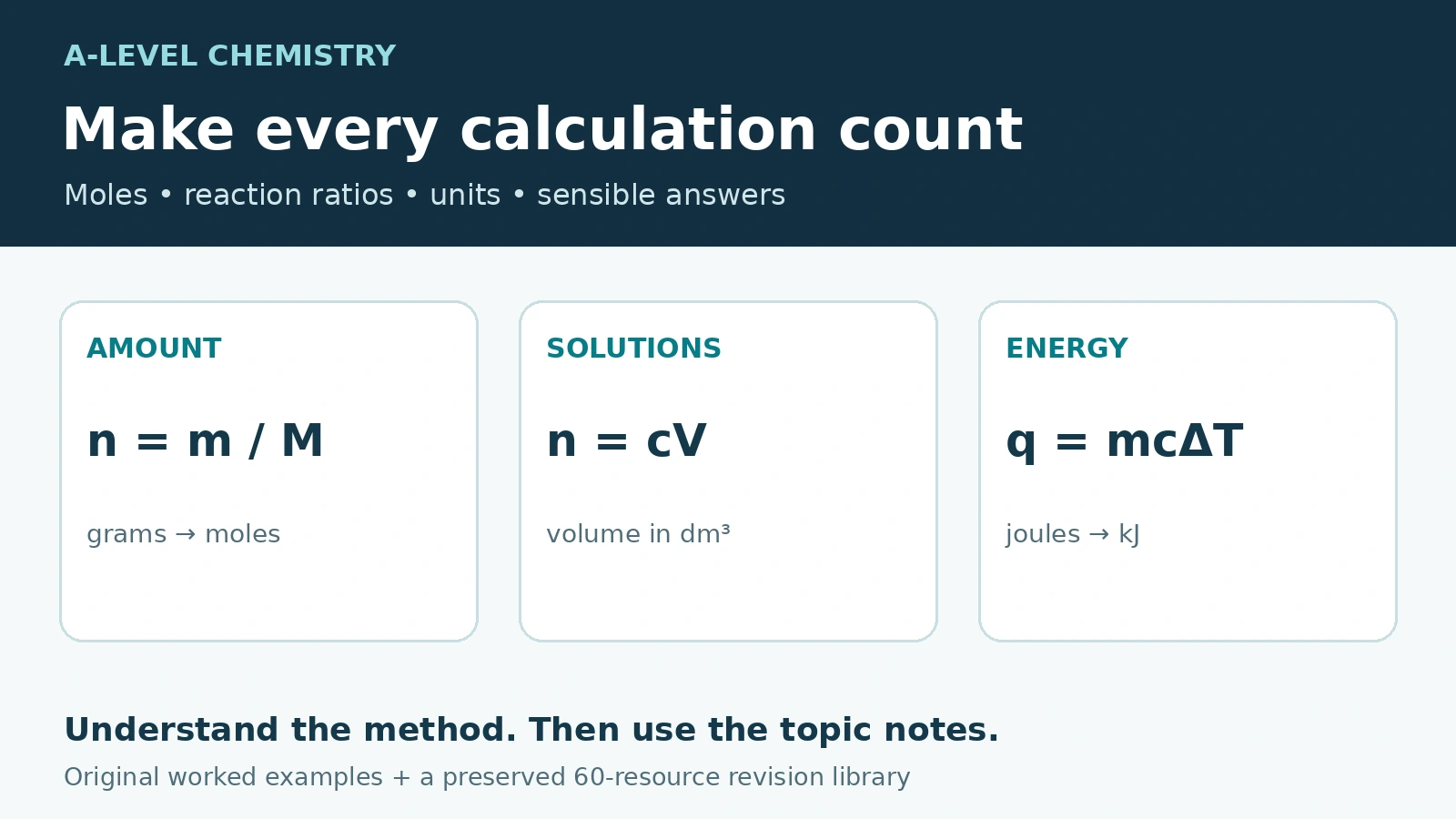
A-LEVEL CHEMISTRY • NOTES + CALCULATION PRACTICE
A useful route through physical chemistry
Find the topic notes you need, then practise the mathematics that makes them useful. This page combines a searchable collection of 60 external chemistry resources with original worked examples on moles, titrations, gas calculations, enthalpy and pH.
This is a revision hub, not a single downloadable textbook. The linked PDFs are Chemrevise resources hosted by their original publisher. They cover physical, inorganic and organic chemistry, spectroscopy and synthesis. Check your exam board, qualification code and exam year before treating any set of notes as your complete syllabus.

How to use these notes for your course
- Match the specification. “A-level chemistry” covers several qualifications. AQA 7405, Pearson Edexcel 9CH0, OCR A H432 and Cambridge International 9701 have their own content and assessment requirements. Topic overlap does not make their courses or papers interchangeable.
- Choose one small learning goal. For example, “find concentration from a titration” is more useful for one study session than “revise physical chemistry”. Use the search or a section filter to find the relevant note.
- Work before reading the answer. Write the equation, label the data and attempt a question. Read the notes to repair the step you could not explain, then close them and repeat that step unaided.
- Return to your board’s questions. Check wording, required practical skills, data-booklet conventions and mark-scheme expectations. Record whether each error came from chemistry, arithmetic, units or interpretation.
The dates printed on resource cards are inherited publication labels. They do not certify alignment with your current exam session. Two different polymer PDFs are intentionally retained; use the title, source date and contents to choose the one you need.
Choose the calculation before touching the calculator
Mass → amount
n = m ÷ M
Amount n is measured in mol. Use mass m in grams with molar mass M in g mol−1. Relative formula mass, Mr, is a ratio and has no unit; its numerical value gives the molar mass in g mol−1.
Solution → amount
n = cV
For concentration c in mol dm−3, volume V must be in dm3. Divide cm3 by 1000. The units cancel to mol. Do not use the same c symbol as a concentration in a calorimetry calculation: there it means specific heat capacity.
Reactant → product
moles → ratio → moles
Balance the chemical equation, calculate the known amount, and use its coefficients to get the unknown amount. Only then convert back to mass, concentration or gas volume. If both reactant amounts are supplied, first check which limits the reaction.
Temperature → energy
q = mcΔT
Use compatible units: grams, J g−1 K−1 and a temperature change in K give joules. A temperature difference has the same numerical value in °C and K. An absolute temperature in a gas calculation must instead be converted to kelvin.
Five worked physical-chemistry examples
1. How much carbon dioxide can a mass of carbonate make?
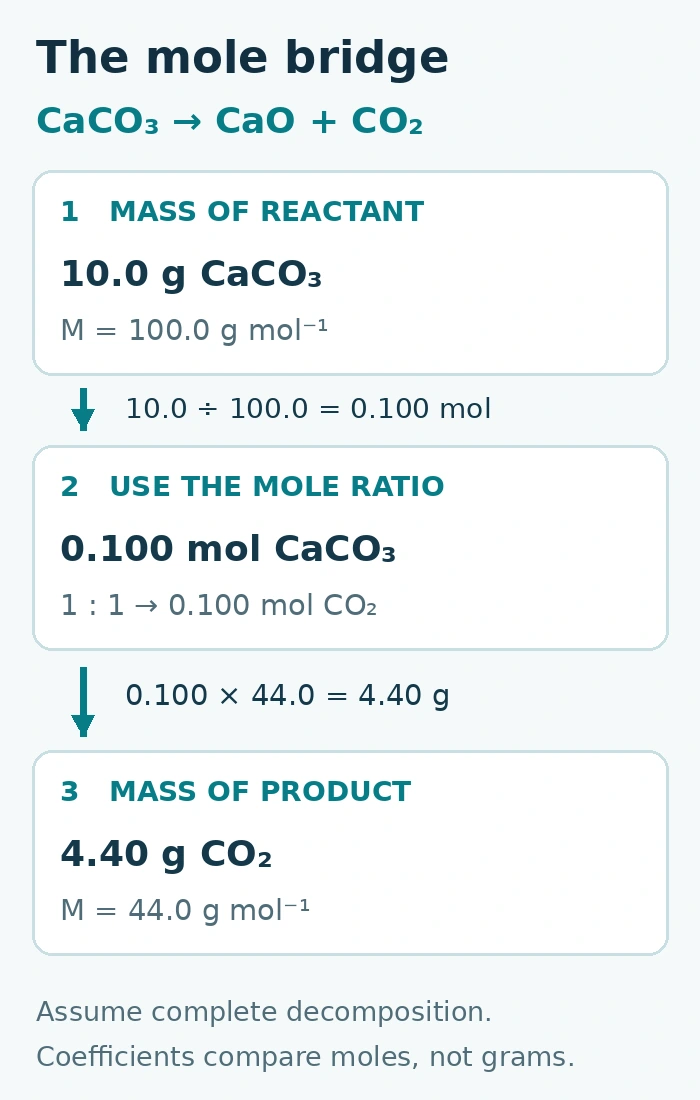
Calculate the theoretical mass of CO2 from complete decomposition of 10.0 g CaCO3. Use M(CaCO3) = 100.0 g mol−1 and M(CO2) = 44.0 g mol−1.
CaCO3(s) → CaO(s) + CO2(g)
- n(CaCO3) = 10.0 ÷ 100.0 = 0.100 mol
- The coefficients give a 1 : 1 mole ratio, so n(CO2) = 0.100 mol
- m(CO2) = 0.100 × 44.0 = 4.40 g
Check: the remaining 5.60 g is CaO in this ideal calculation, so the product masses total 10.0 g. A 1 : 1 mole ratio never meant equal masses. This is a theoretical yield, not a promise of the mass collected in a practical.
2. A titration where the ratio is not 1 : 1
25.00 cm3 of sulfuric acid reacts completely with 20.00 cm3 of 0.1000 mol dm−3 sodium hydroxide. Find the acid concentration at full neutralisation.
H2SO4 + 2NaOH → Na2SO4 + 2H2O
- V(NaOH) = 20.00 ÷ 1000 = 0.02000 dm3
- n(NaOH) = 0.1000 × 0.02000 = 0.002000 mol
- One mole of acid reacts with two moles of NaOH: n(acid) = 0.002000 ÷ 2 = 0.001000 mol
- c(acid) = 0.001000 ÷ 0.02500 = 0.04000 mol dm−3
Common wrong answer: 0.08000 mol dm−3 ignores the coefficient 2. The equality cacidVacid = cbaseVbase does not apply here. The correct relationship is 2cacidVacid = cbaseVbase. For a fuller equation check, use the chemical reaction calculator.
3. A warming solution and a negative enthalpy change
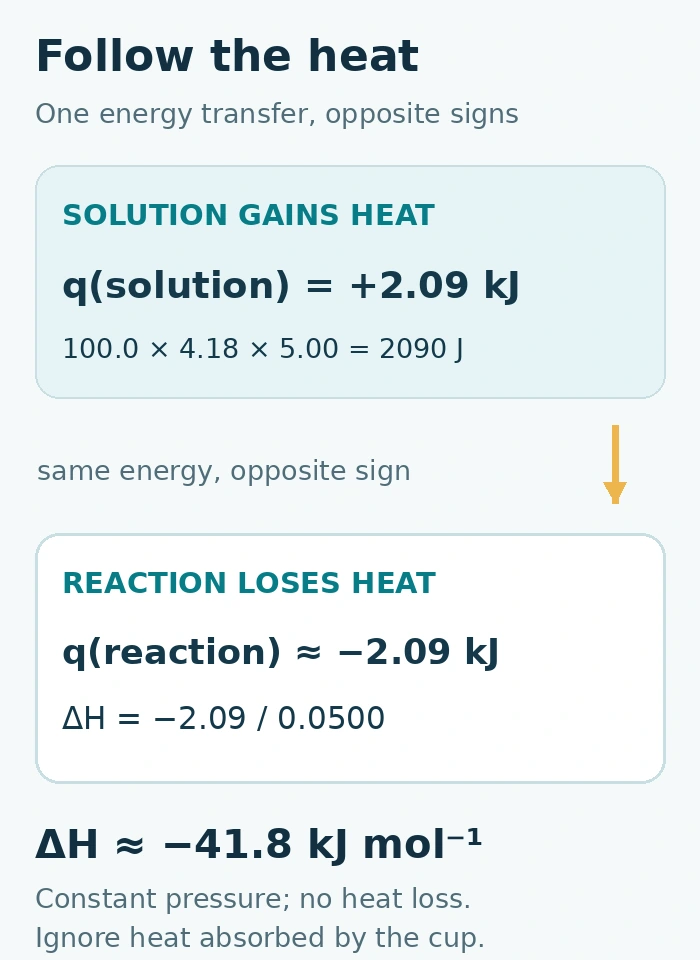
At constant pressure, a reaction warms 100.0 g of solution by 5.00 K. Take its specific heat capacity as 4.18 J g−1 K−1. If the reaction uses 0.0500 mol of the stated reacting substance, estimate the enthalpy change per mole of that substance.
- q(solution) = 100.0 × 4.18 × 5.00 = +2090 J = +2.09 kJ
- Assume no heat escapes and neglect heat absorbed by the cup: q(reaction) ≈ −2.09 kJ
- ΔH ≈ −2.09 ÷ 0.0500 = −41.8 kJ mol−1
The solution gains energy while the reaction releases it. Using a positive sign for the reaction would describe the opposite energy transfer. This estimate assumes a water-like specific heat capacity; a real calorimeter, heat loss and the actual solution composition can change the result. State which substance or reaction amount your “per mole” refers to.
4. Gas volume: why the unit conversion matters
Estimate the volume of 0.100 mol of an ideal gas at 100 kPa and 298 K, using R = 8.314 J mol−1 K−1.
V = nRT ÷ p
- Convert the pressure: 100 kPa = 100,000 Pa
- V = (0.100 × 8.314 × 298) ÷ 100,000 = 0.002477572 m3
- Multiply m3 by 1000: V ≈ 2.48 dm3
The values here are treated as three-significant-figure data. At 25 °C, T would be 298.15 K; 298 K is the temperature explicitly supplied in this question. A memorised molar gas volume belongs to particular conditions and is not a universal replacement for pV = nRT. Real gases can depart from ideal behaviour.
5. Strong-acid pH: use the right concentration
Estimate the pH of 0.0100 mol dm−3 hydrochloric acid using the dilute-solution approximation, complete dissociation and negligible contribution from water.
[H+] ≈ 0.0100 mol dm−3
pH ≈ −log10(0.0100) = 2.00
pH has no unit. A tenfold dilution gives approximately 0.00100 mol dm−3 H+ and pH 3.00 under the same assumptions; doubling pH does not mean halving acidity. For a weak acid, [H+] is generally smaller than the formal acid concentration and an equilibrium calculation is needed. Very dilute or concentrated solutions need further care. The pH calculator and method guide explains the models and their limits.
Six questions to try before opening the answers
Use the values supplied here. These are original practice questions, not official exam-board questions. Write at least one line of working and a unit where appropriate.
1. How many moles are in 5.85 g NaCl, if M = 58.5 g mol⁻¹?
n = 5.85 ÷ 58.5 = 0.100 mol. Dividing g by g mol−1 leaves mol.
2. Find the moles in 35.0 cm³ of 0.200 mol dm⁻³ solution
V = 35.0 ÷ 1000 = 0.0350 dm3; n = 0.200 × 0.0350 = 0.00700 mol, or 7.00 × 10⁻³ mol. An answer of 7.00 mol missed the volume conversion.
3. For 2Mg + O₂ → 2MgO, how many moles of O₂ react with 0.120 mol Mg?
The Mg : O2 ratio is 2 : 1, so n(O2) = 0.120 ÷ 2 = 0.0600 mol. Complete reaction also produces 0.120 mol MgO.
4. A 50.0 g solution warms by 4.00 K. Use c = 4.18 J g⁻¹ K⁻¹. Find q for the solution
q = 50.0 × 4.18 × 4.00 = +836 J, or +0.836 kJ. This is the solution’s heat gain. The corresponding reaction heat is approximately −836 J only under the no-loss assumptions.
5. Find ideal-gas moles in 2.00 dm³ at 100 kPa and 300 K. Use R = 8.314
V = 0.00200 m3 and p = 100,000 Pa. n = pV ÷ RT = 200 ÷ (8.314 × 300) = 0.080186… mol ≈ 0.0802 mol, treating the data as three significant figures.
6. If [H⁺] = 1.00 × 10⁻⁴ mol dm⁻³, what is the approximate pH?
pH ≈ −log10(10−4) = 4.00 using the concentration approximation. Relative to 1.00 × 10⁻³ mol dm−3, the hydrogen-ion concentration is ten times smaller and the pH is one unit higher.
If powers of ten are causing mistakes, review the scientific notation examples before repeating questions 2, 5 and 6.
Frequently asked questions
What is included on this A-Level Physical Chemistry Textbook page?
There are 60 original resource entries across five chemistry sections, plus the worked examples and practice above. Physical chemistry contains 31 entries, inorganic 10, organic 16, spectroscopy 2 and synthetic routes 1. The collection includes notes beyond physical chemistry; it is not one complete textbook or an exam-board-endorsed course.
How do I open the PDF notes on this page?
Use “Open PDF” for the in-page viewer, then Close or Escape to return to the resource. “Open source” opens the original file in a new tab. If your device cannot display an embedded PDF, the source link is the fallback. Browser download controls depend on your device and the publisher’s response.
Can I use this page for topic-by-topic A-Level chemistry revision?
Yes. Combine one section filter with a search word, such as “enthalpy” or “bonding”. The count shows how many resources match both choices. Clear search and filters to start again. The notes supplement your teacher’s plan, board specification, practical work and exam questions.
Are these files hosted on He Loves Math?
No. The notes stay on Chemrevise’s website; their authors retain their rights. HeLovesMath provides an organised reference collection and original teaching material here. Access and versions can change, so a successful link check is not a guarantee of future availability.
Which mistake should I fix first in a chemistry calculation?
Check the equation and units before revising the arithmetic. The wrong mole ratio, cm³ used as dm³, kPa used as Pa, or joules reported as kilojoules can overwhelm otherwise correct calculator work. For an unexplained negative result, ask whether the sign is meaningful, as in enthalpy, or impossible for the quantity, as for an amount of substance.
Sources & References
The worked examples and practice above are original HeLovesMath teaching material. The following specifications support the topic scope and conventions; the searchable PDF collection below is credited to Chemrevise.
- AQA A-level Chemistry 7405: physical chemistry specification — Official scope for moles, solution concentration, ideal gas calculations, calorimetry and pH; identifies qualification 7405.
- Pearson Edexcel A-level Chemistry 9CH0 specification — Official specification, Issue 3, February 2024: identifies 9CH0 and supports quantity/units, stoichiometry, calorimetry assumptions and pH coverage.
- OCR A-level Chemistry A H432 — Official qualification overview identifies A-level code H432 and provides the current specification and assessment routes.
- Cambridge International AS & A Level Chemistry 9701 — Official qualification overview identifies 9701 and provides syllabus files by exam year, supporting the instruction to check the learner’s board and session.
- OpenStax Chemistry 2e: calorimetry — Explains the system/surroundings distinction, opposite solution/reaction heat signs and calorimetry heat-transfer assumptions.
Search the Chemrevise PDF resource collection
60 resources across 5 sections. All 60 original PDF destinations returned a PDF response in the October 4, 2026 link check. That check confirms the response and PDF signature, not a full review of every file or its curriculum alignment. Files remain on the publisher’s site; follow its reuse terms.
60 of 60 resources shown.
No matching resources. Try a shorter search word or choose All.
Physical Chemistry
Build the quantitative and conceptual foundation of A-Level chemistry with calculations, atomic structure, bonding, energetics, kinetics, equilibria and redox.
Calculations
Balancing equations
Original listing: Core stoichiometry and equation balancing.
1.21 moles and formulae
Original listing: Updated December 2019.
1.22 concentrations and solutions
Original listing: Updated December 2019.
1.23 gas calculations
Original listing: Updated December 2019.
1.24 calculations and chemical reactions
Original listing: Updated December 2019.
1.25 titrations
Original listing: Updated November 2018.
Atomic Structure
2.11 atomic structure and mass spectrometry
Original listing: New April 2018.
2.12 electronic structure
Original listing: Updated April 2018.
2.13 ionisation energies
Original listing: Updated January 2022.
Bonding
2.20 introduction to bonding
Original listing: Updated November 2018.
2.21 ionic bonding
Original listing: Updated November 2018.
2.22 covalent bonding
Original listing: Updated November 2018.
2.23 metallic bonding
Original listing: Updated November 2018.
2.24 shapes of molecules
Original listing: Updated December 2019.
2.25 intermediate bonding
Original listing: Updated February 2024.
2.26 intermolecular bonding
Original listing: Updated February 2024.
2.27 structure of solid crystals
Original listing: New April 2018.
Energetics
3.11 introduction enthalpy change
Original listing: New April 2015.
3.12 Hesses law
Original listing: Updated April 2020.
3.13 calorimetry
Original listing: Updated March 2019.
3.14 bond enthalpies
Original listing: Updated March 2019.
3.15 Born Haber Cycle
Original listing: Updated November 2018.
3.16 Entropy and Gibbs Energy
Original listing: Updated November 2018.
3.17 Enthalpies of Solution
Original listing: Updated November 2018.
Kinetics
4.1 reaction kinetics
Original listing: Updated December 2019.
Equilibria
4.2 equilibria
Original listing: Updated November 2018.
Acid-base Equilibria
4.30 acid bases and salts
Original listing: Updated December 2019.
4.35 acid base equilibria
Original listing: New April 2018.
Redox
4.40 redox
Original listing: New April 2018.
4.45 electrolysis
Original listing: New April 2018.
Redox Equilibria
4.50 redox equilibria
Original listing: Updated November 2018.
Inorganic Chemistry
Strengthen periodic trends, group chemistry, extraction processes and transition metal content with focused A-Level inorganic chemistry PDFs.
Periodicity
5.1 periodicity
Original listing: Updated December 2019.
Group 2
5.2 group 2
Original listing: Updated February 2024.
Group 7: The halogens
5.3 group 7
Original listing: Updated February 2024.
Metal Extraction
5.4 metal extraction
Original listing: New April 2018.
Transition Metals
5.51 Introduction to transition metals
Original listing: New April 2018.
5.52 complex ions
Original listing: Updated February 2019.
5.53 colour in complex ions
Original listing: New January 2022.
5.54 chemistry V Mn Cu Co Cr Ag
Original listing: Updated February 2021.
5.55 Catalysis by transition metals
Original listing: New April 2018.
5.56 reactions of aqueous transition metal ions
Original listing: Updated February 2019.
Organic Chemistry
Revise naming, isomerism, hydrocarbons, functional groups and carbonyl chemistry with topic-specific organic chemistry PDFs.
Organic Chemistry Core Topics
6.1 organic naming
Original listing: Updated December 2019.
6.1.5 isomerism
Original listing: Updated December 2019.
6.2 alkanes
Original listing: Updated February 2024.
6.3 alkenes
Original listing: Updated November 2018.
6.4 halogenoalkanes
Original listing: Updated November 2018.
6.5 alcohols
Original listing: Updated December 2019.
6.12 polymers
Original listing: New April 2018.
Reactions of the C=O Bond
6.6 aldehydes and ketones
Original listing: Updated January 2022.
6.7 carboxylic acids and esters
Original listing: Updated January 2022.
6.8 acyl chlorides and acid anhydrides
Original listing: Updated January 2022.
Benzene
6.9 benzene
Original listing: Updated January 2022.
6.95 phenol
Original listing: New April 2018.
Amines, Amino Acids, Polymers
6.10 amines
Original listing: Updated November 2018.
6.10.5 amides
Original listing: Updated December 2019.
6.11 amino acids proteins and DNA
Original listing: Updated December 2019.
6.12 polymers
Original listing: Updated April 2020.
Spectroscopy
Use analytical and problem-solving chemistry notes to sharpen interpretation skills and prepare for structured exam questions.
Spectroscopy
6.13 analytical techniques
Original listing: Updated December 2019.
Organic problem solving
Original listing: New March 2021.
Synthetic Routes
Review how organic chemistry pathways connect together with a focused synthesis resource for route planning and mechanism thinking.
Synthetic Routes
6.14 organic synthesis
Original listing: New April 2018.