Orbital Velocity Calculator
Use this Orbital Velocity Calculator to calculate circular orbit speed, elliptical orbit speed, orbital period, altitude, centripetal acceleration, escape velocity, geostationary radius, Hohmann transfer speeds, reverse orbital radius, and body comparison values. It supports Earth, Moon, Mars, Jupiter, the Sun, and custom gravitational parameters.
Calculate Orbital Velocity
Select a mode, enter body and orbit values, then review orbital speed, period, altitude, acceleration, and escape-speed relationships.
Circular Orbital Velocity Calculator
Elliptical Orbit Velocity Calculator — Vis-Viva Equation
Orbital Period, Radius, and Altitude Solver
Reverse Orbital Velocity Solver
Synchronous / Geostationary Orbit Calculator
Hohmann Transfer Velocity Calculator
Compare Orbital Velocity Across Bodies
Orbital Velocity Unit Converter
Orbital Diagram and Calculation Details
What Is an Orbital Velocity Calculator?
An Orbital Velocity Calculator is a physics and aerospace engineering tool that calculates the speed required for an object to remain in orbit around a planet, moon, star, or custom central body. Orbital velocity is the sideways speed that balances gravity with continuous free fall. A satellite in orbit is not floating because gravity is absent. It is falling under gravity while moving sideways fast enough that the surface curves away beneath it.
This calculator includes circular orbit speed, elliptical orbit speed using the vis-viva equation, orbital period, altitude and radius solving, synchronous orbit calculations, Hohmann transfer velocities, reverse solving, unit conversion, and body comparison tables. It is useful for students, teachers, physics readers, spaceflight enthusiasts, engineering learners, and website visitors who want to understand how orbital speed changes with altitude and central body mass.
The simplest circular orbit equation is \(v=\sqrt{\mu/r}\), where \(v\) is orbital speed, \(\mu\) is the standard gravitational parameter of the central body, and \(r\) is the distance from the center of the body. The equation shows two important patterns. First, a stronger gravitational field requires a higher orbital speed at the same radius. Second, orbital speed decreases as orbital radius increases. A satellite in low Earth orbit moves much faster than a satellite in geostationary orbit because low orbit is closer to Earth.
For elliptical orbits, velocity is not constant. A spacecraft moves faster near periapsis, where it is closest to the central body, and slower near apoapsis, where it is farthest away. The vis-viva equation handles this by using both the current radius and the semi-major axis of the orbit. This is one of the most important equations in orbital mechanics because it connects speed, position, and orbit size in a compact mathematical relationship.
This calculator is educational. Real orbital operations require more than these ideal equations. Engineers must account for non-spherical gravity, atmospheric drag, solar radiation pressure, third-body effects, propulsion, finite burn duration, navigation uncertainty, station keeping, perturbations, launch window constraints, and mission requirements. Still, the two-body equations here are the foundation for understanding orbital motion.
How to Use This Orbital Velocity Calculator
Use Circular Orbit when you want the speed of a circular satellite orbit. Select a central body, choose whether you are entering altitude above the surface or total orbital radius from the center, and click calculate. The result shows orbital speed, escape speed, orbital period, radius, altitude, and centripetal acceleration.
Use Elliptical Orbit when the orbit has a periapsis and apoapsis. Enter periapsis radius, apoapsis radius, and the current radius. The calculator uses the vis-viva equation to find the speed at the current point and also reports periapsis speed and apoapsis speed. Use Period / Radius when you want to solve orbital period from radius or solve the required radius and altitude for a desired period.
Use Reverse Solver when you know orbital speed and want to solve for radius, gravitational parameter, or central mass. Use Synchronous Orbit when the orbit period should match the rotation period of the central body. Use Hohmann Transfer to compute circular speeds and transfer speeds for a two-burn transfer between circular orbits. Use Compare Bodies to see how the same altitude produces different orbital velocities around different bodies. Use Unit Converter for fast velocity conversions.
Orbital Velocity Formulas
The circular orbital velocity formula is:
The distance from the center of the body is:
Escape velocity at the same radius is:
Orbital period for a circular orbit is:
The vis-viva equation for elliptical orbits is:
The semi-major axis for an ellipse is:
Centripetal acceleration in circular orbit is:
Radius from a desired orbital period is:
Circular Orbital Velocity Explained
Circular orbital velocity is the speed required for an object to stay in a circular orbit at a fixed radius. Gravity pulls the object inward, and the object’s sideways motion keeps it from falling straight down. In a perfectly circular two-body orbit, the speed remains constant because radius remains constant.
The equation \(v_c=\sqrt{\mu/r}\) shows that orbital speed decreases with radius. This can feel surprising because high-altitude satellites travel around a larger path, but they move more slowly. A low Earth orbit satellite travels around Earth in roughly 90 minutes. A geostationary satellite is much farther away, moves more slowly, and takes about one sidereal day to complete one orbit.
The central body matters because \(\mu\) measures gravitational strength. Orbiting close to Jupiter requires far more speed than orbiting at the same altitude around the Moon. This is why the calculator includes presets for multiple bodies and a custom gravitational parameter field.
Elliptical Orbit and the Vis-Viva Equation
Most real orbits are not perfectly circular. In an elliptical orbit, the spacecraft moves fastest near periapsis and slowest near apoapsis. This behavior follows conservation of mechanical energy and angular momentum. The vis-viva equation captures the speed at any point in the orbit using the current radius \(r\), semi-major axis \(a\), and central body parameter \(\mu\).
If the current radius equals periapsis radius, the calculator reports periapsis speed. If the current radius equals apoapsis radius, it reports apoapsis speed. If the current radius is between them, it reports the speed at that location. If the current radius is outside the periapsis-apoapsis range, the result may not correspond to that ellipse, so the calculator warns users to keep the current radius between the two orbital extremes.
Orbital Period, Altitude, and Synchronous Orbit
Orbital period is the time required to complete one orbit. For a circular orbit, period depends on orbital radius and gravitational parameter. A larger radius means a longer period. The period formula can also be rearranged to find the radius required for a desired period. This is how a synchronous orbit can be estimated.
A synchronous orbit has the same period as the central body’s rotation period. Around Earth, a geostationary orbit is a special case of a geosynchronous orbit: it is circular, equatorial, and has a period equal to Earth’s sidereal rotation. The calculator can find the orbital radius and altitude for any selected period, including geostationary-style educational examples.
Transfer Orbit Velocities
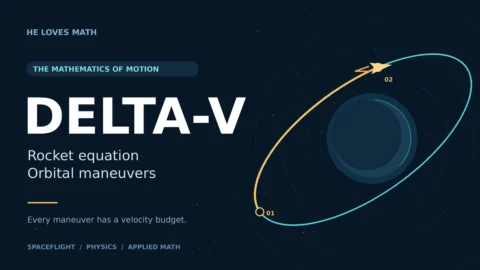
A Hohmann transfer is an ideal transfer between two circular coplanar orbits. The spacecraft performs one burn to enter an elliptical transfer orbit and a second burn to circularize at the target orbit. The transfer orbit has a semi-major axis equal to half the sum of the two circular orbit radii.
The velocity at the inner end of the transfer ellipse differs from the initial circular velocity. The velocity at the outer end differs from the final circular velocity. The difference between these speeds gives the burn sizes. This calculator reports both circular speeds and transfer speeds so users can see why the maneuver requires two velocity changes.
Common Orbital Velocity Mistakes
The first common mistake is using altitude instead of radius. Orbital equations use distance from the center of the central body, not just height above the surface. For Earth orbit, a 400 km altitude means a radius of about 6371 km plus 400 km, not 400 km.
The second mistake is mixing kilometers and meters. Standard gravitational parameters are usually in \(m^3/s^2\), so radius must be in meters inside the formula. The third mistake is confusing orbital velocity with escape velocity. Escape velocity at the same radius is \(\sqrt{2}\) times circular orbital velocity. The fourth mistake is assuming real satellites stay in perfect two-body orbits. Atmospheric drag, Earth’s oblateness, lunar and solar gravity, thrust, and other perturbations change real orbits over time.
Orbital Velocity Worked Examples
Example 1: Low Earth orbit speed. For Earth, \(\mu\approx3.986\times10^{14}\,m^3/s^2\). At 400 km altitude, the radius is approximately:
The circular orbital speed is:
Example 2: Escape speed comparison. Once circular speed is known, ideal escape speed at the same radius is:
Example 3: Orbital period. The period of a circular orbit is:
Example 4: Elliptical orbit speed. For an ellipse with semi-major axis \(a\), speed at radius \(r\) is:
Orbital Velocity Calculator FAQs
What does this Orbital Velocity Calculator do?
It calculates circular orbital velocity, elliptical orbit speed, orbital period, altitude, radius, escape velocity, centripetal acceleration, synchronous orbit radius, Hohmann transfer speeds, and body comparisons.
What is orbital velocity?
Orbital velocity is the speed required for an object to remain in orbit around a central body under gravity. In a circular orbit, it is \(v=\sqrt{\mu/r}\).
Does orbital velocity use altitude or radius?
The formula uses orbital radius from the center of the central body. If you have altitude, add the body radius: \(r=R+h\).
What is the difference between orbital velocity and escape velocity?
Circular orbital velocity keeps an object in orbit. Escape velocity is the speed required to escape gravity entirely. At the same radius, escape velocity is \(\sqrt{2}\) times circular orbital velocity.
Why does orbital speed decrease at higher altitude?
Gravity is weaker farther from the central body, so a lower speed is needed for the required centripetal acceleration.
What is the vis-viva equation?
The vis-viva equation calculates orbital speed at any point in an elliptical orbit using current radius, semi-major axis, and gravitational parameter.
Can this calculator be used for real mission design?
No. It is educational. Real mission design requires high-fidelity astrodynamics, perturbation modeling, propulsion data, navigation constraints, and professional mission analysis.
Important Note
This Orbital Velocity Calculator is for educational physics, astronomy, and aerospace engineering content. It provides idealized two-body estimates and does not replace professional astrodynamics software, trajectory design tools, mission operations analysis, or launch vehicle performance modeling.