
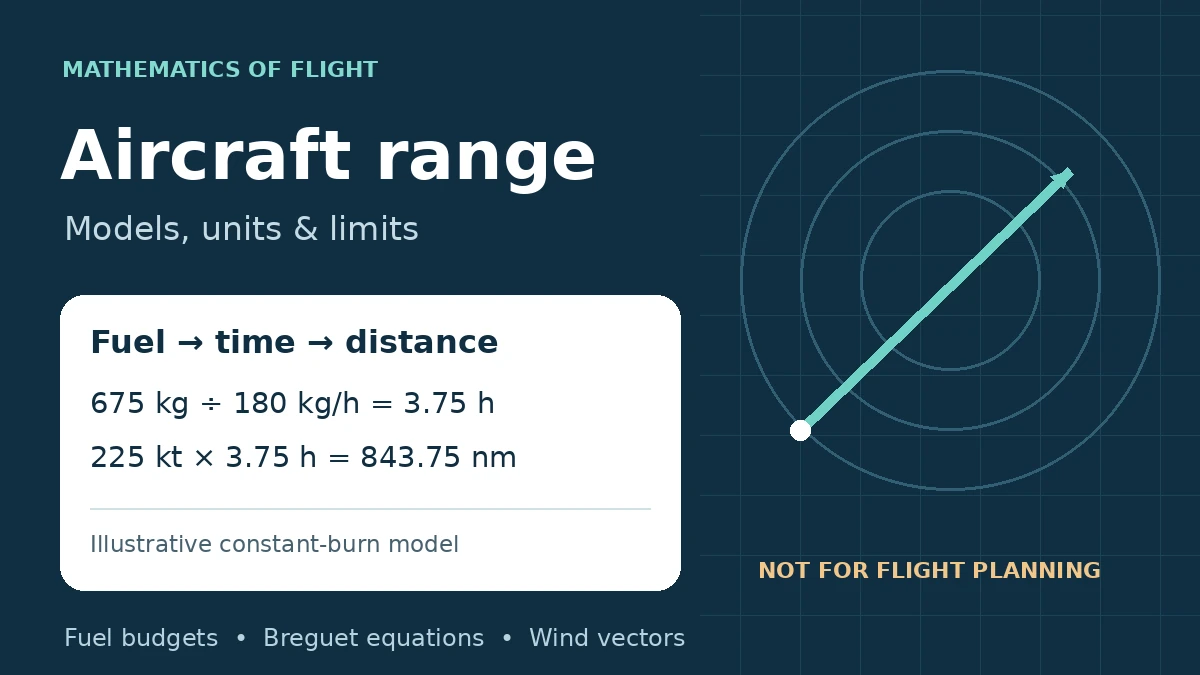
MATHEMATICS OF FLIGHT
Explore range, fuel and wind
Eight educational models connect fuel budgets, Breguet equations, wind vectors and spherical distances. Start with a mode below, then follow the worked examples and unit checks.
Not for flight planning. These are simplified teaching models, not aircraft-specific performance, dispatch, loading, navigation or fuel-reserve guidance.
Calculate an educational range model
Select a mode and check its assumptions. Input values are teaching examples, not approved aircraft data.
Quick Aircraft Range Calculator
Fuel allowances are in kg and burn is in kg/h, regardless of fuel input unit. Along-track wind only; tailwind is negative. Gallon selections load an editable illustrative density.
Breguet Jet Range Calculator
Use weight-flow TSFC in 1/h, not mass TSFC without conversion. Initial and final masses use the same unit. The percentage is a sensitivity setting, not a reserve policy.
Breguet Propeller Aircraft Range Calculator
Use mass BSFC in kg/(kW·h). Still-air range follows the SI expression; TAS sets time and wind exposure. Efficiency must be above 0 and no greater than 1.
Fuel Burn Route and Endurance Calculator
Contingency is a percentage of trip fuel. The headline distance is solved from this same budget. Along-track wind only.
Great-circle distance comparison
Coordinates are decimal degrees. Radius and distance are only geometric comparisons. A positive difference is not operational feasibility.
Wind-Corrected Groundspeed and Range Calculator
Angle is wind FROM relative to desired TRACK: 0° headwind, +90° from the right, 180° tailwind. Wind remains in knots. The model excludes |crosswind| ≥ TAS.
Payload, Fuel, and Range Tradeoff Calculator
Mass-only allocation. Define empty mass and payload without double counting. No center-of-gravity, structural or performance assessment.
Spherical-distance map
Leave BOTH optional destination fields blank for a boundary alone. Radius is limited to half the sphere’s circumference. No terrain, weather or airspace is shown.
Model details and spherical diagram
Range is a distance; endurance is a time
An aircraft-range model connects fuel, time and motion. In the simplest version, dividing the fuel allocated to cruise by a constant fuel-burn rate gives an endurance. Multiplying that time by groundspeed gives a distance. A number in nautical miles and a number in hours answer different questions.
This page is a mathematics and engineering-learning tool. Its sample inputs are invented teaching values, not specifications for a particular aircraft. A result within an entered radius, or a positive fuel difference, does not mean a real flight is feasible. For actual operations, use the applicable approved aircraft documentation, current operational data and qualified aviation procedures.
The models intentionally omit changing altitude, mass-dependent fuel burn, temperature, aircraft-specific performance, actual weather, terrain, airspace, runway limits and regulatory fuel policy. Do not combine their results into a dispatch decision.
Choose the model before entering numbers
- Quick Range: subtract separately chosen fuel allowances, divide the remainder by constant burn, then apply an along-track headwind or tailwind
- Breguet Jet: explore an idealized cruise segment using weight-flow TSFC, lift-to-drag ratio and the initial/final mass ratio
- Breguet Prop: use mass BSFC in kg/(kW·h), propeller efficiency and lift-to-drag ratio. Its units differ from the jet coefficient
- Fuel Burn Route: calculate a fuel requirement for a comparison distance, and solve the same budget for its maximum model distance
- Great-Circle Route: compare a spherical distance, optionally increased by a chosen percentage, with an entered radius
- Wind Correction: solve a track-held wind triangle, including crosswind
- Payload Effect: explore a mass-only fuel allocation. It is not an aircraft loading calculation
- Range Map: draw a spherical constant-distance boundary. Leave both optional destination fields blank for a boundary alone
Selecting a speed unit converts the stored true-airspeed values; wind inputs remain in knots as labeled. Display precision changes only rounding. Press Enter within an input to calculate. Arrow keys move among the mode tabs; Home and End select the first and last. Editing an input clears the previous result so stale numbers are not mistaken for a new calculation.
Use decimal degrees for coordinates: north/east positive, south/west negative. Nonzero scalar inputs other than coordinates must have magnitude from 10⁻⁹ to one billion for numerical safety; percentages and coordinates have narrower stated limits. Nonfinite results or excessively large computed values are rejected. Calculations use ordinary browser floating-point arithmetic, not exact measurement data.
Aircraft-range formula reference
Constant burn: E = Fcruise/q
Along-track range: R = (V − H)E
Jet Breguet: R = (V/cW)(L/D) ln(mi/mf)
Propeller Breguet in meters: R = [3,600,000η/(g0b)](L/D) ln(mi/mf)
Track-held wind: GS = √(V² − C²) − H
Here E is time in hours, q is fuel mass burn in kg/h, V is true airspeed in knots, H is headwind component in knots, C is crosswind component in knots, and L/D is a dimensionless lift-to-drag ratio. η is propeller efficiency, b is mass BSFC in kg/(kW·h), and g0 = 9.80665 m/s². The natural logarithm is written ln. The jet coefficient cW is defined below.
One knot is one nautical mile per hour. This page uses 1 nautical mile = 1,852 m, 1 international statute mile = 1,609.344 m and 1 pound = 0.45359237 kg. The distance label “nm” on this aviation page means nautical miles, not nanometers. For logarithms and trigonometry practice, use the scientific calculator.
Separate fuel quantity from cruise allocation
Write a fuel budget before multiplying by speed. In Quick Range, Fcruise = Fusable − Anoncruise − Aadditional − q treserved. Convert reserved minutes to hours first. The field names describe where a chosen allowance enters the arithmetic; they do not determine what an aircraft or regulation requires.
If the deductions exceed usable fuel, the calculator reports the conflict rather than silently replacing a negative allocation with zero. If they exactly equal usable fuel, the model has zero cruise time and distance.

The US-gallon options convert volume to mass with the density field: mass in kg = US gallons × 3.785411784 L/US gal × density in kg/L. Selecting the Jet-A or Avgas option loads illustrative densities of 0.80 or 0.72 kg/L respectively. These are editable examples, not certified fuel-density values; composition and temperature affect density. All burn and fuel-allowance fields remain in kg/h or kg. See the density and volume-to-mass explanation.
Fuel Burn Route treats the contingency percentage p as a fraction of trip fuel. With a constant groundspeed GS, trip time is distance/GS. Its maximum model distance is solved consistently as GS × (usable fuel − fixed allowance − reserved-time fuel) ÷ [q(1 + p)]. It does not reuse the contingency from one route while claiming a different maximum distance.
Jet and propeller Breguet models use different consumption units
Jet: define the coefficient precisely
The jet input cW is fuel weight flow divided by thrust, in h−1. With constant V, L/D and cW, duration is (L/D) ln(mi/mf)/cW. Multiplying by V in knots yields nautical miles. If a source instead provides mass TSFC s in kg/(N·s), convert with cW = 3,600g0s. Do not enter the unconverted mass coefficient.
Initial and final masses must use the same unit. Their ratio is dimensionless and equals the corresponding weight ratio under constant gravity. Final mass includes the aircraft and everything retained after the modeled cruise segment. It is not simply the empty mass.
Propeller: mass BSFC belongs in kg/(kW·h)
For the propeller mode, shaft power is drag × speed / efficiency. Combining that relation with mass fuel consumption gives the speed-free range expression shown above. The factor 3,600,000 converts kW·h to joules; division by g0 makes the mass-based formulation dimensionally consistent. The result is meters, then divided by 1,852 for nautical miles.
Under those constant-parameter assumptions, changing the separate TAS field does not change still-air range. It changes the corresponding cruise duration and therefore the effect of an along-track wind. Real efficiency, drag and consumption vary with flight condition, so this model does not say actual propeller-aircraft range is independent of speed.
The optional percentage reduction is a sensitivity exercise, not a legal reserve rule. Gross range, reduced range and corresponding durations are labeled separately. A final mass that already retains a fuel allowance and another percentage reduction represent two distinct deductions; avoid unintentionally counting the same allowance twice. For the mass-versus-weight distinction, review weight and gravitational force.
Crosswind changes the wind triangle
The along-track modes assume zero crosswind. Wind Correction instead holds a desired track and changes the heading into the wind. Its angle is the direction the wind comes from, measured clockwise relative to that track: 0° is a headwind, +90° is from the right and 180° is a tailwind.
Resolve the wind into H = W cos θ and C = W sin θ. The aircraft uses a sideways air-velocity component to cancel C, leaving √(V² − C²) along the track. Subtract H to obtain groundspeed. The signed heading correction is arcsin(C/V); positive means toward the right.

This implementation requires |C| < V and positive forward groundspeed. The exact 90°-correction boundary is excluded. A headwind equal to or greater than TAS in an along-track-only model cannot be converted into an arbitrary 1-knot forward speed. The calculator reports that input conflict.
A spherical diagram is not a navigation chart
The coordinate modes use a sphere with radius 6,371,008.8 m. A central angle α corresponds to distance REα. The haversine calculation obtains that angle from the latitude and longitude differences; it works across the date line by using the short angular separation.
The blue boundary is sampled from points at the entered great-circle distance from the origin. It is not a fixed ellipse pasted onto a flat map. Longitude–latitude projection distorts shapes and distances, particularly near the poles. Boundary and route lines split at ±180° to avoid drawing a false connector across the whole display. The grid contains no invented land outlines.
A shortest route between antipodal points is not unique, so that special route line is omitted. A shortest-distance radius cannot exceed half the sphere's circumference, about 10,807.3 nautical miles. At that limit its boundary collapses to the antipode. Exact ellipsoidal geodesy uses a different Earth model; a spherical distance is an approximation, not a certified routing distance.
The optional detour is an arithmetic multiplier. It is not an actual airway, weather or air-traffic-control route. A circular boundary also does not represent wind-dependent reachability.
Payload-range tradeoff: a deliberately small model
Available fuel mass = min(tank mass capacity, maximum mass − operating empty mass − payload). After subtracting the entered mission and reserved fuel, the tool applies constant burn and still-air speed. If empty mass plus payload already exceeds the maximum, it reports the inconsistency even before fuel is added.
Define the contents of operating empty mass consistently: do not add crew or equipment again if already included. Center of gravity, zero-fuel limits, phase-specific structural limits and performance are outside this algebra. More payload can reduce fuel capacity, but not every payload increase does: when tank capacity is already the limiting term, a small increase may leave the available fuel unchanged.
Six worked examples
1. Fuel → time → distance. Start with 900 kg usable fuel; choose 90 kg non-cruise and 45 minutes at 180 kg/h as illustrative allowances. Reserved-time fuel = 0.75 × 180 = 135 kg. Cruise fuel = 900 − 90 − 135 = 675 kg, so E = 675/180 = 3.75 h. At TAS 250 kt with a 25 kt headwind, GS = 225 kt and distance = 225 × 3.75 = 843.75 nautical miles. Still-air distance is 937.5 nautical miles.
2. A route-budget shortfall. With distance 950 nm, TAS 250 kt and 15 kt headwind, time = 950/235 ≈ 4.042553 h. At 180 kg/h, trip fuel ≈ 727.659574 kg. Five percent contingency adds 36.382979 kg. Add 90 kg fixed and 135 kg reserved-time allowances: required fuel ≈ 989.042553 kg. Against 900 kg usable, the difference is −89.042553 kg. Solving that same budget for distance gives 235 × 675/(180 × 1.05) ≈ 839.285714 nm.
3. Jet Breguet. Take V = 450 kt, cW = 0.62 h−1, L/D = 16, and masses 18,000/14,500 in the same unit. ln(18,000/14,500) ≈ 0.2162231085. Range = (450/0.62) × 16 × that logarithm ≈ 2,510.978034 nm. A separate 10% illustrative reduction gives 2,259.880230 nm in still air.
4. Propeller Breguet. Use η = 0.82, L/D = 12, b = 0.35 kg/(kW·h), and masses 1,450/1,280. The SI expression gives 1,287,026.375664 m, or 694.938648 nm. At 135 kt, the corresponding duration is 5.147694 h. Doubling TAS to 270 kt leaves this model's still-air range unchanged and halves the duration. A 10% range reduction gives 625.444783 nm.
5. Pure crosswind. At 100 kt TAS and a 60 kt crosswind, forward airspeed is √(100² − 60²) = 80 kt. With no headwind and two hours available, distance is 160 nm. Simply ignoring the crosswind would incorrectly give 200 nm for a held track.
6. Payload allocation. Maximum mass 18,000 kg − empty mass 10,500 kg − payload 2,500 kg leaves 5,000 kg for fuel. The 5,200 kg tank capacity is not the limiting value. Subtract 900 kg mission/reserved fuel, giving 4,100 kg for cruise. At 620 kg/h and 420 kt, range = (4,100/620) × 420 ≈ 2,777.419355 nm under this still-air constant-burn model.
Common mistakes to catch
- Mixing hours and minutes: 45 minutes is 0.75 h, not 0.45 h
- Confusing volume with mass: gallons require a stated density before comparison with kg/h
- Mixing consumption definitions: jet TSFC and propeller BSFC have different dimensions
- Using log base 10: the Breguet expression uses the natural logarithm ln
- Multiplying propeller range by speed again: the SI expression already produces a distance
- Calling zero a missing coordinate: latitude or longitude 0° is valid; a blank field is different
- Reading a model difference as approval: none of these results establishes operational safety or compliance
Practice: calculate, then reveal the reasoning
1. What is the endurance from 540 kg at 180 kg/h?
540 ÷ 180 = 3 hours. The units kg/(kg/h) simplify to hours.
2. At 200 kt TAS with a 30 kt headwind, how far in 2.5 hours?
Groundspeed = 200 − 30 = 170 kt. Distance = 170 × 2.5 = 425 nautical miles, assuming zero crosswind and constant values.
3. Convert 45 minutes at 160 kg/h into a fuel allowance.
45/60 = 0.75 h; 0.75 × 160 = 120 kg. This is arithmetic for a chosen allowance, not a prescribed reserve.
4. What mass is 100 US gallons at an assumed 0.80 kg/L?
100 × 3.785411784 × 0.80 = 302.83294272 kg. Changing density changes mass; the US-gallon-to-liter factor does not change.
5. What if initial and final Breguet masses are equal?
The ratio is 1 and ln 1 = 0, so modeled fuel-burning cruise range is zero. Final mass greater than initial mass is invalid for this model.
6. A propeller model gives 500 nm. What is its duration at 125 kt?
500 ÷ 125 = 4 hours. Do not multiply 500 nm by speed; that would not yield a distance.
7. What is groundspeed at 130 kt TAS with a 50 kt pure crosswind?
√(130² − 50²) = √14,400 = 120 kt. Two hours would give 240 nm along the held track.
8. What is the mass-limited fuel capacity: maximum 5,000 kg, empty 3,000 kg, payload 1,200 kg, tank 900 kg?
Mass room = 5,000 − 3,000 − 1,200 = 800 kg. min(900,800) = 800 kg. A 100 kg chosen allowance leaves 700 kg for the cruise model.
Questions about the calculator
Can I use the result to plan or approve a flight?
No. It is an educational mathematical model. It is not validated for an individual aircraft, weather situation, jurisdiction or operation and cannot determine flight feasibility.
Why does the propeller result not rise when I increase TAS?
The constant-BSFC, constant-efficiency and constant-L/D range model has no separate speed multiplier. TAS determines the corresponding time and wind effect. Actual performance changes require aircraft-specific data.
Does a 10% reduction satisfy a fuel-reserve rule?
No. That control only scales a modeled distance. It does not calculate regulatory, alternate, holding or final-reserve fuel.
Why is the map boundary not a circle on the screen?
It is a constant-distance boundary on a sphere projected onto latitude and longitude. Projection distortion changes its screen shape. The map does not contain geographic or navigation data.
Are the displayed decimal places a measure of accuracy?
No. They control rounding only. Input uncertainty and simplified assumptions dominate the usefulness of the result. Very small nonzero results use scientific notation rather than a misleading rounded zero.
Sources & References
The teaching examples and diagrams above are original. These primary sources support the underlying definitions, equations and model limitations. The explicit SI propeller conversion is derived from the mass-BSFC definition and dimensional analysis.
- MIT Unified Engineering: Aircraft Range and the Breguet Range Equation — steady-cruise derivation and assumptions
- Embry-Riddle Aeronautical University: Flight Range & Endurance — mass/weight SFC conventions and propeller/jet distinctions
- NASA Glenn: Relative Velocity — air, wind and ground velocity relationships
- NIST: SI conversion factors by quantity — length, mass, energy and standard-gravity conversions
- FAA: Pilot's Handbook of Aeronautical Knowledge — official flight-manual, performance, loading and navigation context
- GeographicLib: Geodesics on an ellipsoid — direct/inverse geodesic problems and non-unique shortest paths
- NOAA National Geodetic Survey: Inverse and Forward — ellipsoidal distance and endpoint calculations