
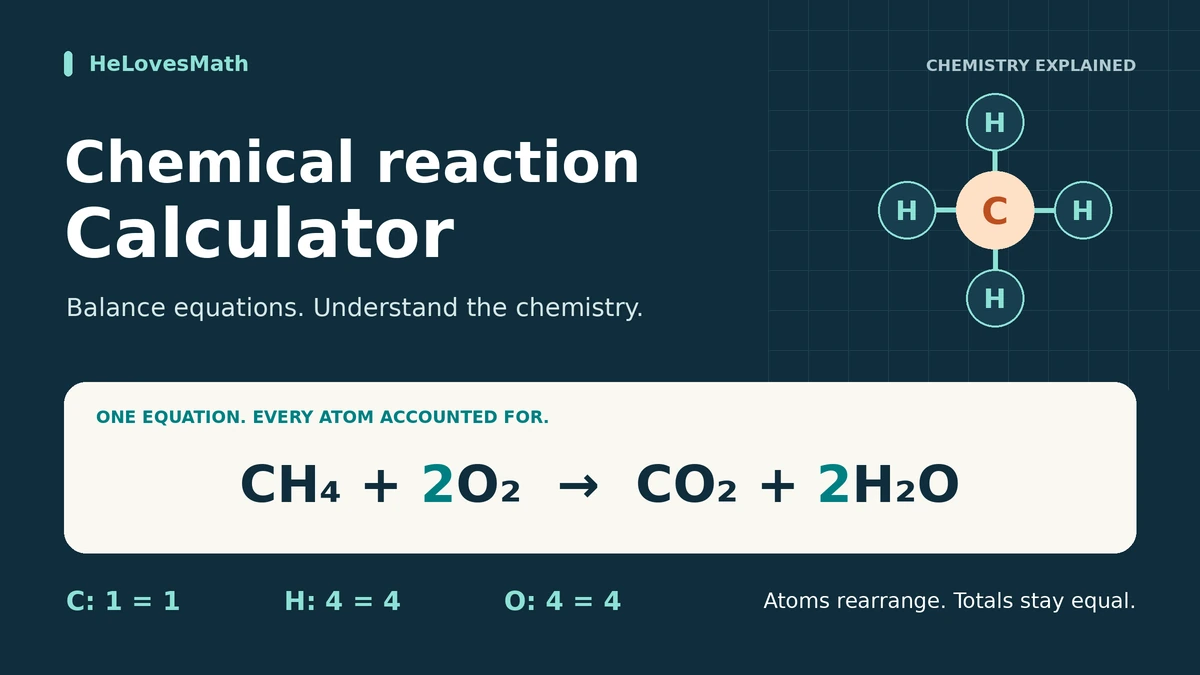
CHEMISTRY • PATTERNS, ATOMS & MOLE RATIOS
Predict products. Check the atoms. Explain the pattern.
Use a supported classroom pattern to predict products, inspect an equation’s reaction type, or calculate a mole ratio. Each answer separates the formula calculation from the assumptions needed for a real reaction.
Predict a Chemical Reaction
Select a reaction mode or use automatic pattern recognition. Enter formulas clearly, such as HCl + NaOH, CH4 + O2, AgNO3 + NaCl, or Zn + HCl.
Reaction Reasoning Table
The table explains what the calculator detected and why the result was predicted.
| Step | Detected Pattern | Explanation |
|---|---|---|
| 1 | Default example | HCl + NaOH → NaCl + H₂O. The 1:1:1:1 coefficients conserve every element. Use the controls to examine another supported pattern. |
What Does a Chemical Reaction Calculator Tell You?
This calculator matches selected reactants to supported classroom reaction patterns, explains the proposed products, and can balance the resulting equation. It also checks a complete equation for familiar reaction patterns and performs a separate mole-ratio calculation.
Keep three questions separate when checking homework:
- Prediction: Are these products reasonable for the substances and conditions?
- Balancing: Does each element have the same atom count on both sides?
- Amount: Given a balanced equation, how much can react or form?
A balanced equation answers the second question only. Even a perfectly balanced arrangement can describe the wrong products. If your worksheet already supplies both sides, use the chemical equation balancer to focus on coefficients.
How to Use the Calculator
- Predict Products: enter reactants separated by +, such as HCl + NaOH or CH4 + O2. Do not include an arrow or products in this tab.
- Choose a mode: start with auto detect. Selecting a specific mode restricts the search to that category; it cannot make an unsupported reaction predictable.
- Check the result: read the reaction, reasoning table, assumptions, and balancing status together. With balancing switched off, the display omits coefficients and may be unbalanced.
- Classify Reaction: enter a complete equation, for example CH4 + 2O2 = CO2 + 2H2O. Use one separator: =, ->, =>, or →. Review the atom-balance check as well as the category.
- Stoichiometry Helper: enter the coefficients from a balanced equation and the known amount in moles. This tab does not identify a limiting reactant for you.
Formula capitalization matters: Co is cobalt; CO is carbon monoxide. Use plain digits or chemical subscripts, with correctly closed groups such as Ca(OH)2. Terminal state labels such as (aq) are accepted as notation; labels that conflict with a supported model may prevent a match. Ionic charges and hydrate-dot formulas are outside the supported input format. The charged equations below are teaching examples, not input templates.
Optional whole-number starting coefficients are recalculated in prediction mode. They do not tell the calculator how much material is present. For an unexpected result, check spelling, the selected tab, and whether the substances fall within the supported examples.
Which reactant pairs does prediction support?
This is a deliberately bounded library of classroom models. Reactant order may be reversed. Formula spellings must match the listed forms; choosing a mode narrows this list.
Neutralization: HCl + NaOH; HCl + KOH; HCl + Ca(OH)2; H2SO4 + NaOH; HNO3 + KOH; CH3COOH + NaOH.
Double replacement: AgNO3 + NaCl; BaCl2 + Na2SO4; Pb(NO3)2 + KI; CaCl2 + Na2CO3; NaCl + KNO3 (no net reaction in its stated model).
Single replacement: Zn + HCl; Mg + HCl; Fe + CuSO4; Cu + ZnSO4 (no net reaction in its stated model); Cu + HCl (no net reaction in its stated model).
Synthesis: Na + Cl2; H2 + O2; N2 + H2; CaO + CO2.
Complete combustion: CH4 + O2; C2H6 + O2; C2H4 + O2; C2H2 + O2; C3H8 + O2; C4H10 + O2; C5H12 + O2; C6H14 + O2; C7H16 + O2; C8H18 + O2; C6H6 + O2; CH3OH + O2; CH4O + O2; C2H5OH + O2; C2H6O + O2; C6H12O6 + O2; CH3COOH + O2; C2H4O2 + O2.
Keyboard: use Ctrl+Enter (Windows/Linux) or ⌘+Enter (Mac) in either equation box. Use the arrow keys to move between tool tabs. In the mole fields, Enter calculates the ratio.
Read the Formula Before Balancing
Coefficient or subscript?
In 3H2O, the coefficient 3 applies to the entire formula: three water molecules contain six H atoms and three O atoms. The subscript 2 belongs only to H. Changing that subscript changes the substance rather than balancing the reaction.
Parentheses multiply a whole group. One Ca(OH)2 formula unit contains one Ca, two O, and two H atoms. Therefore 2Ca(OH)2 represents Ca: 2, O: 4, H: 4. An omitted coefficient or subscript means 1.
Add contributions when an element appears in more than one formula on the same side. In combustion products, oxygen appears in both carbon dioxide and water.
Build a neutral salt before choosing coefficients
A salt formula must have zero total charge. Sodium is Na+ and sulfate is SO42−, so two sodium ions are needed for each sulfate ion: Na2SO4, because 2(+1) + (−2) = 0.
For complete neutralization by sodium hydroxide, the classroom equation is:
Now check the inventory: each side has H: 4, S: 1, O: 6, Na: 2. The formula NaSO4 cannot be repaired by putting a coefficient in front of it: its assumed ions still do not make a neutral formula unit. Product identity and equation balance require separate checks.
Reaction Patterns Are Useful Clues
The letters below stand for substances or ion partners. They are organizational sketches, not formulas to enter directly.
| Pattern | What to look for | Important qualification |
|---|---|---|
| Synthesis: A + B → AB | Several reactants give one product substance. | The pattern does not identify the product or required conditions by itself. |
| Decomposition: AB → A + B | One reactant gives multiple product substances. | Knowing the formula alone often leaves the products uncertain. |
| Single replacement: A + BC → AC + B | A free element replaces another element. | Check reactivity and conditions rather than automatically swapping symbols. |
| Double replacement: AB + CD → AD + CB | Ionic partners are rearranged. | A net change needs a reason, such as precipitation or water formation. |
| Acid–hydroxide neutralization | Acid + hydroxide base → salt + water. | This familiar template does not cover every acid–base reaction. |
| Complete hydrocarbon combustion | Fuel + oxygen → carbon dioxide + water. | Complete combustion is an assumption; oxygen availability and reaction conditions matter. |
Labels can overlap. HCl + NaOH → NaCl + H2O is both a neutralization and a common double-replacement example. Methane combustion is also an oxidation–reduction reaction. A calculator's main label may emphasize one feature; a worksheet may ask for another.
A structural label such as “one reactant, several products” describes the entered equation. It does not establish that the reaction occurs, and two reactants plus two products alone do not prove double replacement.
Precipitation, Spectator Ions, and No Net Reaction
For an aqueous ion-exchange problem, first write electrically neutral candidate products. Then ask whether a product leaves the dissolved-ion mixture. A precipitate is a solid formed from solution.

- Nitrates and common sodium, potassium, and ammonium salts are generally soluble in water
- Many chlorides are soluble; silver chloride is a key exception
- Many sulfates are soluble; barium sulfate is a key exception
- Many carbonates are poorly soluble, with alkali-metal and ammonium salts among the familiar exceptions
These are selected classroom rules, not an exhaustive solubility table. “Insoluble” means low solubility, not literally zero. At very low ion concentrations, a predicted solid may not precipitate; a quantitative decision compares the ion product with the solubility-product constant, Ksp.
Example: silver chloride precipitation
Sodium and nitrate remain dissolved as spectator ions. Removing unchanged ions gives the net ionic equation:
This conserves atoms and charge: +1 and −1 sum to zero on the left, matching the neutral solid.
“No net reaction” and “unsupported” mean different things
For dilute aqueous NaCl + KNO3 under the usual introductory assumptions, the possible exchanged salts remain soluble. The same Na+, Cl−, K+, and NO3− ions remain present; canceling them leaves no net ionic change.
Outside supported patterns means the calculator lacks a matching model. It is not evidence that nothing reacts. Conversely, a supported no-reaction example is conditional on its stated assumptions, not a promise covering every solvent or environment.
Use Balanced Coefficients as Mole Ratios
Coefficients compare numbers of particles and amounts in moles. They are not gram ratios. Convert mass to moles first if a question gives grams; the stoichiometry calculator can help organize the broader calculation.
Worked mole-ratio example
In an idealized complete reaction, how much water corresponds to 0.250 mol Ca(OH)2 with sufficient HCl?
0.250 mol × 2/1 = 0.500 mol water. Enter known coefficient 1, known moles 0.250, and wanted coefficient 2. The same amount of calcium hydroxide requires 0.500 mol HCl.
What changes when a reactant runs out?
If only 0.300 mol HCl is available, it can form 0.300 × 2/2 = 0.300 mol water. That is less than the 0.500 mol allowed by the calcium hydroxide, so HCl is limiting. Only 0.150 mol calcium hydroxide reacts, leaving 0.100 mol in this idealized calculation.
Compare the product amounts allowed by every supplied reactant and use the smallest. The helper calculates one ratio at a time; it does not perform that comparison, model equilibrium, or predict actual yield. Displayed decimal places also do not establish significant figures. For very small amounts, review scientific notation.
Worked Balancing Example: Methane
Start with the complete-combustion skeleton CH4 + O2 → CO2 + H2O. Carbon already matches. Four hydrogen atoms require two water molecules. The products then contain four oxygen atoms in total, requiring two oxygen molecules.

| Element | Reactant count | Product count | Check |
|---|---|---|---|
| C | 1 × 1 = 1 | 1 × 1 = 1 | Equal |
| H | 1 × 4 = 4 | 2 × 2 = 4 | Equal |
| O | 2 × 2 = 4 | (1 × 2) + (2 × 1) = 4 | Equal |
The smallest whole-number coefficient ratio is 1:2:1:2. Notice that there are three reactant molecules and three product molecules here, but equal total molecule counts are not a general balancing requirement. Equal counts of each element are.
Eight Practice Questions with Explained Answers
Work on paper first, then open each answer. These are equation-reading and calculation exercises, not instructions for mixing chemicals.
1. How many Ca, O, and H atoms are represented by 3Ca(OH)2?
Ca: 3; O: 6; H: 6. The outside 2 multiplies both O and H inside the parentheses. The coefficient 3 then multiplies the entire formula, including Ca.
2. Can you balance H2 + O2 → H2O by changing the product to H2O2?
No. That would replace water with a different compound. Keep the given substances and change coefficients: 2H2 + O2 → 2H2O. Both sides now contain four H atoms and two O atoms.
3. Balance complete combustion of ethane: C2H6 + O2 → CO2 + H2O
2C2H6 + 7O2 → 4CO2 + 6H2O. One ethane initially needs two carbon dioxide and three water molecules, totaling seven O atoms. Use 7/2 oxygen temporarily, then double every coefficient to obtain whole numbers.
4. What neutral salt formula follows from Ca2+ and NO3−?
Ca(NO3)2. One +2 calcium ion needs two −1 nitrate ions. Parentheses show that there are two complete nitrate groups, giving Ca: 1, N: 2, O: 6 per formula unit.
5. Which ions are spectators in AgNO3(aq) + NaCl(aq) → AgCl(s) + NaNO3(aq)?
Na+ and NO3−. They remain dissolved and unchanged. Ag+ and Cl− form the solid, so the net ionic equation retains only those ions and AgCl.
6. A new reactant pair gives “Outside supported patterns.” Can you write “no reaction”?
No. The result describes the tool's coverage. You still need chemical evidence, such as solubility, reactivity, and conditions. In contrast, the dilute aqueous NaCl/KNO3 example has a reason for no net ionic reaction: all ions remain dissolved.
7. How much O2 is required for complete combustion of 0.350 mol CH4?
0.700 mol O2. From CH4 + 2O2 → CO2 + 2H2O, use 0.350 × 2/1. This is the oxygen requirement for the stated model, not a prediction of what happens with insufficient oxygen.
8. In HCl + NaOH → NaCl + H2O, 0.300 mol HCl and 0.220 mol NaOH are available. What limits water formation?
NaOH is limiting; the theoretical water amount is 0.220 mol. The 1:1 ratio means the two reactants could separately supply 0.300 and 0.220 mol water. Use the smaller amount. It consumes 0.220 mol HCl, leaving 0.080 mol HCl under the complete-reaction assumption.
Conditions and Limits to Check
- Formula recognition: a correctly parsed formula does not guarantee a known substance or a supported reaction
- Phase and solvent: (s), (l), (g), and (aq) mean solid, liquid, gas, and dissolved in water. Accepting a state label does not simulate that phase
- Conditions: temperature, concentration, pressure, catalysts, and light can change what occurs. None is determined from reactant formulas alone
- Extent and speed: an equation gives a relationship, not a reaction rate, equilibrium composition, or measured yield
- Coverage: this is a selected set of classroom examples and structural checks, not a general organic, electrochemical, or complex-ion predictor
For example, the balanced synthesis equation N2 + 3H2 → 2NH3 does not mean those gases rapidly become ammonia whenever present together. A model result must be read with its conditions.
Chemical Reaction Calculator FAQs
Does the calculator predict every reaction?
No. It recognizes selected school-level reactant combinations and common fuel examples. An unsupported result calls for more information or another reference.
Why can an equation be balanced but still incorrect?
Atom conservation is necessary, but it cannot establish the correct products or show that a reaction occurs under the specified conditions.
Can one reaction have more than one classification?
Yes. Neutralization can also fit double replacement; combustion can also be redox. State which feature supports your answer and follow the classification scheme used in your course.
Does “no net reaction” mean there are no dissolved particles?
No. It means no net chemical change is predicted under the stated assumptions. Soluble salts can still be present as dissolved ions.
Can I use ionic charges in the input?
This calculator's input format is for neutral formulas, not explicitly charged ionic equations. The net ionic examples in the guide explain the chemistry; they are not supported input syntax.
Does the mole-ratio answer equal actual yield?
It is a stoichiometric amount based on the coefficients supplied. Check the limiting reactant first. Actual yield may be lower because reaction completion, side reactions, and recovery are separate issues.
Sources & References
The explanations and practice questions are written for this calculator. These textbook and university resources support the underlying chemistry and provide further study.
- OpenStax, Chemistry 2e: 4.1 Writing and Balancing Chemical Equations — coefficients, atom conservation, states, and ionic equations.
- OpenStax, Chemistry 2e: 4.2 Classifying Chemical Reactions — precipitation, acid–base reactions, and redox.
- OpenStax, Chemistry 2e: 4.3 Reaction Stoichiometry — coefficient ratios and amount conversions.
- OpenStax, Chemistry 2e: 4.4 Reaction Yields — limiting reactants and theoretical versus actual yield.
- Purdue University: Review of Elements, Compounds, and Mixtures — charge balance in ionic formulas.
- Purdue University: Ionic Compounds Containing Polyatomic Ions — parentheses and formula-unit notation.
- Purdue University: Solubility — aqueous solubility patterns and exceptions.
- Purdue University: Solubility Product Constants — why ion concentrations matter when predicting precipitation.