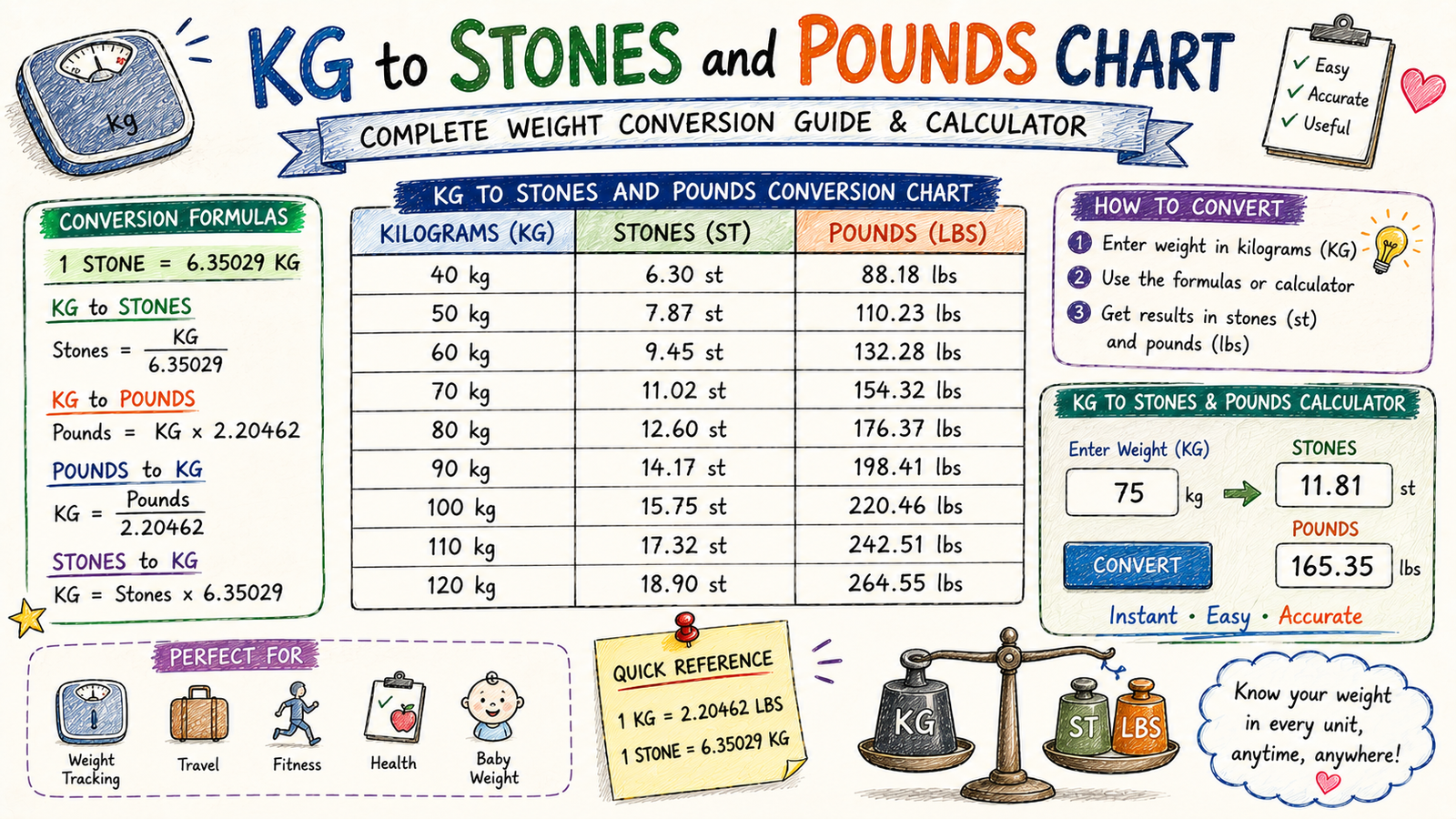
KG to Stones and Pounds
Instantly convert any weight from kilograms (kg) to stones & pounds (st & lbs) — with formula, step-by-step guide & complete reference chart.
⚖️ Weight Converter
Enter kilograms below — stones & pounds calculate instantly
Step-by-step working:
The Core Conversion Relationships
Key Formulas: KG → Stones & Pounds
kg → Total Pounds
\[\text{lbs} = \text{kg} \times 2.20462\]kg → Stones (decimal)
\[\text{st} = \text{kg} \div 6.35029\]Full kg → Stones + Pounds Formula
\[\text{Total lbs} = \text{kg} \times 2.20462\] \[\text{Stones} = \left\lfloor \frac{\text{Total lbs}}{14} \right\rfloor\] \[\text{Remaining lbs} = \text{Total lbs} - (\text{Stones} \times 14)\]Key equivalences to memorise:
Introduction: Why Convert Kilograms to Stones and Pounds?
Weight — one of the most fundamental measurements in human life — is expressed in radically different units depending on where in the world you are. While the vast majority of countries use the metric kilogram (kg) as the standard unit for body weight, goods, and scientific measurement, the United Kingdom and Ireland have a long cultural tradition of using stones and pounds for describing human body weight — a practice that remains deeply embedded in everyday speech to this day.
This creates a very real, everyday need for conversion. A British person stepping onto a metric scale for the first time, a doctor in Ireland recording a patient's weight in kilograms from a stone-based reading, an online clothing retailer publishing size guides in multiple measurement systems, a nutritionist tracking weight-loss progress across different countries — all of these scenarios require accurate, fast conversion between kilograms, stones, and pounds.
The conversion is slightly more involved than a simple single-step calculation, because the stone-and-pound system uses a compound unit — you need to find both the number of whole stones and the remaining pounds. This guide explains exactly how to do that, from first mathematical principles, with worked examples, mental math shortcuts, a complete reference chart, and all the historical and practical context you could ever need.
The History of the Stone as a Unit of Weight
The stone is one of the oldest units of weight still in active use anywhere in the world. Its origins trace back to ancient trade practices, where merchants literally used smooth stones of consistent size as weights on balance scales to measure goods. This practice was widespread across Europe and the Middle East for thousands of years before standardised weight systems were developed.
For much of medieval and early modern history, the exact value of a "stone" varied dramatically depending on the commodity being weighed and the region of the country. In medieval England, different stones were defined for different goods: a stone of wool was 14 pounds in some regions, 15 or even 16 in others. A stone of butter could be 8 pounds in parts of Ireland, while a stone of glass was 5 pounds. The inconsistency was a source of tremendous commercial confusion and dispute.
Standardisation came gradually. By the 14th century, Edward III of England declared the stone for wool to be 14 pounds. Over subsequent centuries, the 14-pound stone became the dominant standard for human body weight across the British Isles, though regional variation persisted in other contexts well into the 19th century.
The modern legal definition was established in the UK Weights and Measures Act of 1985, which defined 1 stone as exactly 14 avoirdupois pounds — itself defined as exactly 0.45359237 kilograms. Therefore, 1 stone = 14 × 0.45359237 = exactly 6.35029318 kg.
Today the stone is not recognised by the International System of Units (SI) and is officially classified as a unit that was "permitted for use with the SI" only in the UK for certain purposes. Despite metric adoption in most official UK contexts, the stone has proven remarkably persistent as the dominant unit for human body weight in British and Irish everyday culture. National health surveys, newspaper articles about celebrities, and casual conversations about weight in pubs and gyms across the UK almost universally use stones and pounds rather than kilograms.
📅 Timeline of the Stone Unit
The History of the Pound (lb)
The pound has an even longer history than the stone. Its name derives from the Latin libra pondo, meaning "a pound by weight" — with libra giving us the abbreviation lb and the symbol for the zodiac sign Libra (the scales), and pondo giving us the English word "pound."
Historically, the pound was used across ancient Rome, Charlemagne's empire, and medieval Europe, always with slight regional variations. There were many historical types of pound: the Troy pound (used for precious metals and gemstones), the Tower pound (used in the English mint), the Merchant's pound, and others. The one that matters today is the avoirdupois pound, from the Old French aveir de peis meaning "goods of weight."
The avoirdupois pound was standardised in England in the 16th century and became the legal standard. It was formally defined in 1959, when the United States, United Kingdom, Canada, Australia, New Zealand, and South Africa signed the International Yard and Pound Agreement, defining 1 avoirdupois pound as exactly 0.45359237 kilograms — the value that forms the basis of all modern unit conversions.
Today, the pound is the primary unit of body weight in the United States and is also used as a subdivision of the stone in the UK and Ireland. The abbreviation "lb" remains universal, derived from that original Latin libra.
The History of the Kilogram (kg)
The kilogram is the base unit of mass in the International System of Units (SI) and is the most widely used unit of weight on Earth. Its origins are far more scientific and precisely defined than the stone or pound.
The kilogram was originally defined in 1799 during the French Revolution as part of the new metric system. It was initially defined as the mass of 1 cubic decimetre (litre) of water at its temperature of maximum density (approximately 4°C). This gave a highly reproducible, nature-based definition linked to the universal properties of water.
In 1889, the International Prototype of the Kilogram (IPK) — a cylinder of platinum-iridium alloy — was created and stored at the Bureau International des Poids et Mesures (BIPM) in Sèvres, France. For 130 years, the kilogram was literally defined as "the mass of this specific physical object."
This changed on 20 May 2019, when the SI was redefined. The kilogram is now defined in terms of fundamental physical constants — specifically by fixing the numerical value of Planck's constant \(h = 6.62607015 \times 10^{-34}\) J·s. This makes the kilogram's definition stable, reproducible anywhere in the universe, and no longer dependent on a single physical object. It was a landmark moment in the history of measurement science.
Today, kilograms are used for body weight in virtually all countries except the United States (which uses pounds) and the UK/Ireland (which culturally uses stones and pounds). In all scientific disciplines worldwide, kilograms are the only accepted unit of mass.
The Mathematics of KG → Stones and Pounds — Explained in Full
Converting kilograms to stones and pounds is a two-stage process. The math involves a simple multiplication followed by an integer division (quotient and remainder). Let's build the full understanding from the fundamental conversion factors.
Step 1: The Fundamental Conversion Factors
The entire conversion chain is built on two legally-defined equalities:
Step 2: Deriving the kg → Pounds Conversion
Since \(1 \text{ lb} = 0.45359237 \text{ kg}\), we can find how many pounds are in 1 kg by dividing:
Step 3: Splitting Total Pounds into Stones + Remaining Pounds
Once we have the total weight in pounds, we use integer (floor) division and modulo arithmetic to find the stones and remaining pounds:
Where \(\lfloor \cdot \rfloor\) is the floor function (round down to the nearest whole integer) and \(\bmod\) is the modulo operation (the remainder after division).
The Complete Combined Formula
Complete kg → Stones and Pounds Conversion
\[\text{Step 1: } W_{\text{lbs}} = W_{\text{kg}} \times 2.20462\] \[\text{Step 2: } \text{Stones} = \left\lfloor \frac{W_{\text{lbs}}}{14} \right\rfloor\] \[\text{Step 3: } \text{Extra lbs} = W_{\text{lbs}} - (14 \times \text{Stones})\] \[\text{Result: } W_{\text{kg}} = \text{Stones} \text{ st} + \text{Extra lbs} \text{ lb}\]The Reverse Formula: Stones and Pounds → Kilograms
Step-by-Step: How to Convert KG to Stones and Pounds
Let's work through the conversion of 80 kg — a common adult body weight — to stones and pounds.
Write Down the Weight in Kilograms
Start with your kilogram value.
Multiply by 2.20462 to Get Total Pounds
Multiply your kilogram value by the conversion factor 2.20462 to convert to total pounds.
Divide by 14 to Find Whole Stones
Divide the total pounds by 14 (since 1 stone = 14 lbs). Take only the whole-number part (floor) — that gives you the stones.
Subtract to Find Remaining Pounds
Subtract 12 × 14 = 168 from the total pounds to find the leftover pounds.
Final Answer
✅ Often written as "12 stone 8 pounds" in everyday British usage.
10 Fully Worked KG to Stones & Pounds Examples
These cover the most commonly searched weight conversions, with every step shown.
Quick Mental Math Shortcuts
When you don't have a calculator handy, these techniques give you fast working estimates.
🧠 Trick #1: The "Divide by 6.35" Shortcut for Stones
Since 1 stone ≈ 6.35 kg, you can divide your kilogram value by 6.35 to get approximate stones in decimal form.
Example: 63.5 kg ÷ 6.35 ≈ 10 st exactly. 70 kg ÷ 6.35 ≈ 11.02 st ≈ 11 st.
🧠 Trick #2: "Multiply by 2.2" for Pounds (Close Enough)
The exact multiplier is 2.20462, but rounding to 2.2 gives a quick, close estimate for total pounds.
Example: 65 kg × 2.2 = 143 lbs (exact: 143.3 lbs) — accurate to within 0.5 lbs for typical body weights.
🧠 Trick #3: Memorise Key "Round Number" Anchors
These are exact or near-exact anchor points worth memorising:
🧠 Trick #4: Use the Symmetry of the 14-Pound Stone
Since 1 stone = 14 lbs, every additional pound is 1/14 ≈ 0.0714 of a stone, and every additional kg is 2.2 lbs ≈ 0.157 stone. So adding 6.35 kg always adds exactly 1 stone — useful for quick mental jumps. Example: if you know 70 kg ≈ 11 st, then 76.35 kg ≈ 12 st.
Real-World Weight Reference Points
Context makes conversions memorable. Here are real-world weights across many categories expressed in all three systems:
| Object / Reference | kg | Stone & lbs | lbs only |
|---|
Weight Conversion in Health & BMI Context
One of the most important reasons to understand kg-to-stone conversion is in the context of health and body weight assessment. The widely used Body Mass Index (BMI) formula — a screening tool used by doctors and health organisations worldwide — uses kilograms and metres:
Where \(W\) = weight in kilograms and \(H\) = height in metres
Because BMI requires weight in kilograms, British and Irish patients who know their weight in stones must convert to kg before calculating BMI. Conversely, a BMI result in kg can be converted back to stones for communication with a patient who thinks in stones.
| BMI Category (WHO) | BMI Range | Approx kg (170cm person) | Approx Stone (170cm person) |
|---|---|---|---|
| Underweight | < 18.5 | < 53.5 kg | < 8 st 6 lbs |
| Normal weight | 18.5 – 24.9 | 53.5 – 72 kg | 8 st 6 – 11 st 5 |
| Overweight | 25.0 – 29.9 | 72 – 86.4 kg | 11 st 5 – 13 st 9 |
| Obese (Class I) | 30.0 – 34.9 | 86.4 – 100.8 kg | 13 st 9 – 15 st 13 |
| Obese (Class II) | 35.0 – 39.9 | 100.8 – 115.2 kg | 15 st 13 – 18 st 2 |
| Obese (Class III) | ≥ 40.0 | ≥ 115.2 kg | ≥ 18 st 2 lbs |
*BMI is a screening tool only and does not directly measure body fat. Consult a healthcare professional for health assessments. Values approximate for a person of 170cm height.
Real-World Applications of KG to Stone Conversion
🏥 Medical and Healthcare Settings
Hospital scales in the UK are increasingly metric, but patients frequently report their weight in stones and pounds. GPs, nurses, dietitians, and pharmacists must convert between systems when calculating drug dosages (typically in mg/kg), assessing BMI, or recording weight in electronic health records. Anaesthesiologists use body weight in kilograms when calculating safe doses of anaesthetic agents — so an accurate conversion is medically critical.
🏋️ Fitness, Gym, and Weight Loss
UK gym equipment typically shows weights in both kg and lbs but not stones. Fitness apps and smart scales in the UK often present weight in both systems. Weight-loss programmes such as Slimming World and Weight Watchers UK have historically used stones as their primary unit, while online calorie calculators and NHS tools increasingly use kg. People tracking their progress need to understand both systems. A typical UK weight-loss goal might be "lose 2 stone" — which translates to losing 12.7 kg or 28 lbs.
✈️ Travel and Luggage Allowances
Airline luggage allowances are almost universally specified in kilograms (e.g., 23 kg checked baggage). A British traveller who thinks in stones needs to know that 23 kg ≈ 3 st 9 lbs. Parcel delivery companies, freight services, and courier firms may use different systems depending on their country of operation — accurate conversion prevents excess weight charges and shipping errors.
🥊 Sports and Athletics
Boxing, wrestling, MMA, weightlifting, judo, and rowing all use weight categories that may be defined in kg (for international/Olympic competition) or in stones/pounds (for traditional British and American events). A boxer weighing 73 kg needs to know they compete in the welterweight class (63.5–67 kg is light welterweight; 69–72 kg is light middleweight under various organisations). Understanding the conversion is essential for athletes, coaches, and fans following international events.
📐 Mathematics Education
KG to stone conversion is an excellent classroom exercise that teaches unit conversion, ratio and proportion, multiplication with decimal factors, integer (floor) division, and modulo arithmetic — all in a personally relevant context. Students in the UK regularly encounter this topic in GCSE Mathematics, where they must apply multi-step unit conversions and demonstrate understanding of conversion factors. The conversion requires students to handle both a scaling operation (× 2.20462) and a decomposition operation (dividing into quotient and remainder), making it a rich multi-concept problem.
Complete KG to Stones and Pounds Chart
From 1 kg to 200 kg — the most comprehensive kg to stone reference table available
| kg | Stones | Extra lbs | st & lbs | Total lbs | Notes |
|---|
* Values rounded: pounds to 1 decimal place
📝 Expert Tips for Students & Exam Takers
Master these points to nail weight conversion questions in GCSE, functional maths, and beyond:
✅ Always convert to total pounds FIRST
Never try to convert directly to stones in one step. The two-step approach (kg → total lbs → stones + remainder lbs) is the only reliable method.
✅ The conversion factor is 2.20462, not 2 or 2.5
Using 2 gives about 9% error; using 2.5 gives about 13% error. The correct value is 2.20462. For exam purposes, check whether you're permitted to use 2.2 as an approximation — usually stated in the question.
✅ Floor division, not rounding, gives stones
When dividing total pounds by 14 to find stones, you MUST use the floor (round down), never standard rounding. If total lbs = 155.7, then 155.7 ÷ 14 = 11.12 → 11 stones (not 11.12 or 12 stones).
✅ Verify: stones × 14 + remaining lbs must equal total lbs
Always do this sense-check: (stones × 14) + remaining_lbs = total_lbs. For 80 kg: (12 × 14) + 8.37 = 168 + 8.37 = 176.37 ✓. If this doesn't hold, you've made an arithmetic error somewhere.
Frequently Asked Questions
🌿 Brought to you by HeLovesMath.com
Your trusted resource for math tools, calculators, and step-by-step guides.