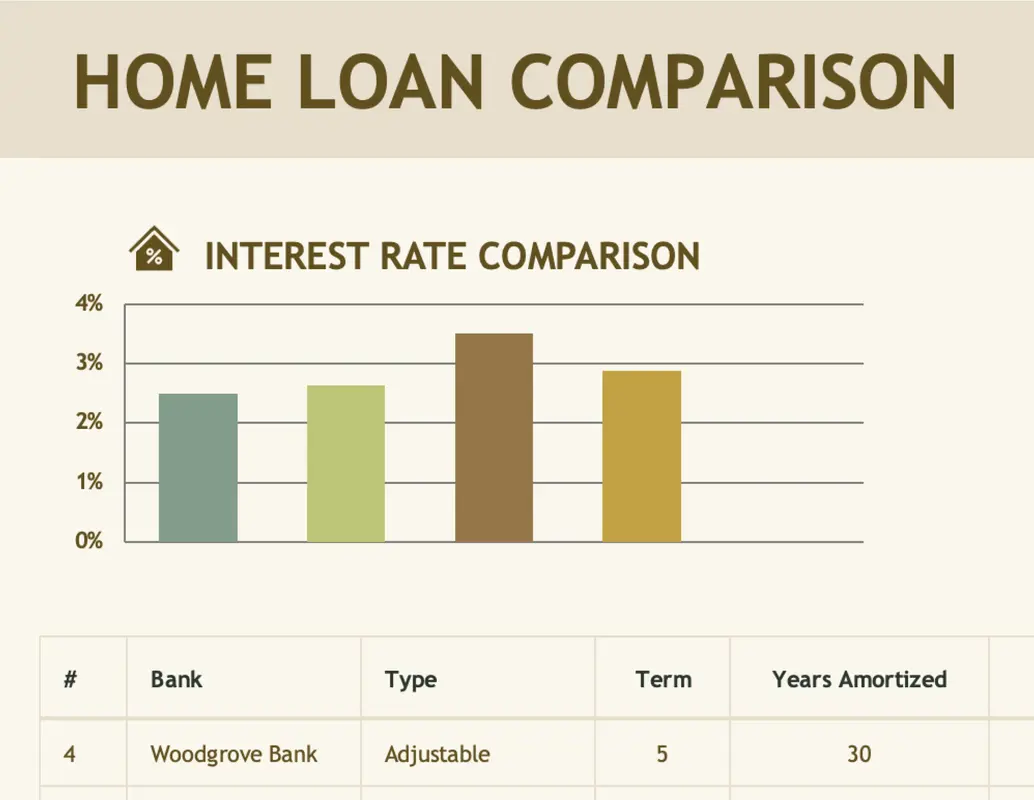
Home Loan Comparison
Use this Home Loan Comparison calculator to compare two mortgage or home loan offers side by side. Estimate monthly payment, total interest, total cost, upfront fees, APR-style cost difference, and potential savings between Loan A and Loan B before choosing a home loan.
Compare Two Home Loans
Enter the home price, down payment, loan terms, interest rates, and upfront costs for each offer. The calculator compares the full payment and cost difference.
Loan A
Loan B
What Is a Home Loan Comparison?
A Home Loan Comparison is a side-by-side analysis of two mortgage or home loan offers. It helps borrowers compare more than just the advertised interest rate. A complete comparison should consider loan amount, interest rate, term length, upfront fees, discount points, mortgage insurance, property taxes, insurance, HOA costs, monthly payment, total interest, and total cost over the life of the loan.
Many borrowers focus only on the lowest interest rate. That can be misleading because a lower rate may come with higher upfront fees or points. A loan with a slightly higher rate and lower fees may be better if you plan to sell, refinance, or pay off the loan early. A loan with a lower monthly payment may also cost more in total if the repayment term is longer. This calculator helps reveal those tradeoffs by comparing Loan A and Loan B using the same home price and down payment.
The goal of this calculator is to provide a clear planning estimate. It calculates the principal and interest payment for each loan, adds recurring ownership costs such as property tax, insurance, HOA, and mortgage insurance, then estimates total cost across the full loan term. The result shows which option appears cheaper under the assumptions entered and how much the estimated difference is.
This tool is useful for home buyers comparing lender quotes, homeowners comparing refinance offers, real estate students learning amortization, and anyone trying to understand how loan terms affect long-term cost. It is not a substitute for a lender’s official Loan Estimate, closing disclosure, mortgage advisor, or financial planner.
How to Use the Home Loan Comparison Calculator
Start by entering the home price and down payment. The calculator subtracts the down payment from the home price to estimate the base loan amount. Then enter annual property tax, annual homeowners insurance, and monthly HOA or other recurring housing costs. These recurring costs are included in the monthly payment estimate so the result is closer to real housing cash flow.
Next, enter details for Loan A and Loan B. Each loan needs an interest rate, loan term in years, upfront fees or points, and optional monthly mortgage insurance. Upfront fees are included in the total cost comparison. Mortgage insurance is included as a monthly recurring cost. If one loan has a lower rate but higher upfront fees, the calculator will show how that tradeoff affects the full cost.
Click the compare button. The result panel shows the estimated better option, the estimated cost difference, monthly payment for both loans, and total cost for both loans. The monthly payment shown includes principal and interest, estimated monthly property tax, monthly insurance, HOA, and mortgage insurance. Total cost includes all scheduled payments plus upfront fees.
Use the result as a planning tool. For an official decision, compare lender-provided APR, cash to close, total interest, prepayment rules, escrow setup, mortgage insurance rules, and the time you expect to keep the loan. A loan that is better over 30 years may not be better if you refinance after three years.
Home Loan Comparison Formulas
The calculator uses standard fixed-rate mortgage formulas. In the formulas below, \(P\) is the loan principal, \(r\) is the monthly interest rate, \(n\) is the total number of monthly payments, and \(M\) is the monthly principal and interest payment.
Monthly Payment Explained
A home loan payment is often discussed as a single number, but it usually has several parts. The core mortgage payment is principal and interest. Principal is the amount borrowed. Interest is the lender’s charge for lending money. In a fixed-rate mortgage, the principal and interest payment stays the same for the full term, assuming the loan is paid according to schedule.
Many homeowners also pay property taxes and insurance through an escrow account. These amounts can change over time, even if the mortgage principal and interest payment remains fixed. HOA fees, mortgage insurance, flood insurance, and other recurring costs can also affect affordability. That is why this calculator includes tax, insurance, HOA, and PMI fields in the monthly payment estimate.
When comparing two loans, monthly payment is important for cash flow. A loan that saves money over the long run may still be difficult if the monthly payment is too high. A lower monthly payment can create breathing room, but it may also increase total cost if it comes from a longer term or higher fees. Good comparison requires both monthly and lifetime views.
Total Cost Comparison
Total cost estimates how much the loan and recurring housing payments cost across the full loan term. This calculator includes scheduled monthly housing payments plus upfront fees. It also shows total interest so borrowers can see how much of the cost is interest rather than principal repayment.
Total cost is helpful because a small monthly difference can become large over time. For example, a difference of 150 per month over 30 years equals 54,000 before considering upfront fees. A lower interest rate can save a large amount over a long term. However, if the lower rate requires high discount points or fees, the borrower should consider the break-even period.
Remember that most borrowers do not keep the same mortgage for the full 30 years. They may sell, refinance, make extra payments, or change loan terms. If you expect to keep the loan only a few years, upfront fees matter more. If you expect to keep the loan for decades, a lower rate may become more valuable.
Fees, Points, and Break-Even Thinking
Mortgage fees can include origination fees, application fees, underwriting charges, discount points, lender credits, title-related costs, and other closing costs. Discount points are upfront payments made to reduce the interest rate. One point usually means 1% of the loan amount. Paying points can make sense if the monthly savings are large enough and you keep the loan long enough to recover the upfront cost.
Break-even thinking compares upfront cost with monthly savings. If Loan B costs 4,000 more upfront but saves 100 per month, the simple break-even period is about 40 months. If you expect to keep the loan longer than that, the lower-rate loan may be attractive. If you expect to refinance or sell before that, the higher-fee option may not pay off.
This calculator focuses on total cost over the full term, but users should also think about their personal time horizon. The best loan depends on both math and life plans.
Home Loan Comparison Example
Suppose a buyer is purchasing a 350,000 home with a 70,000 down payment. The loan amount is 280,000. Loan A offers a 6.75% rate for 30 years with 3,500 in fees. Loan B offers a 6.25% rate for 30 years with 7,500 in fees. Loan B has a lower monthly principal and interest payment, but it also costs 4,000 more upfront.
The calculator compares the monthly payment and the total cost. If the lower-rate loan saves enough every month, it may eventually offset the higher upfront fee. If the borrower keeps the home loan for the full term, Loan B may save money. If the borrower sells or refinances quickly, Loan A may be better because it has lower upfront cost.
| Comparison Point | Why It Matters | What to Check |
|---|---|---|
| Interest rate | Drives principal and interest payment. | Compare fixed rates for the same term. |
| Term | Changes monthly payment and total interest. | Compare 15-year vs 30-year carefully. |
| Upfront fees | Can offset a lower rate. | Check points, origination, and closing costs. |
| Monthly insurance | Affects affordability. | Include PMI, homeowners insurance, and HOA. |
| Total cost | Shows long-term impact. | Use it with your expected time in the home. |
Practical Tips for Comparing Home Loans
Always compare loan offers using the same home price, down payment, and time horizon. Ask lenders for the official APR, monthly payment, cash to close, lender fees, third-party fees, escrow estimate, and whether points are included. A rate quote without the closing-cost details is incomplete.
Compare both monthly payment and total interest. A 15-year loan usually has a higher monthly payment but much lower total interest than a 30-year loan. A 30-year loan gives lower monthly pressure but can cost much more over time. The best choice depends on income stability, emergency savings, debt load, investment plans, and comfort with risk.
Consider the length of time you expect to keep the loan. If you plan to refinance, relocate, upgrade, or sell within a few years, paying high upfront fees for a lower rate may not be worth it. If you plan to keep the mortgage long term, a lower rate can create substantial savings.
Home Loan Comparison FAQs
What does a home loan comparison calculator do?
It compares two home loan offers by estimating monthly payments, total interest, upfront fees, and total cost.
Is the lowest interest rate always best?
No. A lower rate can come with higher fees or points. Compare total cost and break-even time, not just the rate.
What is included in the monthly payment?
This calculator includes principal and interest, estimated monthly property tax, homeowners insurance, HOA, and mortgage insurance.
Does this calculator estimate official APR?
No. It provides planning estimates. Official APR depends on lender disclosures, fee classification, loan type, and regulations.
What is a break-even point?
The break-even point is the time needed for monthly savings from a lower-rate loan to recover the extra upfront cost.
Can I compare a 15-year and 30-year loan?
Yes. Enter different terms for Loan A and Loan B. The calculator will compare monthly payment and total cost.
Important Note
This Home Loan Comparison calculator is for educational and planning purposes only. It is not mortgage, legal, tax, accounting, or financial advice. Final loan costs depend on lender disclosures, underwriting, credit profile, property details, escrow rules, taxes, insurance, local laws, and closing documents.