
GPA conversion, explained carefully
GPA to percentage: choose the right method
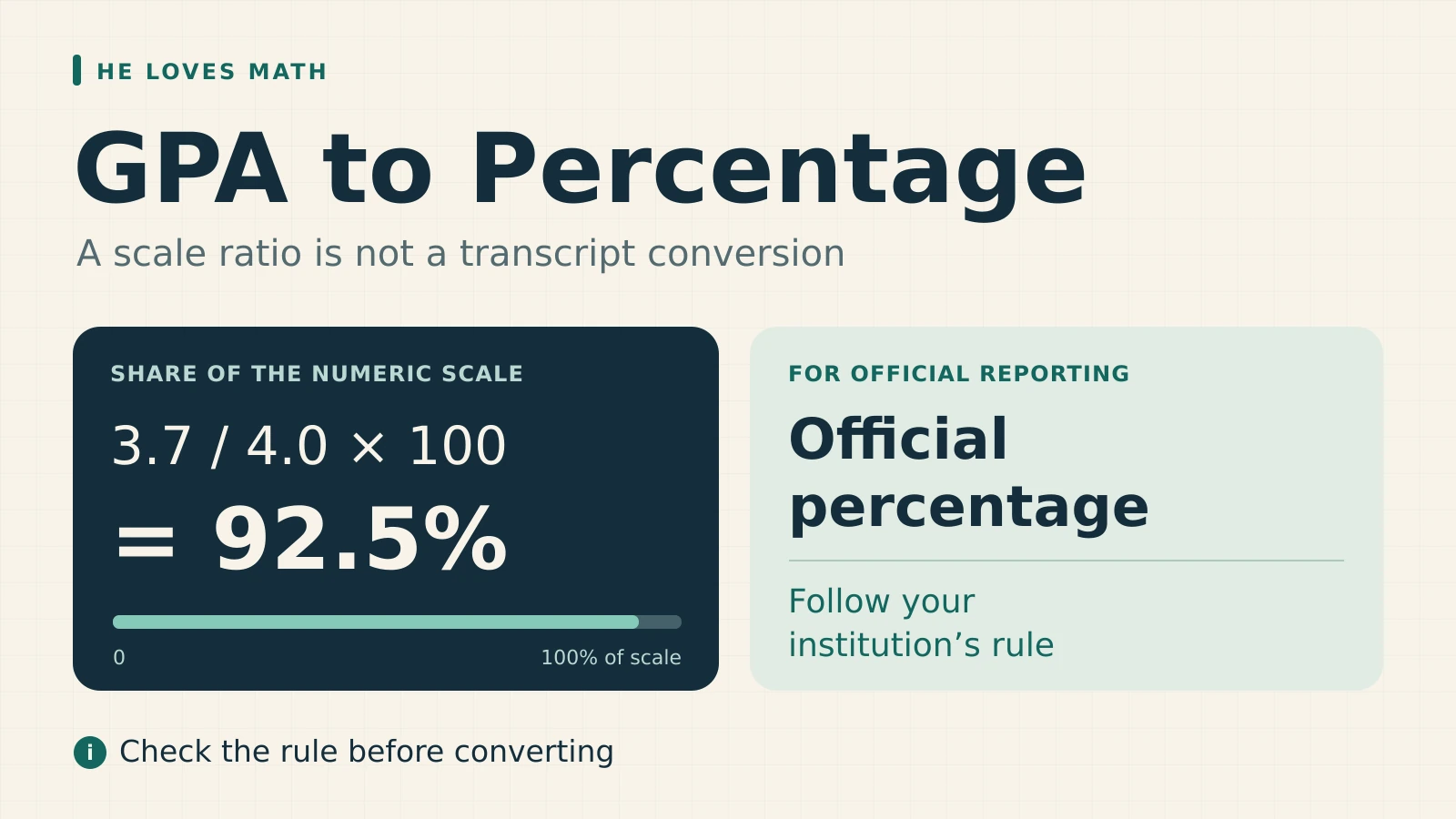
There is no universal GPA-to-percentage formula. This calculator finds your GPA as a percentage of its numerical maximum. It cannot recover your original marks or determine an official academic equivalent.
GPA to Percentage Calculator
Method: numerical scale share only. GPA ÷ maximum GPA scale × 100. Select the scale printed on your record; do not guess a weighted GPA’s maximum.
Results are rounded to 2 decimal places. Zero is valid; the maximum must be positive, and GPA cannot exceed it. Editing an input clears the previous result.
Why GPA does not reveal percentage marks
A percentage mark usually compares marks earned with marks available. GPA averages grade points assigned under a school’s rules, often with course credits as weights. A range of raw marks may map to the same grade points, so information is lost. Reversing the process from a single GPA cannot generally recover the original marks.
For a concrete example, the University of Northern British Columbia’s undergraduate table assigns an A worth 4.00 grade points to marks from 85% to 89.9%. Its maximum A+ is worth 4.33 points. Dividing 4.00 by 4.33 gives about 92.38% of the numerical maximum, which is different from that A grade’s mark band. These are course-grade bands, not a lookup table for cumulative GPA. See the official registrar source at the end.
Two students can have the same GPA while earning different original marks. A proportional ratio is therefore a numerical comparison, not a reliable estimate of the underlying academic percentage.
The formula this calculator uses
For 3.70 on a 4.00 scale, calculate 3.70 ÷ 4.00 = 0.925, then 0.925 × 100 = 92.50%. The correct interpretation is “3.70 is 92.50% of 4.00.” It is not “my marks are 92.50%.” This ratio also does not measure percentile rank or distance above a passing grade.
Round the result, not the input
Enter the GPA as reported and keep the actual maximum, including 4.33 if that is your scale. The calculator keeps the entered precision during the calculation and displays two decimal places. For example, 3.70 ÷ 4.33 × 100 = 85.450346…%, displayed as 85.45%. Rounding cannot create greater accuracy than the original GPA provides. Follow any official rounding or truncation rule for formal reporting.
For more arithmetic practice, see how percentages work and how to calculate a percentage.
GPA to percentage table: numerical ratios only
Every value below is a share of the stated maximum, not a universal marks conversion chart.
| GPA / maximum | Calculation | Share of maximum |
|---|---|---|
| 3.00 / 4.00 | 3 ÷ 4 × 100 | 75.00% |
| 3.50 / 4.00 | 3.5 ÷ 4 × 100 | 87.50% |
| 3.70 / 4.00 | 3.7 ÷ 4 × 100 | 92.50% |
| 4.00 / 4.00 | 4 ÷ 4 × 100 | 100.00% |
| 3.70 / 4.33 | 3.7 ÷ 4.33 × 100 | 85.45% (rounded) |
| 4.20 / 5.00 | 4.2 ÷ 5 × 100 | 84.00% |
| 5.60 / 7.00 | 5.6 ÷ 7 × 100 | 80.00% |
| 8.40 / 10.00 | 8.4 ÷ 10 × 100 | 84.00% |
The scale changes the ratio: 3.70/4.00 and 3.70/4.33 produce different numbers. Neither ratio says how an admissions office will evaluate the transcript.
Choose an official conversion only when it applies

- Read the destination’s instructions. Some applications want your original GPA and scale; others specify their own conversion or evaluation.
- Identify the exact policy. Check the institution, program, admission year or examination scheme, transcript legend, and any amendments.
- Use the prescribed formula or table. Apply its required rounding. Keep a record of the policy used.
- Ask if instructions are missing or conflict. Do not fill the gap with an unrelated online multiplier.
An institutional rule can resemble the ratio without being universal
VTU’s B.E./B.Tech Regulations 2022, clause 22OB6.7, specify percentage = CGPA × 10 and give 8.20 → 82.0% as an example. Clause 1.4 scopes that document to admissions from 2022–23 until revision or withdrawal. This is an example from that regulation, not a claim that it is the current rule for every VTU program or cohort. Check the applicable regulation and subsequent amendments with VTU before using it.
Do not copy this multiplier to every ten-point CGPA. Likewise, familiar multipliers such as 9.5 belong to particular policies, not to GPA arithmetic generally. This calculator does not select or certify an institution’s rule.
Some applications expressly ask you not to convert
Stanford Graduate Admissions, for example, asks applicants to report their transcript GPA and its original scale rather than converting a differently scaled GPA to 4.0. Follow the instructions for your own application. The official sources supporting these examples are collected in Sources & References.
How GPA is calculated from grades and credits
Suppose three included courses have 4.0 points for 4 credits, 3.0 points for 3 credits, and 3.7 points for 2 credits. Their quality points total 16 + 9 + 7.4 = 32.4 across 9 credits, giving GPA = 32.4 ÷ 9 = 3.60.
On a maximum of 4.00, that GPA has a scale share of 90.00%. It still does not reconstruct the courses’ original percentage marks. Institutions also decide which courses, repeats, withdrawals and pass/fail grades count. Use the separate GPA calculator if you are starting from course grades and credits, and check those inclusion rules.
Weighted and unweighted GPA: two different meanings of weight
Course-credit weighting gives a higher-credit course more influence on the average. This can apply even to a GPA described as “unweighted.” Advanced-course weighting adds grade-point bonuses for designated course difficulty; schools may call that a weighted GPA.
A 4.3 weighted GPA cannot be entered against a 4.0 maximum in this tool. Find the actual maximum from the school’s profile or registrar. Even if it is 5.0, the calculation 4.3 ÷ 5 × 100 = 86.00% is only a scale share, not an official marks percentage. Do not guess a maximum simply to make an input valid.
Keep cumulative GPA (the included record across terms) distinct from term GPA (one reporting period). Report whichever the form requests. For assessment-category weights rather than grade points, see the weighted grade calculator.
Using 4.0, 4.33, 5.0, 7.0, 10.0 or custom scales
The presets supply a numerical denominator, not a country or university policy. Select 4.33 only if that is the actual maximum on your record; do not substitute 4.0. A 5.0 scale is not automatically a weighted version of every 4.0 scale. A 7.0 or 10.0 scale does not identify one universal set of grade boundaries.
Custom scale supports a positive finite maximum, such as 20. GPA must be from zero through that maximum. Some grading systems have a nonzero lowest grade or use lower numbers for better performance. This simple ratio does not normalize those systems, reverse their direction, or measure academic quality.
What to put on an application or resume
Report the original metric clearly, for example: Cumulative GPA: 3.70/4.00. Include weighted or unweighted status if requested. Do not replace it with “92.5%” just because that is the ratio this tool calculates.
If a percentage field is mandatory and no applicable method is given, contact the admissions office, employer or scholarship provider. Ask whether they want original marks, an institutional equivalent, an evaluator’s result, or the original GPA. An online scale-share result does not establish eligibility, honours, class rank or a scholarship threshold.
Worked examples and a quick check
Example 1: a 4.33 scale
For GPA 4.15 out of 4.33: 4.15 ÷ 4.33 × 100 = 95.842956…%, displayed as 95.84% of the scale maximum. The original GPA remains 4.15/4.33.
Example 2: actual marks are a different calculation
For 420 marks earned out of 500 available: 420 ÷ 500 × 100 = 84%. That is a percentage of marks. It does not require a GPA conversion and does not establish a GPA without the institution’s grading rules.
Example 3: invalid maximum
Entering 4.3 with a maximum of 4.0 is rejected. Do not clamp it to 100% or change the GPA. Check whether the record is weighted and what maximum actually applies.
Practice: what is the scale share of 6.1/7.0? Does it tell you the original marks?
6.1 ÷ 7 × 100 = 87.142857…%, displayed as 87.14%. No: it does not recover the original marks.
Practice: zero and maximum. What do 0/4 and 4/4 produce?
They produce 0.00% and 100.00% of the numerical maximum. They do not by themselves assign a fail/pass decision or certify perfect raw marks.
Common mistakes to avoid
- Calling a scale share a marks percentage. Use precise labels, especially when sharing the output.
- Using the wrong denominator. Preserve the actual 4.33, 7.0 or other maximum.
- Applying another institution’s formula. Check program, cohort, version and amendments.
- Rounding the GPA first. Keep the original reported value and round only as required.
- Confusing percentage with percentile. A ratio says nothing about how many students you outperformed.
Frequently asked questions
What is a 3.0 GPA in percentage on a 4.0 scale?
3 ÷ 4 × 100 = 75.00% of the numerical maximum. This does not mean a 3.0 GPA officially equals 75% marks.
What are 3.5 and 3.7 GPA on a 4.0 scale?
The scale shares are 87.50% and 92.50%. The corresponding academic marks cannot be determined from those GPA values alone.
Does a 4.0 GPA mean 100%?
It is 100% of a 4.0 numerical maximum, but it does not imply 100% in every course. On a 4.33 maximum, 4.0 is about 92.38% of the scale maximum.
Can GPA be converted exactly to percentage?
An applicable institutional rule can define an official equivalent. That equivalent does not necessarily reconstruct original raw marks. Without such a rule or the original marks, there is no universal exact conversion.
Should I multiply a ten-point CGPA by 9.5 or 10?
Only use the factor prescribed for your institution, program and cohort. Multiplying by 10 always gives the numerical share of a ten-point maximum, but it is an official academic equivalent only when the applicable policy says so.
Can I reverse this calculation to get an official GPA?
No. Multiplying a percentage by a maximum and dividing by 100 only reverses the numerical ratio. It does not recreate course grade points, credit weights or an official GPA.
Can I use a weighted GPA here?
You can find its numerical scale share if you know the actual maximum. That does not remove advanced-course bonuses or make it comparable to an unweighted GPA.
Why does my result disappear when I change an input?
The previous result belongs to the previous inputs. Press Convert again or use Enter after editing. Reset clears the values and returns to the 4.0 scale.
Sources & References
These primary sources support the institutional examples. The calculator performs a numerical ratio; it is not endorsed by these institutions. Confirm the policy applicable to your own record and application.
- UNBC Registrar: Understanding Academic Standing — undergraduate grade bands, grade points and credit-weighted GPA. Course-grade bands are not cumulative-GPA conversion bands.
- VTU: B.E./B.Tech Regulations 2022 (PDF) — clause 1.4, printed page 2, for stated applicability; clause 22OB6.7, printed page 35, for CGPA × 10. Check later amendments before formal use.
- Stanford Graduate Admissions: Application FAQs — Academic History instructions on reporting GPA in its original scale.