Gold Custom Duty Calculator: UAE, US, UK, EU, KSA, Qatar, Kuwait to India
Use this calculator to estimate customs duty on gold carried to India from Dubai, Abu Dhabi, Sharjah, the United States, the United Kingdom, Europe, Saudi Arabia, Qatar, Kuwait, Bahrain, Oman, Singapore and other countries. It handles gold jewellery, gold bars, coins, tola bars, purity, duty-free jewellery weight allowance, concessional duty, normal duty, tariff-value valuation, invoice-value valuation and declaration guidance.
Calculate Gold Duty
Estimated Duty Result
| Component | Formula | Amount |
|---|
\( V = \frac{W_d}{10} \times T_{10g} \times R_{USD/INR} \)
\( BCD = V \times r_{BCD} \), \( AIDC = V \times r_{AIDC} \), \( SWS = BCD \times r_{SWS} \)
\( Total\ Duty = BCD + AIDC + SWS \)
Latest India Gold Baggage Rule Summary
This calculator is designed for people who buy or carry gold from foreign countries to India and want a practical estimate before they travel. The most common use cases are UAE to India gold duty, Dubai to India gold duty, Qatar to India gold duty, Kuwait to India gold duty, Saudi Arabia to India gold duty, US to India gold duty, UK to India gold duty and Europe to India gold duty. The basic decision is not only “how much gold did I buy?” but also “what form of gold is it?”, “am I eligible for the concessional passenger baggage rate?”, “is it jewellery or a bar?”, “have I stayed abroad long enough?”, “am I using the jewellery duty-free allowance?”, and “what value will Customs use for assessment?”
| Rule area | Current calculator default | What it means for travellers |
|---|---|---|
| Baggage Rules | Baggage Rules, 2026 | Rules apply to passengers arriving in India. General allowance, jewellery allowance, temporary import, re-import and transfer-of-residence rules are separated. |
| General duty-free allowance | ₹75,000 for eligible resident / tourist of Indian origin / qualifying non-tourist visa holder; ₹25,000 for foreign-origin tourist | This general allowance does not automatically cover gold bars or silver because gold or silver in any form other than ornaments is treated separately. |
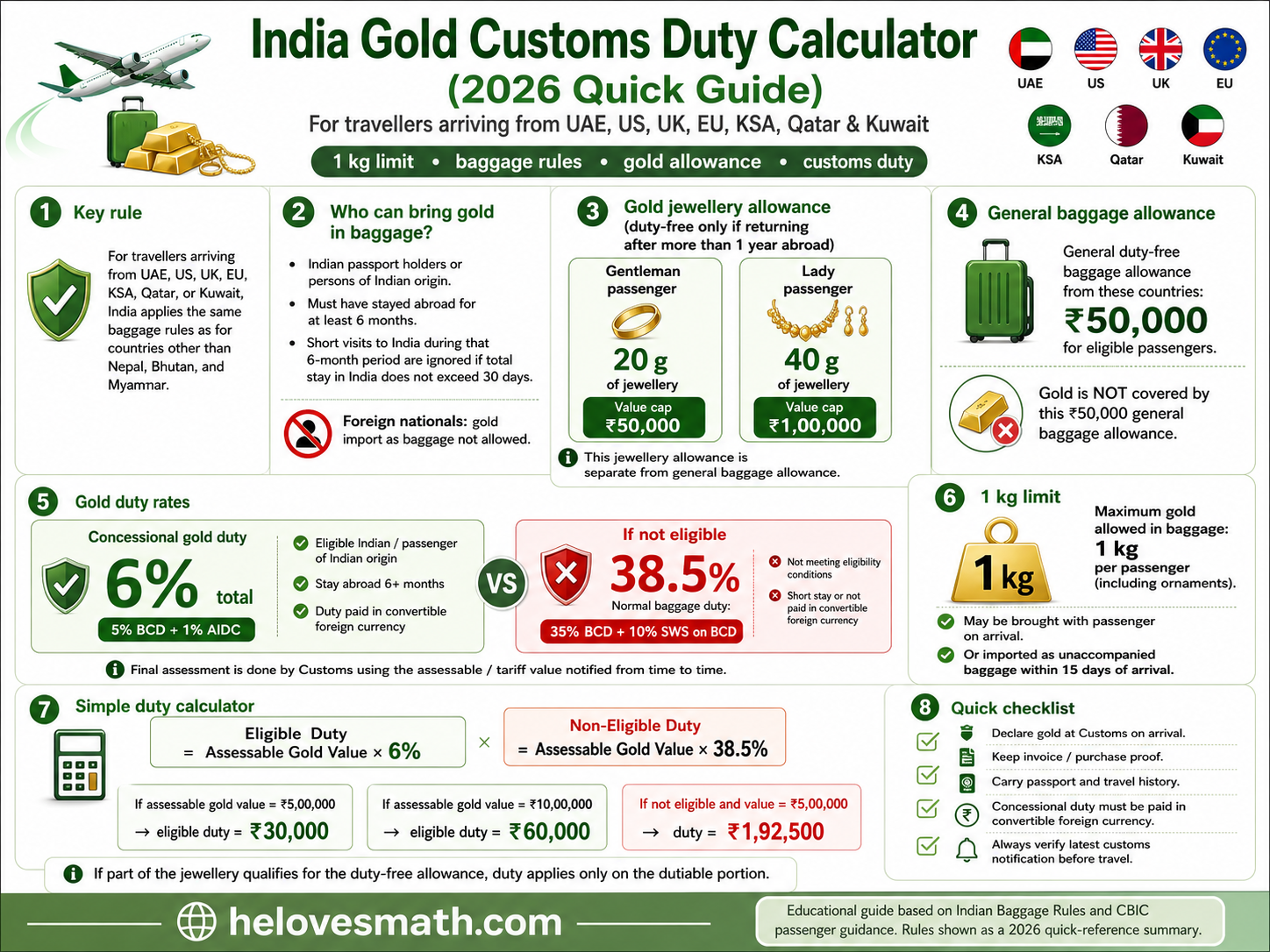
| Jewellery duty-free allowance | 40g for female passenger; 20g for passenger other than female | Applies to eligible resident or tourist of Indian origin residing abroad for more than one year, and only to bona fide jewellery in baggage. |
| Eligible passenger gold duty | 6% estimate: 5% BCD + 1% AIDC | Used when the passenger is eligible for the concessional baggage import route. Duty must normally be paid in convertible foreign currency. |
| Other passenger estimate | 36% estimate: 35% BCD + 1% AIDC | Use only as a rough warning estimate. Non-eligible passengers may not be allowed to import gold in baggage under the concessional route. |
| Maximum gold quantity | 1 kg per eligible passenger | Above this level, the calculator displays a high-risk warning because baggage import rules may not support the quantity. |
| Tariff value default | USD 1456 per 10 grams | Editable field. Replace it with the latest official tariff value applicable on your arrival or assessment date. |
How the Gold Custom Duty Calculator Works
The calculator first identifies whether the item is jewellery, a bar, a coin, a tola bar or another form of gold. This is important because India’s duty-free jewellery allowance is not the same as the duty treatment of gold bars or coins. Jewellery carried by a qualifying returning passenger may receive a weight-based duty-free allowance. Gold bars, gold coins, tola bars and other non-ornament forms generally need declaration and duty calculation, even if the passenger has a general baggage allowance for other goods.
The tool then checks passenger eligibility. For the jewellery duty-free allowance, the calculator expects the passenger to be an Indian resident or tourist of Indian origin who has resided abroad for more than one year. If that box is selected, the calculator applies 40 grams of duty-free jewellery for a female passenger and 20 grams for a passenger other than female. The duty is then computed only on the balance weight. For example, if an eligible female passenger brings 50 grams of plain gold jewellery, the first 40 grams are treated as duty-free jewellery in this estimate and only 10 grams are treated as dutiable. If an eligible passenger other than female brings the same 50 grams, the estimate treats 20 grams as duty-free and 30 grams as dutiable.
Next, the calculator applies a valuation method. The recommended default is the tariff-value style estimate because Customs may use notified tariff values for gold. In that method, the formula is:
\( V = \frac{W_d}{10} \times T_{10g} \times R_{USD/INR} \)
In this formula, \(V\) is the assessable value in Indian rupees, \(W_d\) is the dutiable gold weight in grams, \(T_{10g}\) is the tariff value of gold per 10 grams in USD, and \(R_{USD/INR}\) is the customs exchange rate for USD to INR. If the default tariff value is USD 1456 per 10 grams and the default USD to INR customs exchange rate is 94.20, then the estimated assessable value of 10 grams is:
\( V = \frac{10}{10} \times 1456 \times 94.20 = ₹137155.20 \)
For an eligible passenger, the calculator uses:
\( Total\ Rate = 5\% + 1\% = 6\% \)
The estimated duty on 10 grams at those default values is:
\( Duty = 137155.20 \times 6\% = ₹8229.31 \)
The tool also supports an invoice-value mode. That mode is useful when you want to compare what you paid abroad with an estimated duty burden. For example, if you bought gold in UAE dirhams, Saudi riyals, Qatari riyals, Kuwaiti dinars, US dollars, pounds or euros, you can enter the invoice amount and the foreign-currency-to-INR rate. The calculator then allocates the invoice value across the dutiable weight. This is useful for personal planning, but it should not be treated as the final customs assessment because the officer may use notified values, purity checks or other valuation rules.
Country-Wise Practical Notes
The origin country matters mainly for purchase price, invoice currency, gold purity standard, hallmarking documentation and travel route. The Indian duty calculation is based on Indian customs rules at arrival, not on the tax rules of the country where the gold was purchased. A passenger buying gold in Dubai may see a different retail price and making charge from a passenger buying in London, New York, Doha, Riyadh or Kuwait City, but the Indian customs calculation still asks the same core questions: form, weight, value, eligibility and declaration.
UAE is one of the most searched routes because Dubai, Abu Dhabi and Sharjah have a large Indian community and a strong retail jewellery market. Travellers often compare UAE gold prices with India gold prices and assume that the price difference is pure profit. The real comparison must include customs duty, making charges, currency conversion, payment method fees, risk of declaration delay, resale spread and purity differences. This calculator lets you enter an optional India local gold price per gram so you can estimate whether the foreign purchase remains cheaper after duty.
For US, UK and EU purchases, invoice documentation becomes especially important because retail bills may show tax, making charges, brand premium and purity details differently. If your invoice includes VAT or sales tax, the calculator does not automatically remove it. Enter the value you want to compare and keep the original invoice for inspection. For Saudi Arabia, Qatar, Kuwait, Bahrain and Oman, jewellery purity may be clearly marked, but travellers should still keep the purchase invoice and certificate because airport customs may ask for supporting evidence.
Declaration Guidance
A simple rule is useful: if the gold is dutiable, declare it. If it is a bar, coin, tola bar or another non-jewellery form, declare it. If jewellery exceeds the duty-free weight allowance, declare the excess. If the quantity is close to or above 1 kg, do not treat this as ordinary baggage; get official guidance before travelling. If you are unsure whether your gold is covered by the jewellery allowance or concessional passenger rate, choose the safer path and declare it.
Non-declaration can create serious consequences. A passenger may think that a small item is “personal jewellery,” but Customs can still inspect the item, verify weight and purity, check invoices and decide whether duty applies. Concealment is a separate risk. Gold hidden in clothing, bags, shoes, electronics, paste form, capsules or other disguised forms can trigger seizure, penalty and prosecution concerns. This calculator is built for transparent declaration planning, not for evasion.
Examples
Example 1: Female passenger bringing 50g plain jewellery after more than one year abroad
Suppose an eligible female passenger carries 50 grams of plain gold jewellery. The estimated duty-free jewellery allowance is 40 grams, so 10 grams remain dutiable. If the calculator uses the tariff-value method with USD 1456 per 10 grams and USD/INR 94.20, the assessable value of the dutiable portion is approximately ₹137,155. At the eligible passenger rate of 6%, the estimated duty is approximately ₹8,229. This result changes if the official tariff value, exchange rate, purity adjustment or passenger eligibility changes.
Example 2: Passenger other than female bringing 50g plain jewellery
For a passenger other than female, the jewellery allowance is 20 grams if the passenger satisfies the rule conditions. On 50 grams, the dutiable weight becomes 30 grams. Using the same default tariff-value assumptions, the assessable value is three times the 10g value, and the estimated duty is about three times the 10g duty. This is why the passenger category selection matters in the calculator.
Example 3: Gold bar from Dubai to India
A gold bar is not treated like ordinary jewellery for the duty-free jewellery allowance. Even if the passenger has a general baggage allowance, the calculator does not reduce the gold bar value using that general allowance. If the passenger is eligible for the concessional gold baggage route, the calculator estimates duty at 6%. If not, the calculator warns that normal duty or import restriction risk may apply.
Why General Baggage Allowance Is Not Enough for Gold
Many travellers confuse the general duty-free baggage allowance with the special gold or jewellery treatment. General allowance is designed for ordinary baggage articles within the stated value limit, subject to excluded articles. Gold and silver in forms other than ornaments are excluded from that simple general allowance pathway. Jewellery has its own special allowance when the passenger satisfies the conditions. Therefore, a traveller should not assume that a gold bar worth less than the general allowance is automatically duty-free. The form of gold matters.
Formula Breakdown
The central formula in this calculator is the assessable value formula:
\( V = \frac{W_d}{10} \times T_{10g} \times R \)
Here, \(W_d\) is the dutiable weight in grams after applying any eligible jewellery allowance. \(T_{10g}\) is the tariff value per 10 grams. \(R\) is the USD to INR rate used for customs conversion. Once \(V\) is found, the duty components are:
\( BCD = V \times \frac{r_{BCD}}{100} \)
\( AIDC = V \times \frac{r_{AIDC}}{100} \)
\( SWS = BCD \times \frac{r_{SWS}}{100} \)
\( Total\ Duty = BCD + AIDC + SWS \)
In the default eligible passenger case, \(r_{BCD}=5\), \(r_{AIDC}=1\), and \(r_{SWS}=0\). That makes the total effective duty 6% of the assessable value. In the “other passenger estimate” mode, the calculator uses 35% BCD and 1% AIDC, giving a 36% warning estimate. That mode should not be interpreted as an automatic permission to import gold; it is included to show the possible cost difference when the concessional passenger route is not available.
What Documents Should You Keep?
Keep the purchase invoice, payment receipt, purity certificate, hallmark details, passport, boarding pass, visa or residence evidence, travel dates and any earlier declaration for re-imported jewellery. If jewellery was taken from India and is being brought back, a prior export or departure declaration can help establish re-import instead of new import. If the gold is newly purchased abroad, the invoice helps show purchase details but the final assessable value may still follow notified customs valuation rules.
Limitations of This Calculator
This calculator cannot replace an official customs assessment. It does not decide whether a passenger has legally satisfied every condition. It does not verify travel history, nationality, visa status, residence period, purity, hallmarking, valuation disputes, or whether jewellery is bona fide personal baggage. It also does not calculate penalties, fines, redemption fine, prosecution risk, warehouse handling, airport-specific processes or any special exemption. Use it for planning and education, then verify with official customs sources before travel.
How to Use This Calculator
- Select the country you are travelling from. The origin is mainly used to prefill the invoice currency exchange field.
- Choose passenger category and whether you satisfy the 6-month or 1-year residence condition.
- Select the gold form: jewellery, gold bar, gold coin, tola bar or other form.
- Enter total weight, non-gold stone weight if any, and purity.
- Use tariff-value mode for an official-style estimate or invoice mode for purchase-cost comparison.
- Review the duty result, declaration warning and component table.
- Update tariff value and customs exchange rate before publishing or using the calculator for live travel planning.
Gold Customs Duty FAQs
How much gold jewellery can I bring to India duty-free?
An eligible female passenger may get a duty-free jewellery allowance up to 40 grams. A passenger other than female may get a duty-free jewellery allowance up to 20 grams. The allowance is for eligible residents or tourists of Indian origin residing abroad for more than one year and applies to bona fide jewellery, not gold bars or coins.
Can I use the normal ₹75,000 baggage allowance for gold bars?
No. Gold or silver in forms other than ornaments is treated separately from ordinary baggage articles. This calculator does not reduce gold bars or gold coins by the general baggage allowance.
What is the current eligible passenger duty rate used in this calculator?
The default eligible passenger estimate is 6%, calculated as 5% Basic Customs Duty plus 1% Agriculture Infrastructure and Development Cess. The fields are editable because customs notifications can change.
What is the maximum gold quantity for an eligible passenger?
The calculator warns above 1 kilogram because the concessional passenger baggage condition generally uses a 1 kg gold limit per eligible passenger. Do not travel with high-value gold without checking official customs guidance.
Do I need to declare gold at Indian airport customs?
Declare dutiable gold, gold bars, gold coins, tola bars, non-jewellery gold and jewellery exceeding the duty-free allowance. When unsure, choose declaration. Non-declaration can lead to seizure, penalty and legal problems.
Does the calculator work for Dubai to India gold duty?
Yes. Select UAE as the origin. The Indian duty calculation still depends on Indian customs rules, passenger eligibility, form of gold, weight, valuation and declaration status.
Does purity affect customs duty?
Purity can affect valuation. The calculator includes an optional purity adjustment. Customs may verify purity and use official methods for assessment, so keep invoices and purity certificates.
Is this legal or tax advice?
No. This is an educational calculator for helovesmath.com. Use it to understand the mathematics of customs duty, then confirm final rules, tariff values and exchange rates with official customs sources.
Suggested internal links: travel calculators, currency converter, percentage calculator, GST calculator, VAT calculator, profit calculator and unit conversion tools.