Convert heat-transfer rate from BTU/hr to kW
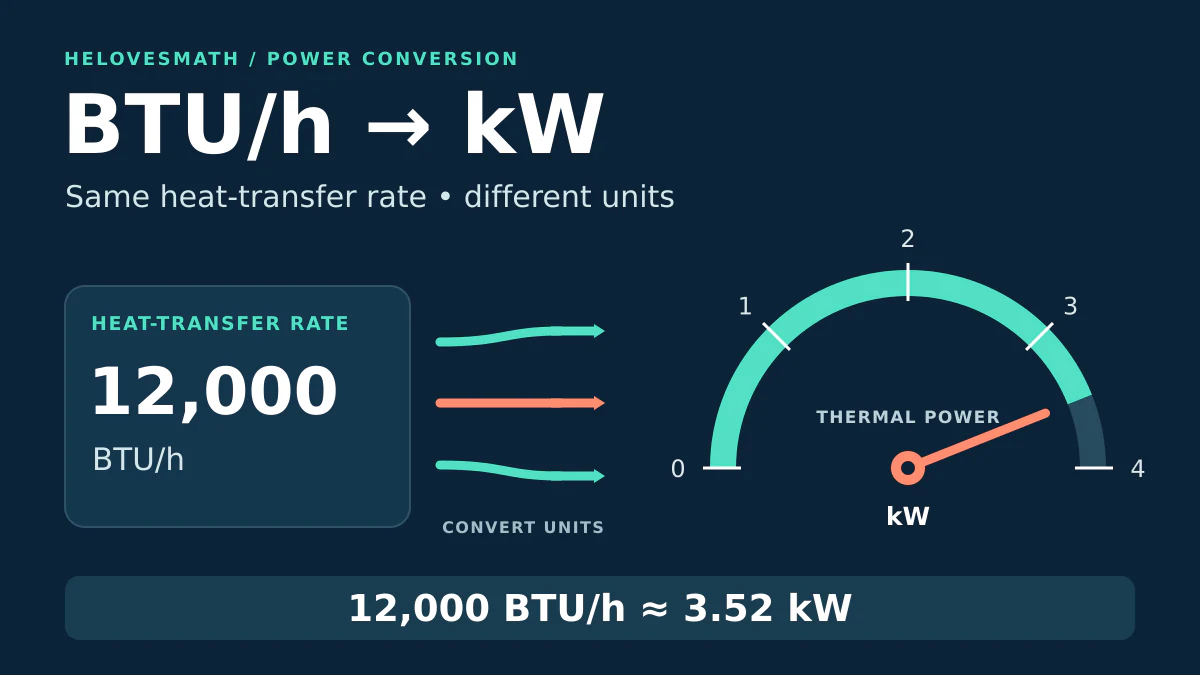
12,000 BTU/hr is approximately 3.52 kW. Multiply BTU/hr by 0.000293071070172222… using the International Table BTU definition. The number describes the same rate of energy transfer in a different unit. For an air conditioner or heat pump, a converted capacity is not automatically its electrical demand.
BTU/hr to kW calculator
Enter the rate, choose a display precision and read kilowatts, watts and the refrigeration-ton equivalent. Results update as you type.
Use a decimal point and no commas or unit text. Scientific notation such as 1.2e4 is accepted. Signed rates are allowed; a minus sign follows your chosen heat-flow direction. Equipment capacities are normally positive.
Equivalent watts: 3,516.85 W
Refrigeration-ton equivalent: 1.00 RT
kW = (BTU/h × 1055.05585262) ÷ 3,600,000
12000 BTU_IT/h = 3.52 kW (rounded). This is the same energy-transfer rate in different units, not an estimate of electrical input.
Calculation uses exact decimal input and the exact International Table definition, then rounds half away from zero. Very small results and results of magnitude at least 10¹⁵ use scientific notation, with the selected decimal places in the mantissa. Accepted nonzero magnitudes: 1e-100 to 1e100; exponent: −100 to 100; maximum 160 characters. Extra digits do not make an equipment rating more precise.
Why dividing by an hour changes the quantity
A BTU measures energy. BTU/hr measures energy transferred each hour, so it is a unit of power. A watt is one joule per second, and one kilowatt is 1000 watts. The conversion must therefore change both the energy unit and the time unit.
Start with the exact International Table definition, 1 BTUIT = 1055.05585262 J. An hour contains 3600 seconds. For a rate of one BTU per hour:
1 BTUIT/h = 1055.05585262 J ÷ 3600 s
≈ 0.293071070172222 W
≈ 0.000293071070172222 kW
The small final multiplier is sensible: one BTU spread over a whole hour is a very small power. Multiplying by 0.293071… produces watts; using that number for kilowatts would make the answer 1000 times too large.

Which BTU definition is being used?
This page and tool use the International Table convention throughout. NIST also lists the thermochemical BTU, about 1054.350 J, giving approximately 0.000292875 kW per BTUth/h. Its result is about 0.067% smaller. If a laboratory, source table or engineering specification names another BTU convention, use that convention rather than silently treating all BTUs as identical.
kW and kWh answer different questions
Kilowatts describe a rate; kilowatt-hours describe an amount of energy. At a constant rate, energy in kWh equals power in kW multiplied by elapsed hours. Thus a thermal rate of 3 kW sustained for 2 hours transfers 6 kWh of thermal energy. This does not say how much electrical energy a heat pump consumed.
If you are given a total of 12,000 BTU with no duration, you can convert it to about 3.51685 kWh of energy. You cannot infer kW until you know how long the transfer takes. Over one hour the average rate would be 3.51685 kW; over two hours it would be half that.
Worked examples: conversion and interpretation
1. A 5,000 BTU/hr heat-transfer rate
5000 × 1055.05585262 ÷ 3,600,000
= 1.465355350861… kW ≈ 1.47 kW
In watts this is about 1465.36 W. Keep the unit attached: 1.47 kW and 1465.36 W refer to the same rate, rounded differently.
2. A 9,000 BTU/hr cooling rating
9000 × 0.000293071070172222…
= 2.63763963155 kW ≈ 2.64 kW
This is cooling capacity. The electrical input is a separate specification. Conversion alone cannot tell you the current, electricity bill or required circuit size.
3. One refrigeration ton: 12,000 BTU/hr
12,000 BTU/hr = 1 RT
= 3.516852842066… kW ≈ 3.52 kW
A refrigeration ton is a rate of heat removal. It is not the equipment's mass. Doubling the rate doubles every equivalent: 24,000 BTU/hr is 2 RT or about 7.03 kW; 60,000 BTU/hr is 5 RT or about 17.58 kW.
4. Reverse a 3 kW rating
3 × 3,600,000 ÷ 1055.05585262
= 10,236.424899… BTU/hr
≈ 10,236.42 BTU/hr
As a quick sense-check, 10,000 BTU/hr is about 2.93 kW, so 3 kW should be slightly more than 10,000 BTU/hr. Reverse the full factor rather than repeatedly converting rounded results.
5. Estimate electrical input using matching COP data
Suppose the same operating condition gives a cooling capacity of 12,000 BTU/hr and a cooling coefficient of performance (COP) of 3.2. COP is useful thermal power divided by electrical input, with both powers expressed in the same units.
Electrical input = 3.516852842… kW ÷ 3.2
≈ 1.09902 kW
If those conditions and that input stayed constant for 4 hours, electrical energy would be about 4.39607 kWh. Actual cycling, weather, auxiliary loads and changing performance can alter consumption. Use capacity and COP from the same mode, conditions and measurement boundary.
6. Use EER without confusing watts and kilowatts
For an illustrative air conditioner rated 12,000 BTU/hr with a matching EER of 12 BTU/(W·h), divide capacity by EER:
Electrical input = 12,000 ÷ 12 = 1000 W = 1 kW
This corresponds to a cooling COP of about 3.51685 at those same conditions. A US-unit EER and a dimensionless COP are different numerical scales. SEER and SEER2 are seasonal ratings; do not substitute them for instantaneous EER in this calculation.
Common conversion table
All rows use BTUIT/h. kW and W are rounded independently to two decimal places. These are numerical reference values, not room-size or equipment recommendations.
| BTU/hr | kW | W | RT |
|---|---|---|---|
| 1,000 | 0.29 | 293.07 | 0.0833 |
| 3,000 | 0.88 | 879.21 | 0.2500 |
| 5,000 | 1.47 | 1,465.36 | 0.4167 |
| 8,000 | 2.34 | 2,344.57 | 0.6667 |
| 9,000 | 2.64 | 2,637.64 | 0.7500 |
| 12,000 | 3.52 | 3,516.85 | 1.0000 |
| 18,000 | 5.28 | 5,275.28 | 1.5000 |
| 24,000 | 7.03 | 7,033.71 | 2.0000 |
| 36,000 | 10.55 | 10,550.56 | 3.0000 |
| 60,000 | 17.58 | 17,584.26 | 5.0000 |
Capacity, input and energy balance
Heating or cooling capacity is useful heat delivered or removed per second. Electrical input is energy taken from the supply per second. Both may be expressed in kW, but their shared unit does not make them the same physical quantity.
A heat pump can deliver more heat than the electricity it consumes because it also collects heat from its surroundings. For example, a simplified steady-state heating balance can be 2 kW taken from outdoors plus 1 kW electrical input, giving 3 kW heating output. The heating COP is 3. Energy is conserved: the 3 kW comes from two inputs.

A furnace label can also distinguish fuel input from useful heat output. Converting either number changes its unit; it does not apply an efficiency correction. Always read what the original rating measures.
Common mistakes and quick checks
- BTU without “per hour”: it is energy, so first establish duration if you need average power.
- 1000-fold errors: about 0.293 W equals about 0.000293 kW for each BTU/hr.
- Rounding tiny rates to zero: 1 BTU/hr is about 2.93 × 10⁻⁴ kW, not zero. The tool switches to scientific notation where needed.
- Negative signs: a signed heat-flow calculation may use a negative rate to mark direction. It does not describe a negative air-conditioner capacity.
- Unmatched conditions: do not divide a heating capacity by a cooling COP, or mix ratings at different temperatures.
- Sizing from one number: this unit converter does not calculate a building's heating or cooling load. Use appropriate load calculations and qualified design advice for actual equipment selection.
For more unit work, explore the length converter and scientific notation examples.
Practice, then check the reasoning
Use the IT convention. Round only your final answer unless a question asks for an exact relationship.
Convert 6,000 BTU/hr to kW.
6000 × 1055.05585262 ÷ 3,600,000 = 1.758426421… kW, so 1.76 kW.
Convert 18,000 BTU/hr to watts and refrigeration tons.
18,000 × 0.293071070172222… = 5275.2792631 W ≈ 5275.28 W. Divide 18,000 by 12,000 to get exactly 1.5 RT.
Convert 2.5 kW to BTU/hr.
2.5 × 3,600,000 ÷ 1055.05585262 = 8530.3540828… BTU/hr ≈ 8530.35 BTU/hr.
How much thermal energy is transferred at 24,000 BTU/hr for 3 hours?
The rate is 7.033705684… kW. Multiply by 3 h: about 21.10 kWh of thermal energy. Electrical energy is not established by these data.
A heat pump delivers 6 kW of heat with a heating COP of 4. What is the electrical input at those conditions?
6 ÷ 4 = 1.5 kW electrical input. In a simplified steady-state balance, 4.5 kW is collected from the surroundings.
A cooling unit provides 18,000 BTU/hr at EER 10 BTU/(W·h). Find its input.
18,000 ÷ 10 = 1800 W = 1.8 kW. The EER and cooling capacity must describe the same operating conditions.
Does 1 BTU/hr equal 0.00 kW?
No. It is approximately 0.000293071 kW. A two-decimal fixed display hides the nonzero value; 2.93e-4 kW makes its scale visible.
A result is −3.52 kW. Can you infer a negative cooling capacity?
No. A signed heat-flow result depends on the chosen positive direction. It does not mean a piece of equipment has a negative capacity.
BTU/hr to kW FAQs
What is the formula for BTU/hr to kW?
For International Table BTUs, multiply BTU/hr by 1055.05585262 and divide by 3,600,000. The approximate multiplier is 0.000293071070172222.
How many kW is 1 BTU/hr?
One BTU_IT/hr is approximately 0.000293071070172222 kW, or about 0.293071 W.
How many kW is 12000 BTU/hr?
12,000 BTU_IT/hr is approximately 3.516852842 kW. Rounded to two decimal places, it is 3.52 kW. It is also one refrigeration ton.
How many BTU/hr is 1 kW?
One kW is approximately 3412.141633 BTU_IT/hr, usually rounded to 3412.14 BTU/hr.
Is BTU/hr the same as kW?
They measure the same kind of quantity, power, in different units. The conversion changes the numerical value and unit, not the energy-transfer rate.
Does BTU/hr converted to kW show electricity use?
Only if the original rating actually measures the relevant electrical input rate. For a heating or cooling capacity, the converted value is thermal power. Estimating electrical input needs matching efficiency data.
Sources & References
Definitions and efficiency terminology were checked on October 4, 2026. The examples, practice and illustrations on this page are original worked applications of these definitions.
- NIST SP 811, footnote 9: exact International Table BTU definition and thermochemical distinction.
- NIST SP 811, Appendix B.9: heat-flow units, watt, kilowatt-hour and refrigeration ton.
- ENERGY STAR, HVAC glossary: COP, EER and seasonal efficiency definitions. Used here for terminology, not a recommendation or claim that a product qualifies.
- U.S. Department of Energy, heating and cooling efficiency terminology: heating/cooling COP and consistent measurement units.
- Original site index: He Loves Math calculator collection.
- Original general reference destinations: National Institute of Standards and Technology and U.S. Department of Energy.