
CHEMISTRY • IDEAL AQUEOUS MODELS AT 25°C
Find pH. Check the chemistry.
Convert pH, pOH and ion concentrations, or estimate an acid, base, buffer or dilution. Strong and weak acid/base modes include water autoionization, so a very dilute acid stays on the acidic side of neutral.
Calculate pH
Choose a mode. Enter concentrations in mol/L (M); scientific notation such as 1e-8 is accepted. Press Enter in a field to calculate.
Use equilibrium ion concentration, not the amount of acid added. Direct conversion assumes ideal concentration behavior at 25°C.
For complete dissociation only. Use factor 1 for HCl or NaOH, factor 2 for dissolved Ba(OH)₂ in its ideal model. Do not automatically use 2 for H₂SO₄: its second dissociation needs a separate equilibrium treatment.
For a neutral monoprotic acid HA or neutral one-proton-accepting base B initially in water. Enter the relevant Ka or Kb. Added salts, buffers and polyprotic systems need a different model.
Henderson–Hasselbalch estimate. The ratio uses equilibrium acid/conjugate-base species in the same solution. Formal concentrations are approximations only when equilibrium changes are small. This does not check buffer capacity.
Strong monoprotic acid or one-hydroxide base (factor 1). Use the same volume unit for both fields. Final total volume must be at least the initial volume; this is a dilution model, not a mixing or titration model.
Input limits and interpretation
Concentrations: 1e-16 to 100 mol/L; concentration × ion factor must not exceed 100 mol/L. Ka/Kb: 1e-16 to 1. pH, pOH and pKa: −2 to 16. Volumes: 1e-12 to 1e12 in the same unit; final dilution concentration must be at least 1e-16 mol/L.
These are computational limits, not a chemically valid range for every substance. A high-concentration result is an ideal-model calculation, not a prediction of measured pH. Decimal places control display only.
What does a pH calculator actually calculate?
A pH calculation has two jobs: find the hydrogen-ion level from the chemistry, then express it on a logarithmic scale. This calculator separates those jobs into direct conversion, strong acid/base, weak acid/base, buffer, and dilution modes. Choosing the right model matters more than displaying extra decimal places.
Strictly, pH = −log10a(H+), where activity is dimensionless and accounts for nonideal behavior. In dilute ideal-solution calculations, activity is approximated by [H+]/c°, with c° = 1 mol/L. Thus pH has no unit; ion concentrations do. H+ is conventional shorthand for the hydrated proton, often written H3O+ in introductory chemistry.
Model boundary: all modes use water at 25 °C, Kw = 1.0 × 10⁻¹⁴, and ideal concentration-based relationships. Strong and weak modes include water autoionization. That correction does not make concentrated solutions ideal.
Choose the mode from the information given
- pH / pOH / Ion: convert an already-known pH, pOH, [H+], or [OH−]. An ion concentration is an equilibrium concentration, not the amount of acid originally present.
- Strong Acid / Base: enter formal concentration C and a justified complete-dissociation ion factor n.
- Weak Acid / Base: enter C and Ka for an acid, or Kb for a base. Do not enter pKa in the K field.
- Buffer pH: enter pKa and matching conjugate-base/acid quantities in the same concentration units.
- Dilution: enter a factor-1 strong acid/base concentration, initial volume, and final total volume. Both volumes must use the same unit.
Enter concentrations in mol/L, also called M. For example, 0.000018 = 1.8 × 10−5 = 1.8e-5 in E notation. Review scientific notation examples if negative exponents are unfamiliar.
The conversion formulas
Let h and o be the numerical values of [H+] and [OH−] in mol/L. Later equations also use numerical molar concentrations. Within this calculator's ideal model:
pH = −log10 h and h = 10−pH
pOH = −log10 o and o = 10−pOH
ho = Kw = 10−14 and pH + pOH = 14
Use the base-10 log key, not ln. Concentrations must be positive because log(0) is undefined. A negative pH is a different matter: it is mathematically possible when hydrogen-ion activity exceeds one.
Read the scale as powers of ten
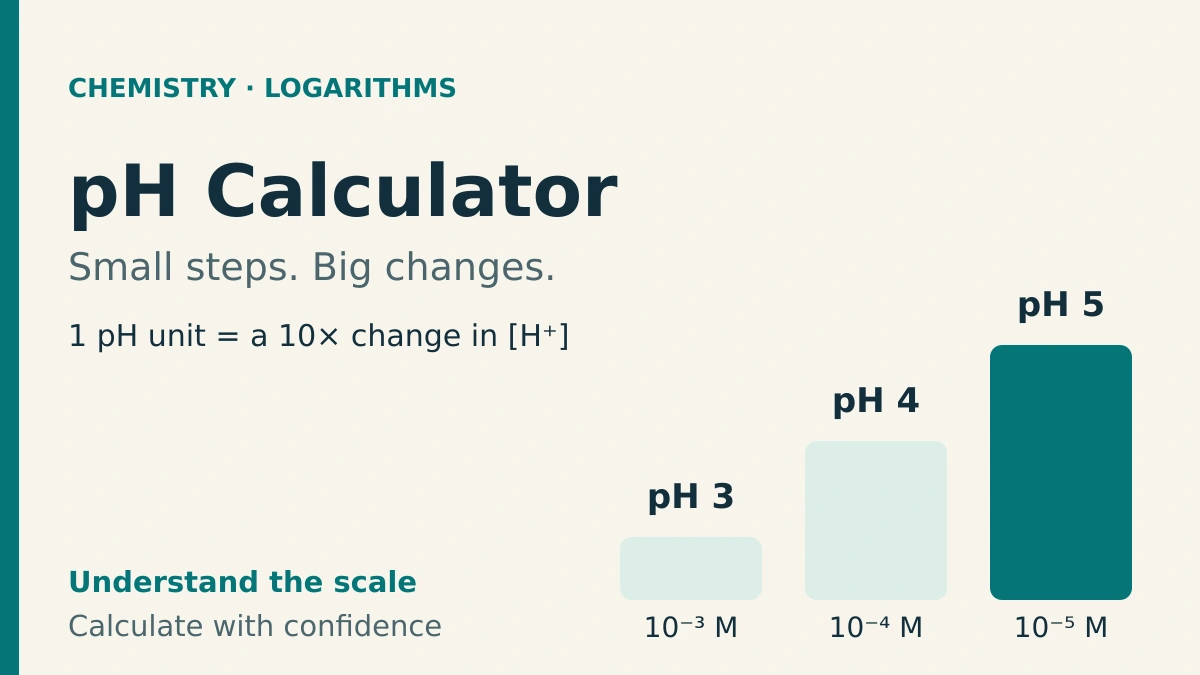
Moving from pH 5 to pH 3 multiplies hydrogen-ion activity by 105−3 = 100. Under the ideal approximation, the concentration changes by the same factor. A drop of 0.30 pH units corresponds to approximately twice the hydrogen-ion level, not a 30% change.
At 25 °C in this model, acidic means h > o and pH < 7; basic means h < o and pH > 7. Neutrality means equal hydrogen- and hydroxide-ion concentrations. Because Kw changes with temperature, neutral pH is pKw/2 rather than always 7. The familiar 0–14 diagram is a useful display range, not an absolute chemical boundary.
![For an ideal dilute solution at 25 degrees Celsius, pH 3 means [H+] = 10^-3 M, pH 4 means 10^-4 M and pH 5 means 10^-5 M. Each one-unit increase in pH divides [H+] by 10; a two-unit increase divides it by 100. Dot counts represent relative concentration 100:10:1.](https://helovesmath.com/wp-content/uploads/2025/06/ph-logarithmic-ladder-mobile.webp)
Strong acids and bases: include the water
Strong describes the extent of ionization; concentrated describes the amount per volume. A very dilute strong acid can have a higher pH than a more concentrated weak acid.
Set D = nC, the acid or hydroxide equivalents supplied per liter. Charge balance and water equilibrium give x − Kw/x = D, so:
x = [D + √(D² + 4Kw)]/2
For an acid, x is h. For a base, x is o; calculate pOH first, then subtract from 14. When D is much larger than 10−7, x ≈ D. Near that scale, neglecting water gives misleading answers.
The ion factor counts ions released per dissolved formula unit under complete dissociation. It does not establish solubility or justify counting every hydrogen atom. Do not automatically use n = 2 for H2SO4: its second ionization has a finite equilibrium constant and may require a separate equilibrium calculation.
![An ideal 10^-8 M fully dissociated monoprotic strong acid at 25 degrees Celsius is slightly acidic. Charge balance [H+] = C + [OH-] and [H+][OH-] = 10^-14 M^2 give [H+] approximately 1.051249 × 10^-7 M, [OH-] approximately 9.51249 × 10^-8 M, and pH approximately 6.9783. The equal-length concentration bars represent [H+] and C plus [OH-]. Water re-equilibrates, so do not add a fixed 10^-7 M to C.](https://helovesmath.com/wp-content/uploads/2025/06/ph-dilute-acid-water-mobile.webp)
Weak acids and bases: equilibrium before logarithms
This mode models one neutral monoprotic acid HA, or one neutral base B that accepts one proton, in water without an added conjugate partner. It is not a general solver for salts, polyprotic systems, or mixtures.
For HA, mass balance gives C = [HA] + [A−]; charge balance gives [H+] = [A−] + [OH−]. Combining these with the equilibrium constant produces the numerical equation:
x = Kw/x + KC/(K + x)
Use x = h and K = Ka for the acid. For B + H2O ⇌ BH+ + OH−, use x = o and K = Kb. The calculator solves this balance including water.
The familiar x ≈ √(KC) shortcut makes two assumptions: ionization changes C only slightly, and water contributes negligibly. Checking x/C < 5% tests the first assumption only. If water is negligible but depletion is not, solve x²/(C − x) = K instead. “Weak” alone never guarantees that the square-root shortcut works.
Buffer pH: what belongs in the ratio?
pH ≈ pKa + log10([A−]/[HA])
The thermodynamic Henderson–Hasselbalch relationship uses activities. In the ideal concentration model, rearranging Ka gives the ratio of the equilibrium species. Replacing those species concentrations with formal prepared quantities adds an approximation: equilibration must change each quantity only slightly.
Use a matched conjugate pair, appreciable amounts of both partners, and conditions where water and nonideality are minor. A ratio near 0.1–10 is a useful buffer-design guideline, not proof that every solution in that range satisfies these assumptions. Extreme dilution can invalidate the estimate.
Equal species concentrations give pH ≈ pKa; more conjugate base raises pH. Diluting both partners equally preserves their formal ratio, so the approximation predicts little pH change, while their capacity to absorb added acid or base per unit volume decreases. This tab does not calculate neutralization reactions or buffer capacity.
Dilution: conserve solute, then recalculate pH
C2 = C1V1/V2, with V2 ≥ V1
V2 is the final solution volume, not the volume of water added. This mode takes C2 into the factor-1 strong acid/base model, including water. Tenfold dilution changes pH by approximately one unit only when the strong solute dominates water: upward for an acid, downward for a base.
Dilution toward pure water approaches neutrality without crossing it. Mixing acid and base is a different problem requiring reaction stoichiometry before equilibrium. The chemical reaction calculator can support equation practice, but its product prediction is not a mixture-pH calculation.
Worked examples with reasonableness checks
1. A concentration that is not a power of ten
Given [H+] = 4.0 × 10⁻⁴ M, pH = −log10(4.0 × 10⁻⁴) = 4 − log104 = 3.3979. Then pOH = 10.6021 and [OH−] = 2.5 × 10⁻¹¹ M. Check: their product is 10−14.
2. Why 10−8 M HCl does not have pH 8
Here D = 10−8. The strong-acid equation gives h = (10−8 + √(10−16 + 4 × 10⁻¹⁴))/2 = 1.0512492 × 10⁻⁷. Thus pH = 6.9783, slightly acidic. Adding a fixed 10−7 to D is also wrong: water's equilibrium contribution adjusts.
3. A weak acid and a shortcut that works
For C = 0.100 M and Ka = 1.8 × 10⁻⁵, the water-inclusive solution gives h = 0.001332671 and pH = 2.8753. Ionization is about 1.33%. The shortcut gives √(KC) = 0.001341641, close because depletion and water are both small.
4. A weak base and a shortcut that fails
For C = 1.0 × 10⁻⁵ M and Kb = 1.8 × 10⁻⁵, the full result is o = 7.156582 × 10⁻⁶, pOH = 5.1453, and pH = 8.8547. The shortcut predicts 1.34 × 10⁻⁵, exceeding C even though water is minor. About 71.6% ionization makes depletion impossible to ignore.
5. A buffer and a dilution
For pKa = 4.76 and [A−]/[HA] = 2, pH ≈ 4.76 + 0.30103 = 5.0610. Separately, a factor-1 strong acid at 0.100 M with V1 = 10 mL and V2 = 100 mL has C2 = 0.0100 M and pH ≈ 2.0000. These are different models, despite both involving concentration ratios.
Accuracy, rounding, and limits
- Numerical precision is not measurement accuracy. Extra digits help compare models; they do not improve uncertain inputs. Round at the end.
- Displayed 7.00 can hide slight acidity or basicity. Classification uses the underlying model rather than the rounded display.
- Concentrated solutions need activities. Permitted input ranges are computational limits, not assurances of solubility or chemical validity.
- Other systems need other equations. Temperature changes, nonaqueous solvents, multiple equilibria, added salts, and absorbed gases are outside this model.
This is an educational tool, not a measurement, laboratory procedure, or basis for chemical handling, treatment, or dosing decisions.
Practice: choose the chemistry before calculating
Assume ideal aqueous conditions at 25 °C. Try each question before opening its explanation.
1. [H⁺] = 2.5 × 10⁻⁶ M. What are pH and pOH?
pH = 6 − log102.5 = 5.6021; pOH = 8.3979. Use the direct concentration mode.
2. pH falls from 6.2 to 4.7. By what factor does h rise?
The difference is 1.5, so the factor is 101.5 = 31.62. Subtract the pH values before exponentiating.
3. A fully dissolved strong base has C = 0.0020 M and n = 2. Estimate pH.
o ≈ nC = 0.0040; pOH = 2.3979 and pH ≈ 11.6021. Water is negligible here; the factor applies to dissolved formula units.
4. Does diluting an acid make it basic once its formal concentration falls below 10⁻⁷ M?
No. Water autoionization becomes important. The positive-root strong-acid expression remains above h = 10−7 for positive D, approaching neutrality from the acidic side.
5. A weak-acid shortcut predicts x/C = 0.18. Is the small-depletion assumption justified?
No. Eighteen percent ionization is not a small change to C. Use the full balance; a small K alone does not validate the shortcut.
6. For pKₐ = 6.10 and an equilibrium base/acid ratio of 0.25, estimate pH.
6.10 + log100.25 = 5.4979. The negative log term makes sense because acid exceeds conjugate base.
7. A 0.030 M factor-1 strong acid goes from 20 mL to 150 mL. Find the final pH.
C2 = 0.030 × 20/150 = 0.0040 M, so pH ≈ 2.3979. Divide by the final total volume.
8. In the ideal model, another temperature has pKw = 13.60. Is neutral pH 7?
No: neutral pH = 6.80. Equal h and o split pKw equally. This calculator itself remains fixed at 25 °C.
Frequently asked questions
Why does a weak base require Kb rather than Ka?
Its modeled reaction generates OH−. If only the conjugate acid's Ka is given, use Kb = Kw/Ka at the same temperature.
Can I average two pH values to find the pH of a mixture?
No. pH is logarithmic, and mixing may involve neutralization and new equilibria. Determine amounts and reactions first; none of these modes is a general mixture solver.
Can this calculate a household liquid's pH from its name?
No. Composition, concentrations, and the appropriate equilibrium model are required. A familiar product name does not supply those data.
Sources & References
Definitions and model assumptions were checked against the sources below. Explanations, numerical checks, and practice questions were written for this guide.
- IUPAC Gold Book: pH — activity-based definition and measurement conventions.
- OpenStax Chemistry 2e, 14.2: pH and pOH — logarithmic relationships and classification.
- OpenStax Chemistry 2e, 14.3: Relative Strengths of Acids and Bases — dissociation and conjugate-pair constants.
- OpenStax Chemistry 2e, 14.5: Polyprotic Acids — stepwise sulfuric-acid ionization.
- OpenStax Chemistry 2e, 14.6: Buffers — buffer ratios and approximation limits.
- University of Texas at Austin: Autoionization of Water — temperature dependence and coupled ion concentrations.
- Purdue University: Weak Acids and Equilibrium — separate depletion and water approximations.
- Michael Stapleton, Slippery Rock University: Introduction to Weak Acid Equilibrium — mass and charge balances; hosted by Carleton College SERC.
- OpenStax Chemistry 2e, 3.3: Molarity — concentration and dilution relationships.