EDUCATIONAL GUIDE · LEVEL 1 AND LEVEL 2 · CHECKED 6 OCTOBER 2026
Find the right Number and Measure paper, strengthen the method behind each answer, and practise with units that make sense. This guide supports the Pearson Edexcel Awards ANM10 and ANM20, with original worked examples and an archive of papers, mark schemes and reports.
Choose your level before downloading: a Level 1 paper and a Level 2 paper are not interchangeable. Pearson currently lists both awards as extended until 2029. The guidance here was checked on 6 October 2026; your centre should confirm your entry and examination arrangements.
Which Number and Measure paper do you need?
The awards develop number and measurement skills. They are separate qualifications, assessed as pass or unclassified; they are not complete GCSE Mathematics qualifications. Check the paper reference on the front cover as well as the year.
| Award | Calculator section | Non-calculator section | Total |
|---|---|---|---|
| Level 1 · ANM10 | 1A: 60 minutes, 50 marks | 1B: 30 minutes, 30 marks | 90 minutes, 80 marks |
| Level 2 · ANM20 | 2A: 60 minutes, 50 marks | 2B: 30 minutes, 30 marks | 90 minutes, 80 marks |
The current specification labels these as Section A and Section B, taken in the same examination session. Older archive entries sometimes combine both sections into one file, while newer entries list them separately. A combined mark scheme must match the same level and examination series as the question paper. Follow the instructions printed on the paper and those given by your centre.
Next listed January series: Pearson’s final January 2027 timetable places the Number and Measure sections on the morning of 12 January 2027. This is a dated timetable check, not an entry confirmation or a promise about later series. The official timetable is in Sources & References.
Build a revision plan around the method
Level 1 foundations: place value and ordering, whole-number and decimal calculations, simple fraction–decimal–percentage connections, money, metric measures, time, perimeter, area, volume, and reading tables and charts. Practise estimating a sensible answer before completing the exact calculation.
Level 2 development: more demanding number work, fractions and percentages, ratio and proportion, and multi-step measurement problems. The examples below are a focused selection, not the entire specification. Use the official topic list to check what still needs practice.
- Diagnose: try the short practice set without looking at its answers. Record whether a mistake came from the method, calculation or units.
- Rebuild: work through one example for the weakest method, then change its numbers and try again.
- Practise both sections: use a calculator only where the selected paper permits one. Include written non-calculator methods every week.
- Check: mark one paper, read the relevant examiner feedback and repeat missed skills after a short gap. A remembered answer is less useful than a method you can explain.
For extra method practice, try the adding fractions guide and calculator. For metric work, use the length converter to check a conversion after doing it by hand.
Six worked examples, one clear step at a time
These original examples show the method, a sensible check and a mistake to avoid. Examples 1–3 build Level 1 skills; examples 4–6 apply Level 2 skills. Level 2 learners should be comfortable with the earlier skills too.
Worked example 1 · Level 1
Connect a fraction, a decimal and a percentage
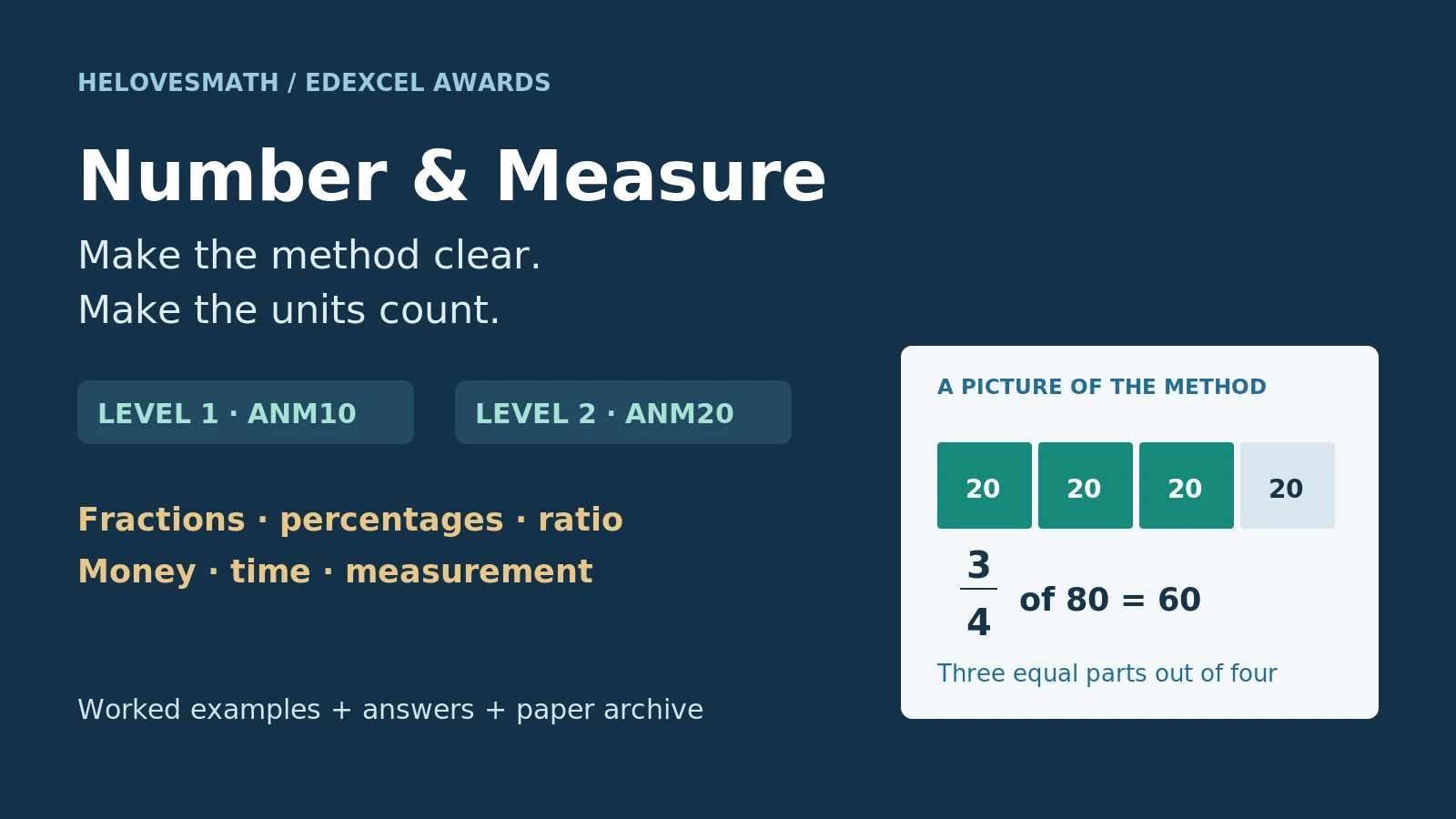
A club has 80 badges. of them are blue. Write this fraction as a decimal and a percentage, then work out how many badges are blue.

- Divide the numerator by the denominator.
- Read the decimal as hundredths. Seventy-five hundredths is 75 out of 100, so it is 75%.
- Find one quarter of the whole, then take three quarters.
Answer: The fraction is 0.75 or 75%, and 60 badges are blue.
Check it: The unshaded quarter contains 20 badges. Adding it back gives 80 badges altogether.
Avoid this mistake: The denominator tells you to split the whole into four equal groups. Dividing 80 by 3 does not find one quarter.
Worked example 2 · Level 1
Calculate a bill and change
Three notebooks cost £2.85 each. A pen costs £1.40. You pay with a £20 note. How much change should you receive?
- Find the cost of all three notebooks.
- Add the pen to find the total bill.
- Subtract the bill from the amount paid.
Answer: £10.05 change
Check it: £9.95 plus £10.05 is £20.00. A bill just below £10 should leave change just above £10.
Avoid this mistake: £10.05 means ten pounds and five pence. £10.50 would mean ten pounds and fifty pence. Keep two decimal places when writing a money answer.
Worked example 3 · Level 1
Convert units before subtracting
A ribbon is 2.4 m long. You cut off 75 cm. How much ribbon remains? Give your answer in centimetres and metres.
- Choose one unit for the calculation. There are 100 centimetres in 1 metre, so convert the full length to centimetres.
The full ribbon is 240 cm long.
- Subtract the length cut off.
- Convert the remaining length back to metres.
Answer: 165 cm, which is 1.65 m
Check it: The cut piece is 0.75 m. Adding 0.75 m to 1.65 m gives the original 2.4 m.
Avoid this mistake: Do not subtract 75 directly from 2.4: those measurements are in different units. Convert first, then calculate.
Worked example 4 · Level 2
Share a quantity in a ratio, then scale it
A drink is mixed using concentrate and water in the ratio . How much of each is needed for 750 ml of drink? How much concentrate is needed for 1.5 litres of the same mixture?
- Count all the equal parts.
The concentrate takes 2 parts and the water takes 3 parts.
- Find the size of one part.
Each part is 150 ml.
- Multiply by each share.
Use 300 ml of concentrate and 450 ml of water.
- Scale both ingredients by the same factor. 1.5 litres is 1500 ml, which is twice 750 ml. The concentrate must also double.
Answer: For 750 ml, use 300 ml concentrate and 450 ml water. For 1.5 litres, use 600 ml concentrate.
Check it: 300 ml plus 450 ml is 750 ml. Dividing both shares by 150 gives the original ratio of 2 to 3.
Avoid this mistake: The total is split into five parts, not three. The second number in a ratio represents the water share, not the whole drink.
Worked example 5 · Level 2
Keep perimeter, area and volume separate
A solid display model is a right prism, 2 cm deep. Its cross-section is an 8 cm by 4 cm rectangle joined to a right-angled triangle with base 3 cm and perpendicular height 4 cm. The sloping edge is given as 5 cm. Find the cross-section’s area, its outer perimeter and the model’s volume.

- Find the area of the rectangular part.
- Find the area of the triangular part. A triangle has half the area of a rectangle with the same base and perpendicular height.
- Add the two areas.
The cross-sectional area is 38 cm2.
- Add only the outside edges for perimeter. The bottom edge is 8 cm plus 3 cm, giving 11 cm.
- Multiply cross-sectional area by prism depth.
Answer: Cross-section area: 38 cm2; outer perimeter: 28 cm; volume: 76 cm3
Check it: The surrounding 11 cm by 4 cm rectangle has area 44 cm2. Removing the spare triangle of area 6 cm2 leaves 38 cm2. Doubling that area for the 2 cm depth gives 76 cm3.
Avoid this mistake: The dashed join is inside the shape, so it is not part of its perimeter. Use the perpendicular height of 4 cm for triangle area, not the sloping edge of 5 cm. Length, area and volume need different units.
Worked example 6 · Level 2
Use time conversion in a constant-rate journey
A cyclist covers 18 km in 45 minutes at a constant speed. Work out the speed in kilometres per hour. At that same speed, how far would the cyclist travel in 1 hour 30 minutes? Use the relationship below.
This is an application of time conversion and Level 2 direct proportion. The speed relationship is supplied; speed is not listed as a separate topic in the specification.
- Match the time unit to the question. Kilometres per hour requires time in hours.
The first journey takes 0.75 hours.
- Divide distance by time.
The speed is 24 kilometres per hour.
- Convert the second time. 30 minutes is half an hour, so 1 hour 30 minutes is 1.5 hours.
- Scale the distance with the time.
Answer: 24 kilometres per hour and 36 km in 1 hour 30 minutes
Check it: 90 minutes is twice 45 minutes, so the distance must be twice 18 km. This independently gives 36 km.
Avoid this mistake: 45 minutes is 0.75 hours, not 0.45 hours: there are 60 minutes in an hour. Do not mix minutes with a speed stated per hour.
Try it yourself: ten questions with explained answers
Write down your method and include units. Attempt each question before opening its answer. Questions 1–5 practise Level 1 skills; questions 6–10 apply Level 2 skills. Question 10 supplies a speed relationship as a context for direct proportion.
These are original practice questions, not Pearson examination questions or a complete mock paper. They sample selected skills; use the full topic checklist to plan the rest of your revision.
Question 1 · Level 1
Equivalent forms
Write as a decimal and a percentage. Then find of 90.
Show answer and method for question 1
Answer: 0.4, 40% and 36
Make the denominator 10 by multiplying both parts of the fraction by 2.
0.4 is 40 hundredths, or 40%. To find two fifths of 90, find one fifth first, then double it.
Check: 40% is less than half, and 36 is less than half of 90.
Question 2 · Level 1
Money and change
Four drinks cost £1.75 each. A snack costs £2.60. How much change is due from £10?
Show answer and method for question 2
Answer: £0.40, or 40p
Multiply before adding the separate snack.
Check: £9.60 plus £0.40 gives £10.00. Writing £0.04 would mean only 4p.
Question 3 · Level 1
Capacity conversion
A jug contains 2.5 litres of juice. You pour out 650 ml. How much remains? Give your answer in millilitres and litres.
Show answer and method for question 3
Answer: 1850 ml, or 1.85 litres
There are 1000 millilitres in 1 litre. Convert first so both quantities use the same unit.
Check: 1.85 litres plus 0.65 litres is 2.5 litres.
Question 4 · Level 1
Elapsed time
A train leaves at 17:48 and arrives at 19:12 on the same day. How long is the journey?
Show answer and method for question 4
Answer: 1 hour 24 minutes, or 84 minutes
Count forward in manageable jumps: 17:48 to 18:00 is 12 minutes; 18:00 to 19:00 is 60 minutes; 19:00 to 19:12 is another 12 minutes.
84 minutes is 60 minutes plus 24 minutes.
Check: Adding 1 hour 24 minutes to 17:48 reaches 19:12. Treat clock times in hours and minutes, not as decimal numbers.
Question 5 · Level 1
A rectangle and a cuboid
A cuboid has length 8 cm, width 5 cm and height 3 cm. Find the perimeter and area of its rectangular base, then its volume.
Show answer and method for question 5
Answer: 26 cm, 40 cm2 and 120 cm3
The base has two sides of each length.
Area counts square units; volume counts cubic units.
Check: Three layers, each with base area 40 square centimetres and height 1 cm, give 120 cubic centimetres.
Question 6 · Level 2
Different fraction denominators
Work out . Give your answer as a mixed number in its simplest form.
Show answer and method for question 6
Answer:
Use a common denominator of 12. Multiply numerator and denominator by the same number for each equivalent fraction.
Check: Both original fractions are greater than one half, so their sum must be greater than 1. Do not add the denominators.
Question 7 · Level 2
Divide in a ratio
Two teams share 640 counters in the ratio . How many counters does each team receive?
Show answer and method for question 7
Answer: 240 counters and 400 counters, in that order
The ratio contains eight equal parts altogether.
Multiply one part by each team’s share.
Check: The shares add to 640. Dividing each share by 80 gives 3 and 5.
Question 8 · Level 2
Percentage increase
A school bag costs £64. Its price increases by 15%. What is the new price?
Show answer and method for question 8
Answer: £73.60
First calculate 15% of the original price.
An increase means adding this amount to the original price.
Check: 10% is £6.40 and 5% is £3.20; together they make £9.60. £9.60 is the increase, not the final price.
Question 9 · Level 2
Volume of a triangular prism
A right prism has a triangular cross-section with base 10 cm and perpendicular height 6 cm. The prism is 8 cm long. Find its volume.
Show answer and method for question 9
Answer: 240 cm3
Find the area of the triangular cross-section first.
Then multiply that area by the prism’s length.
Check: Its volume is half the volume of a cuboid measuring 10 cm by 6 cm by 8 cm. Half of 480 cubic centimetres is 240 cubic centimetres.
Question 10 · Level 2
A constant-rate journey
A cyclist travels 27 km in 45 minutes at a constant speed. Find the speed in kilometres per hour, then the distance covered in 1 hour 20 minutes at the same speed. Use the relationship below.
Show answer and method for question 10
Answer: 36 kilometres per hour and 48 km
Convert 45 minutes to 0.75 hours before finding the speed.
For the second part, use direct proportion in minutes. Each 5 minutes covers 3 km because 45 minutes contains nine groups of 5. There are sixteen groups of 5 minutes in 80 minutes.
Check: At 36 km per hour, 60 minutes covers 36 km and the extra 20 minutes covers one third of that, or 12 km. Total: 48 km.
Common mistakes that lose an otherwise good answer
- Using unlike units: put lengths into one unit before finding a perimeter or an area. The unit in the final answer depends on the quantity: length, area or volume.
- Adding denominators: a denominator names the size of the fractional parts. Rewrite fractions with a common denominator before adding them.
- Confusing a discount with the price: find the amount removed, then subtract it from the original price. State which amount your answer represents.
- Treating the time display as a decimal: minutes are parts of an hour measured in sixtieths. Convert the interval before using a rate per hour.
- Reading a ratio as the total: add the parts first when sharing a whole amount. Check that the separate shares add back to the original total.
- Rounding halfway through: keep useful precision during the calculation and round the final value as requested. Money answers need a sensible currency format.
Use a labelled sketch for measurement questions and show enough working for another person to follow your decisions. When an answer seems implausible, check the unit conversion before redoing every arithmetic step.
How to use the archive well
Start with a paper for your award and section. Try it under its printed time limit, then use the matching mark scheme to locate the first step that went wrong. Examiner reports can explain common errors, but their comments relate to that particular series.
Paper files belong to their publishers. Some historical resources are unavailable or have restricted access; a retained link is not a claim that a file is currently open. The checks and any individual cautions below make that distinction explicit.