
Work through every question in the English-language August 2026 Algebra II Regents. Each solution explains the method, gives the final answer, and highlights details that matter for a complete written response.
Try the question first, then compare your reasoning with the steps below. Select a question image or diagram to open a larger view. The question numbers and paper-page references follow the official exam. The original paper and NYSED scoring documents are linked in Sources & References.
For Parts II–IV, show your method. A final number on its own can lose substantial credit, and a question that specifies algebraic solution or a graph requires that method.
These are independent HeLovesMath explanations, not an official NYSED publication. Answers and required methods were checked against the official scoring key and rating guide. Valid alternative methods can also earn credit unless a question specifies a method.
Quick check: Part I answer choices
- Q1: (3)
- Q2: (2)
- Q3: (3)
- Q4: (3)
- Q5: (4)
- Q6: (3)
- Q7: (3)
- Q8: (1)
- Q9: (1)
- Q10: (4)
- Q11: (3)
- Q12: (4)
- Q13: (1)
- Q14: (1)
- Q15: (2)
- Q16: (2)
- Q17: (3)
- Q18: (4)
- Q19: (1)
- Q20: (1)
- Q21: (4)
- Q22: (1)
- Q23: (2)
- Q24: (2)
Use the worked explanations below to check why each answer is correct.
Part I: Multiple-choice solutions
Questions 1–24 • 2 credits each • 48 credits total
Question 1: Simplify an imaginary radical
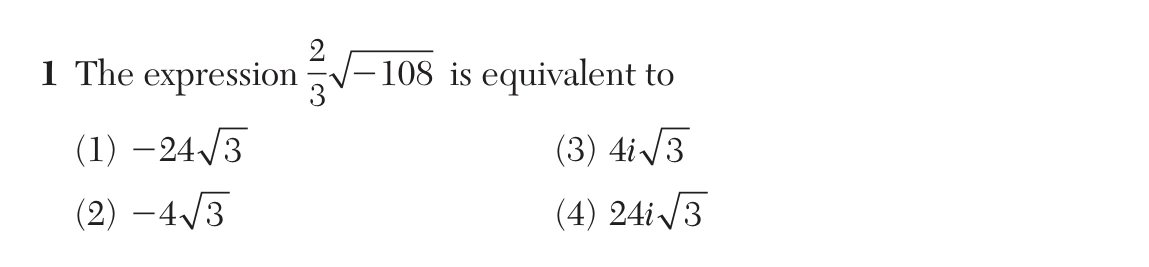
- The expression is . Separate the negative factor using .
- Factor out the largest perfect square: .
- Multiply the coefficient: .
Exam detail: The square root of a negative number introduces i; it does not produce a negative real square root.
Question 2: Find the square-root graph’s intercept
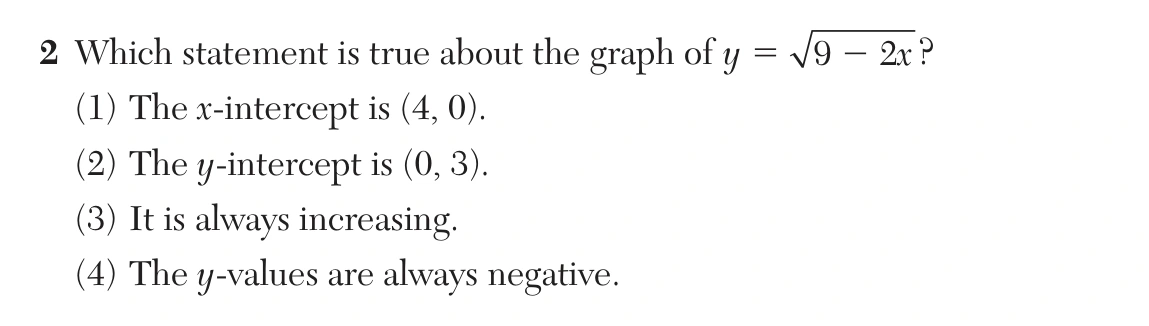
- A y-intercept occurs when . Substitute into .
- Evaluate: . Therefore the y-intercept is .
- For comparison, setting gives , so the x-intercept is . The square root is nonnegative, and its value decreases as x increases on its domain.
Exam detail: An intercept must be checked by setting the other coordinate equal to zero. Do not read 9 − 2x as 9 − 2 raised to x.
Question 3: Build an exponential model from two points

- Write the general exponential model as .
- Use : , so the initial value is .
- Use : , so .
- Substitute both values to obtain .
Exam detail: The value at x = 0 determines the initial coefficient. The ratio of consecutive outputs determines the base.
Question 4: Use the addition rule for probability
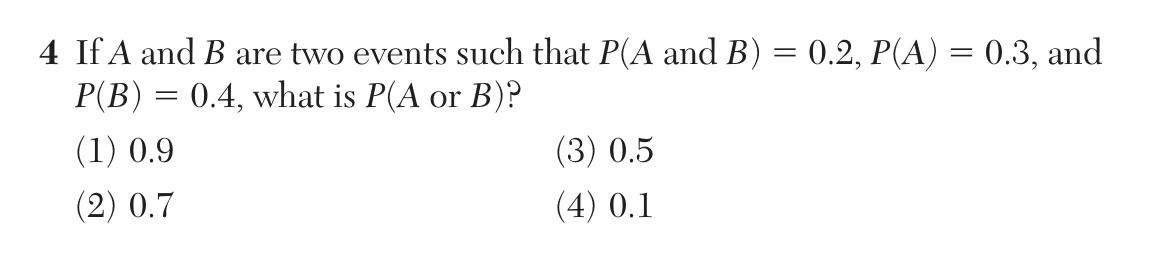
- For overlapping events, .
- Substitute the given probabilities: .
- Compute . The subtraction removes the overlap counted twice in the first sum.
Exam detail: Do not simply add 0.3 and 0.4: the overlap is already included in both probabilities.
Question 5: Test a strict function inequality
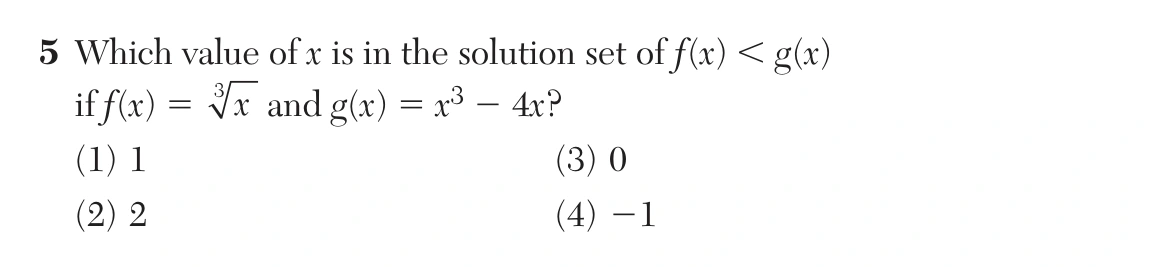
- The functions are and . We need .
- For , and .
- The inequality is true, so belongs to the solution set.
- The other choices fail: at , the outputs are equal; at , is false; at , is false.
Exam detail: A strict inequality excludes equality. Also, the real cube root of −1 is −1.
Question 6: Generate terms of a recursive sequence
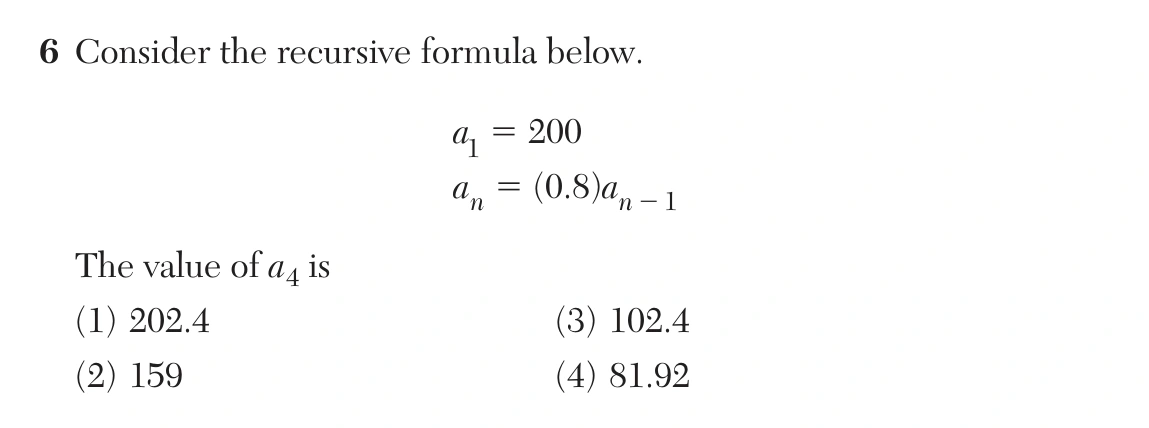
- Start with the given first term . Each next term is 0.8 times the preceding term.
- Compute .
- Compute .
- Compute . Equivalently, .
Exam detail: Reaching the fourth term from the first requires three multiplications, not four.
Question 7: Identify a binomial-expansion error
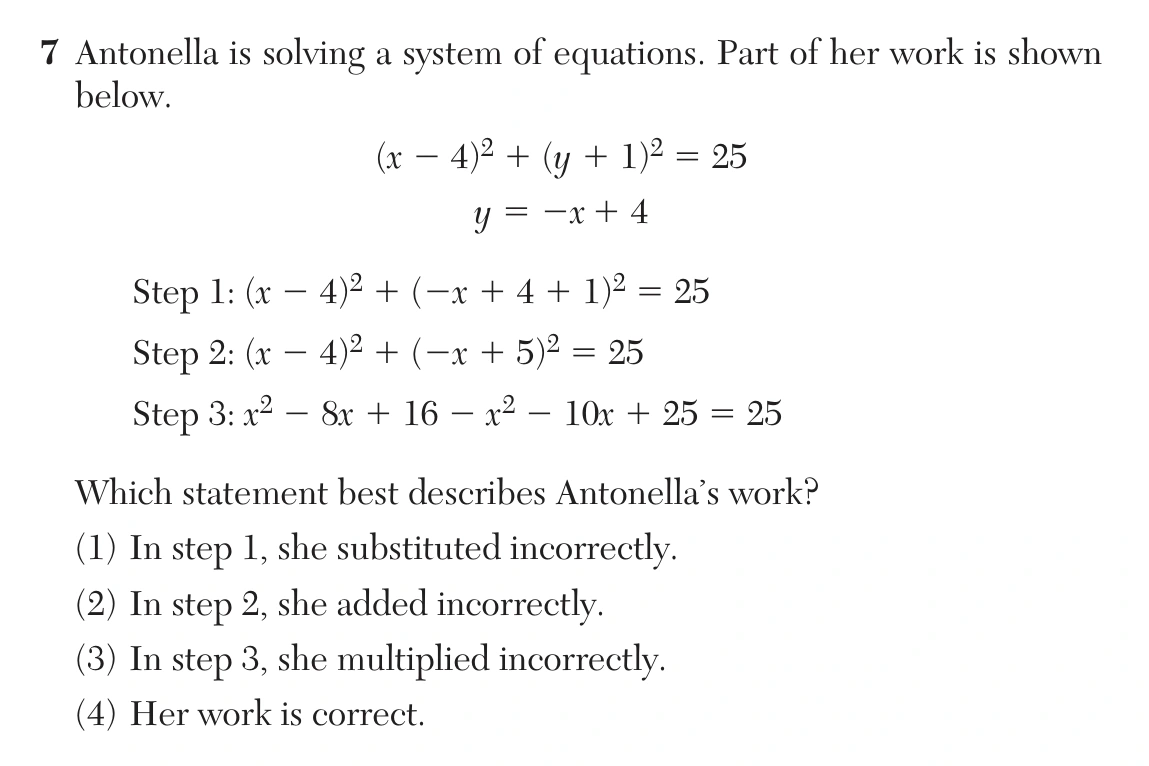
- The second equation is . Substitution into gives , so step 1 is correct.
- Combining gives , so step 2 is also correct.
- Expand the second square carefully: becomes , which simplifies to .
- The first square is . Add the second expansion , then set the sum equal to 25. Antonella wrote for the second squared term instead of , so the error is in step 3.
Exam detail: Squaring −x gives +x². The negative sign does not survive the squaring.
Question 8: Simplify a quotient of different roots
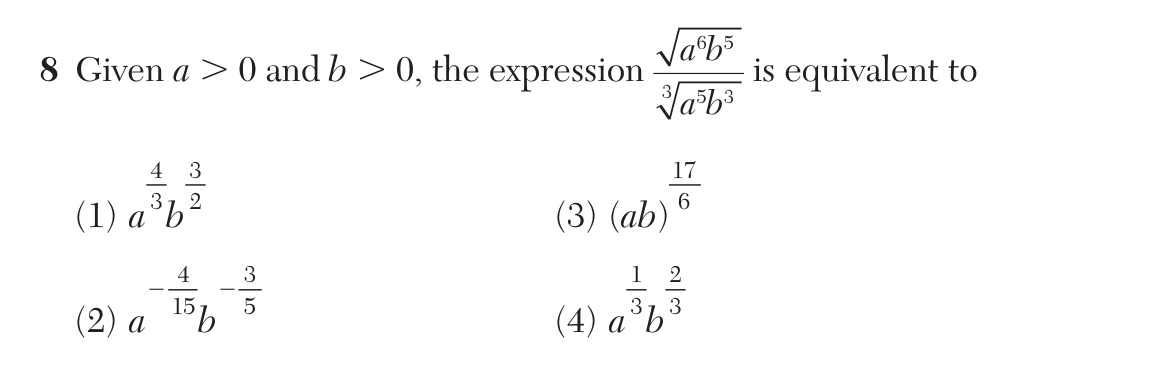
- The expression is . Rewrite the roots using fractional exponents.
- Because a and b are positive, the numerator is and the denominator is .
- Divide like bases by subtracting exponents: .
- Simplify and . The result is .
Exam detail: The numerator has a square root, but the denominator has a cube root. Convert each with its own root index before subtracting exponents.
Question 9: Read a cubic function’s end behavior
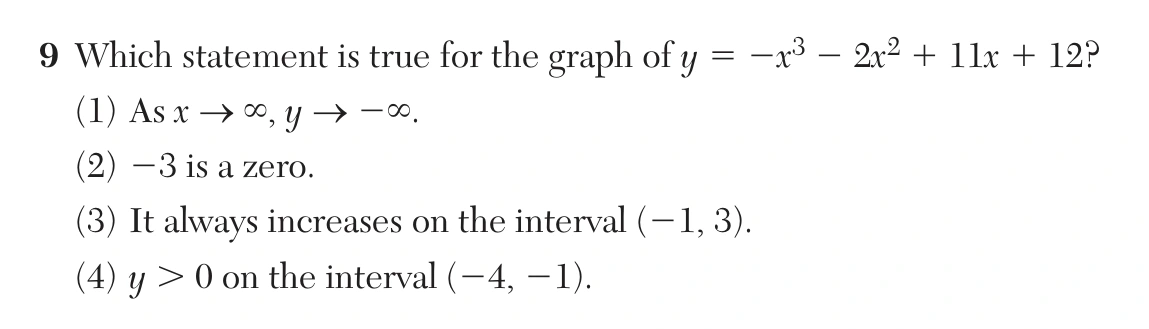
- The polynomial is . Its highest-degree term is .
- For very large positive x, the cubic term dominates the lower-degree terms.
- As , , so the whole polynomial satisfies .
- As a check on another option, , so −3 is not a zero.
Exam detail: End behavior depends on the leading term, including its negative sign, rather than on the constant or the sign of one nearby output.
Question 10: Solve an equation with a fractional exponent
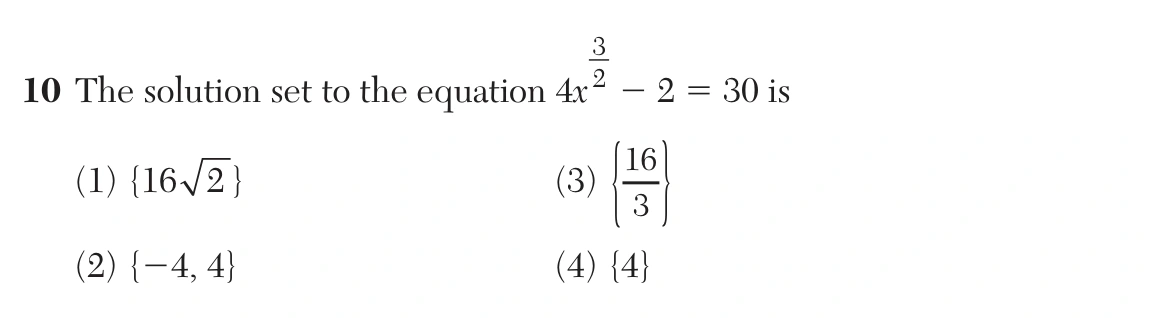
- The equation is . Add 2 and divide by 4: , then .
- For real-valued powers with a square-root denominator, . Write .
- Take the cube root: . Square both sides to get .
- Check: . The solution set is .
Exam detail: Do not add −4. A negative x is outside the real domain of .
Question 11: Evaluate a tangent at a special angle
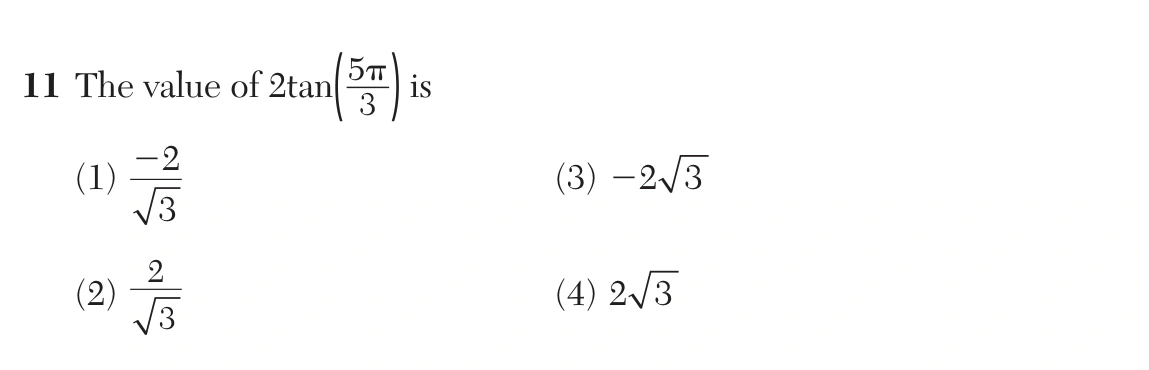
- The angle is 300°, which lies in Quadrant IV and has reference angle or 60°.
- At this angle, and .
- Therefore .
- Multiply by 2: .
Exam detail: Tangent is negative in Quadrant IV. If using a calculator with 5π/3, select radian mode.
Question 12: Model annual depreciation
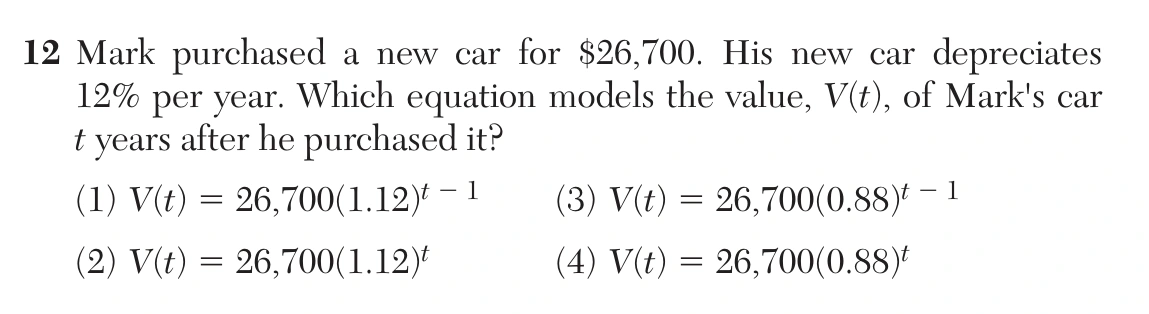
- The car’s initial value at is $26,700.
- A 12% annual loss leaves of the previous year’s value, so the annual multiplier is .
- After t years, repeated multiplication gives .
- Check the starting value: .
Exam detail: Depreciation uses 1 minus the rate. The exponent is t because t counts years since purchase, beginning at zero.
Question 13: Find a joint probability from a table
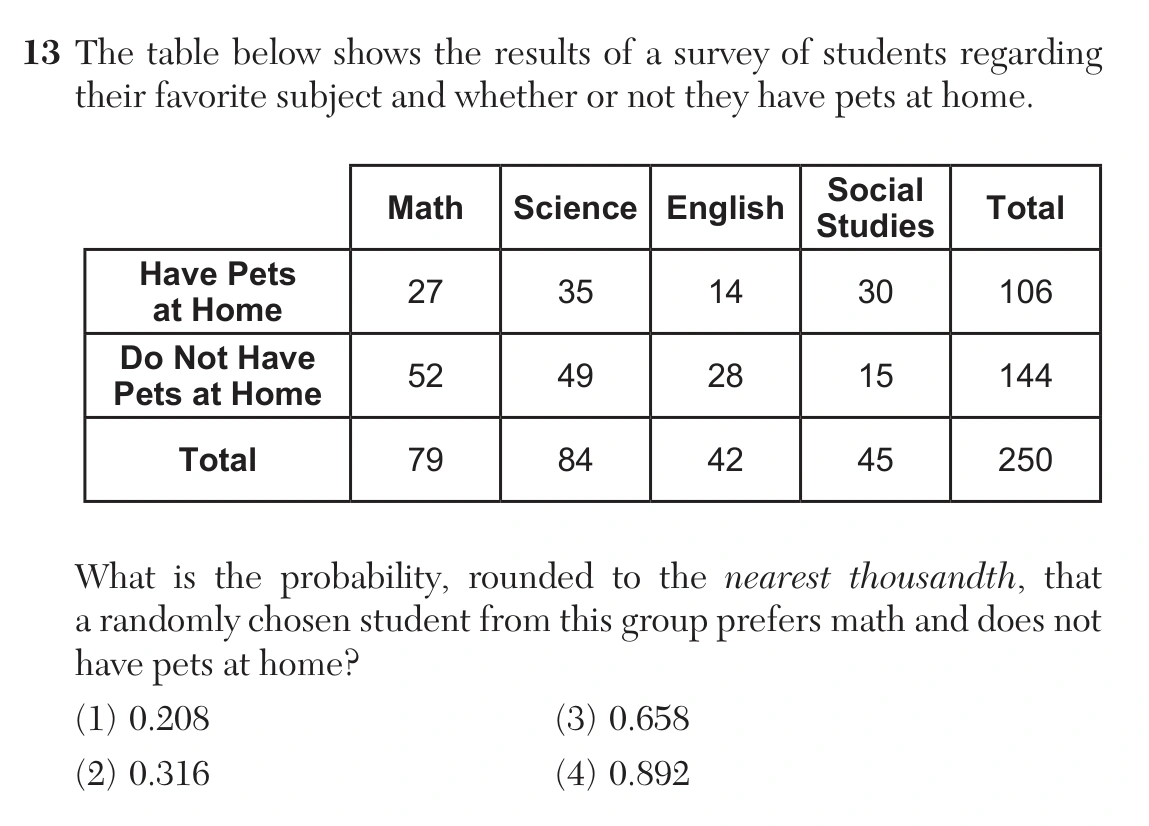
- We need students who satisfy both conditions: prefer math and do not have pets at home.
- The intersection of the Math column and the Do Not Have Pets row contains 52 students.
- The student is chosen from the entire group of 250, so the probability is .
- This is already rounded to the nearest thousandth.
Exam detail: This is a joint probability, not a conditional probability. Use the grand total 250 as the denominator, rather than 79 or 144.
Question 14: Apply the factor theorem
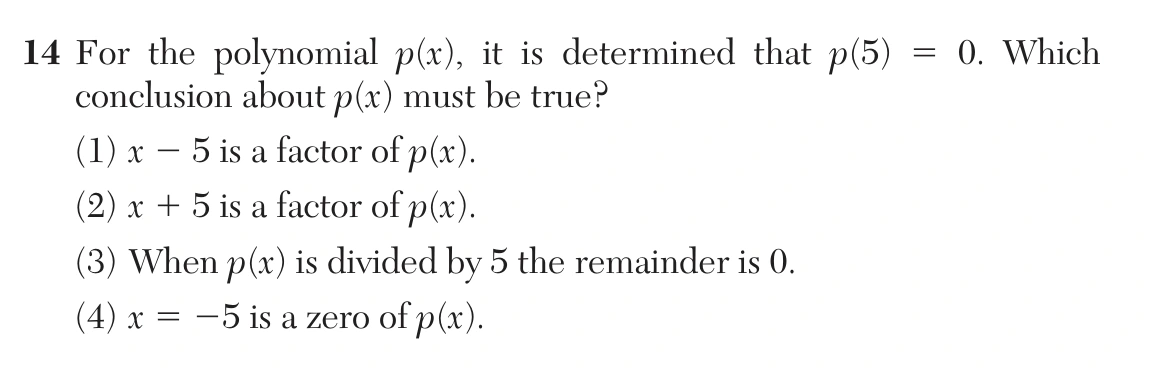
- The statement means that x = 5 is a zero of the polynomial.
- The factor theorem says exactly when is a factor of .
- With , the required factor is . Equivalently, dividing p(x) by x − 5 leaves remainder zero.
Exam detail: A zero at +5 corresponds to the factor x − 5, not x + 5. The factor theorem concerns division by x − 5, not division by 5.
Question 15: Find tangent from sine and a quadrant
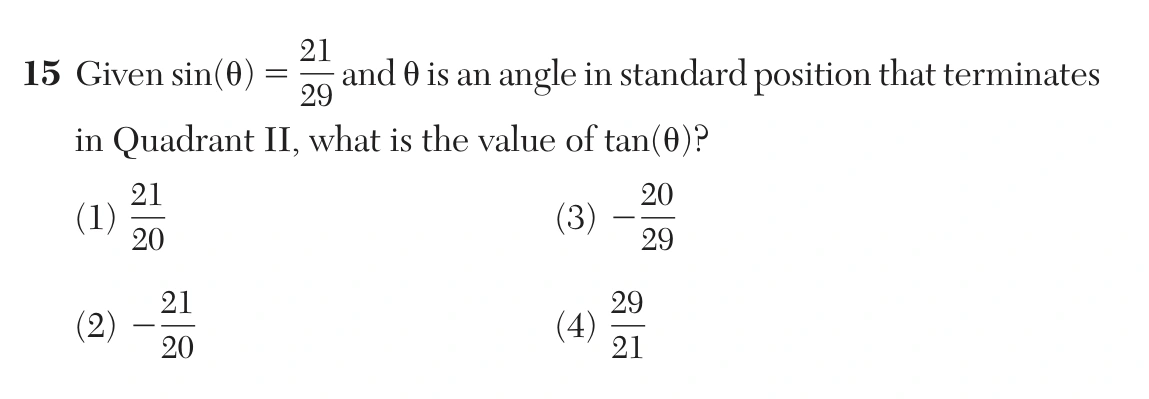
- Given , use a reference triangle with opposite side 21 and hypotenuse 29.
- The horizontal side has magnitude . Since , this is .
- Quadrant II has a negative horizontal coordinate and positive vertical coordinate, so the horizontal coordinate is −20.
- Therefore .
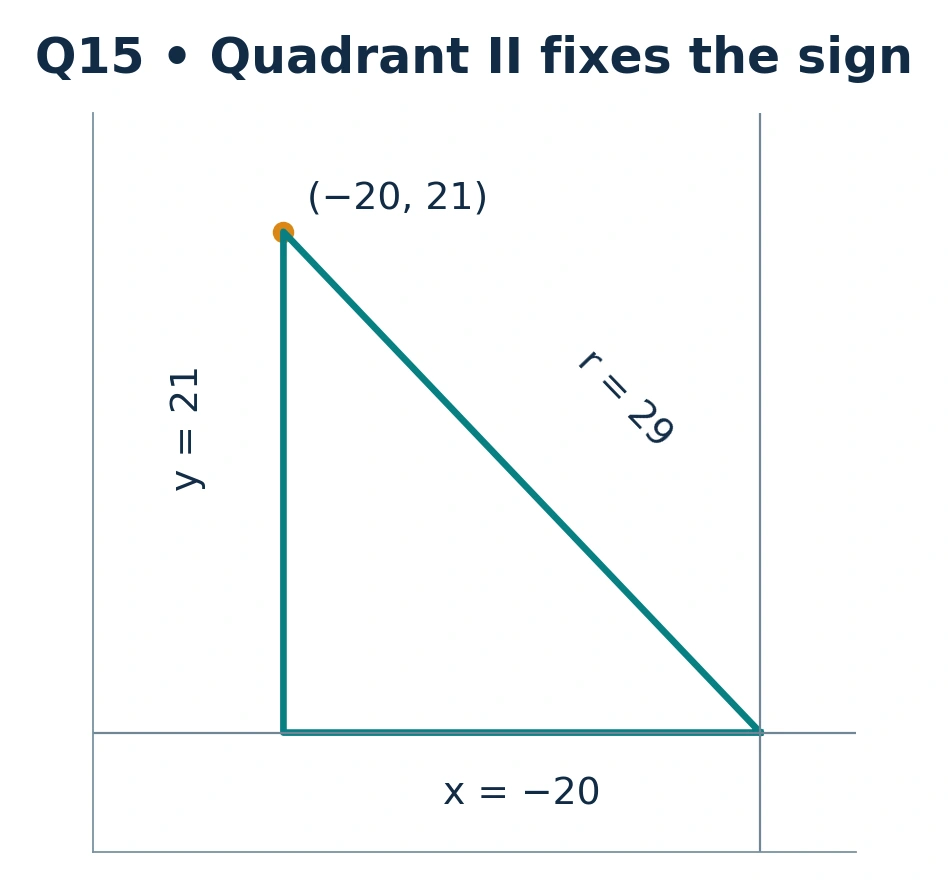
Exam detail: The triangle determines the side length, while the quadrant determines the sign. Tangent is negative in Quadrant II.
Question 16: Solve a rational equation
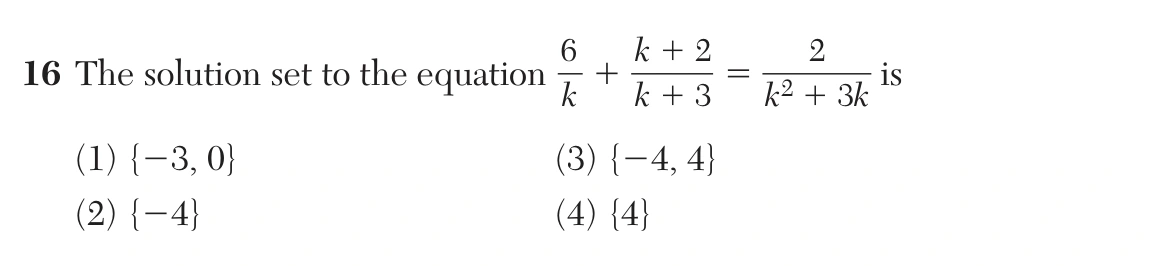
- The equation is . Factor , so and .
- Multiply every term by : .
- Expand and move all terms to one side: , so .
- Factor: , giving .
- This value is allowed by the denominator restrictions. Checking gives , which equals . Thus the solution set is .
Exam detail: The excluded values −3 and 0 make denominators zero; they are not solutions. Multiply every term by the full common denominator.
Question 17: Estimate a count within one standard deviation
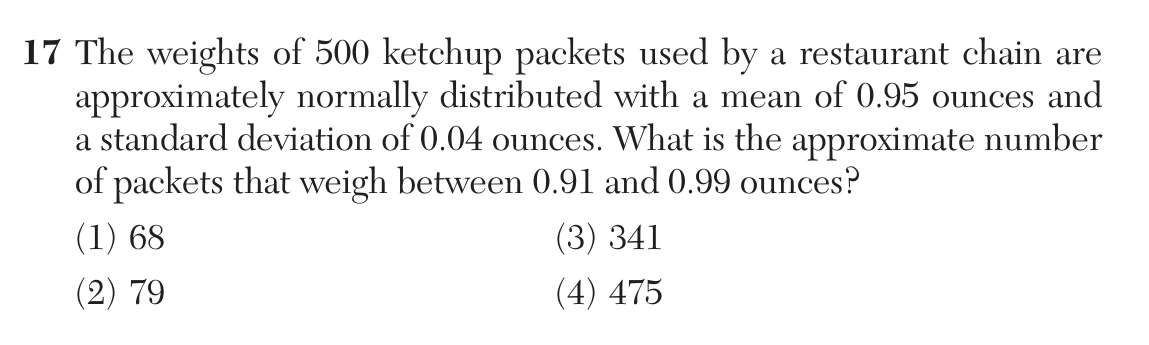
- The interval is from to , exactly one standard deviation below and above the mean.
- Standardize the endpoints: and .
- The normal area between z = −1 and z = 1 is approximately . On a graphing calculator, normalcdf(0.91, 0.99, 0.95, 0.04) gives this value.
- Multiply the probability by the number of packets: . The closest whole-number count is 341 packets.
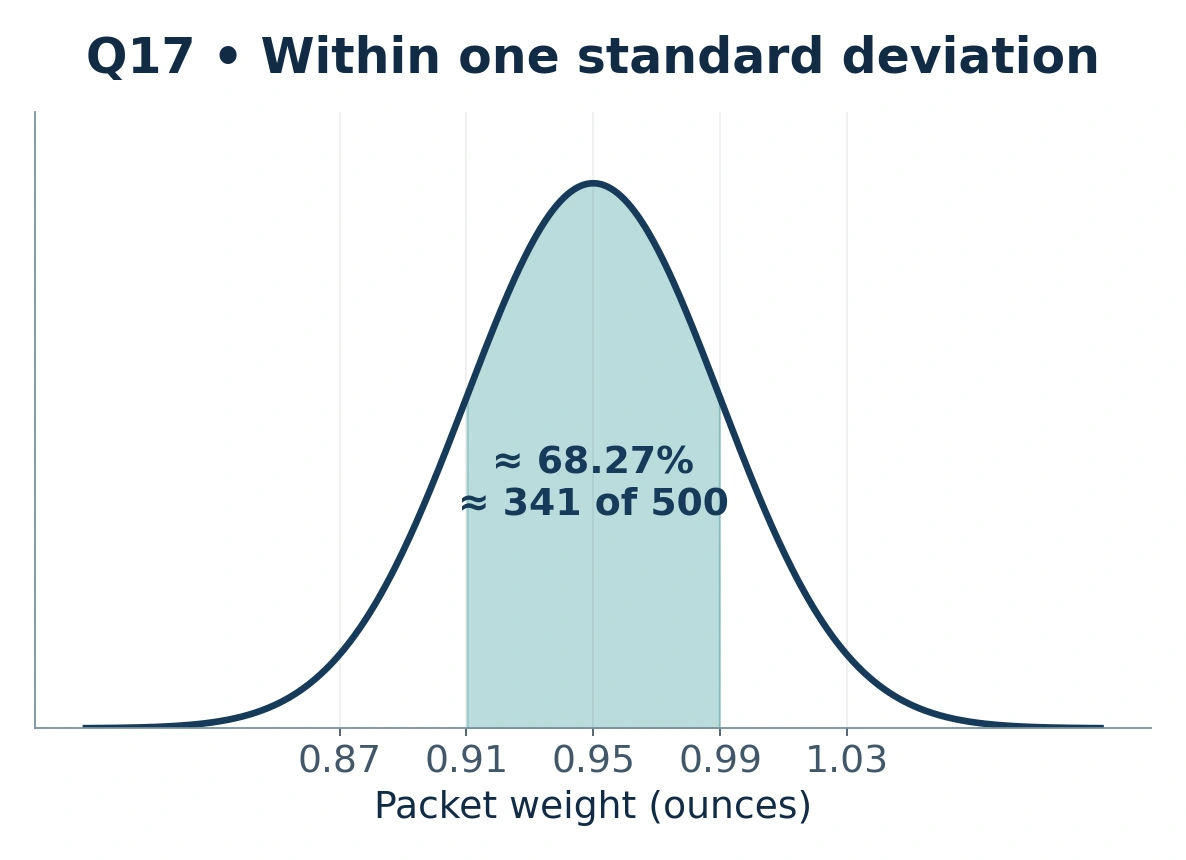
Exam detail: The normal probability is a proportion, so multiply by 500. The rough 68% rule gives about 340; the more precise normal area supports the listed choice 341.
Question 18: Identify the population parameter
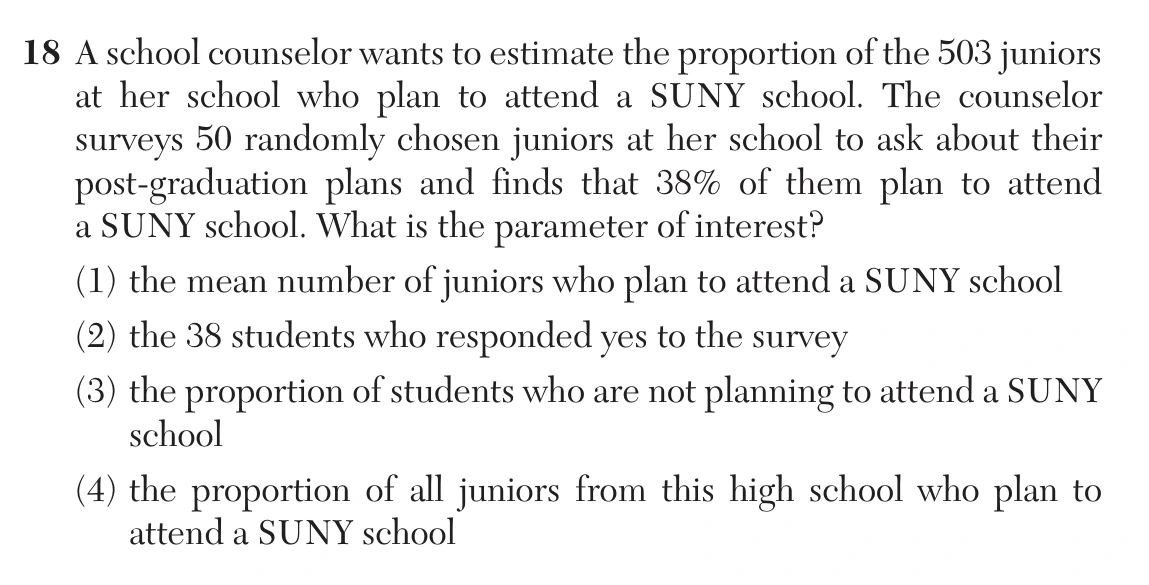
- The population of interest is all 503 juniors at the school. The 50 randomly selected juniors are the sample.
- A parameter describes the population. Here, the unknown quantity is the proportion of all 503 juniors who plan to attend a SUNY school.
- The observed 38% describes the sample and is a statistic used to estimate that population proportion.
- Therefore the parameter of interest is the proportion of all juniors at the school who plan to attend a SUNY school, which is choice (4).
Exam detail: Do not confuse the sample statistic, 38%, with the unknown population parameter. Also, 38% of 50 is 19 students, not 38 students.
Question 19: Convert a three-year growth factor to a yearly factor
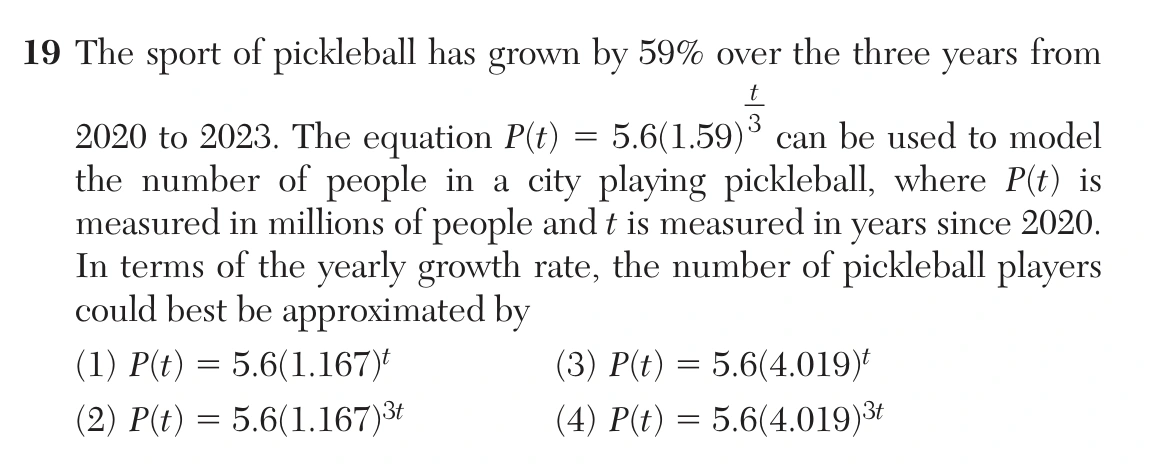
- The original model is . The factor 1.59 describes growth over three years.
- Rewrite the exponent using a yearly factor: .
- Calculate the yearly multiplier: .
- Therefore . This corresponds to an annual growth rate of approximately 16.7%.
Exam detail: Divide the exponent by 3 by taking a cube root of the growth factor. Do not divide 59% by 3 or keep a 3t exponent after converting to an annual factor.
Question 20: Solve a quadratic with nonreal roots
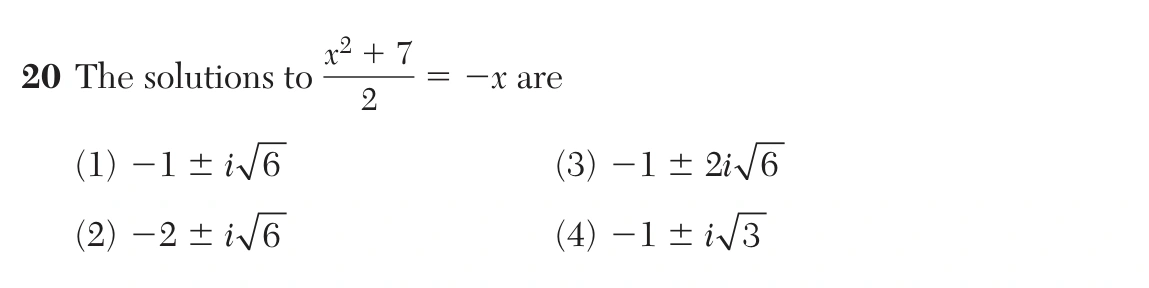
- The equation is . Multiply both sides by 2: .
- Move all terms to one side: .
- Complete the square by rewriting , so .
- Take square roots: . Subtract 1 to obtain .
Exam detail: The right side of the original equation is −x, so multiplying by 2 gives −2x. Keep both complex-conjugate solutions.
Question 21: Factor a sixth-degree expression completely
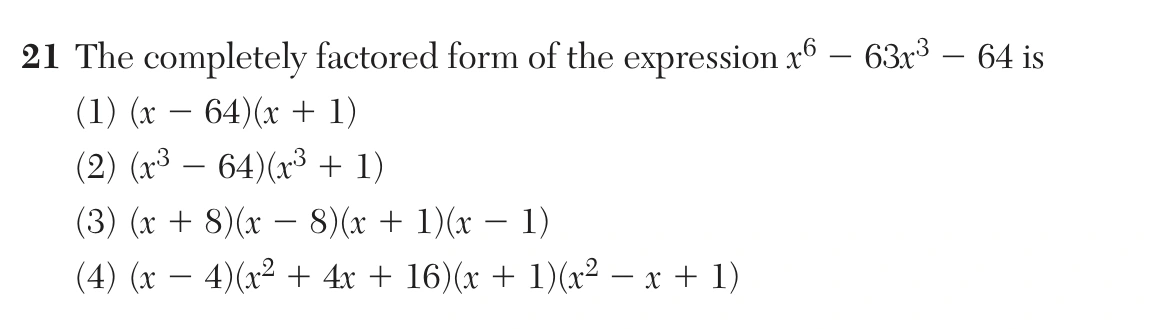
- Treat the polynomial as a quadratic in : .
- The numbers −64 and 1 multiply to −64 and add to −63, so .
- Substitute back: . Each factor is a difference or sum of cubes.
- Use and .
- The complete factorization is . The remaining quadratics have negative discriminants, so they do not factor further over the reals.
Exam detail: Choice (2) is a valid intermediate factorization, but it is not complete: both cubic factors can still be factored.
Question 22: Recognize an odd function

- A function is odd when for every x in its domain; its graph has origin symmetry.
- For , , using the oddness of sine.
- The vertical shift in breaks origin symmetry. Also, , so both cosine choices are even.
- Therefore only is odd.
Exam detail: A horizontal stretch or compression preserves sine’s oddness, but a nonzero vertical shift does not. Replacing x with −x does not make cosine odd.
Question 23: Find the inverse of a shifted exponential
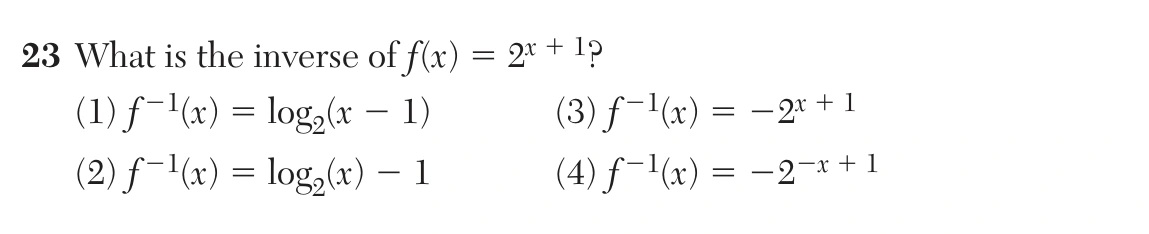
- The function is ; the +1 is part of the exponent.
- Interchange x and y to find the inverse: .
- Take logarithms base 2: .
- Solve for y: . Thus , with .
Exam detail: Distinguish from . A shift inside the original exponent becomes a subtraction outside the inverse logarithm.
Question 24: Match a cosine model’s period and maximum
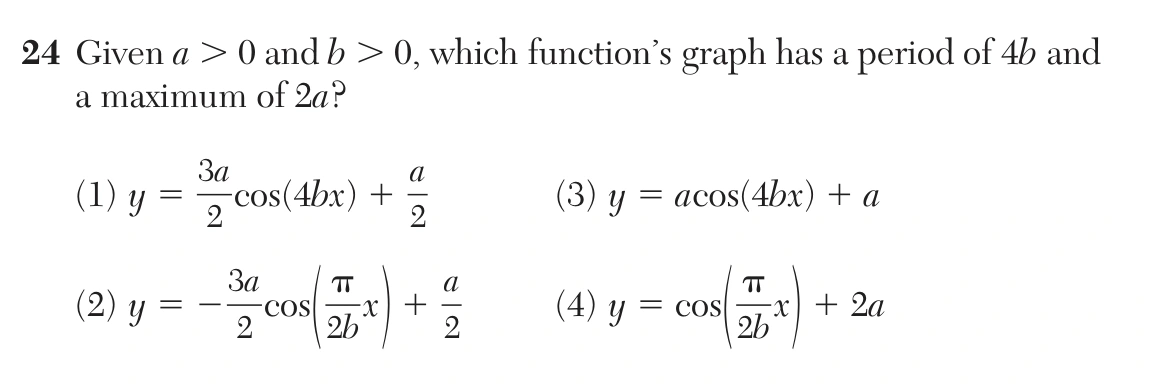
- For , the period is and the maximum is .
- In choice (2), . Since , the period is .
- The amplitude is , and the vertical shift is .
- The maximum is . Both required conditions hold, so choose (2).
- The negative coefficient reflects the cosine graph, but its amplitude remains positive. The maximum occurs when the cosine value is −1.
Exam detail: Use the absolute value of the cosine coefficient to find amplitude and maximum. The coefficient inside cosine controls period, not amplitude.
Part II: Short constructed responses
Questions 25–32 • 2 credits each • 16 credits total
Question 25: Classify the data-collection method

- The manager examines randomly selected sales records that already exist. She observes what customers bought on different days.
- She does not assign customers to treatments or change the conditions under which they shop, so this is not an experiment.
- She does not ask customers questions, so this is not a survey. The method is an observational study.
Exam detail: Randomly choosing records does not make the study an experiment. An experiment requires imposing a treatment.
Question 26: Subtract two functions

- Write the entire second function in parentheses: .
- Distribute the subtraction through both terms of the second function: .
- Combine like terms and place them in descending powers of x: .
Exam detail: Subtracting the constant -5 produces +5. Forgetting those parentheses gives the wrong constant.
Question 27: Find all zeros by grouping

- Set the function equal to zero: .
- Group the first two and last two terms: .
- Factor out the common binomial: .
- Factor the difference of squares: .
- Use the zero-product property. The equations , , and give , , and .
Exam detail: After factoring by grouping, continue factoring x² – 9. It gives two zeros, not just x = 3.
Question 28: Translate the whole graph
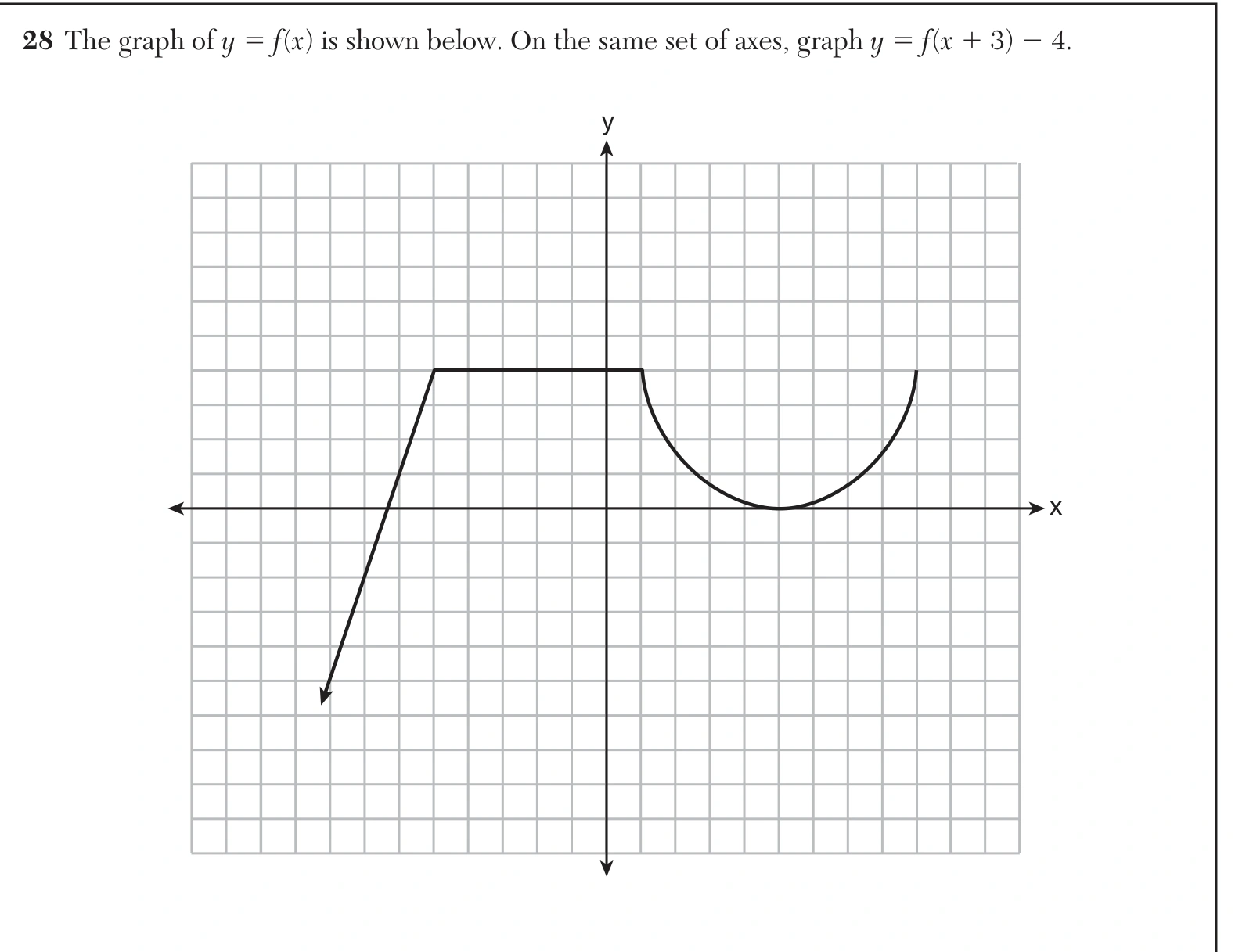
- For , the +3 inside the function shifts the graph 3 units left. The -4 outside shifts it 4 units down.
- Apply the point rule . The original key points (-5, 4), (1, 4), (5, 0), and (9, 4) become (-8, 0), (-2, 0), (2, -4), and (6, 0).
- Draw the horizontal segment on the x-axis from (-8, 0) to (-2, 0).
- Continue the slanted ray down and left from (-8, 0), preserving its slope of 3. Useful points on this ray are (-9, -3), (-10, -6), and (-11, -9). Include an arrow at the lower-left end.
- Draw the same U-shaped curved arc from (-2, 0) through (2, -4) to (6, 0). Keep the original shape and connect it to the horizontal segment at (-2, 0).
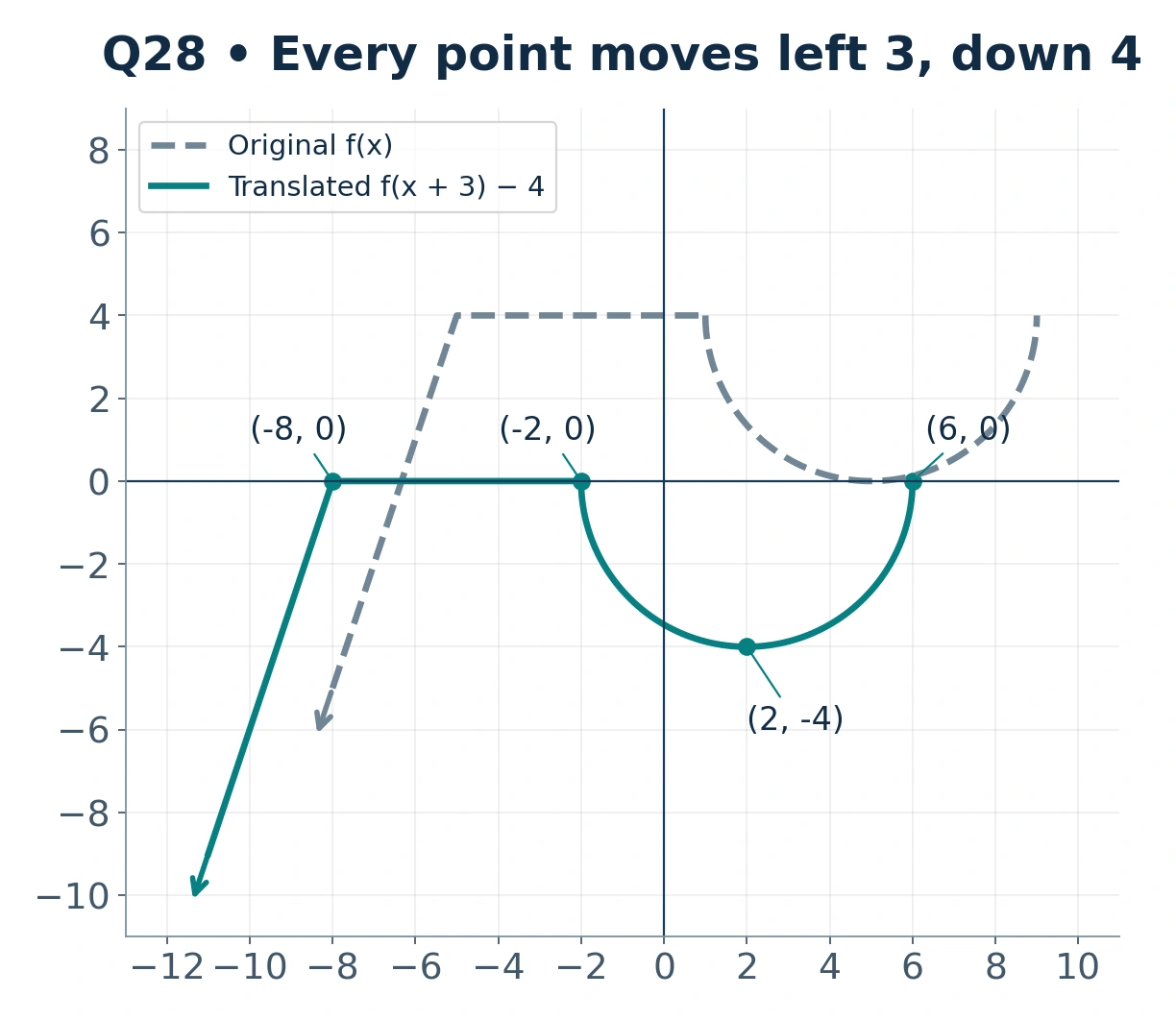
Exam detail: The horizontal direction is opposite the sign inside f: x + 3 shifts left. Translate every part, including both endpoints and the ray.
Question 29: Square a complex number

- Use to rewrite the square root: . The expression becomes .
- Expand using the square of a binomial: .
- Simplify each term: .
- Substitute and combine the real terms: .
Exam detail: The middle term is -20i, and (5i)² = -25. Squaring a sum does not mean squaring the terms separately.
Question 30: Write a half-life model

- A half-life model has the form , where h is the half-life.
- The initial amount is 2.7 micrograms and the half-life is 30 years, so substitute and .
- Therefore , for .
- Check the model: and , so the amount is halved after 30 years.
Exam detail: The exponent is t/30, the number of half-lives that have passed. Using 30t would describe a very different decay rate.
Question 31: Expand and solve a summation

- The index a takes the five values 0, 1, 2, 3, and 4. Substitute each value into .
- The five terms are , , , , and . Add these terms and set the total equal to 5.
- Combine like terms: .
- Add 15, giving , then divide by 10 to obtain .
- Check: with , the five terms are -3, -1, 1, 3, and 5; their sum is 5.
Exam detail: Include the term for a = 0. That term is -3, not 0, so there are five copies of -3.
Question 32: Rewrite a continuous exponential model

- Use the exponent rule . Thus .
- Calculate the new base: .
- Round the base to the nearest thousandth: . The coefficient is already .
- The requested form is . This is the rounded model; the exact base is .
Exam detail: Do not use 0.214 or 1.214 as the new base. The base is e raised to 0.214.
Part III: Extended constructed responses
Questions 33–35 • 4 credits each • 12 credits total
Question 33: Divide polynomials and retain the remainder
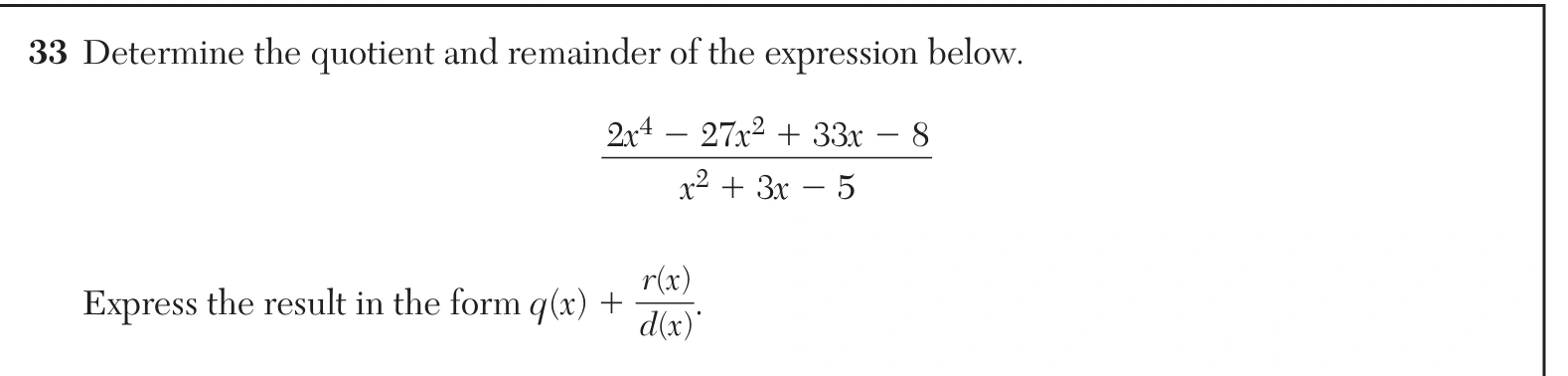
- Write the dividend with its missing cubic term: . The divisor is .
- Divide the leading terms: . Multiply the divisor by to get . Subtract to obtain .
- Divide the new leading terms: . Multiply the divisor by to get . Subtract to obtain .
- Divide again: . Subtract from to obtain the remainder -3.
- The remainder has smaller degree than the divisor, so division is complete. Write quotient plus remainder over divisor: .
- Check by multiplying the quotient by the divisor. The product is . Adding the remainder gives the original dividend .
Exam detail: Align powers using the 0x³ placeholder, and subtract every term of each product. The remainder stays over the original quadratic divisor. The original divisor must be nonzero: .
Question 34: Recover a sine equation from its graph
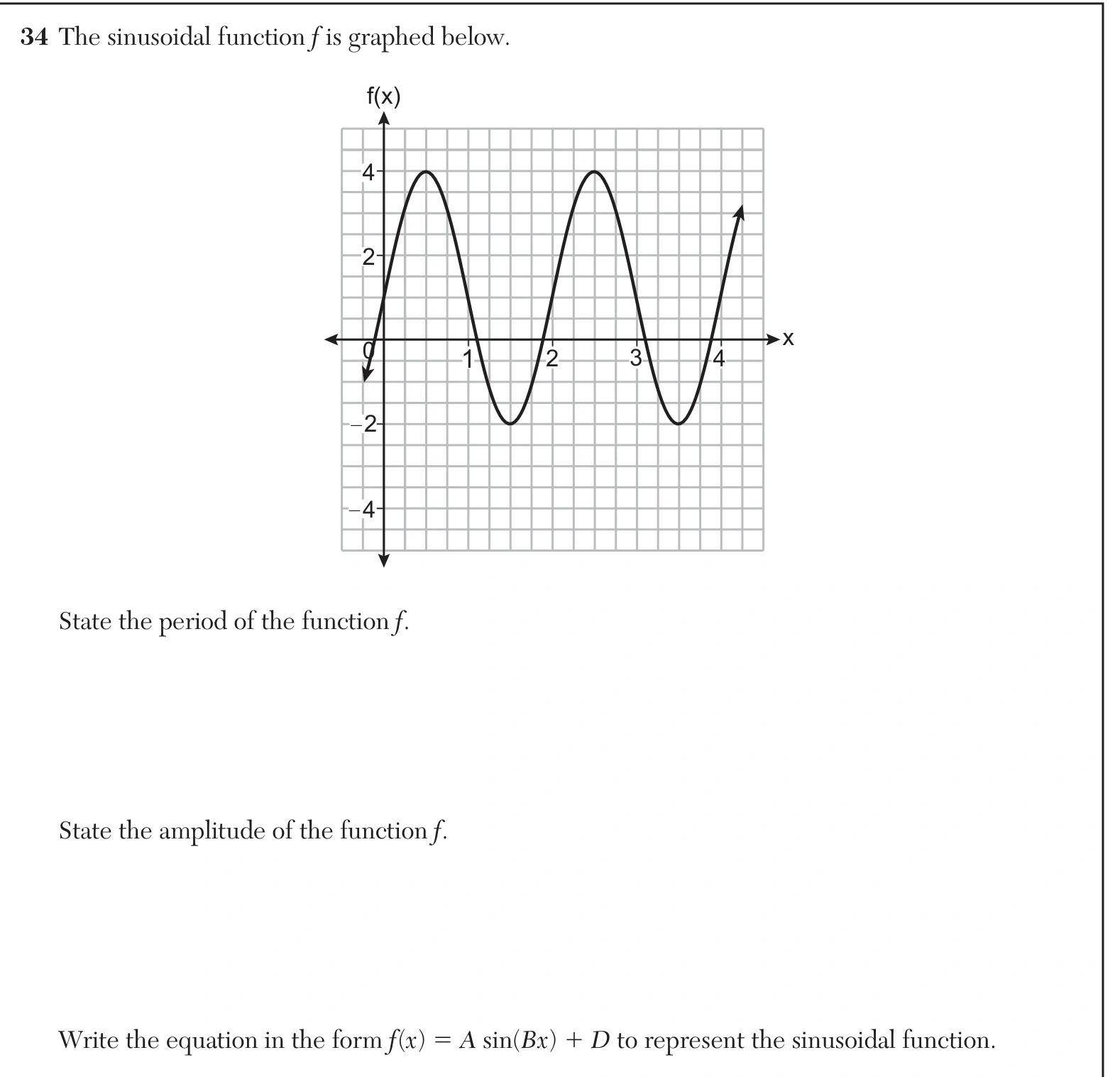
- Read the highest and lowest values from the graph: the maximum is 4 and the minimum is -2.
- The amplitude is half the vertical range: . The midline is the average of the extremes: .
- Consecutive peaks occur at and , so one full cycle takes .
- For a sine function in radians, . Choose positive B, giving .
- At , the graph crosses its midline while increasing, which matches a positive sine curve without a horizontal shift.
- Substitute into the requested form: . For example, this gives and , agreeing with the graph.
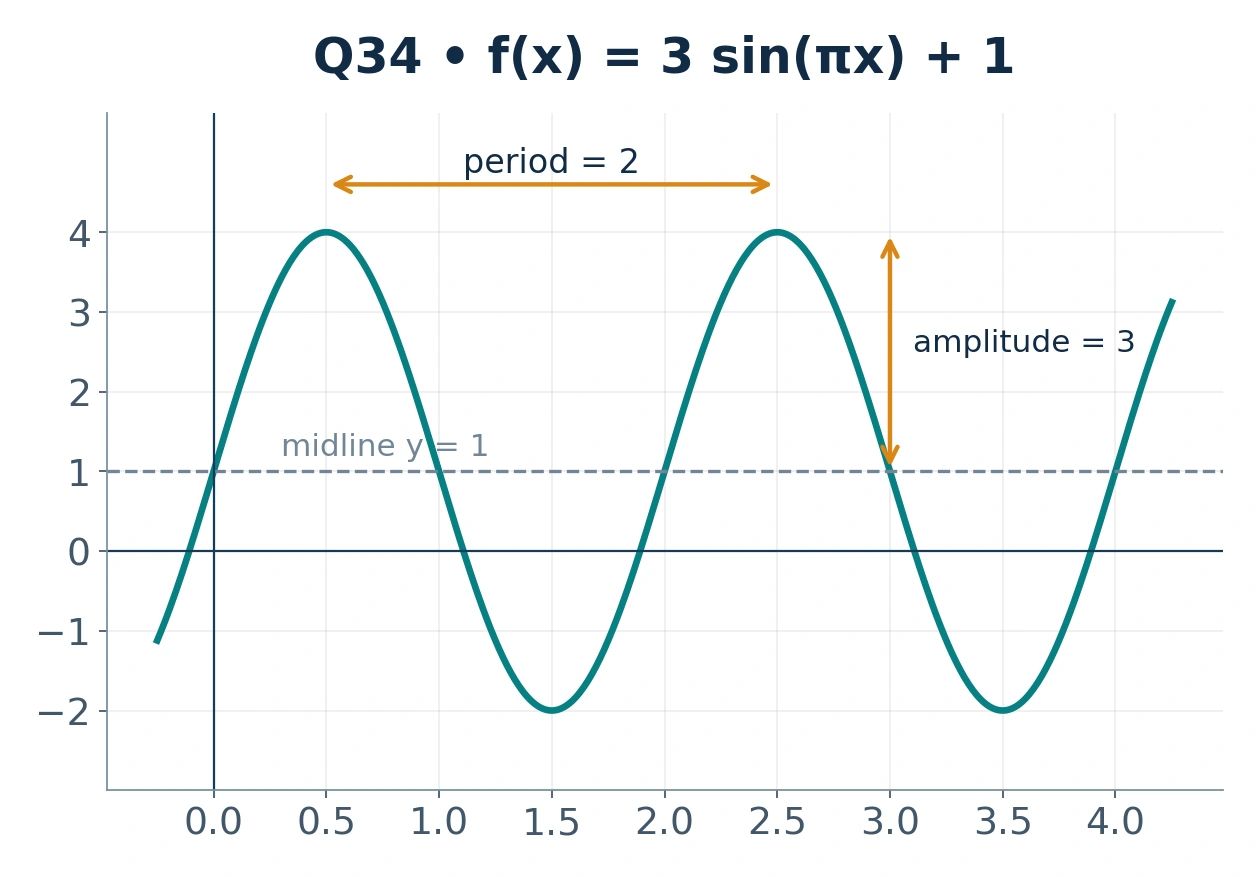
Exam detail: Amplitude is half the peak-to-trough distance, not the maximum height. Include the +1 vertical shift, and use π as the sine coefficient for a period of 2.
Question 35: Use a simulation to assess a proportion
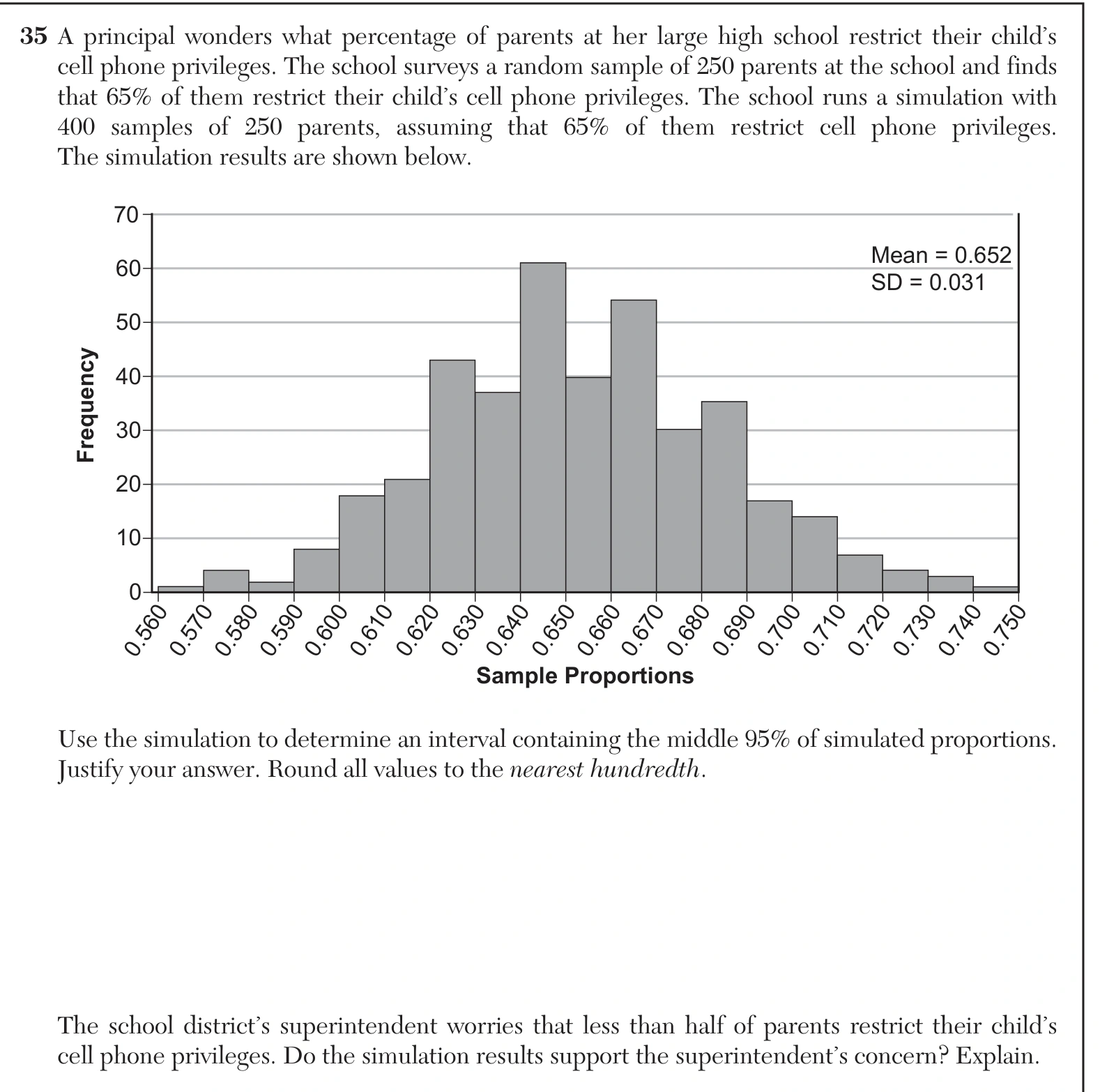
- The simulation reports a mean of 0.652 and a standard deviation of 0.031. Its distribution is approximately bell-shaped.
- By the empirical rule, approximately the middle 95% of values fall within two standard deviations of the mean. Calculate .
- The lower endpoint is . The upper endpoint is .
- Round the endpoints to the nearest hundredth: , or approximately 59% through 71%.
- Half of the parents corresponds to a proportion of 0.50. That is below the entire 95% interval; proportions below 0.50 would be unusual in this simulation.
- Therefore, these results do not support the superintendent’s concern that less than half of parents restrict privileges. The observed sample and simulation instead indicate a proportion above one-half.
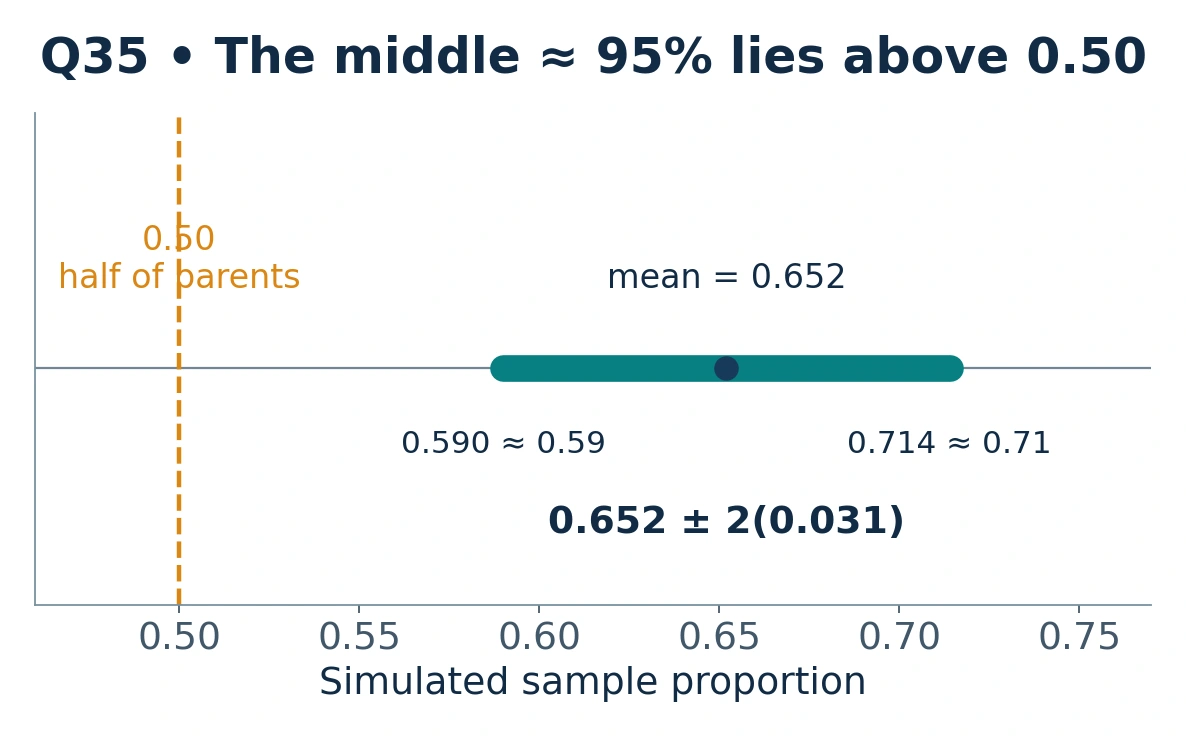
Exam detail: Use the simulation’s mean and standard deviation and multiply the standard deviation by 2. A value outside the interval is not made plausible by rounding.
Part IV: Modeling a cooling drink
Question 36 • 6 credits
Question 36: Interpret and solve a cooling model
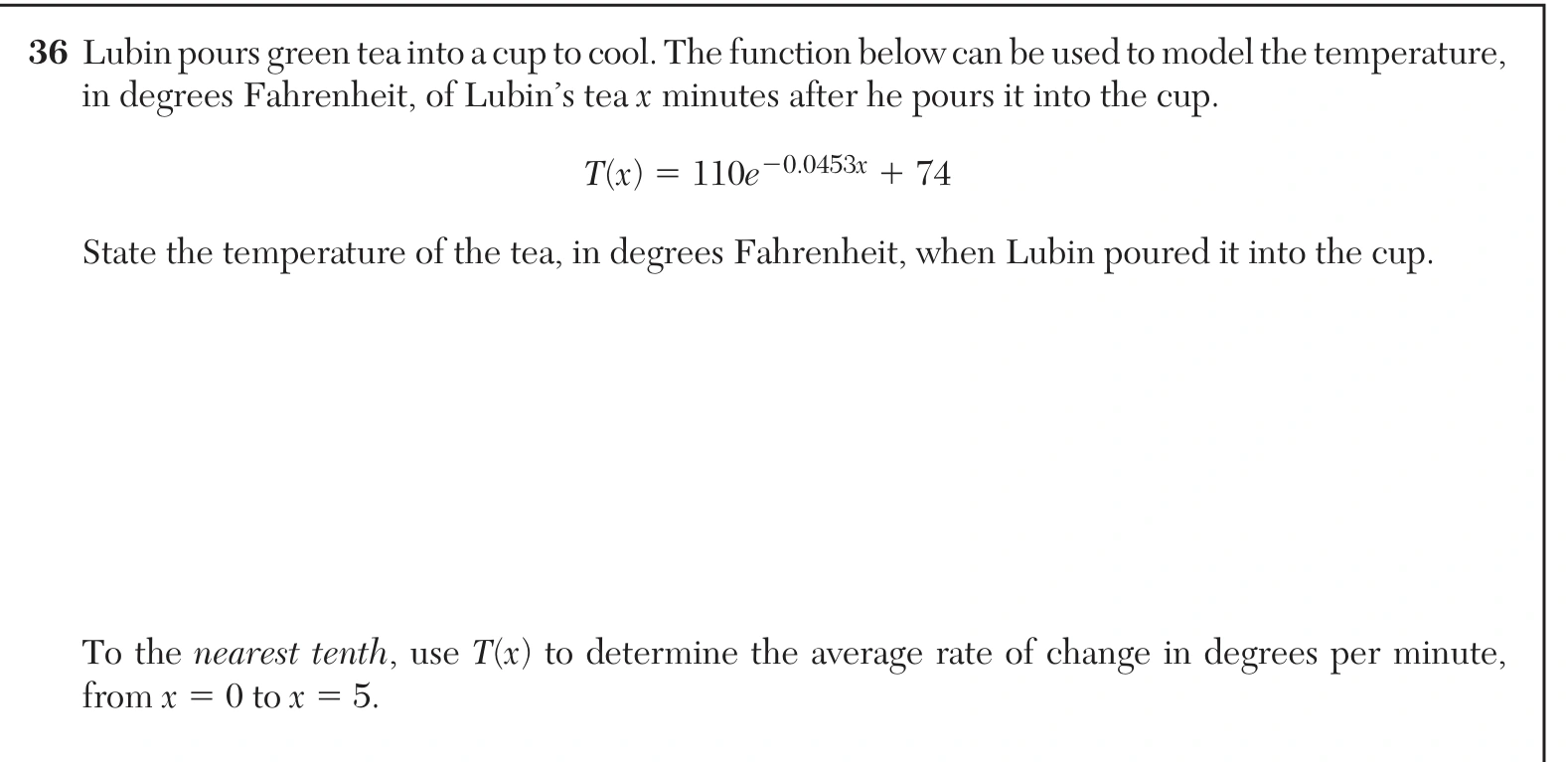
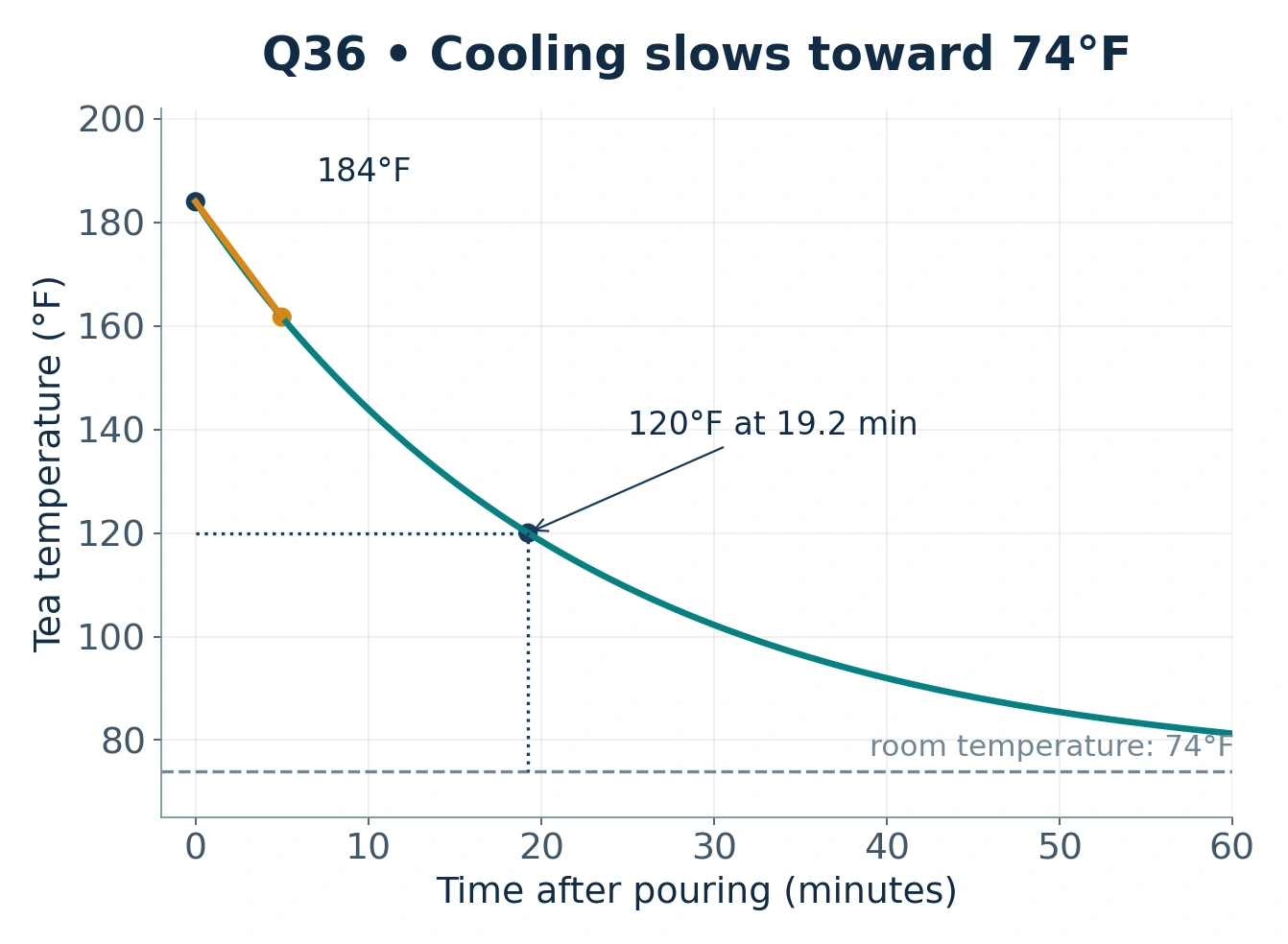
- Initial temperature: pouring occurs at . Substitute into : . The tea starts at 184°F.
- Temperature after 5 minutes: substitute into . This gives °F. Keep the full calculator value for the rate calculation.
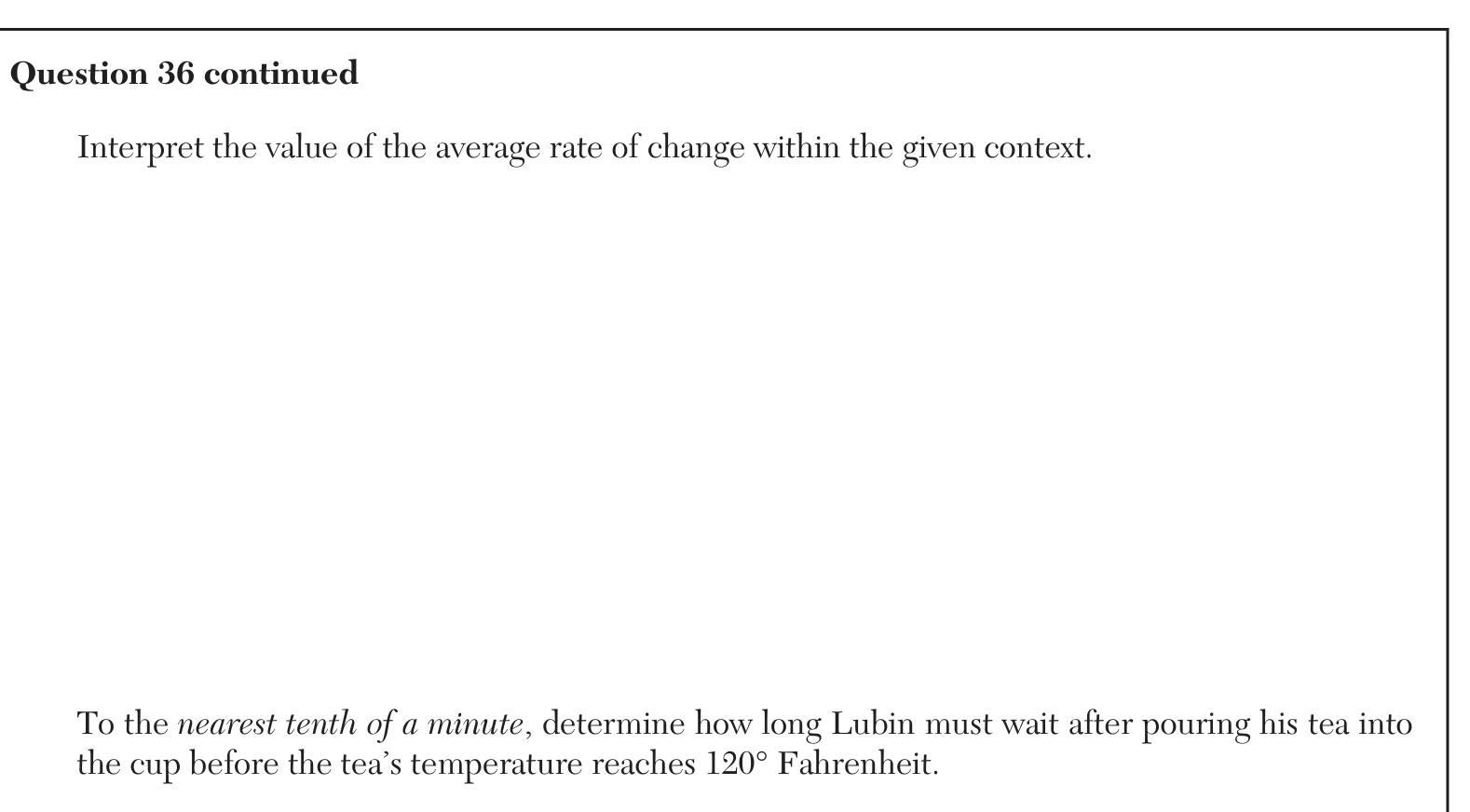
- Average rate of change is . The temperature change is about °F. Divide by 5 minutes to obtain about °F per minute. To the nearest tenth, the average rate is -4.5°F per minute.
- Interpretation: during the first 5 minutes after pouring, the tea’s temperature decreased by an average of about 4.5°F per minute. This describes the average over the interval, not a constant cooling rate at every instant.
- To find the time when the temperature is 120°F, set . Subtract 74 and divide by 110: .
- Take the natural logarithm of both sides: .
- Divide by -0.0453: . To the nearest tenth, Lubin must wait 19.2 minutes.
Exam detail: The initial temperature includes the +74. Use change in temperature divided by change in time for the average rate, and isolate the exponential before taking logarithms.
Check your score carefully
The maximum raw score is 82. Use the official August 2026 Algebra II conversion chart for the scaled Regents score; another administration’s chart may give a different result. For related practice, see the June 2026 Algebra II Regents solutions.
Sources & References
Official materials accessed October 8, 2026. Question and scoring references use the English edition throughout this page.
- Official August 2026 Algebra II examination (questions; PDF)
- Official August 2026 multiple-choice scoring key (PDF)
- Official August 2026 rating guide (PDF)
- Official August 2026 model response set (PDF)
- Official August 2026 conversion chart (PDF)
- NYSED Algebra II past-examination index
- NYSED terms of use and reproduction conditions
From the New York State Education Department. Regents Examination in Algebra II, August 2026. Internet. Available from the official examination link above; accessed 8 October 2026. Original question images are distinguished from HeLovesMath’s original explanations and solution diagrams.