
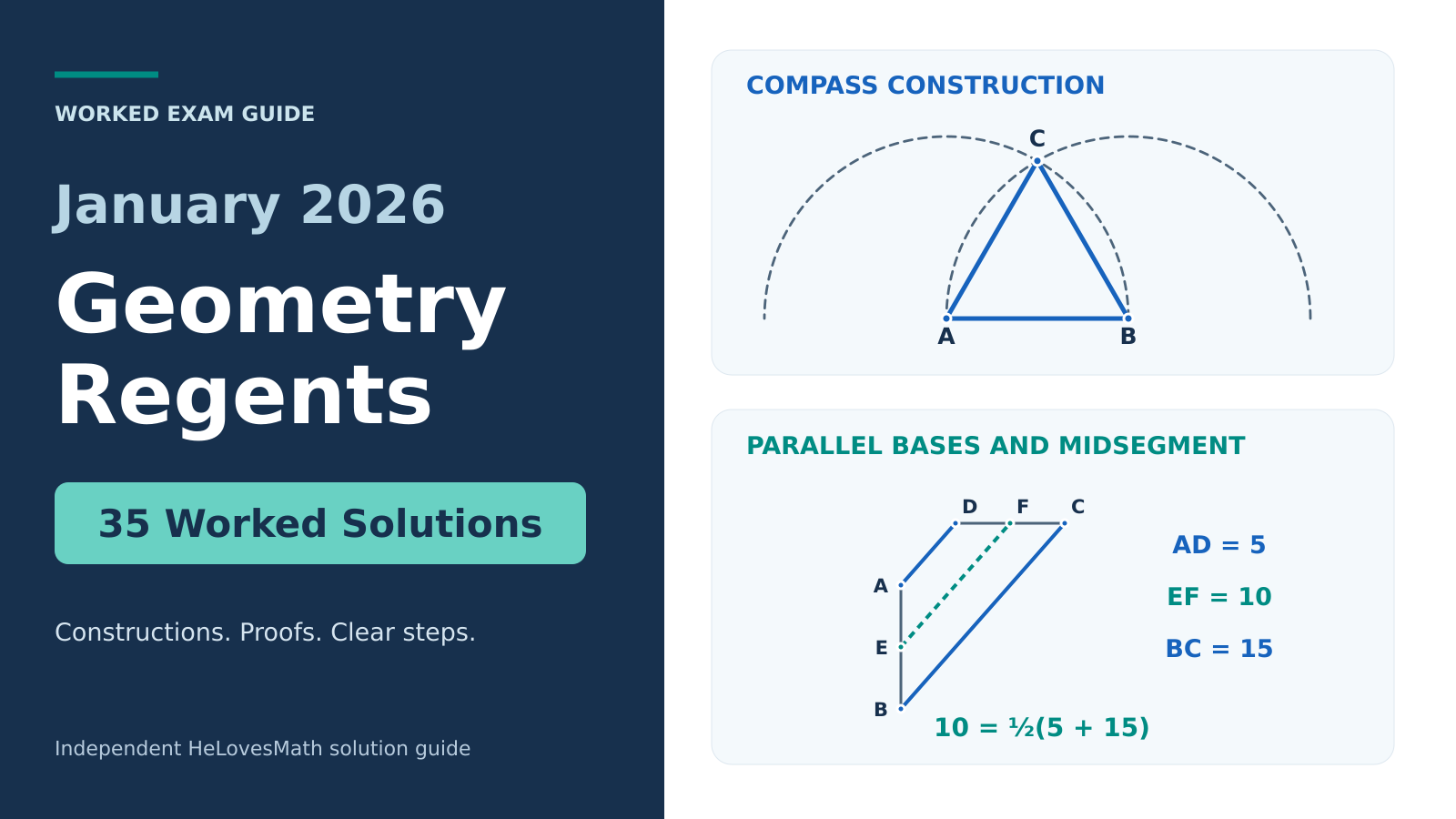
Work through every question in the English-language January 2026 Geometry Regents. Each solution explains the method, gives the final answer, and highlights details that matter for a complete written response.
Try the question first, then compare your reasoning with the steps below. Select a question image or diagram to open a larger view. The question numbers and paper-page references follow the official exam. The original paper and NYSED scoring documents are linked in Sources & References.
For Parts II–IV, show your method. A final number on its own can lose substantial credit, and a question that specifies compass-and-straightedge construction or coordinate geometry requires that method.
These are independent HeLovesMath explanations, not an official NYSED publication. Answers and required methods were checked against the official scoring key, rating guide, and model response set. Valid alternative methods can also earn credit unless a question specifies a method.
Quick check: Part I answer choices
- Q1: (4)
- Q2: (2)
- Q3: (1)
- Q4: (3)
- Q5: (1)
- Q6: (2)
- Q7: (2)
- Q8: (4)
- Q9: (4)
- Q10: (3)
- Q11: (1)
- Q12: (4)
- Q13: (2)
- Q14: (3)
- Q15: (2)
- Q16: (4)
- Q17: (4)
- Q18: (2)
- Q19: (3)
- Q20: (1)
- Q21: (1)
- Q22: (3)
- Q23: (3)
- Q24: (2)
Use the worked explanations below to check why each answer is correct.
Part I: Multiple-choice solutions
Questions 1–24 • 2 credits each • 48 credits total
Question 1: Identify the reflection
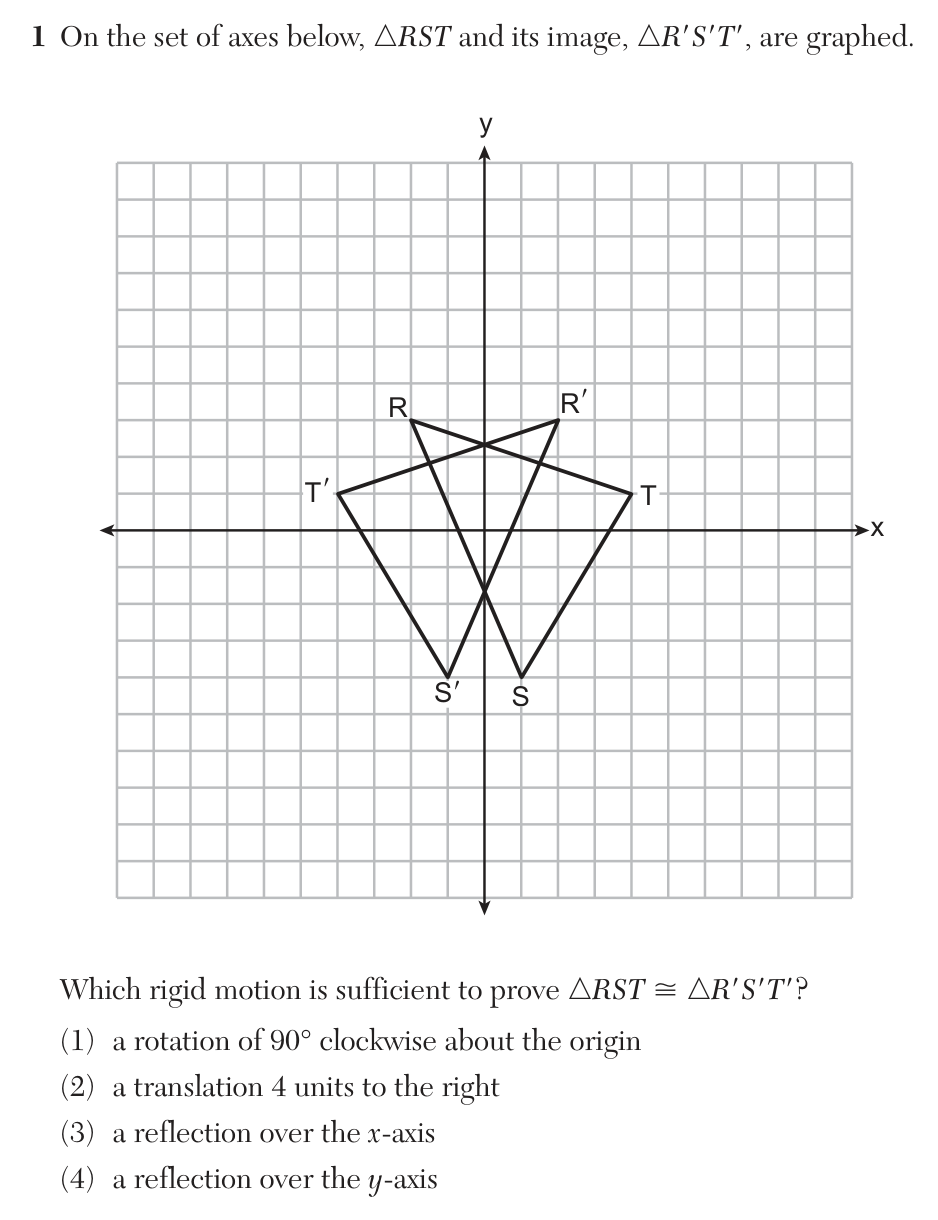
- Compare corresponding coordinates: , , and .
- Each x-coordinate changes sign while the y-coordinate stays the same. This is the rule .
- A reflection over the y-axis is a rigid motion, so it preserves all lengths and angle measures and establishes the triangles’ congruence.
Question 2: Use rotational symmetry of a regular polygon
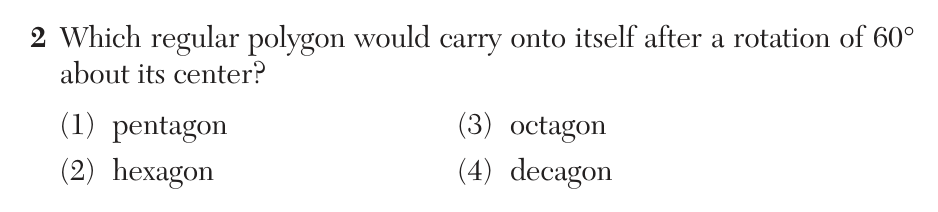
- The smallest positive rotation carrying a regular n-sided polygon onto itself is .
- For a hexagon, . The listed pentagon, octagon and decagon have basic rotations of 72°, 45° and 36°, respectively; 60° is not a whole-number multiple of those rotations.
Question 3: Describe a solid of revolution
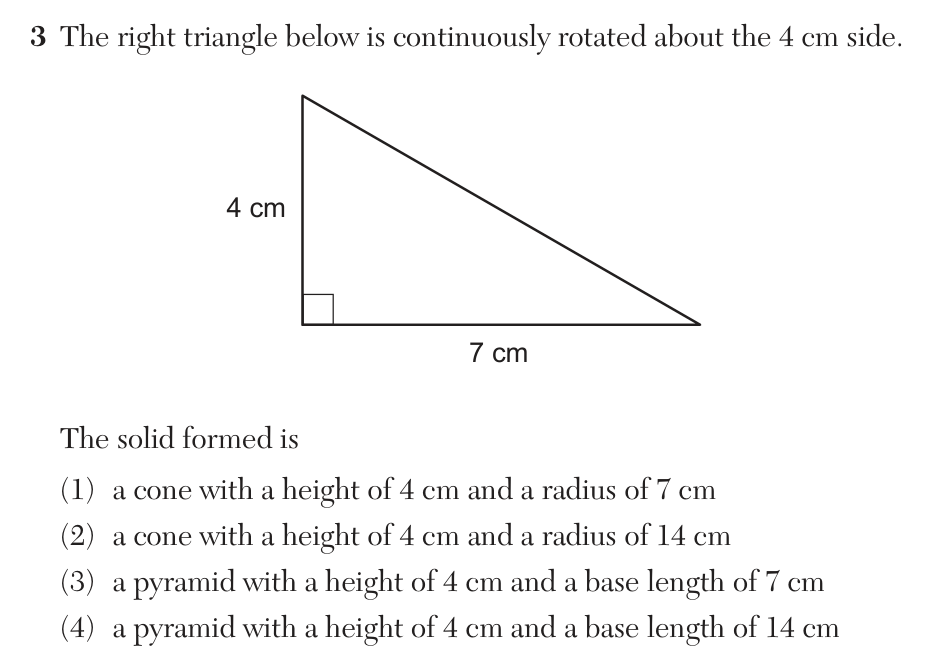
- The 4-centimeter leg is the fixed axis of rotation, so it becomes the height of the solid.
- The perpendicular 7-centimeter leg sweeps out a circular base. Its length is the radius, while the hypotenuse sweeps out the sloping surface.
Exam detail: The rotating leg is a radius, not the diameter.
Question 4: Find an exterior angle of an isosceles triangle
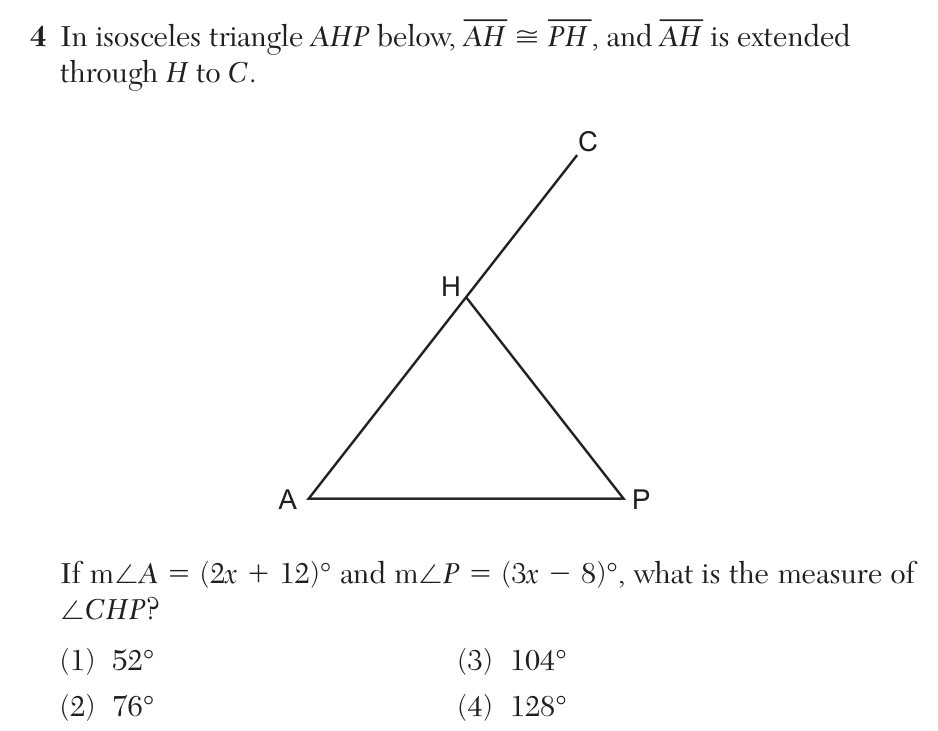
- Equal sides imply equal base angles at A and P. Set their expressions equal:
- Each base angle is .
- The exterior angle at H equals the sum of the two remote interior angles:
Exam detail: The interior vertex angle is 76°, but the question asks for the exterior angle.
Question 5: Recover the center of a dilation
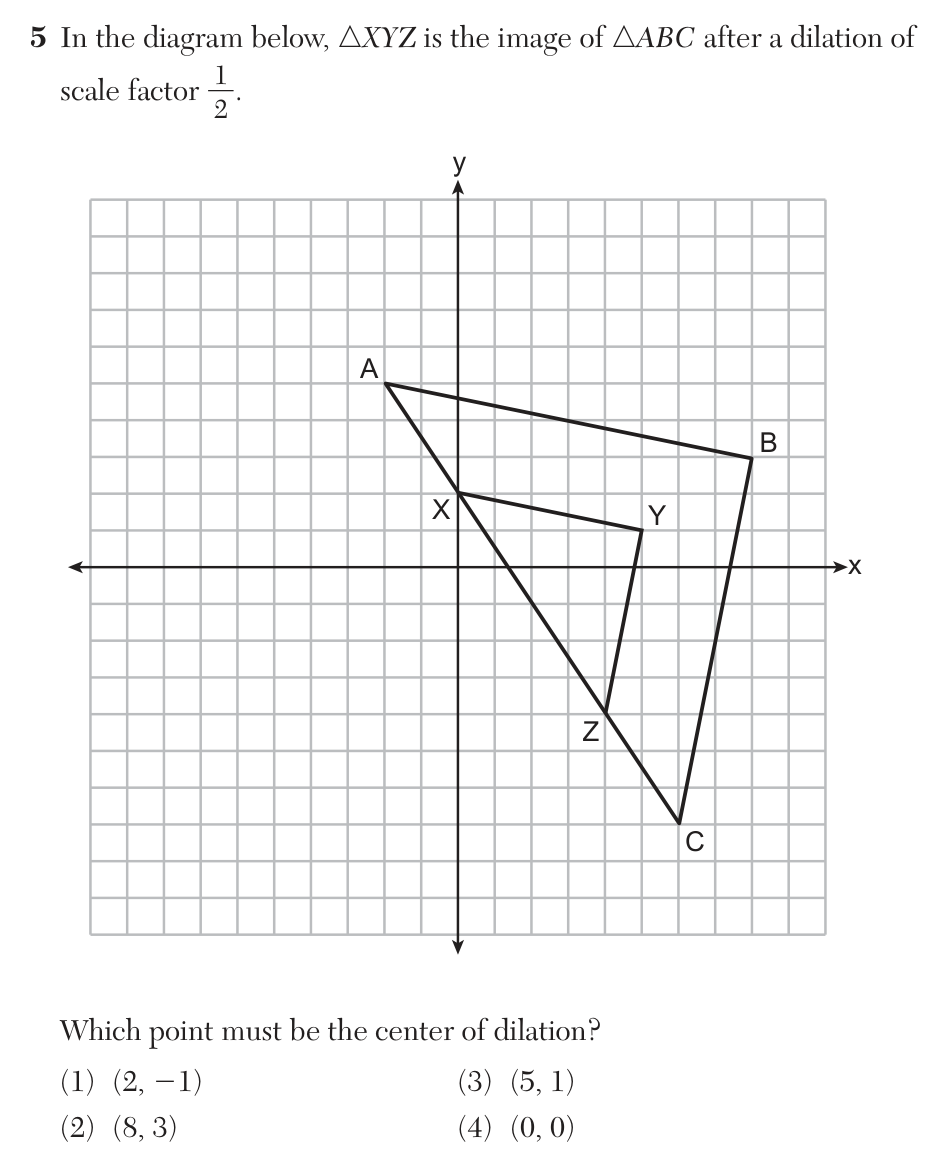
- The scale factor is one-half, so each image point is the midpoint of its original point and the center.
- From the graph, and . If the center is , the midpoint equations give:
- Solve to get and . The same center also makes Y the midpoint of B and the center, and Z the midpoint of C and the center.
Question 6: Recognize complementary acute angles
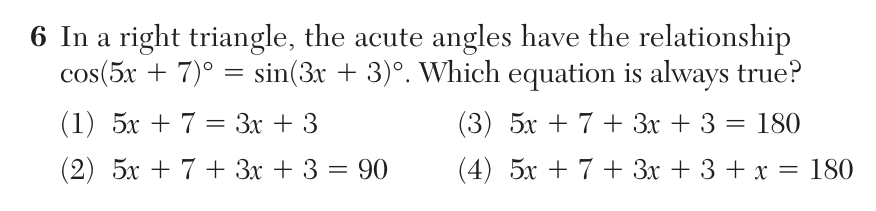
- For acute angles, the cosine of one angle equals the sine of its complement.
- Therefore the two angle expressions must add to 90°:
Exam detail: The two acute angles in a right triangle are complementary, not supplementary.
Question 7: Calculate arc length
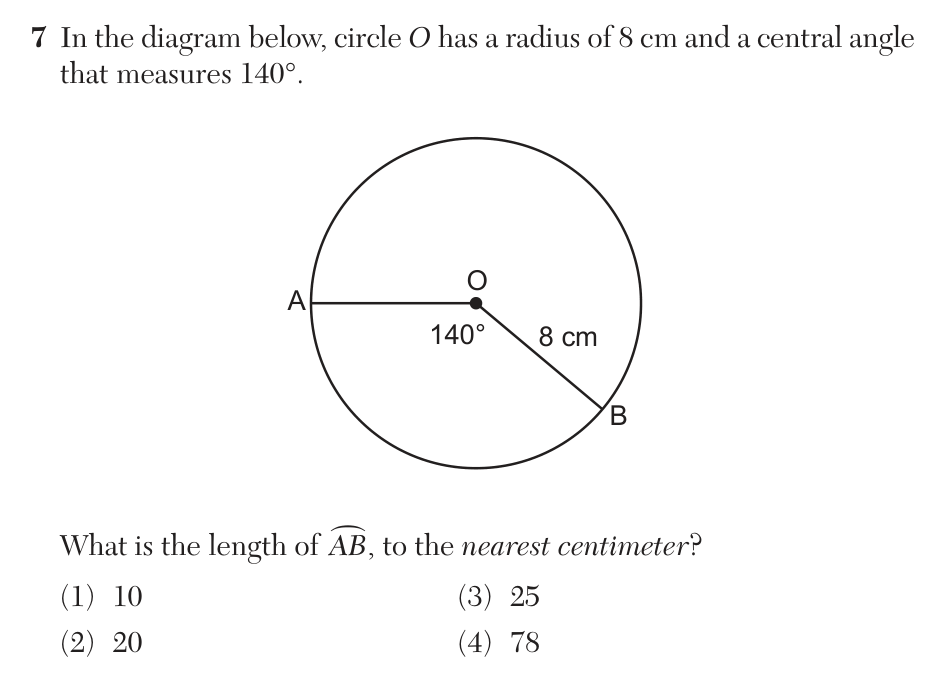
- The question asks for the curved arc AB. A 140° arc occupies of the full circumference.
- With radius 8 cm, apply the arc-length formula:
- This is approximately 19.55 cm, which rounds to 20 cm.
Exam detail: Arc length is a portion of the circumference. It is different from the straight chord connecting A and B.
Question 8: Use cone volume and round trips upward
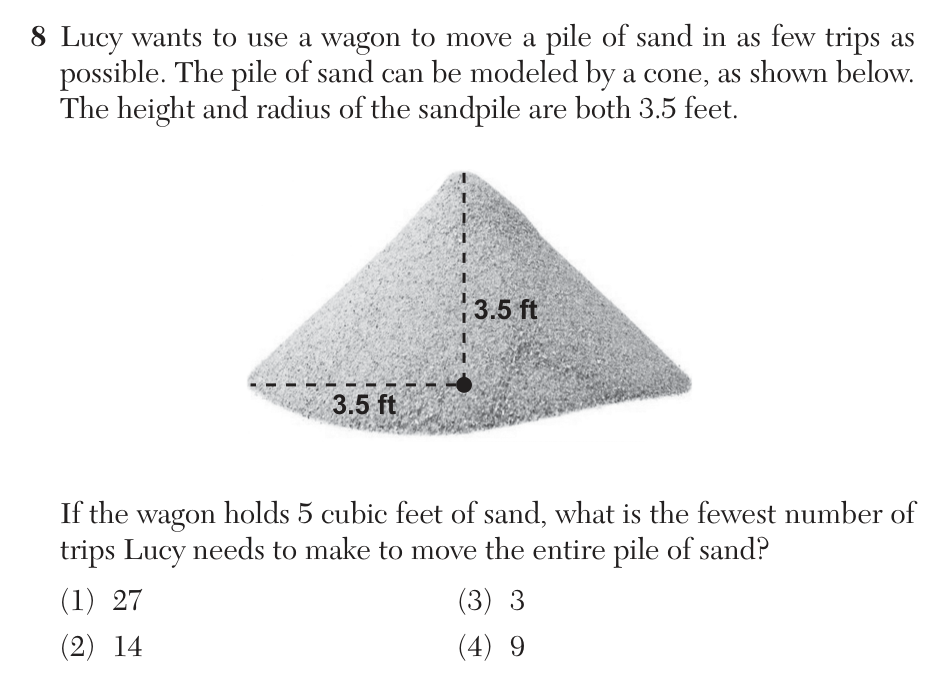
- The sandpile has radius and height both 3.5 feet. Its volume is:cubic feet.
- Divide by the wagon’s capacity of 5 cubic feet:
- Eight trips carry at most 40 cubic feet, which is insufficient. Nine trips carry up to 45 cubic feet, so nine is the minimum.
Exam detail: For a minimum whole number of trips, round upward whenever any sand remains.
Question 9: Separate similarity from congruence
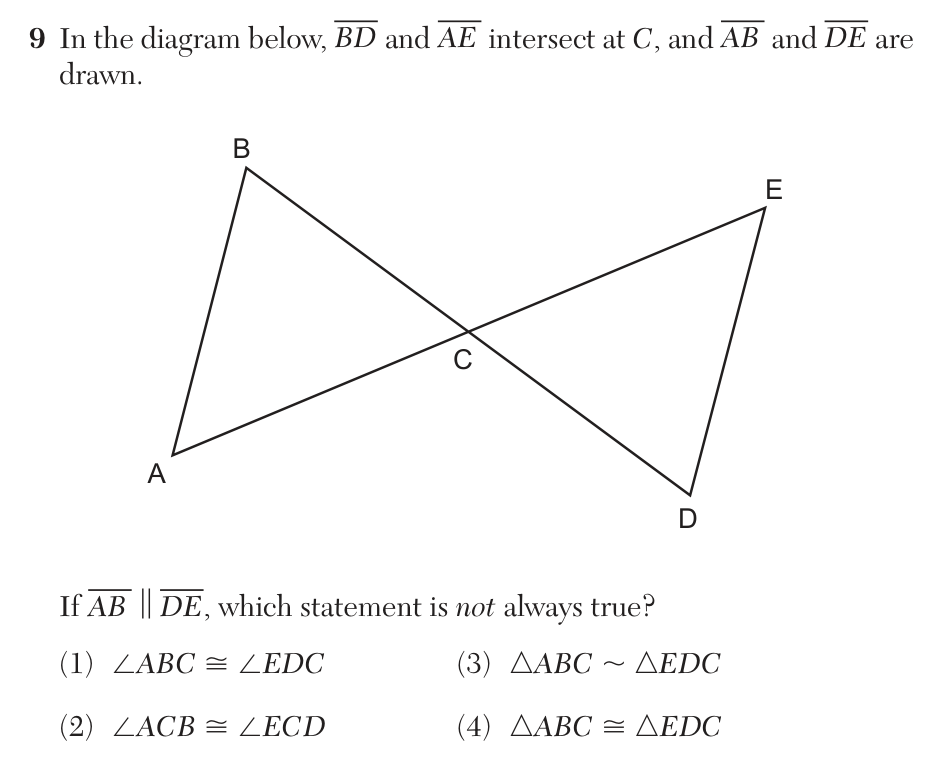
- Parallel sides produce a pair of congruent alternate interior angles, and the angles at C are vertical angles.
- Thus by AA similarity. The listed corresponding angle statements are also true.
- The given information does not force the scale factor to be 1. Similar triangles can have different side lengths, so congruence is not guaranteed.
Question 10: Find a roof angle with tangent
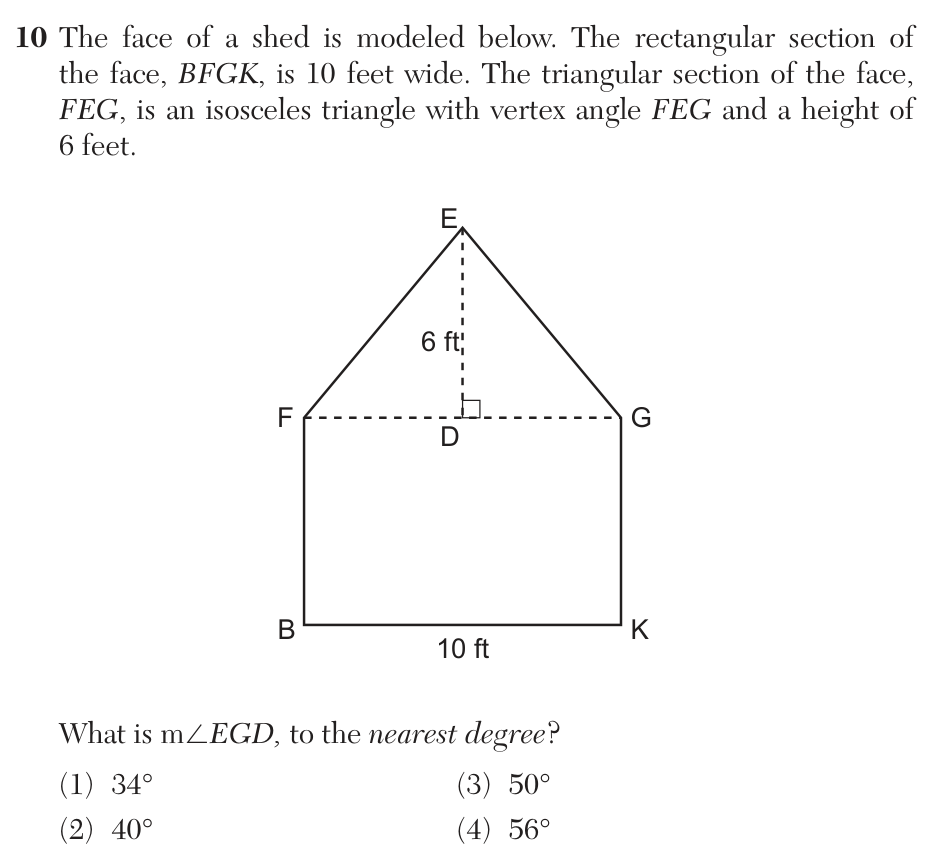
- The isosceles triangle’s altitude bisects its 10-foot base, so feet and feet.
- In right triangle EDG, relative to the angle at G, 6 is the opposite leg and 5 is the adjacent leg:
- Use inverse tangent in degree mode:
Question 11: Track a sequence of rigid motions
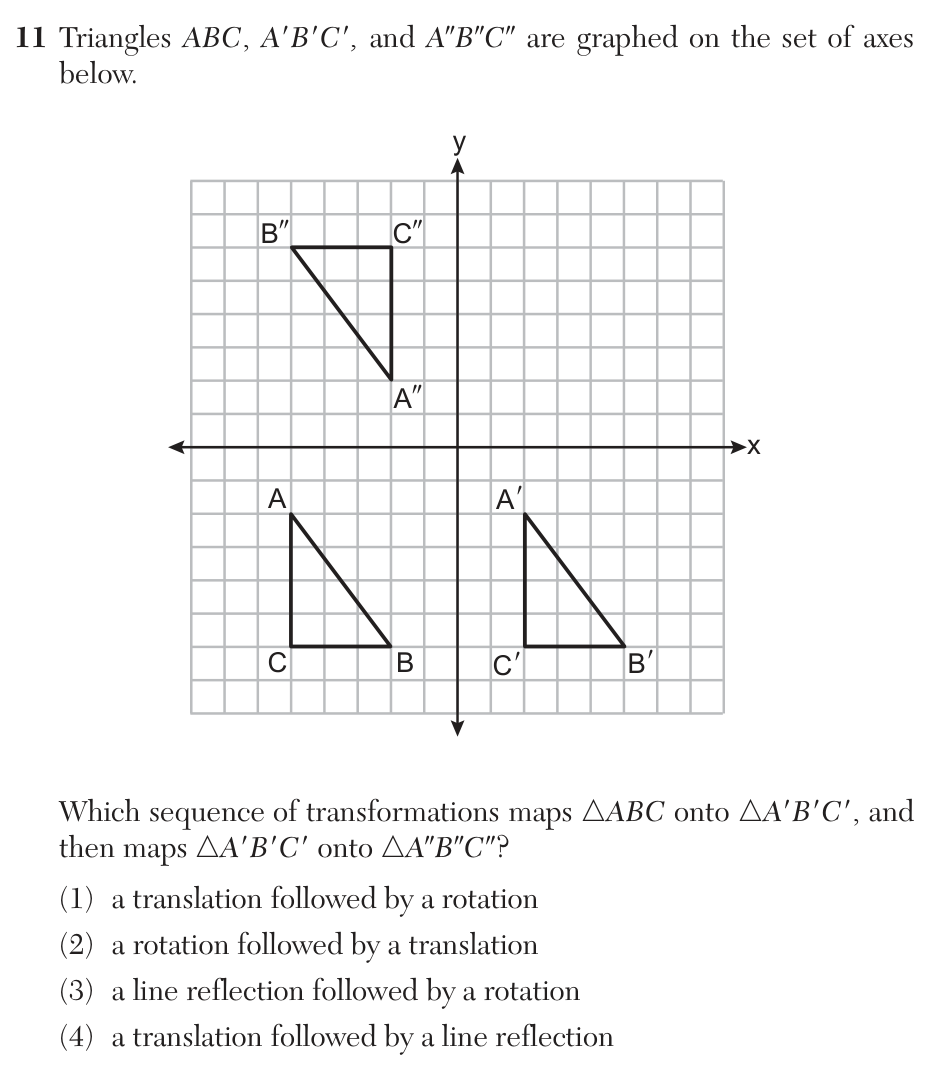
- The first image has the same orientation and is shifted seven units right: for example, . This is a translation.
- The next image follows . For example, and .
- That second rule is a 180° rotation about the origin.
Question 12: Find a perpendicular slope
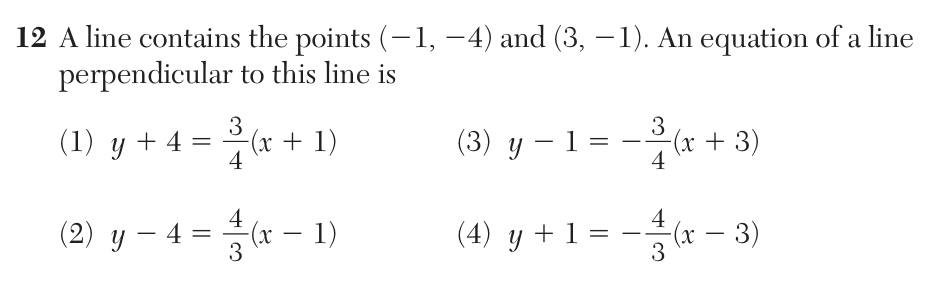
- Calculate the slope of the given line:
- A perpendicular line has slope equal to the negative reciprocal, .
- Only choice (4) has this slope:
Question 13: Use the equal legs of a right triangle
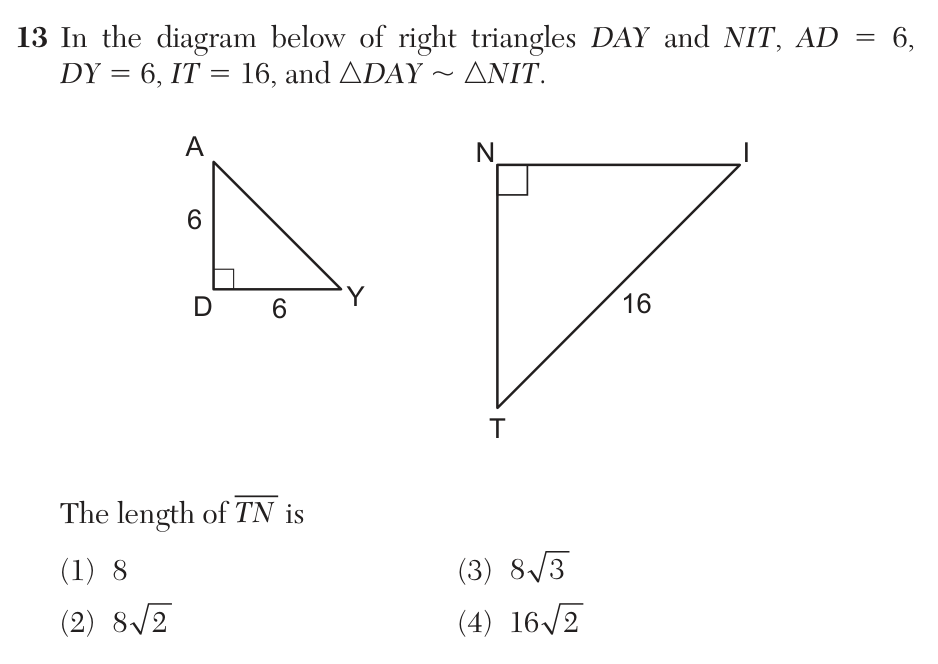
- The small right triangle has two equal legs of length 6, so it is a 45°–45°–90° triangle.
- Similarity gives the same angle structure in the larger triangle. Its hypotenuse IT is 16, so each leg has length .
- Simplify the exact value:
Exam detail: The length 16 is the larger triangle’s hypotenuse, not a leg.
Question 14: Find a sphere’s diameter from its volume
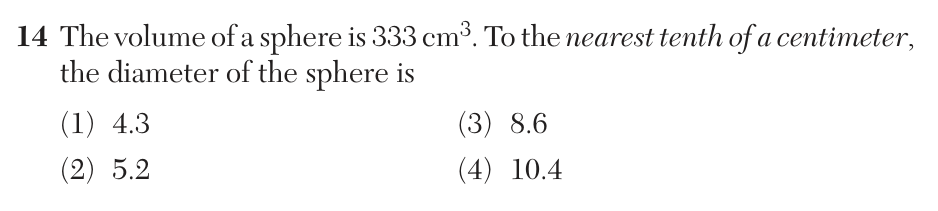
- Start with the sphere-volume formula and isolate the cube of the radius:
- Take the cube root to obtain cm.
- The diameter is twice the radius:Round to the nearest tenth of a centimeter.
Exam detail: Do not stop after finding the radius; the requested measurement is the diameter.
Try another radius or diameter with the sphere volume calculator.
Question 15: Combine parallel lines and a perpendicular segment
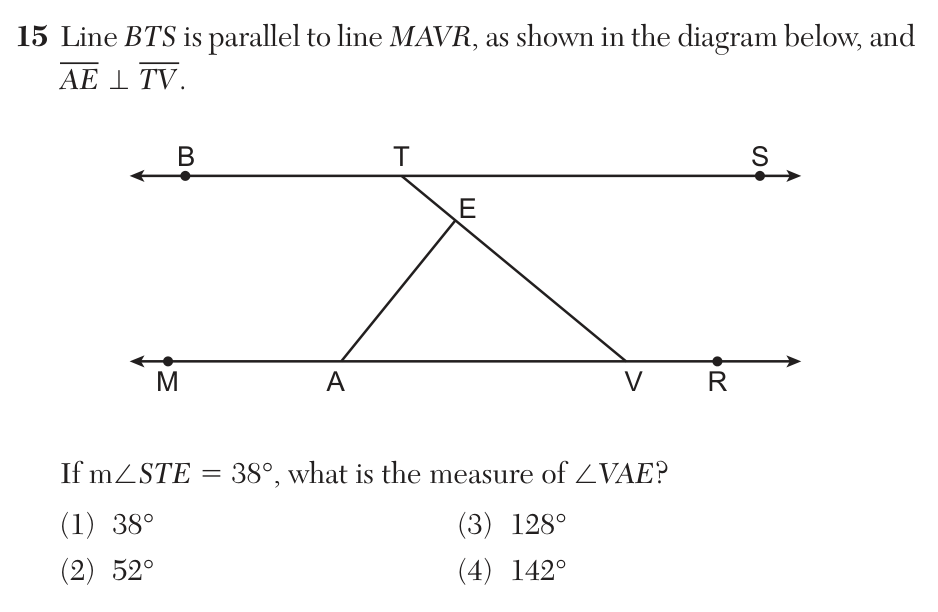
- Because the horizontal lines are parallel, alternate interior angles give .
- The condition makes .
- Use the angle sum in triangle AEV:
Question 16: Divide a segment in a given ratio
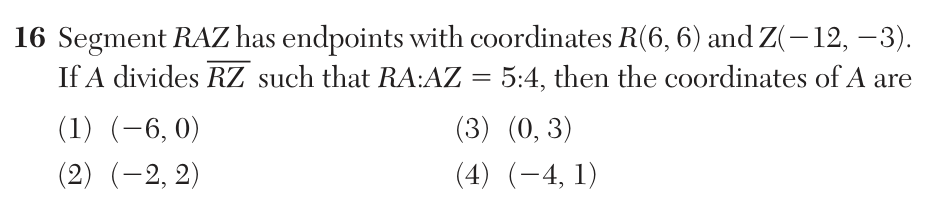
- The ratio means A is five-ninths of the way from R to Z.
- Apply that fraction separately to the change in each coordinate:
Exam detail: Use five of the total nine parts when starting at R.
Question 17: Use proportional segments in a triangle
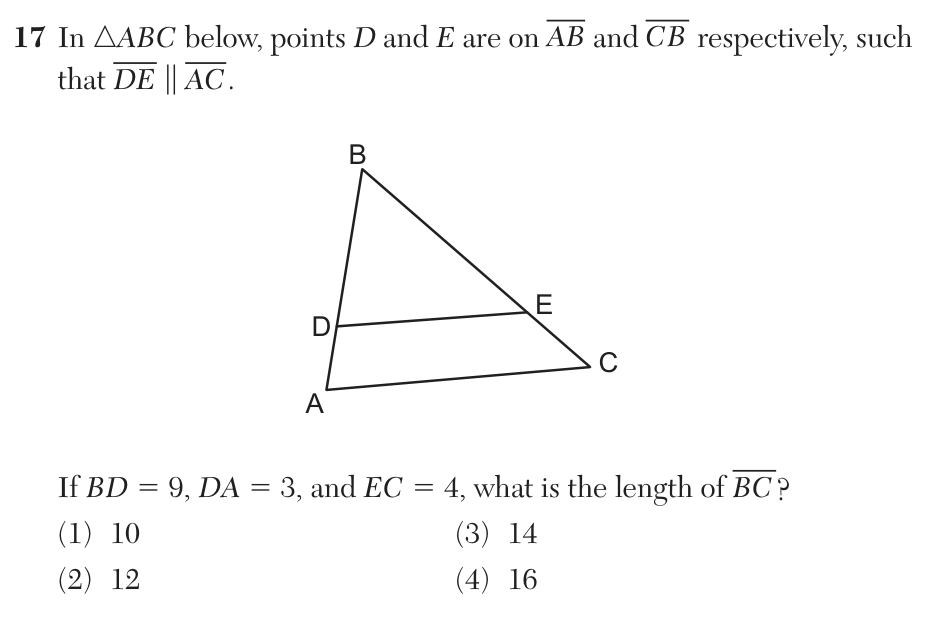
- A segment parallel to one side of a triangle divides the other two sides proportionally. Therefore:
- Substitute the given lengths and solve:
- The full side BC includes both pieces:
Exam detail: The intermediate result 12 is BE, not the complete side BC.
Question 18: Use what rigid motions preserve
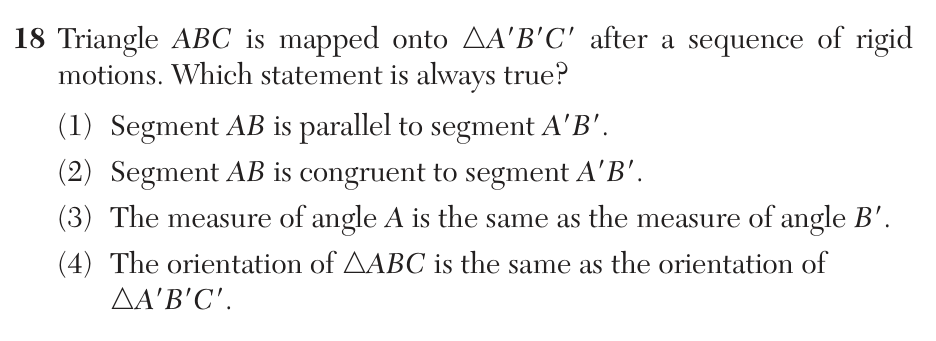
- Rigid motions preserve distances between corresponding points, so corresponding segments have equal lengths.
- Here A corresponds to A′ and B corresponds to B′, giving .
- Parallel position and orientation are not guaranteed for every sequence: rotations can change direction, and reflections reverse orientation.
Question 19: Put a circle equation in standard form
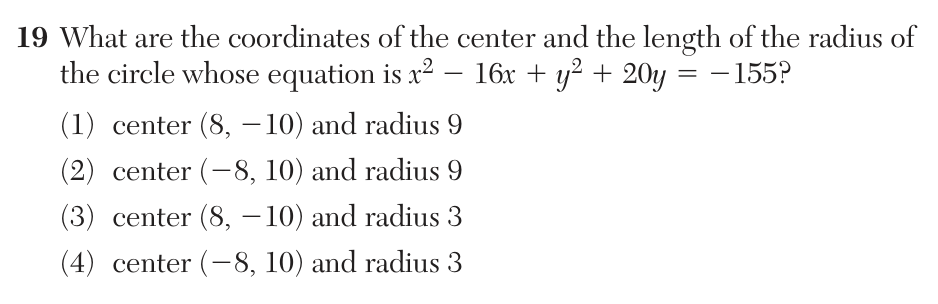
- Complete the square separately in x and y:
- Adding 64 and 100 to both sides changes the right side to . Thus:
- Compare with . The center is and the radius is .
Question 20: Compare population densities
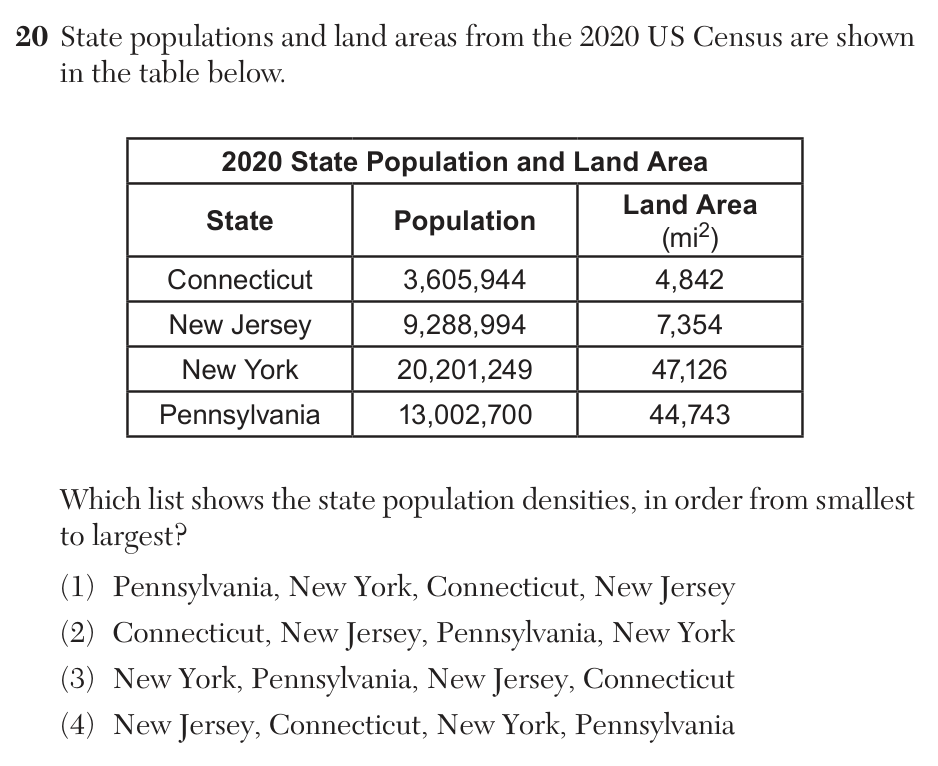
- Population density equals population divided by land area. Use the values supplied in the exam, with area measured in square miles.
- Compute each ratio in people per square mile:
Connecticut: .
New Jersey: .
New York: .
Pennsylvania: .
- Arrange these values from smallest to largest: .
Exam detail: Population alone does not determine density; the land-area denominator matters.
Question 21: Dilate a line about the origin
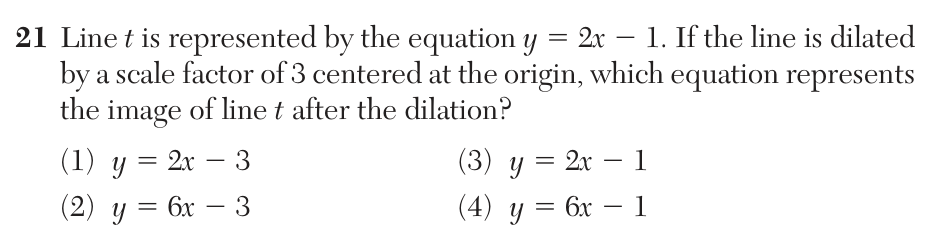
- Two convenient points on are and .
- A dilation of scale factor 3 multiplies both coordinates by 3, producing and .
- The image line has slope and y-intercept −3, so:
Exam detail: The slope stays the same; multiplying the coordinates does not triple the line’s slope.
Question 22: Add the condition that makes a parallelogram a rhombus
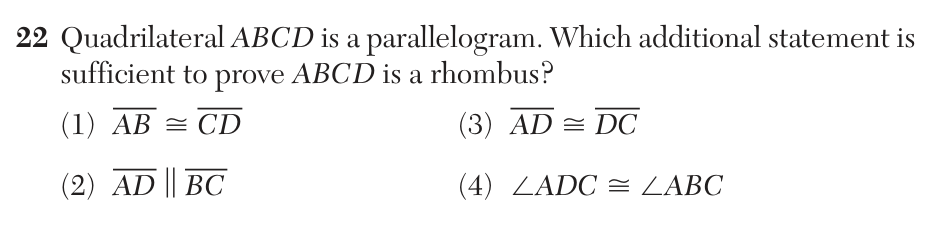
- A parallelogram already has two pairs of equal opposite sides.
- Adding equality of adjacent sides, , forces all four sides to have the same length.
- A parallelogram with all four sides congruent is a rhombus.
Exam detail: The other listed conditions already hold for every parallelogram.
Question 23: Use the right-triangle leg theorem
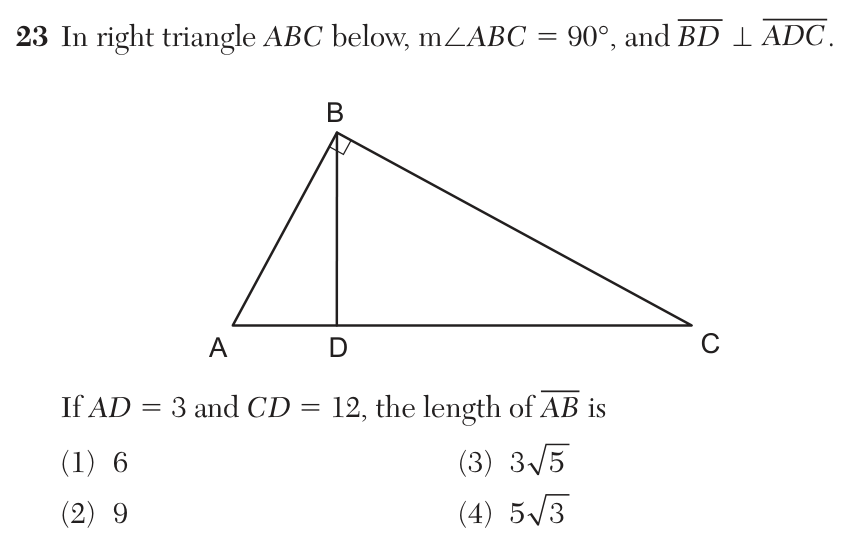
- The entire hypotenuse is .
- With an altitude to the hypotenuse, a leg squared equals the hypotenuse times that leg’s adjacent hypotenuse segment. For leg AB, that segment is AD:
- Take the positive square root because a side length is positive:
Question 24: Use the centroid’s two-to-one ratio
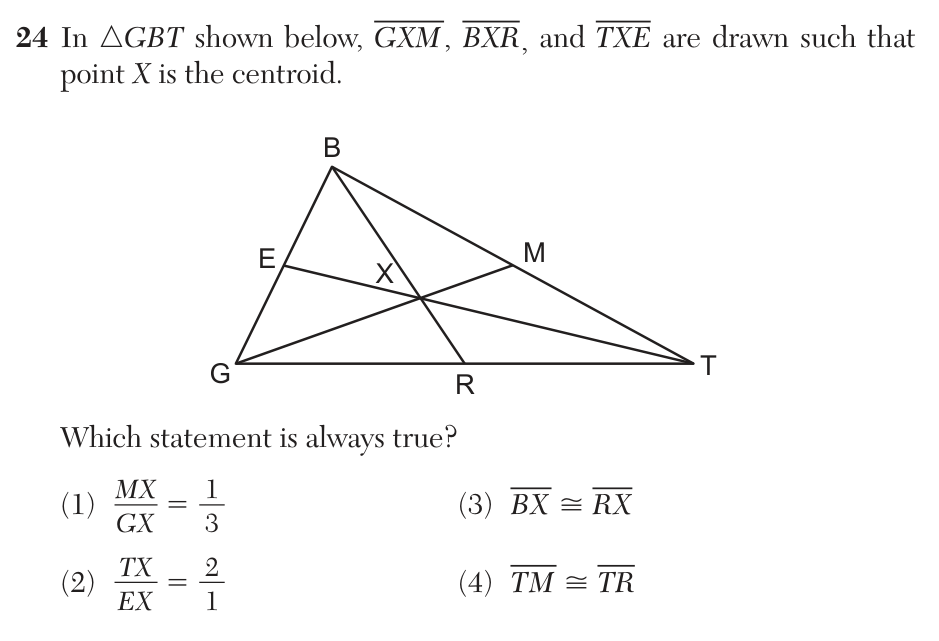
- A centroid divides every median in a 2:1 ratio, with the longer part next to the triangle’s vertex.
- On median TE, the vertex-to-centroid piece is TX and the centroid-to-midpoint piece is XE. Therefore:
Exam detail: The one-third ratio applies to the short piece divided by the whole median, not the short piece divided by the long piece.
Part II: Short constructed responses
Questions 25–31 • 2 credits each • 14 credits total
Question 25: Apply the two transformations in order
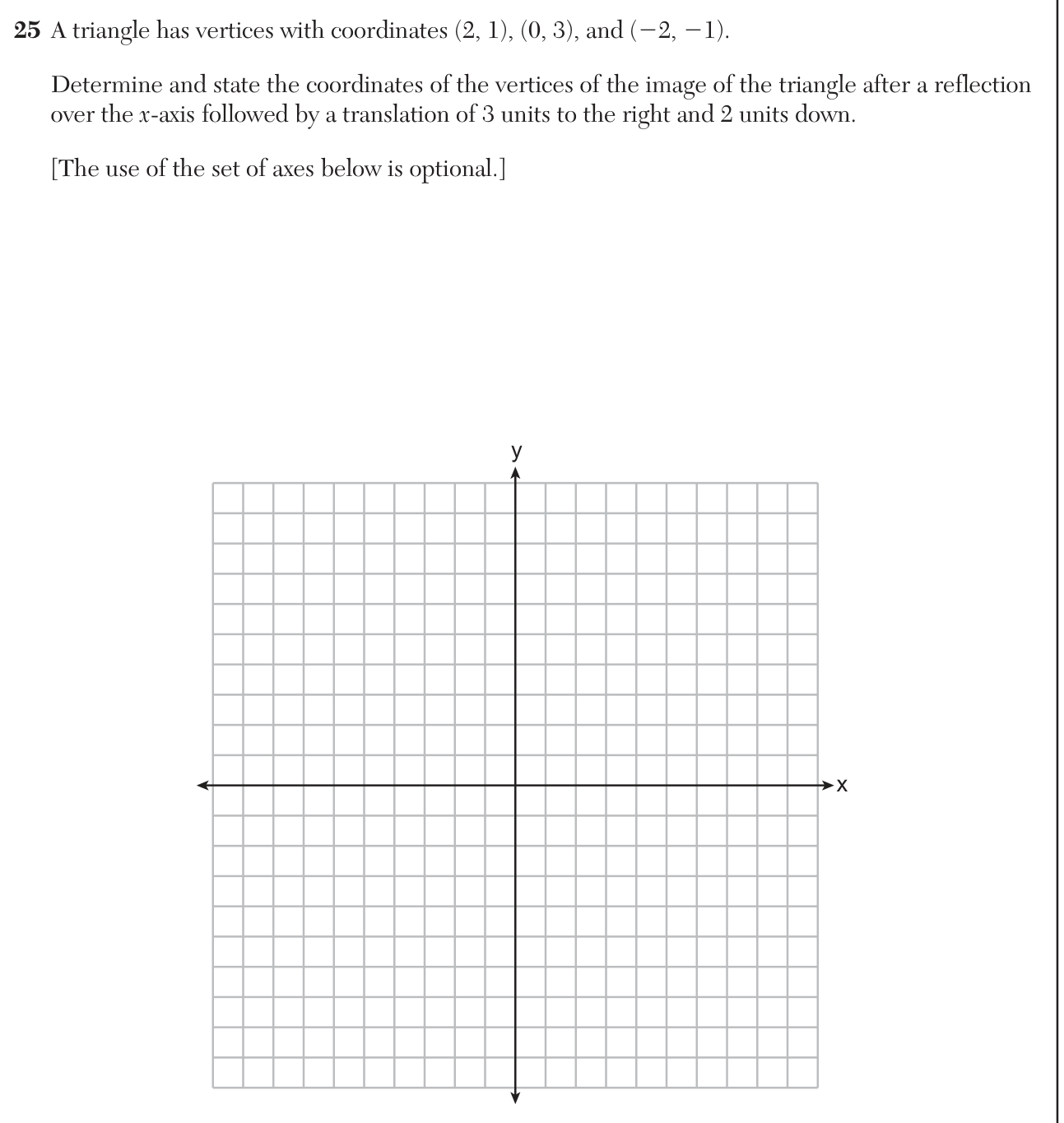
- Reflect over the x-axis first, using . Then translate three units right and two units down.
- The combined rule is . Apply it to each vertex:
Coordinates after each transformation Original After reflection After translation
Exam detail: Order matters. The downward translation occurs after the reflection.
Question 26: Convert cylinder volume into topsoil weight

- The bucket’s inside diameter is 10 inches, so the radius is 5 inches.
- Calculate the volume using the inside dimensions:The volume is measured in cubic inches.
- Multiply by the given weight per cubic inch:Round to the nearest pound.
Exam detail: Use the radius in the cylinder formula, and retain π until the final calculation.
Explore the radius and height relationship with the cylinder calculator.
Question 27: Use cosine to find an adjacent leg

- The right angle is at R, so ST is the hypotenuse. Relative to angle S, side SR is the adjacent leg.
- Write the cosine ratio and solve:
- Round the length to the nearest tenth.
Exam detail: Use degree mode. The question does not specify a physical unit.
Question 28: Find triangle area from two sides and their included angle
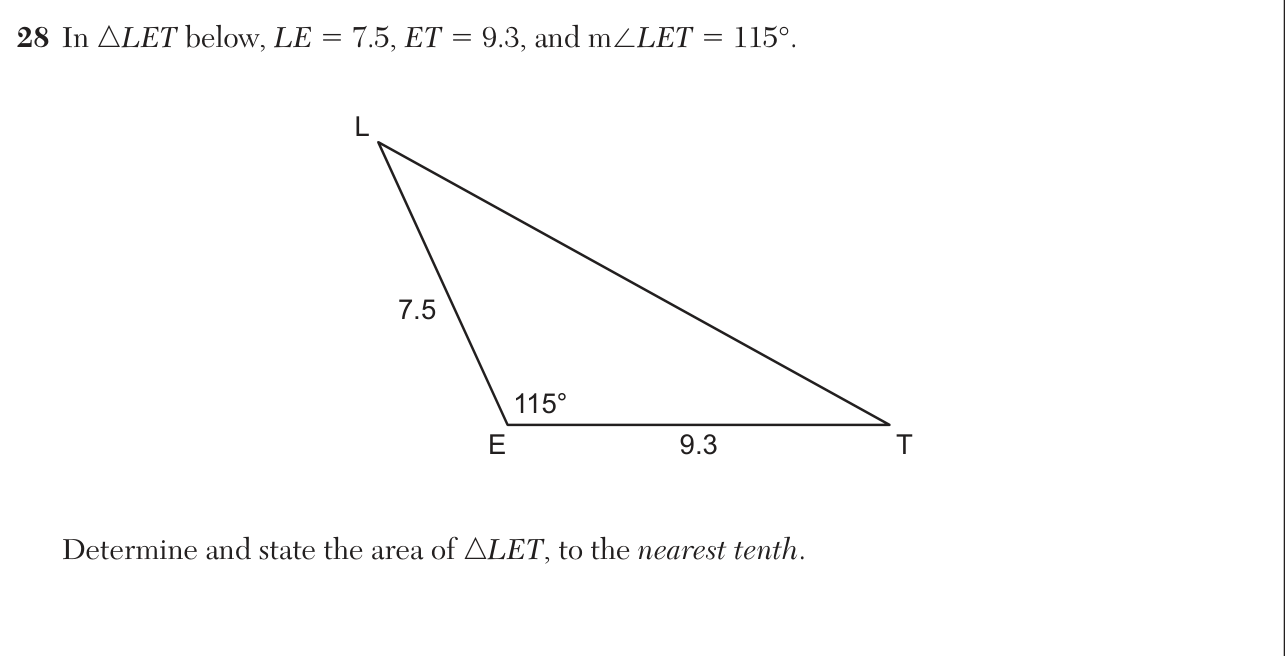
- The given angle 115° is between sides LE and ET, so use .
- Substitute both adjacent side lengths and the included angle:
- Round only the final area to the nearest tenth.
Exam detail: The area formula also applies when the included angle is obtuse.
Question 29: Subtract the pool area from the outer circular area
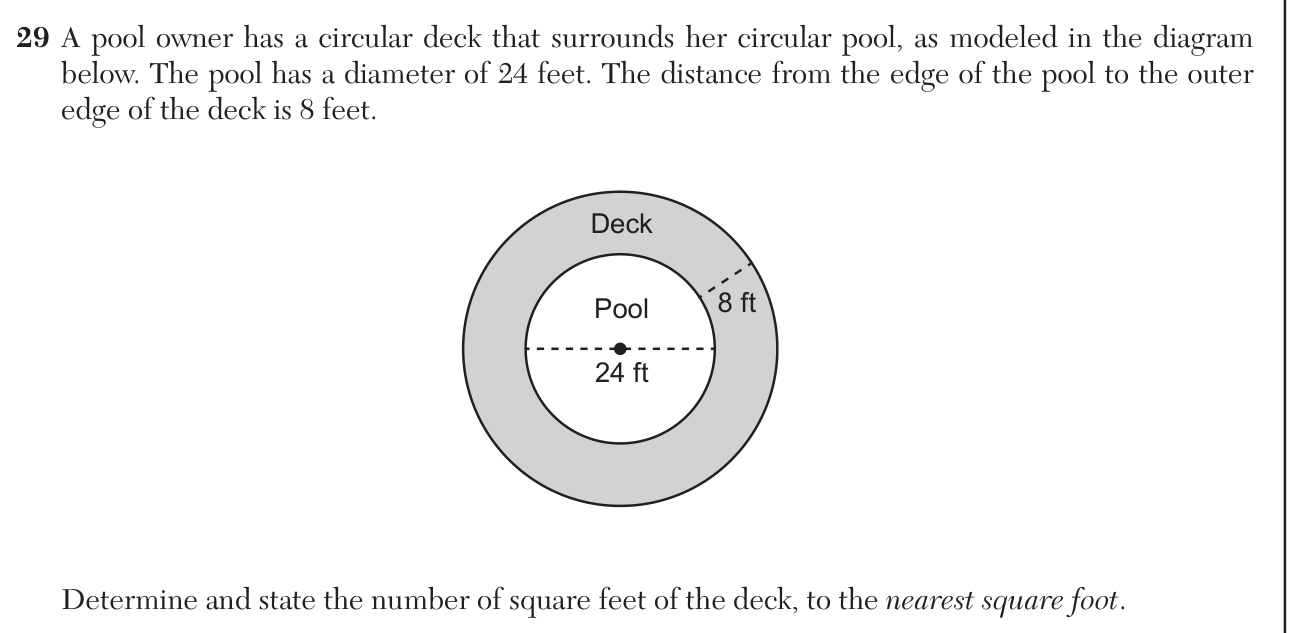
- The pool’s diameter is 24 feet, so its radius is 12 feet. The deck adds 8 feet radially, giving outer radius feet.
- Subtract the inner disk from the outer disk:
- The area is approximately 804.2477 square feet, which rounds to 804 square feet.
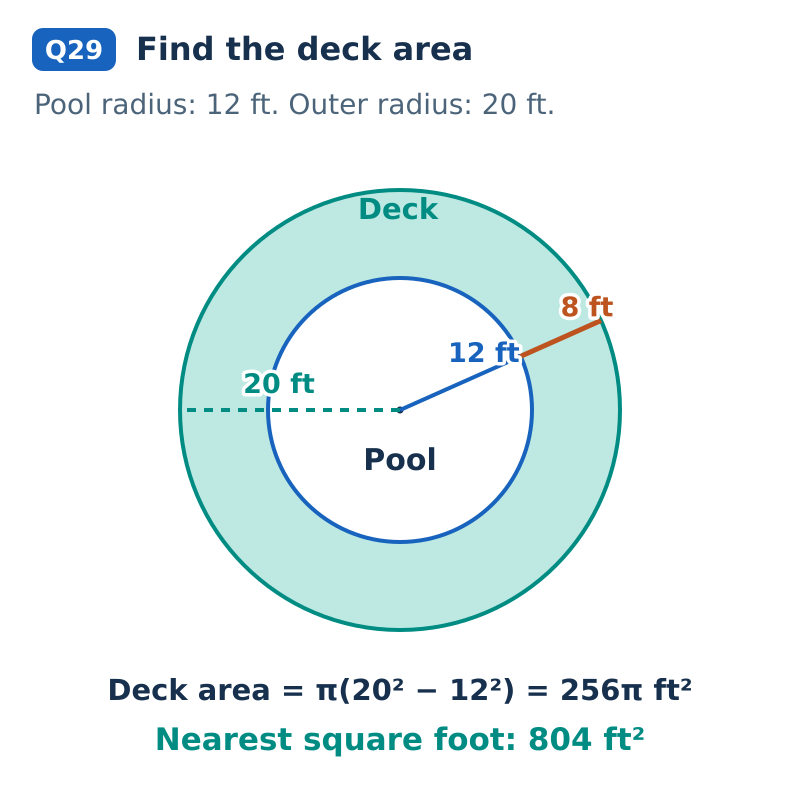
Exam detail: The deck width is added to the pool’s radius, not used as the outer radius.
Question 30: Construct an equilateral triangle with compass marks
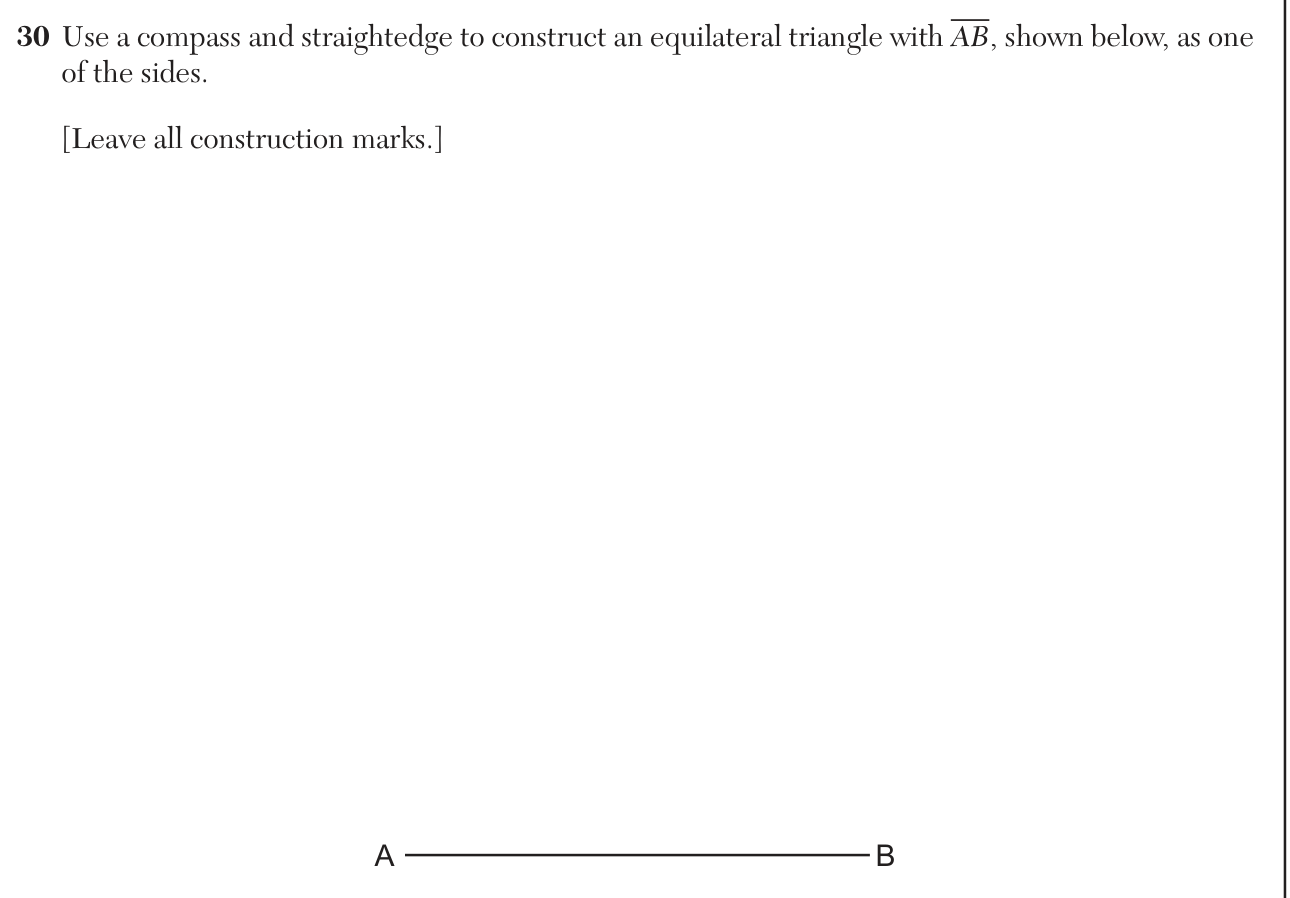
- Open the compass to the length of the given segment AB. Keep that compass setting unchanged.
- With center A, draw an arc or circle passing through B. With center B and the same radius, draw another arc or circle that intersects the first.
- Label either intersection C. Use the straightedge to draw segments AC and BC, retaining the construction marks.
- Because both circles have radius AB, and . Therefore all three side lengths are equal, so triangle ABC is equilateral.
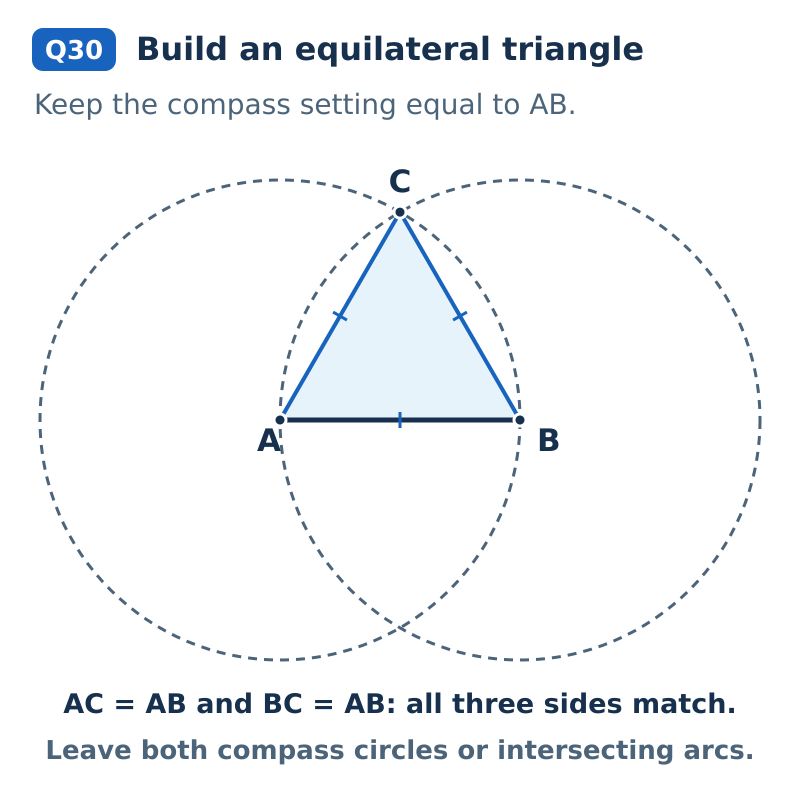
Exam detail: A triangle outline without the intersecting construction marks does not show the requested construction. Either side of AB can be used.
Question 31: Explain why the hypotenuse is a diameter
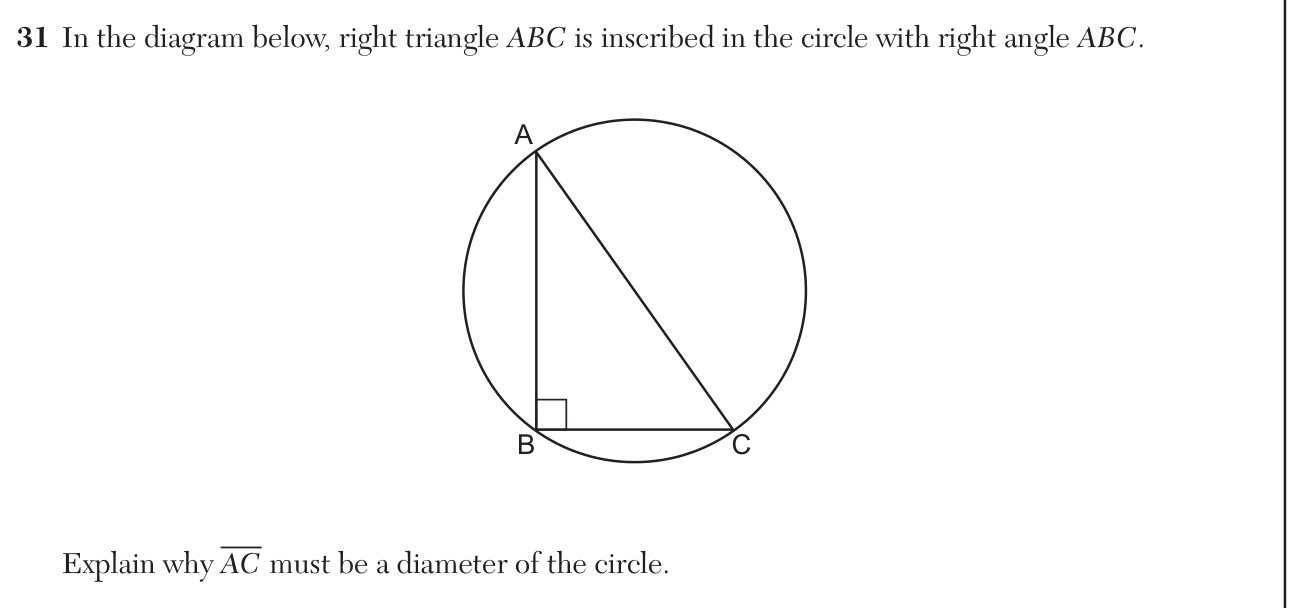
- Angle ABC is an inscribed angle with measure 90°. An inscribed angle measures half its intercepted arc.
- Therefore the arc AC that does not contain B measures , making it a semicircle.
- The chord joining the endpoints of a semicircle passes through the center of the circle. Thus AC is a diameter.
Exam detail: The inscribed-angle theorem supplies the reason; the appearance of the drawing alone is not a proof.
Part III: Extended constructed responses
Questions 32–34 • 4 credits each • 12 credits total
Question 32: Find the perimeter of an isosceles triangle
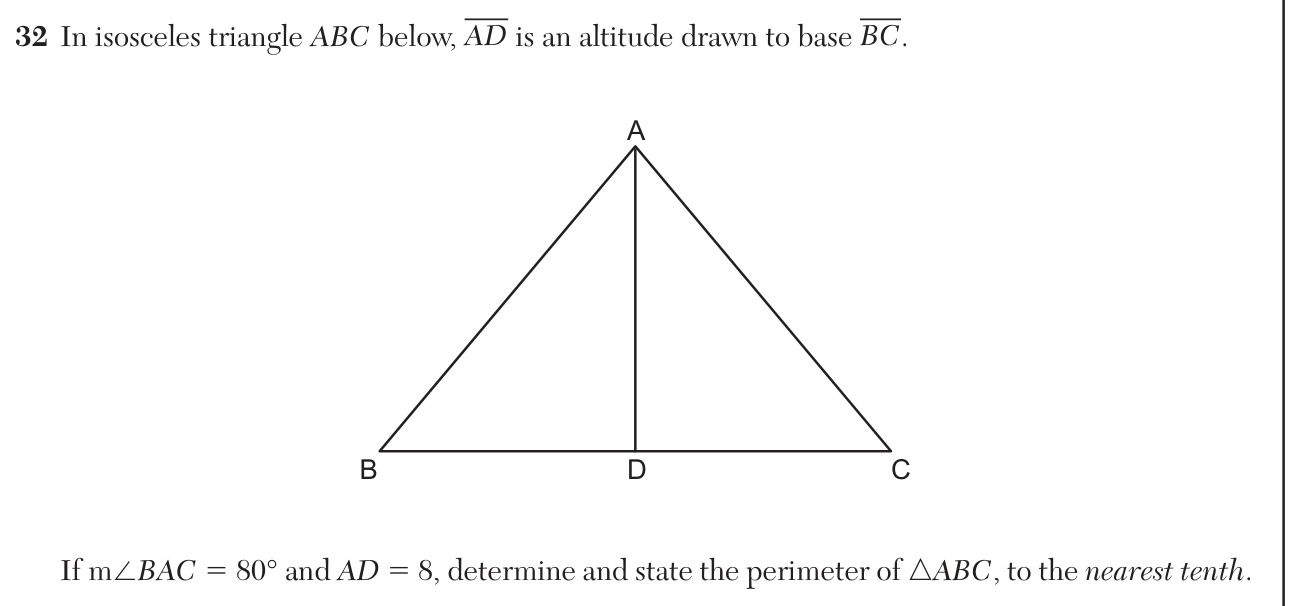
- The altitude from the vertex of an isosceles triangle bisects both the base and the vertex angle. Hence and .
- In right triangle ABD, use cosine for the equal side:
- Use tangent for half the base:
- Add both equal sides and both half-bases using the unrounded calculator values:
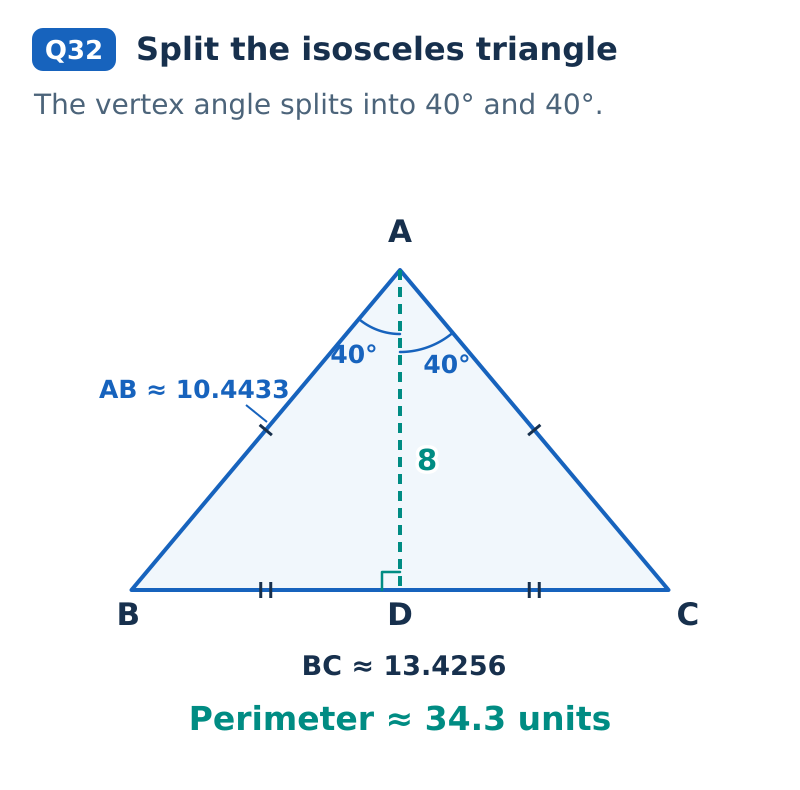
Exam detail: Rounding the side lengths to tenths before adding can change the final answer. Keep full precision until the perimeter is calculated.
Question 33: Prove the two triangles congruent
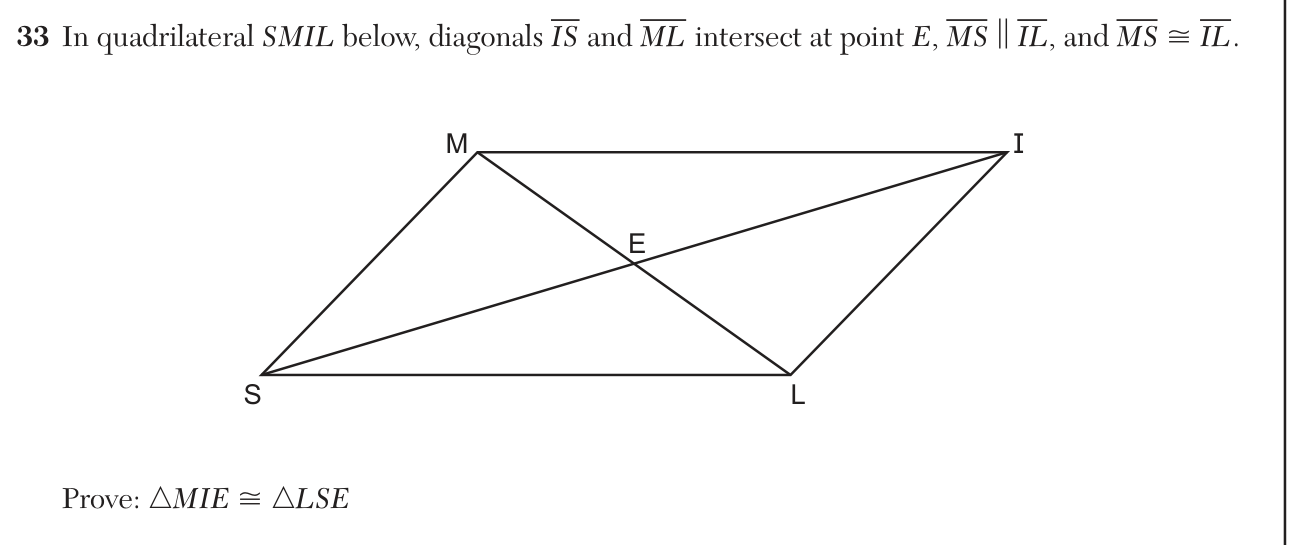
- The givens state and . These are opposite sides of quadrilateral SMIL.
- A quadrilateral with one pair of opposite sides both parallel and congruent is a parallelogram. Therefore SMIL is a parallelogram.
- The diagonals of a parallelogram bisect each other. Because the diagonals meet at E, and .
- The included angles at E are vertical angles, so .
- The two corresponding side pairs and their included angle are congruent. Therefore by SAS.
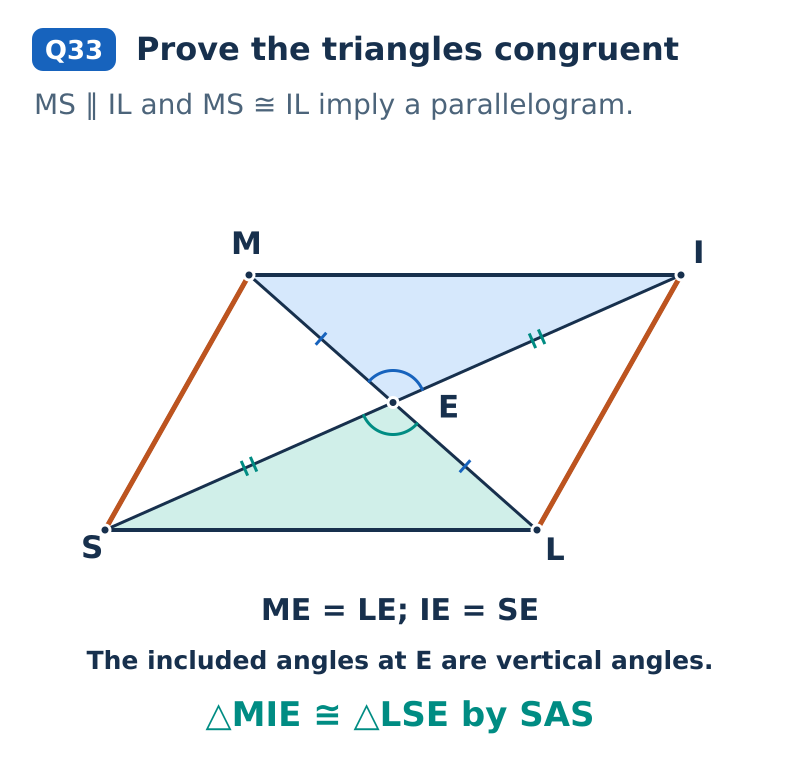
Exam detail: The correspondence is M to L, I to S, and E to E. Each stated fact has a geometric justification.
Question 34: Find the mass of a composite solid
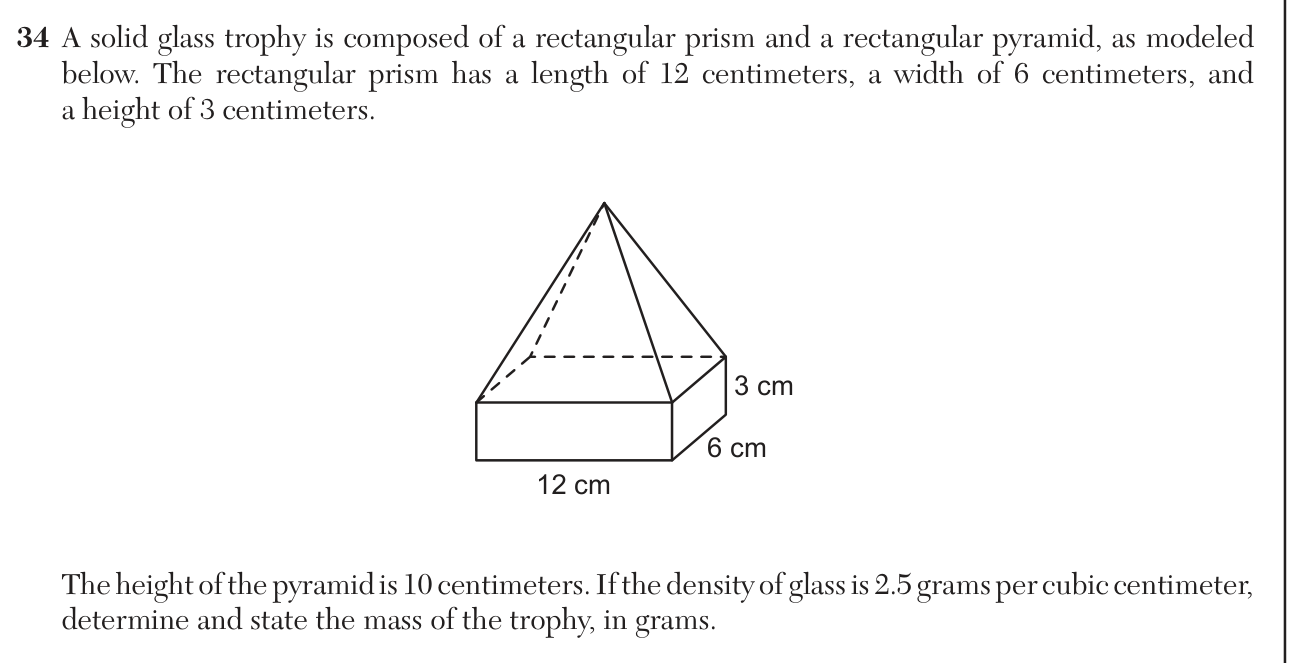
- The rectangular prism has volume:cubic centimeters.
- The pyramid shares the 12-by-6 base and has its own height of 10 centimeters:cubic centimeters.
- Add the component volumes:
- Multiply the total cubic centimeters by 2.5 grams per cubic centimeter:
Exam detail: The stated 10 centimeters is the pyramid’s height; do not subtract the prism’s height from it.
Part IV: Multi-step modeling problem
Question 35 • 6 credits
Question 35: Prove the trapezoid and verify its midsegment
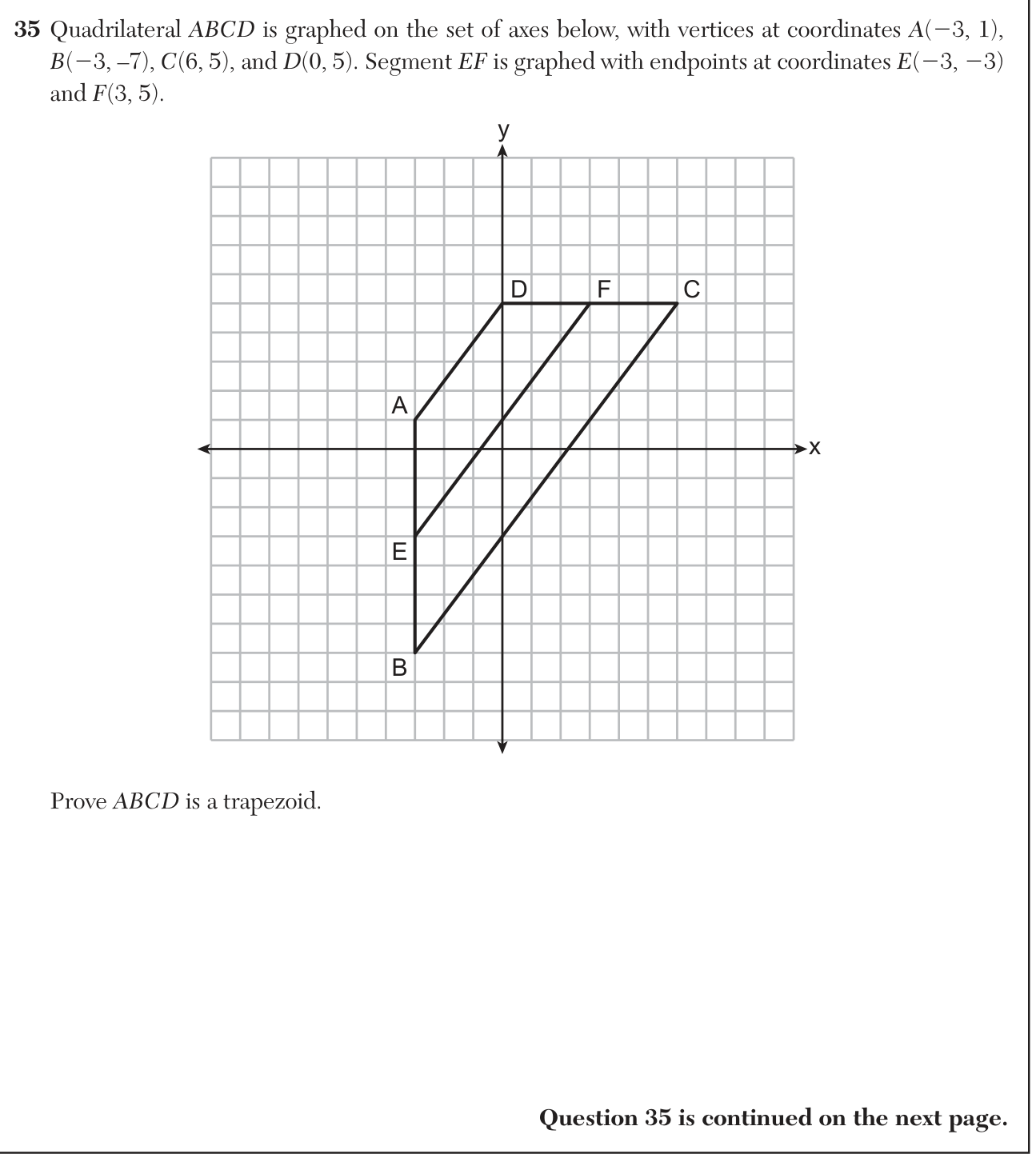
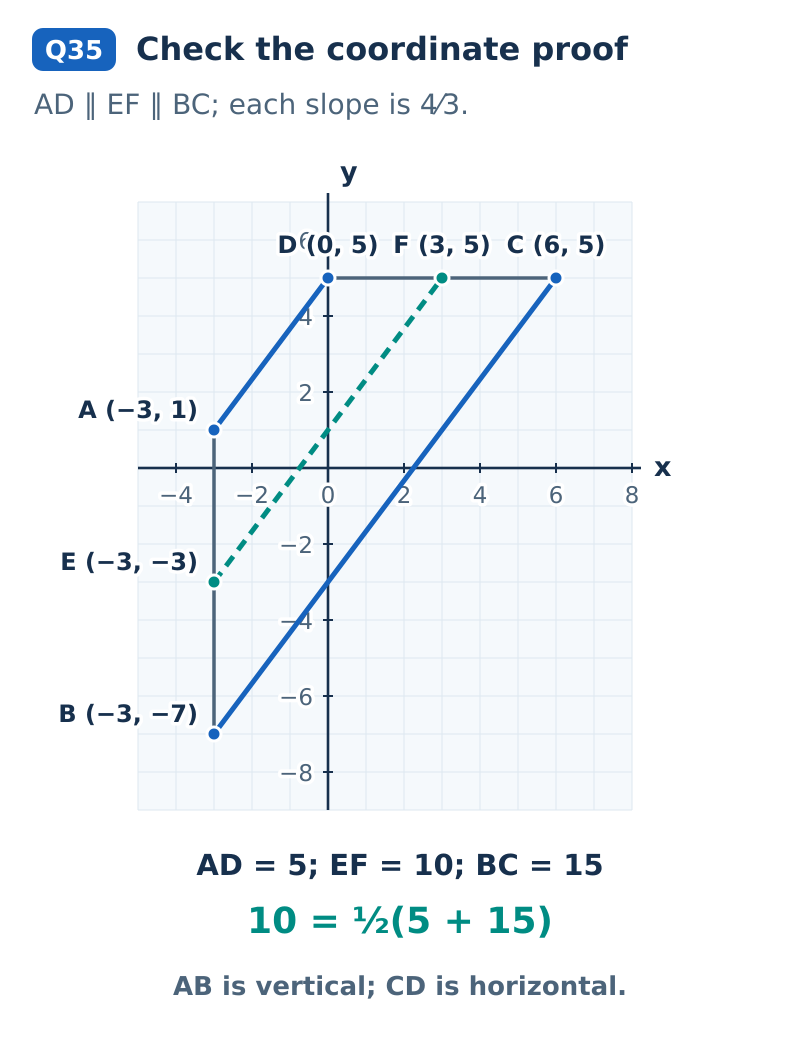
- First compare slopes of opposite sides AD and BC:Thus . Side AB is vertical because both x-coordinates are −3; CD is horizontal because both y-coordinates are 5. Those two sides are not parallel, so ABCD has exactly one parallel pair and is a trapezoid.
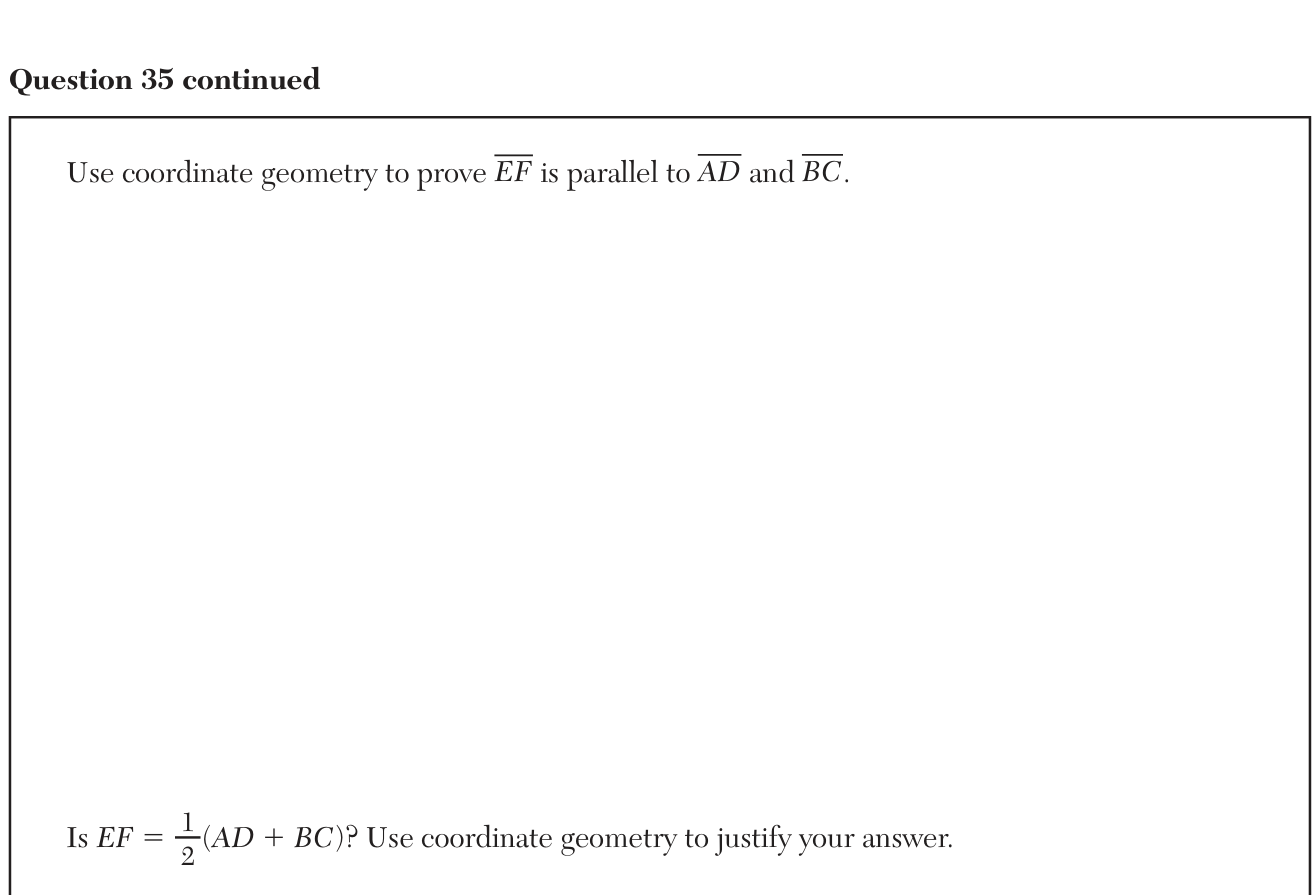
- For the segment joining E and F:Its slope equals both base slopes, proving and .
- Use the distance formula. The horizontal and vertical changes for AD are 3 and 4; for BC they are 9 and 12; for EF they are 6 and 8:
- Check the required relationship:Therefore the relationship is true.
Exam detail: This question continues on page 23. Include the trapezoid proof, the slope proof for EF, and the distance calculations with an explicit yes conclusion.
Check another coordinate example in the 2D Points mode of the distance calculator.
Check your score carefully
The maximum raw score is 80. Use the official January 2026 Geometry conversion chart for the scaled Regents score; another administration’s chart may give a different result. For related practice, see the January 2026 Algebra I Regents solutions.
Sources & References
Official materials accessed October 7, 2026. Question and scoring references use the English edition throughout this page.
- Official January 2026 Geometry examination (questions; PDF)
- Official January 2026 multiple-choice scoring key (PDF)
- Official January 2026 rating guide (PDF)
- Official January 2026 model response set (PDF)
- Official January 2026 conversion chart (PDF)
- NYSED Geometry past-examination index
- NYSED terms of use and reproduction conditions
From the New York State Education Department. Regents Examination in Geometry, January 2026. Internet. Available from the official examination link above; accessed 7 October 2026. Original question images are distinguished from HeLovesMath’s original explanations and solution diagrams.