
Comparing Fractions Calculator
Use this Comparing Fractions Calculator to compare two fractions, mixed numbers, negative fractions, proper fractions, and improper fractions. The calculator shows which fraction is greater, less, or equal using cross multiplication, common denominators, decimal values, simplified forms, and a visual fraction bar.
Compare Two Fractions Step by Step
Enter two fractions as numerator and denominator values. The calculator will compare them using exact fraction arithmetic, not only rounded decimals.
What Is a Comparing Fractions Calculator?
A Comparing Fractions Calculator is a math tool that determines whether one fraction is greater than, less than, or equal to another fraction. It is useful for students, teachers, parents, homeschoolers, test-prep learners, and anyone who needs to compare rational numbers clearly. Instead of guessing from the numerator or denominator alone, this calculator uses exact mathematical methods to compare the two values.
Fractions can be difficult to compare because the numerator and denominator work together. A larger numerator does not always mean a larger fraction, and a larger denominator does not always mean a smaller final value unless the numerators are the same and the fractions are positive. For example, \(\frac{5}{8}\) has a larger numerator than \(\frac{3}{4}\), but \(\frac{3}{4}\) is greater because \(\frac{3}{4}=0.75\) and \(\frac{5}{8}=0.625\).
This calculator compares fractions using several methods: cross multiplication, least common denominator, simplified forms, and decimal comparison. Cross multiplication is often the fastest exact method for two fractions. The common denominator method is helpful for learning because it turns both fractions into equivalent fractions with the same denominator. Decimal comparison is intuitive, but it can become less reliable when rounded values are used. That is why the calculator primarily relies on exact integer relationships and uses decimals as supporting evidence.
The tool supports proper fractions, improper fractions, negative fractions, and equivalent fractions. It also normalizes denominators so the denominator is positive, which makes the comparison easier to understand. For example, \(\frac{-2}{3}\) and \(\frac{2}{-3}\) represent the same value. The calculator treats them consistently and shows the result in a readable form.
Comparing fractions is a core skill in arithmetic, pre-algebra, algebra, ratios, proportions, measurement, probability, statistics, cooking, construction, finance, and science. Students need it when ordering rational numbers, solving inequalities, comparing rates, interpreting slopes, and working with proportions. A strong comparison tool should therefore do more than give an answer; it should show why the answer is correct.
How to Use the Comparing Fractions Calculator
Enter the numerator and denominator of the first fraction. Then enter the numerator and denominator of the second fraction. A numerator can be positive, negative, or zero. A denominator can be positive or negative, but it cannot be zero. If a denominator is negative, the calculator moves the negative sign to the numerator for a cleaner standard form.
Choose how many decimal places you want to display. The decimal value is helpful for understanding the size of each fraction, but the comparison itself is based on exact fraction logic. This prevents errors caused by rounding. For example, two fractions may look similar when rounded to two decimal places, but exact comparison may still show one is greater.
Select a method display option. The default setting shows all methods: cross multiplication, common denominator, simplification, and decimal comparison. If you only want to teach or review one method, choose cross multiplication, common denominator, or decimal comparison from the dropdown.
Click Compare Fractions. The result area will show the correct inequality symbol: greater than \(>\), less than \(<\), or equal to \(=\). It also shows decimal values, common denominator, cross products, visual bars, and step-by-step reasoning.
The Swap Fractions button switches the first and second fraction. This is useful for checking that the inequality direction changes correctly. For example, if \(\frac{3}{4}>\frac{5}{8}\), then after swapping, the calculator should show \(\frac{5}{8}<\frac{3}{4}\).
Comparing Fractions Formulas
For two fractions \(\frac{a}{b}\) and \(\frac{c}{d}\), where \(b\ne0\) and \(d\ne0\), the comparison can be made by cross multiplication when denominators are positive:
If \(ad>bc\), then \(\frac{a}{b}>\frac{c}{d}\). If \(ad The common denominator method uses the least common multiple of the denominators: Once denominators match, compare only the numerators:
Cross Multiplication Method
Cross multiplication is one of the fastest ways to compare two fractions. The method works because multiplying both fractions by the positive product of their denominators removes the denominators without changing the inequality direction. In practical terms, compare \(a\times d\) with \(c\times b\).
For example, compare \(\frac{3}{4}\) and \(\frac{5}{8}\). Cross multiply: \(3\times8=24\), and \(5\times4=20\). Since 24 is greater than 20, the first fraction is greater. Therefore, \(\frac{3}{4}>\frac{5}{8}\).
This method is exact and efficient. It is especially useful when the denominators are different and the least common denominator is not immediately obvious. It also avoids rounded decimal mistakes. However, students should understand why it works, not only memorize the arrow pattern. Cross multiplication compares the same scaled quantity on both sides of the inequality.
When negative denominators appear, it is best to normalize the fractions first by moving the negative sign to the numerator. This calculator does that automatically. Once denominators are positive, the cross multiplication rule is straightforward.
Common Denominator Method
The common denominator method rewrites both fractions so they have the same denominator. Once two fractions have equal denominators, the fraction with the larger numerator is greater. This method is very important for learning because it shows the meaning of fraction comparison visually: both fractions are being measured in equal-size pieces.
For example, compare \(\frac{2}{3}\) and \(\frac{3}{5}\). The least common denominator of 3 and 5 is 15. Rewrite \(\frac{2}{3}\) as \(\frac{10}{15}\), and rewrite \(\frac{3}{5}\) as \(\frac{9}{15}\). Since 10 fifteenths is greater than 9 fifteenths, \(\frac{2}{3}>\frac{3}{5}\).
The common denominator method is also useful for ordering more than two fractions. If several fractions all become equivalent fractions with one common denominator, their numerators can be compared directly. This is why the method appears often in elementary math, middle school math, and pre-algebra.
Decimal Comparison Method
Another way to compare fractions is to convert each fraction into a decimal by dividing the numerator by the denominator. For example, \(\frac{3}{4}=0.75\), and \(\frac{5}{8}=0.625\). Since 0.75 is greater than 0.625, \(\frac{3}{4}>\frac{5}{8}\).
Decimal comparison is easy to understand, especially when the decimals terminate. It is useful in calculators, measurement, money, and estimation. However, decimals can be misleading if rounded too early. For example, \(\frac{1}{3}\approx0.3333\) and \(\frac{333}{1000}=0.333\). If both are rounded to two decimal places, they may appear equal as 0.33, even though \(\frac{1}{3}\) is slightly greater. Exact fraction comparison avoids this issue.
This calculator displays decimal values for clarity, but the final inequality is determined using exact cross products. That makes the answer reliable even when decimal forms are repeating or rounded.
Comparing Negative Fractions
Negative fractions follow the same comparison rules as negative numbers. A number closer to zero is greater than a more negative number. For example, \(-\frac{1}{4}\) is greater than \(-\frac{1}{2}\) because \(-0.25\) is greater than \(-0.5\). This can feel counterintuitive because \(\frac{1}{2}\) is greater than \(\frac{1}{4}\), but the negative signs reverse their position on the number line.
The calculator handles negative numerators and denominators. If both numerator and denominator are negative, the fraction becomes positive. For example, \(\frac{-3}{-5}=\frac{3}{5}\). If only one part is negative, the whole fraction is negative. The standard form places the negative sign in the numerator or before the fraction.
When comparing negative fractions manually, using a number line or decimal values can help. Cross multiplication also works after denominators are normalized to positive values. This calculator includes both exact and decimal explanations so the result is easier to trust.
Comparing Fractions Examples
Example 1: Compare \(\frac{3}{4}\) and \(\frac{5}{8}\).
Example 2: Compare \(\frac{2}{3}\) and \(\frac{3}{5}\).
Example 3: Compare \(\frac{4}{6}\) and \(\frac{2}{3}\).
Example 4: Compare \(-\frac{1}{4}\) and \(-\frac{1}{2}\).
Common Mistakes When Comparing Fractions
The first common mistake is comparing only numerators. For example, a student may think \(\frac{5}{8}\) is greater than \(\frac{3}{4}\) because 5 is greater than 3. That is incorrect because the denominator changes the size of the parts. The correct comparison is \(\frac{3}{4}>\frac{5}{8}\).
The second mistake is comparing only denominators. A smaller denominator can mean larger pieces, but that only gives a shortcut when the numerators are the same and the fractions are positive. For example, \(\frac{1}{3}>\frac{1}{5}\), but this shortcut does not apply to \(\frac{2}{3}\) and \(\frac{4}{5}\).
The third mistake is rounding decimals too early. Fractions with repeating decimals can look equal when rounded, even when they are not exactly equal. Use cross multiplication or common denominators for exact comparison.
The fourth mistake is misunderstanding negative values. With negative fractions, the number closer to zero is greater. For example, \(-\frac{1}{10}\) is greater than \(-\frac{1}{2}\), even though \(\frac{1}{10}\) is smaller than \(\frac{1}{2}\).
Comparing Fractions Calculator FAQs
What does a comparing fractions calculator do?
It compares two fractions and shows whether the first fraction is greater than, less than, or equal to the second fraction.
How do you compare fractions with different denominators?
You can use cross multiplication or rewrite both fractions with a common denominator. The calculator shows both methods.
What is the cross multiplication rule for comparing fractions?
For \(\frac{a}{b}\) and \(\frac{c}{d}\), compare \(a\times d\) with \(c\times b\), assuming denominators are positive.
Can this calculator compare negative fractions?
Yes. It supports negative numerators and denominators and normalizes the sign before comparing.
Can two different-looking fractions be equal?
Yes. For example, \(\frac{4}{6}\) and \(\frac{2}{3}\) are equal because both simplify to the same value.
Is decimal comparison always reliable?
Decimal comparison is useful, but rounded decimals can be misleading. Exact methods such as cross multiplication are more reliable.
Important Note
This Comparing Fractions Calculator is for educational and general math use. It provides exact fraction comparison and step-by-step explanations, but students should still follow teacher instructions for showing work, simplifying fractions, using inequality symbols, and rounding decimal values.
How to Compare Fractions
Comparing fractions might seem challenging; it seems a bit like comparing apples and oranges. Fortunately, there are a few methods for comparing one fraction to another.
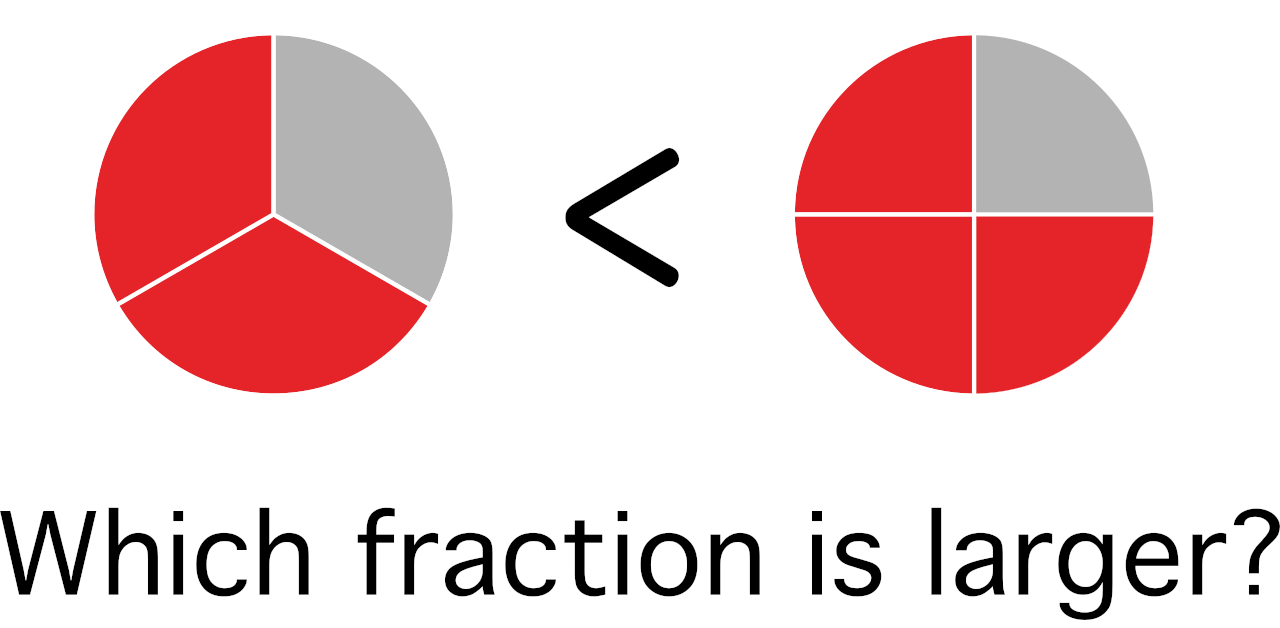
Method One: Compare Fractions by Converting to Decimal First
The first way to compare fractions is to convert them to a decimal value. Divide the numerator of each fraction by the denominator, then compare the decimal values.
You can also convert the fraction into a fraction with a denominator of 100. This will make it easier to divide the numerator by the denominator.
Here’s a tip: use our fraction to decimal calculator to get the decimal value for your fraction. You might also want to check out our decimal equivalents chart to see the decimal equivalents for common fractions.
Method Two: Compare Fractions By Finding the Common Denominator
Another way to compare fractions is to rewrite all the fractions to equivalent fractions with the same denominator. To do this, find the greatest common denominator, then make the denominators of each fraction equal.
Start by finding the lowest common denominator, which we sometimes refer to as the least common denominator. This is the smallest number that each denominator divides equally into. If you’re not sure how to do this, our lowest common denominator calculator will help you find it.
For example, let’s find the lowest common denominator of 6 and 9.
6 × 3 = 18
9 × 2 = 18
LCD = 18
Next, convert each fraction to an equivalent fraction with the common denominator. To do this, multiply both the numerator and denominator of each fraction by the same number so that they have the same denominator.
For example, convert 1/6 to a fraction with a denominator of 18.
18 ÷ 6 = 3
3 × 1 = 3
1/6 = 3/18
You’ll want to repeat this step for each fraction until they all have the same denominator.
You can also use an equivalent fractions calculator or our equivalent fraction chart to see equivalents for common fractions, which might help shortcut the conversion.
Finally, compare the numerators to find which fraction is the largest or smallest. The fraction with the larger numerator is the larger number.
For example, compare 3/18 to 2/18 to see which is largest.
numerator #1 = 3
numerator #2 = 2
3 > 2
Thus, 3/18 is greater than 2/18
Method Three: Compare Fractions With the Same Numerator
When fractions have the same numerator, compare them by comparing the denominators. When the numerators are the same, the fraction with the smaller denominator is larger.
Saying this a different way, the larger the denominator, the smaller the number is.
For example, to compare ⅖ and 2/7:
- The numerators of both fractions are the same.
- The denominator of the first fraction is 5, while the denominator of the second fraction is 7.
- 5 < 7, so we know that 2/5 is larger than 2/7.
Method Four: Cross Multiplication
To compare fractions using cross multiplication, you can start by writing the two fractions side by side and then multiplying the numerator of the first fraction by the denominator of the second fraction.
For example, let’s compare 2/7 and 3/5.
2 × 5 = 10
2/7 is equivalent to 10/35
Then, multiply the numerator of the second fraction by the denominator of the first fraction.
3 × 7 = 21
3/5 is equivalent to 21/35
Compare the two products. The fraction with the larger product is the bigger fraction!
Since 21 is larger than 10, we know that 3/5 is larger than 2/7.
In addition to these methods, our fraction calculator also makes it easy to compare fractions.
How to Compare Fractions to Decimals and Percentages
To compare a fraction to a decimal or percent, convert the fraction to either a decimal or percentage and then compare the values.
To convert a fraction to a decimal, divide the numerator by the denominator.
To convert a fraction to a percentage, first convert the fraction to a decimal, and then multiply the decimal by 100.
You can also convert both the fraction and percent into a decimal and compare both values as decimals. To convert a percent into a decimal, simply divide the percent value by 100.
Comparing numbers, fractions, and percentages is also an essential step in sorting a set of numbers from least to greatest.
Frequently Asked Questions
Why do we compare fractions?
We may compare fractions for multiple reasons:
- To determine which fraction is larger or smaller to compare quantities or measurements.
- To simplify fractions and identify common factors.
- To add or subtract fractions.
- To convert fractions to decimals or percentages.
Why is it easier to compare decimals instead of fractions?
Comparing decimals is easier than comparing fractions because decimals are based on the base-10 numbering system, which provides a more precise representation of the number’s size.
You can easily compare decimals by looking at their values to the right of the decimal point, while comparing fractions involves finding common denominators and additional calculations.
How do you compare fractions with whole numbers?
To compare a fraction to a whole number, convert the whole number to a fraction with the same denominator as the fraction you want to compare it to.
You can also convert the fraction to a decimal and compare the whole number to the value.
How do you compare more than two fractions at a time?
You can compare more than two fractions at a time using multiple methods, including:
- Find a common denominator: Convert the fractions so that they share a common denominator, and then compare the numerators. The fraction with the largest numerator is the largest fraction.
- Use cross-multiplication: Multiply the numerator of the first fraction by the denominator of the second fraction and compare it with the numerator of the second fraction multiplied by the denominator of the first fraction. Repeat this process for all pairs of fractions. The fraction with the largest product is the largest fraction.
- Order the fractions: Order the fractions from smallest to largest and then compare the first and last fractions.
