
HeLovesMath • Printable practice guide
Choose a geometry skill. Practise it with purpose.
Find 97 free Kuta Geometry PDF worksheets by topic, with guidance on printing, six original worked examples and ten questions to check your understanding.
97 worksheet links14 topic groupsOriginal worked practice
Looking for the files? Choose a topic below to jump straight to its PDF links in Sources & References. The worksheets remain hosted by Kuta Software; this guide’s explanations and self-check questions are original HeLovesMath material.
How to choose and use these printable geometry worksheets
These resources span several levels of secondary mathematics. Topic names alone do not establish a match to a particular grade, exam board or course. Preview the questions and follow your teacher’s sequence when it differs from the suggested route here.
A sensible route through the worksheet topics
- Build the foundations. Begin with geometric notation, measuring segments, naming angles and angle pairs. Refresh equations and square roots if the algebra is slowing you down.
- Connect angles and triangles. Study parallel lines, triangle angle sums and exterior angles. Then tackle congruence, making a habit of matching corresponding vertices.
- Use ratios and right triangles. Move through proportions and similarity before similar solids. Learn the Pythagorean theorem before special right triangles and trigonometry.
- Measure shapes. Practise perimeter and area, then circles, surface area and volume. Keep a sketch beside each calculation so every length has a clear role.
- Add coordinates and reasoning. Study plotting, midpoint and distance alongside translations, reflections and rotations. Use construction and proof exercises when you can explain the facts behind each step.
You do not need to complete every sheet. Try a few questions without help, identify the first step you cannot explain, and choose a worksheet for that gap. After marking, redo one missed question without looking at the solution. On another day, mix it with a different topic so you must choose the method yourself.
Before printing: scale, equipment and answer pages
For worksheets that ask you to measure printed lengths, select “Actual Size” or 100% scale. “Fit to page,” booklet printing and multiple pages per sheet can change those lengths. Check the paper size and print preview for clipping. If a calibration length is provided, check it with a ruler; otherwise ask your teacher to confirm the print scale before relying on measurements.
Have a ruler, protractor, pencil and any requested compass ready. Use a calculator only when permitted. A screen’s zoom level is not a reliable physical ruler. On calculation questions, use the stated measurements and diagram markings; an ordinary geometry sketch need not be drawn to scale.
The sampled Kuta PDFs include answer versions after the question pages. Preview your chosen file before printing, because the page count varies. Print the question pages first if you want to keep the answers hidden. Check the required units, exact form and rounding instructions before deciding that your answer disagrees with the key.
Read the notation before calculating
In ∠ABC, the middle letter B identifies the vertex. Matching tick marks identify equal segment lengths; matching angle arcs identify equal angles. Arrow marks can indicate parallel lines, and a small square indicates a right angle. The symbols ∥ and ⊥ mean parallel and perpendicular; ≅ means congruent and ∼ means similar. A prime, as in A′, labels the image of A after a transformation.
Write the reason as well as the result: “angles in a triangle total 180°” is more useful than an unexplained subtraction. Use cm for length, cm² for area and cm³ for volume. An answer involving π or a square root may be exact; a rounded decimal is an approximation.
Six worked geometry examples
1. Find angles using a triangle’s angle sum
A triangle has angles x°, (2x + 10)° and 50°. Find all three.
The interior angles of a plane triangle total 180°, so x + (2x + 10) + 50 = 180. Combine terms to get 3x + 60 = 180, giving x = 40. The angles are 40°, 90° and 50°. Substitute back into the expressions and check: 40 + 90 + 50 = 180.
The value of x is only one part of the answer. Whenever a diagram labels an angle with an expression, calculate that expression too. Continue with triangle angle sums before trying multi-step exterior-angle questions.
2. Distinguish congruence from similarity
Triangle A has side lengths 6, 8 and 10 cm. Triangle B has corresponding sides 9, 12 and 15 cm. A third triangle C has sides 6, 8 and 10 cm but is drawn in a different orientation.
For A to B, the corresponding ratios are 9 ÷ 6 = 12 ÷ 8 = 15 ÷ 10 = 1.5. Thus A and B are similar, with scale factor 1.5 from A to B. Their corresponding sides differ in length, so they are not congruent. A and C are congruent by SSS: all three matching side lengths agree.
Congruent figures have matching shape and size; similar figures have equal corresponding angles and proportional corresponding lengths. Congruent figures are also similar, with scale factor 1. Rotation or reflection of a drawing does not change these relationships.
3. Use Pythagoras only after identifying a right angle
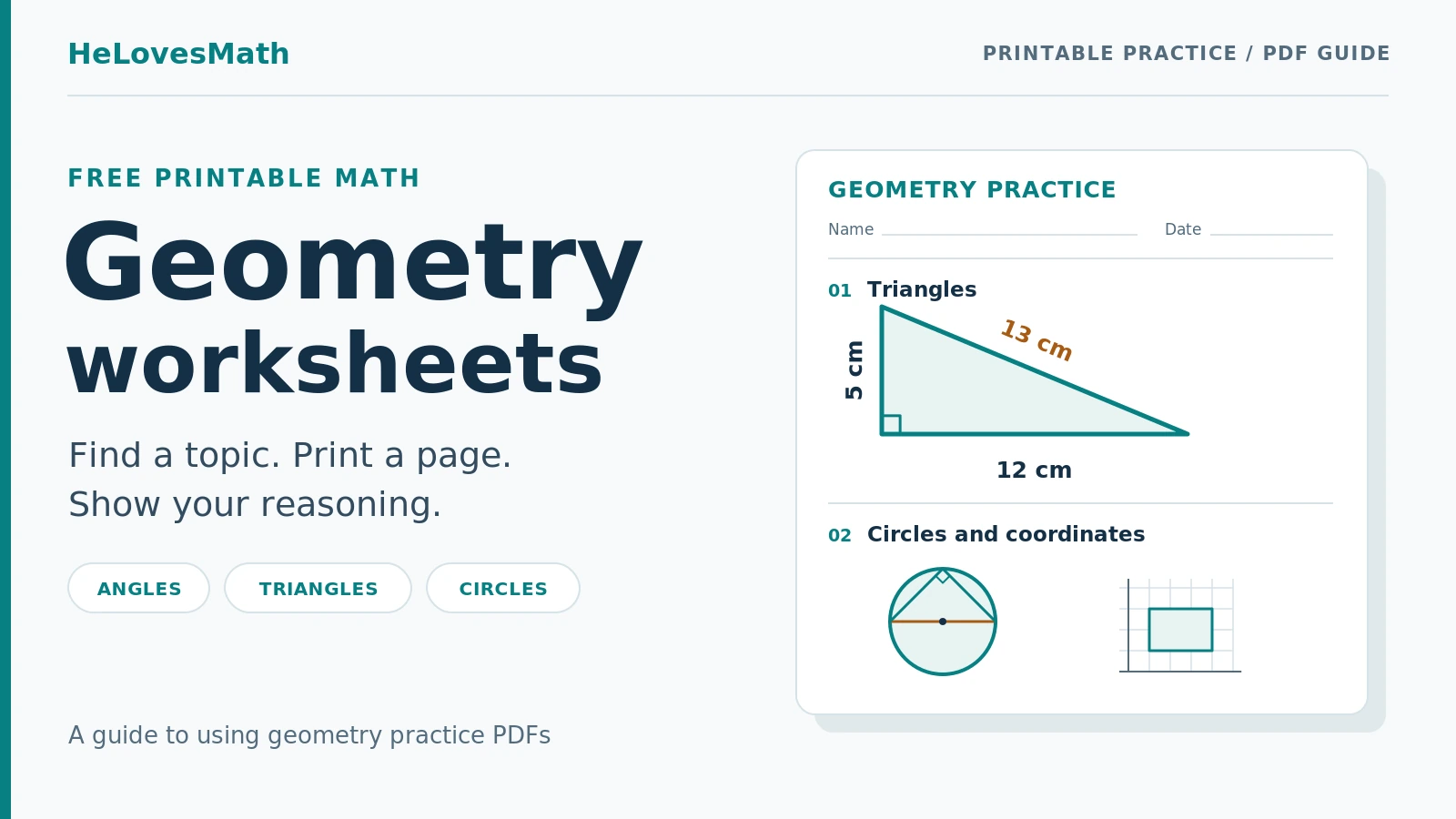
A right triangle has perpendicular sides of 5 cm and 12 cm. Find the hypotenuse.
The hypotenuse c lies opposite the right angle. Using c² = 5² + 12² gives c² = 25 + 144 = 169, so c = 13 cm. Take the positive square root because a length is positive. The result is longer than either leg, as expected.
If the hypotenuse and one leg are given instead, rearrange the equation and subtract the known leg’s square. You cannot apply this formula to an arbitrary triangle just because one side looks longest.

4. Scale lengths, surface area and volume
A rectangular box measures 2 cm by 3 cm by 4 cm. Every length is enlarged by scale factor 3.
The new dimensions are 6 cm, 9 cm and 12 cm. The original volume is 2 × 3 × 4 = 24 cm³. Volume scales by 3³ = 27, giving 648 cm³. Direct multiplication, 6 × 9 × 12, confirms this.
The original total surface area is 2(2 × 3 + 2 × 4 + 3 × 4) = 52 cm². Area scales by 3² = 9, giving 468 cm². For geometrically similar figures with positive length scale factor k, lengths scale by k, areas by k² and volumes by k³. These rules require the same factor in every direction.

5. Separate circumference, area and part of a circle
A circle has radius 6 cm. Find its circumference and area, then the arc length and area of a 120° sector.
Circumference measures the boundary: C = 2πr = 12π cm, approximately 37.70 cm. Area measures the region inside: A = πr² = 36π cm², approximately 113.10 cm².
The sector occupies 120 ÷ 360 = one third of the circle. Its curved arc has length 4π cm, approximately 12.57 cm, and its area is 12π cm², approximately 37.70 cm². The matching number 12π describes different quantities here, so units matter. The sector’s full perimeter would also include its two radii.
6. Apply coordinate transformations in order
Start with P(−2, 3). Translate it 5 units right and 1 unit down, reflect the result in the y-axis, then rotate that result 90° anticlockwise about the origin.
- Translation adds 5 to x and subtracts 1 from y: P′ = (3, 2).
- Reflection in the y-axis changes the sign of x: P″ = (−3, 2).
- A 90° anticlockwise rotation about the origin follows (x, y) → (−y, x): P‴ = (−2, −3).
Plot each intermediate point to check direction and position. Apply the same rule to every vertex of a shape. Translations, reflections and rotations preserve lengths and angles. State a rotation’s centre, angle and direction; changing the order of transformations can change the result.
Ten original practice questions with explained answers
Work on paper first, then open each answer. Give exact circle answers in terms of π unless a decimal is requested. These questions are original practice for this guide, separate from the linked PDF worksheets.
Two adjacent angles form a straight line. One is 68°. Find the other.
Show answer 1
112°. Angles forming a straight angle total 180°, so subtract: 180 − 68 = 112.
An isosceles triangle has a vertex angle of 38° between its equal sides. Find each base angle.
Show answer 2
71° each. The equal base angles share the remaining 180 − 38 = 142°. Divide by 2 to get 71°.
Three interior angles of a quadrilateral are 83°, 97° and 106°. Find the fourth.
Show answer 3
74°. A simple plane quadrilateral’s interior angles total 360°. The known angles total 286°, leaving 360 − 286 = 74°.
Two triangles have corresponding angles of 45°, 65° and 70°. Must they be congruent?
Show answer 4
No. They are similar, but their sizes may differ. Equal corresponding angles establish triangle similarity. They do not fix the side lengths, so congruence needs additional information.
Similar triangles have corresponding sides of 8 cm and 14 cm. Another side of the smaller triangle is 10 cm. Find its corresponding larger side.
Show answer 5
17.5 cm. The smaller-to-larger scale factor is 14 ÷ 8 = 1.75. Multiply the matching smaller length by this factor: 10 × 1.75 = 17.5.
A right triangle has hypotenuse 17 cm and one leg 8 cm. Find the other leg.
Show answer 6
15 cm. The missing leg’s square is 17² − 8² = 289 − 64 = 225. Its positive square root is 15.
A shape has area 48 cm². A similar enlargement has length scale factor 1.5. Find the enlarged area.
Show answer 7
108 cm². Square the length factor before multiplying the area: 48 × 1.5² = 48 × 2.25 = 108.
A solid has volume 250 cm³. A geometrically similar model has every length reduced by scale factor 0.4. Find its volume.
Show answer 8
16 cm³. The volume factor is 0.4³ = 0.064. Therefore 250 × 0.064 = 16. A reduction in every dimension has a larger proportional effect on volume.
A circle has diameter 14 cm. Find its circumference and area.
Show answer 9
Circumference: 14π cm. Area: 49π cm². Use C = πd for the boundary. The radius is half the diameter, 7 cm, so the area is π × 7².
Reflect Q(4, −3) in the x-axis. Then rotate the image 180° about the origin. Give both images.
Show answer 10
Q′(4, 3), then Q″(−4, −3). Reflection in the x-axis changes the sign of y. A half-turn about the origin changes both coordinate signs.
Common mistakes to catch before marking
- Trusting appearance. Equal-looking sides or parallel-looking lines need supporting labels, markings or a stated fact.
- Mixing corresponding sides. Write vertex matches before setting up a proportion, and keep the same direction in every ratio.
- Confusing radius and diameter. Label both on your sketch before substituting into a circle formula.
- Using one scale factor everywhere. Decide whether the question asks for length, area or volume before choosing k, k² or k³.
- Rounding halfway through. Keep exact values or extra calculator digits until the final answer, then follow the requested accuracy.
Frequently asked questions
Where should I start if geometry feels difficult?
Start with notation and a small set of angle or measurement questions. If you understand the geometry but cannot solve the equation, use the algebra review first. Record the step that caused difficulty so your next practice has a clear purpose.
Do I have to buy Infinite Geometry to use these PDFs?
Kuta lists these files as free worksheets. Its worksheet-generation software is a separate product. Follow the provider’s terms and retain the attribution on the files.
Why is my ruler answer different from the printed key?
Check print scaling, units, ruler alignment and rounding. Align the segment with the ruler’s zero mark, which may be slightly in from its edge. A resized print can produce consistently different lengths even when your measuring technique is correct.
What should I do when my answer is wrong?
Find the first incorrect step: reading the diagram, choosing a fact, substituting, calculating or reporting units. Correct it, close the answer and solve again. Ask for help if you cannot explain why the corrected method works.
More geometry practice
For a different worksheet collection with editable files and separate answers, use our Geometry Worksheets study guide and Dr Austin resource directory. For more advanced algebra, matrices and calculus, explore Level 2 Further Mathematics resources.
Sources & References
The PDF directory below retains all 97 original resource destinations. Kuta Software publishes these free worksheets; linked files stay on its servers and retain their own attribution and terms. All external links open in a new tab.
Resource check, 5 October 2026: all 97 original links returned PDFs and matched the publisher’s current directory. Fourteen representative files, one per topic group, were reviewed for titles, instructions and answer pages, with selected answers checked. A correction for question 2 of Mutually Exclusive Events appears beside the probability resources. This is a sample review, not a question-by-question validation of the full collection.
Review of Algebra
Refresh equations and radical expressions before combining algebra with geometry.
5 PDF worksheets · Kuta Software
Basics of Geometry
Use ruler and protractor work to build accurate notation and interpretation.
9 PDF worksheets · Kuta Software
- Line segments and their measures inches (PDF)
- Line segments and their measures cm (PDF)
- Segment Addition Postulate (PDF)
- Angles and their measures (PDF)
- Classifying angles (PDF)
- Naming angles (PDF)
- The Angle Addition Postulate (PDF)
- Angle pair relationships (PDF)
- Understanding geometric diagrams and notation (PDF)
Parallel Lines and the Coordinate Plane
Connect angle relationships with plotting, midpoint, distance and slope.
6 PDF worksheets · Kuta Software
Congruent Triangles
Compare matching sides and angles, then justify when triangles have the same shape and size.
9 PDF worksheets · Kuta Software
Properties of Triangles
Explore bisectors, medians, the centroid and triangle inequalities.
6 PDF worksheets · Kuta Software
Quadrilaterals and Polygons
Classify shapes, reason about their angles and calculate areas.
10 PDF worksheets · Kuta Software
- Classifying quadrilaterals (PDF)
- Angles in quadrilaterals (PDF)
- Properties of parallelograms (PDF)
- Properties of trapezoids (PDF)
- Properties of rhombuses (PDF)
- Properties of kites (PDF)
- Areas of triangles and quadrilaterals (PDF)
- Introduction to polygons (PDF)
- Polygons and angles (PDF)
- Areas of regular polygons (PDF)
Similarity
Match corresponding lengths before writing ratios and proportions.
6 PDF worksheets · Kuta Software
Right Triangles
Identify the right angle and hypotenuse before using Pythagoras or special-triangle facts.
4 PDF worksheets · Kuta Software
Trigonometry
Use right-triangle ratios, inverse ratios and multi-step reasoning. Check your angle mode.
6 PDF worksheets · Kuta Software
Surface Area and Volume
Separate length, square units and cubic units when measuring solids.
8 PDF worksheets · Kuta Software
Circles
Work from radius and diameter through arcs, angles, tangents and circle equations.
9 PDF worksheets · Kuta Software
Transformations
Describe each image using a direction, distance, centre, angle or mirror line as appropriate.
4 PDF worksheets · Kuta Software
Statistics & Probability
These statistics and probability extras are retained from the original collection. They are separate from the core geometry route.
7 PDF worksheets · Kuta Software
- Sample spaces and The Counting Principle (PDF)
- Independent and dependent events (PDF)
- Mutually exclusive events (PDF)
- Permutations (PDF)
- Combinations (PDF)
- Permutations vs combinations (PDF)
- Probability using permutations and combinations (PDF)
Answer-key correction, Mutually Exclusive Events, question 2: purple jerseys are numbered 1–4, so a jersey cannot be purple and have a number greater than 5. The events are mutually exclusive; the linked worksheet’s answer key incorrectly says “Not mutually exclusive.” Keep the question and use this corrected classification.
Constructions
Practise precise ruler-and-compass work; follow each worksheet’s construction instructions.
8 PDF worksheets · Kuta Software
Teaching and printing references
- Kuta Software: free Infinite Geometry worksheets — the official worksheet directory.
- Kuta Software: Line Segments and Measure, centimetres (PDF) — an example of physical measurement questions and later answer pages.
- Kuta Software: Information in Geometric Diagrams (PDF) — interpreting geometric markings.
- Adobe Acrobat: adjust page size for printing PDFs — the difference between Actual Size and Fit printing.
- OpenStax: angles, triangles and the Pythagorean theorem — angle sums and right-triangle calculations.
- OpenStax: triangles — triangle congruence and similarity.
- OpenStax: polygons, perimeter and circumference — polygon angle sums and circle boundaries.
- OpenStax: mathematical formulas — circle area and circumference formulas.
- OpenStax: angles — central angles, arc lengths and sectors.
- Illustrative Mathematics: Scaling Solids — area and volume scale factors.
- Illustrative Mathematics: Similarity, Unit 3 Lesson 6 (PDF) — similarity and the special case of scale factor 1.
- OpenStax: tessellations and transformations — translations, reflections and rotations.