1. Introduction
Fractions and decimals are two common ways of representing numbers, including whole numbers and non-integers. Understanding how to convert between fractions and decimals, as well as performing operations with them, is essential for many areas of mathematics. In these notes, we cover the basic definitions, conversion methods, and operations, along with 50 examples (with solutions) to illustrate the concepts.
2. Basic Definitions
Fractions
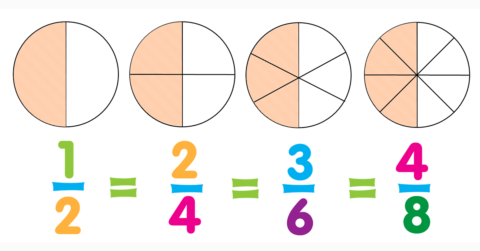
A numerical fraction represents a quotient and may also describe parts of a whole. It can be less than, equal to, or greater than one, or negative. It is written in the form:
where a is the numerator and b is the denominator. For a rational number, a and b are integers and b is nonzero. A zero numerator is allowed: 0/5 = 0. For measurements, use the same unit or reference whole before combining quantities.
Decimals
Decimal notation represents numbers using base-ten place value. Terminating decimals can be written as fractions with denominators that are powers of 10. For example:
represents the fraction 75100, which can be simplified to 34.
3. Converting Between Fractions and Decimals
Fraction to Decimal
To convert a fraction to a decimal, divide the numerator by the denominator.
Decimal to Fraction
To convert a terminating decimal to a fraction, write its digits as an integer over the appropriate power of 10 and simplify. Keep its sign. For n decimal places, use 10n. A repeating decimal needs a different method; a rounded decimal gives only an approximation to the original number.
Terminating, Repeating and Nonrepeating Decimals
A fraction in lowest terms with a positive denominator has a terminating decimal exactly when its denominator has no prime factors other than 2 and 5 (the denominator 1 also terminates). For example, 312 = 14 = 0.25; reduce before testing. Otherwise a rational number has an eventually repeating decimal. An irrational number such as √2 has a nonterminating, nonrepeating decimal and cannot equal a fraction of two integers.
The bar marks digits that repeat forever: 0.3 = 0.333…; it is not the finite decimal 0.333. To convert, set x = 0.3. Then 10x = 3.3; subtract x to obtain 9x = 3, so x = 13. For 0.16, use 10x = 1.6 and 100x = 16.6. Subtract to get 90x = 15 and x = 16.
4. Operations with Fractions and Decimals
Operations with Fractions
Addition/Subtraction: Find a common denominator, convert fractions, and then add/subtract.
Multiplication: Multiply the numerators and denominators (b and d must be nonzero):
Division: Multiply by the reciprocal of a nonzero divisor. In the formula below, b, d and c must be nonzero:
Operations with Decimals
Operations with decimals are similar to whole numbers, but it is important to align the decimal points for addition and subtraction. For multiplication, multiply as whole numbers and place the decimal using the total number of decimal places in the factors. For division, multiply both dividend and divisor by the same power of 10 to make the divisor a whole number, then divide. The divisor must be nonzero. For example, 1.2 ÷ 0.05 = 120 ÷ 5 = 24.
5. 50 Examples with Solutions
-
Converting Fraction to Decimal
Convert 12 to a decimal.
Solution: 12 = 1 ÷ 2 = 0.5 -
Converting Fraction to Decimal
Convert 34 to a decimal.
Solution: 34 = 3 ÷ 4 = 0.75 -
Converting Fraction to Decimal
Convert 14 to a decimal.
Solution: 14 = 1 ÷ 4 = 0.25 -
Converting Fraction to Decimal
Convert 25 to a decimal.
Solution: 25 = 2 ÷ 5 = 0.4 -
Converting Fraction to Decimal
Convert 35 to a decimal.
Solution: 35 = 3 ÷ 5 = 0.6 -
Converting Fraction to Decimal
Convert 18 to a decimal.
Solution: 18 = 1 ÷ 8 = 0.125 -
Converting Fraction to Decimal
Convert 38 to a decimal.
Solution: 38 = 3 ÷ 8 = 0.375 -
Converting Fraction to Decimal
Convert 58 to a decimal.
Solution: 58 = 5 ÷ 8 = 0.625 -
Converting Fraction to Decimal
Convert 78 to a decimal.
Solution: 78 = 7 ÷ 8 = 0.875 -
Converting Fraction to Decimal
Convert 110 to a decimal.
Solution: 110 = 1 ÷ 10 = 0.1 -
Converting Fraction to Decimal
Convert 310 to a decimal.
Solution: 310 = 3 ÷ 10 = 0.3 -
Converting Fraction to Decimal
Convert 710 to a decimal.
Solution: 710 = 7 ÷ 10 = 0.7 -
Adding Fractions
Compute 12 + 14.
Solution: Find a common denominator: 12 = 24, so 24 + 14 = 34. In decimal, 34 = 0.75. -
Subtracting Fractions
Compute 34 - 12.
Solution: 34 - 24 = 14 = 0.25. -
Multiplying Fractions
Compute 12 × 23.
Solution: 1 × 22 × 3 = 26 = 13 ≈ 0.333. -
Dividing Fractions
Compute 34 ÷ 12.
Solution: Multiply by the reciprocal: 34 × 21 = 64 = 32 = 1.5. -
Simplifying a Fraction
Simplify 812.
Solution: Divide numerator and denominator by 4: 8÷412÷4 = 23 ≈ 0.667. -
Converting a Repeating Decimal to Fraction
Express 0.3 as a fraction.
Solution: 0.3 = 13. -
Converting a Repeating Decimal to Fraction
Express 0.6 as a fraction.
Solution: 0.6 = 23. -
Adding Fractions with Different Denominators
Compute 13 + 14.
Solution: Common denominator is 12: 412 + 312 = 712 ≈ 0.5833. -
Multiplying Mixed Numbers
Compute 112 × 213.
Solution: Convert to improper fractions: 32 × 73 = 216 = 3.5. -
Converting a Decimal to a Fraction
Convert 0.125 to a fraction.
Solution: 0.125 = 1251000 = 18. -
Multiplying Decimals
Compute 0.25 × 0.4.
Solution: 0.25 × 0.4 = 0.1. -
Converting a Decimal to a Simplified Fraction
Convert 0.625 to a fraction.
Solution: 0.625 = 6251000 = 58. - Decimal to FractionConvert 0.2 to a fraction.
Solution: 0.2 = 210 = 15. - Small Decimal to FractionConvert 0.04 to a fraction.
Solution: 0.04 = 4100 = 125. - Decimal to FractionConvert 0.375 to a fraction.
Solution: 0.375 = 3751000 = 38. - Decimal Greater Than OneConvert 1.25 to a fraction and mixed number.
Solution: 1.25 = 125100 = 54 = 114. - Negative DecimalConvert −0.6 to a fraction.
Solution: −0.6 = −610 = −35. - Fraction to DecimalConvert 920 to a decimal.
Solution: 920 = 45100 = 0.45. - Fraction to DecimalConvert 725 to a decimal.
Solution: 725 = 28100 = 0.28. - Fraction to DecimalConvert 1140 to a decimal.
Solution: 1140 = 2751000 = 0.275. - Fraction to DecimalConvert 1350 to a decimal.
Solution: 1350 = 26100 = 0.26. - Repeating Decimal and RoundingConvert 56 to a decimal.
Solution: 56 = 0.83 ≈ 0.8333, rounded to four decimal places. - Repeating BlockConvert 0.27 to a fraction.
Solution: Let x = 0.27. Then 100x − x = 27, so 99x = 27 and x = 2799 = 311. - Nonrepeating PrefixConvert 0.16 to a fraction.
Solution: Let x = 0.16. Then 100x − 10x = 15, so 90x = 15 and x = 1590 = 16. - Repeating NinesExpress 0.9 exactly.
Solution: Let x = 0.9. Then 10x − x = 9, so 9x = 9 and x = 1. Thus 0.9 = 1 exactly. - Adding Unlike FractionsCompute 712 + 518.
Solution: 712 + 518 = 2136 + 1036 = 3136. - Subtracting Unlike FractionsCompute 56 − 38.
Solution: 56 − 38 = 2024 − 924 = 1124. - Multiplying and SimplifyingCompute 35 × 109.
Solution: 35 × 109 = 3045 = 23. - Dividing FractionsCompute 78 ÷ 1415.
Solution: 78 × 1514 = 105112 = 1516. - Adding Mixed NumbersCompute 214 + 123.
Solution: 94 + 53 = 2712 + 2012 = 4712 = 31112. - Subtracting Mixed NumbersCompute 415 − 234.
Solution: 215 − 114 = 8420 − 5520 = 2920 = 1920. - Adding DecimalsCompute 1.35 + 0.8.
Solution: Align decimal points: 1.35 + 0.80 = 2.15. - Subtracting DecimalsCompute 5 − 0.075.
Solution: Write 5 as 5.000, then subtract: 5.000 − 0.075 = 4.925. - Multiplying DecimalsCompute 0.06 × 0.3.
Solution: 6 × 3 = 18; the factors have three decimal places altogether, so 0.06 × 0.3 = 0.018. - Dividing DecimalsCompute 1.2 ÷ 0.05.
Solution: Multiply both numbers by 100: 1.2 ÷ 0.05 = 120 ÷ 5 = 24. - Comparing Equal ValuesCompare 0.875 and 78.
Solution: 0.875 = 8751000 = 78, so they are equal. - Exact Versus Rounded ComparisonCompare 23 and 0.667.
Solution: 23 = 0.6 < 0.667. Exactly, 6671000 − 23 = 13000 > 0. Rounding to 0.667 does not make the numbers equal. - Rounding a Terminating DecimalWrite 716 as a decimal, then round to two decimal places.
Solution: 716 = 0.4375 ≈ 0.44. The third decimal digit is 7, so increase the hundredths digit from 3 to 4.
6. Summary
In these notes, we reviewed the definitions of fractions and decimals, learned how to convert between the two, and performed various operations such as addition, subtraction, multiplication, and division. The examples provided illustrate a wide range of conversions and operations, ensuring a thorough understanding of fractions and decimals.