
Net Income Calculator
Instantly calculate your true "bottom line." Whether you are an entrepreneur determining your company's profitability or an individual calculating your take-home pay, our tool provides precise financial clarity.
📋 Table of Contents
- Interactive Net Income Calculator
- What Exactly is Net Income?
- The Mathematics & Formulas Behind Net Income
- Step-by-Step Breakdown of an Income Statement
- Business vs. Personal Net Income: The Difference
- Why Net Income is the Ultimate Financial Measure
- Common Mistakes & Pitfalls to Avoid
- Proven Strategies to Increase Your Net Income
- Frequently Asked Questions (FAQ)
🧮 Interactive Net Income Calculator
Select your calculation type below. For businesses, input your total revenue and systematically subtract your expenditures. For individuals, input your gross salary and deduct your taxes and withholdings to discover your take-home pay.
📘 What Exactly is Net Income?
Net Income (often referred to colloquially as the "bottom line" or "net profit") is the definitive financial metric demonstrating the true profitability of a business—or the actual spendable wealth of an individual. It represents the residual amount of money that strictly belongs to the owners, shareholders, or wage earner after every single conceivable expense has been systematically accounted for and paid.
To understand net income, one must distinguish it from top-line revenue (or gross income). When you make a sale and cash enters the register, that is revenue. However, that money does not belong to you yet. You owe a portion to your raw material suppliers, a portion to your landlord, a portion to your employees, a portion to the bank (for interest on loans), and finally, a substantial portion to the government via taxes. What survives this gauntlet of deductions is your Net Income.
📐 The Mathematics & Formulas Behind Net Income
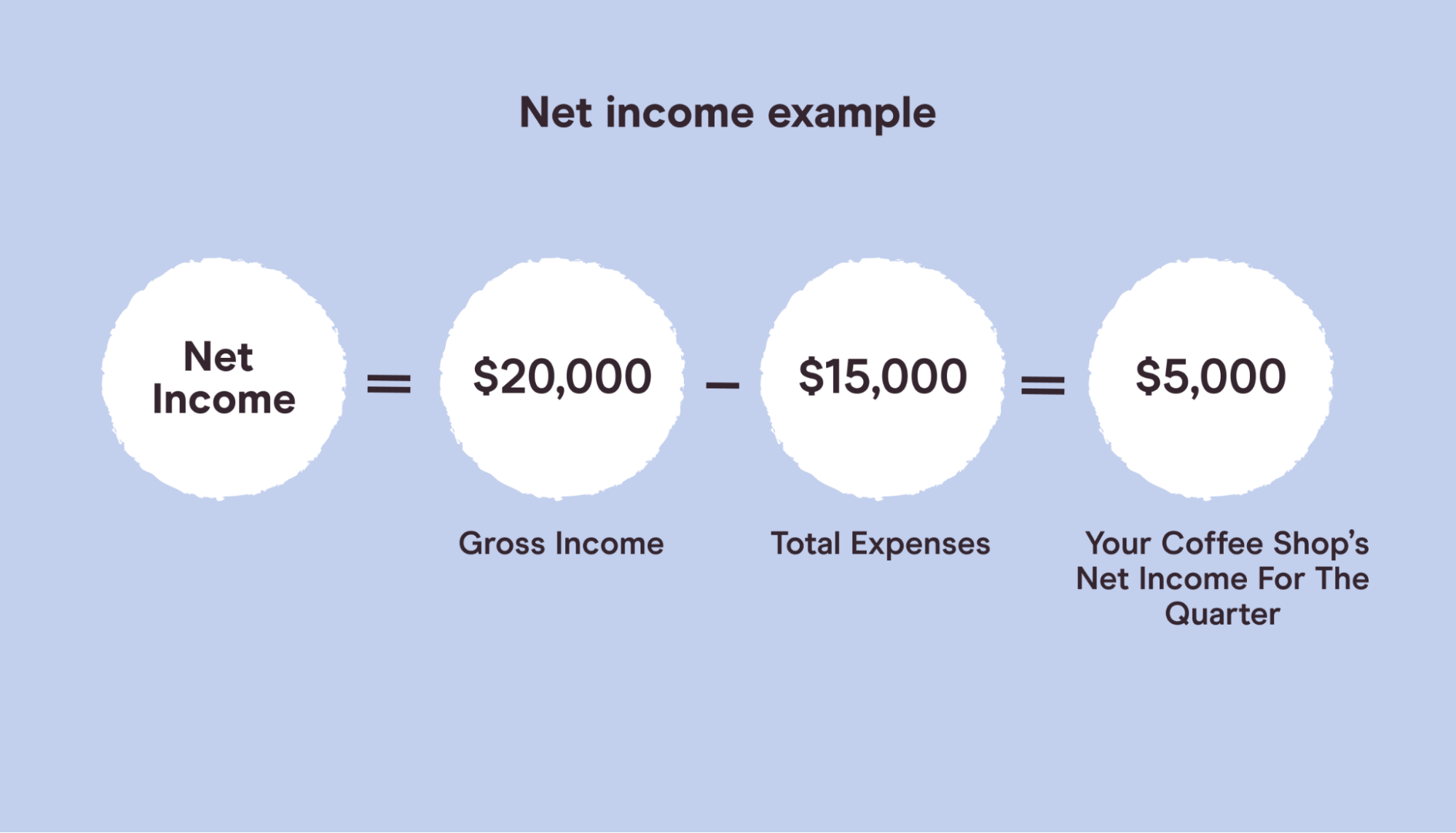
The mathematical computation of Net Income is fundamentally an exercise in methodical subtraction. It takes the largest possible number (your total sales) and cascades downwards through various expense classifications until reaching the final, unencumbered profit.
The Primary Net Income Equation
While accurate, "Total Expenses" is too broad for professional accounting. To glean actionable insights, accountants break this master formula down into a multi-step algebraic equation reflecting the logic of a corporate Income Statement.
Example Calculation:
Imagine a hardware store sells \$500,000 worth of merchandise (Revenue).
The physical cost to purchase that inventory from suppliers was \$200,000 (COGS). Their Gross Profit is \$300,000.
Running the store (paying the clerks, electricity, and local advertising) costs \$150,000 (Operating Expenses). Their Operating Income is \$150,000.
Finally, they pay \$10,000 in loan interest and \$40,000 in corporate taxes. (\$150,000 - \$50,000)
Their final Net Income is \$100,000.
📑 Step-by-Step Breakdown of an Income Statement
When you view a company's P&L (Profit and Loss Statement), the journey from top-line revenue to bottom-line net income is structured sequentially. This allows analysts to pinpoint exactly where a company is losing its efficiency. Here is the anatomical breakdown of how net income is generated:
| Income Statement Line Item | Definition and Scope |
|---|---|
| 1. Total Revenue (Sales) | The absolute top line. The total gross amount of money generated from selling goods or rendering services before any discounts or returns are processed. |
| 2. Cost of Goods Sold (COGS) | The direct, variable costs strictly tied to producing the product. This includes raw materials, direct factory labor, and inbound freight logistics. |
| 3. Gross Profit | (Revenue minus COGS). This subtotal indicates how efficiently a company can manufacture and sell its core product, ignoring administrative overhead. |
| 4. Operating Expenses (OpEx) | The fixed overhead costs required to keep the business doors open. Includes executive salaries, software, marketing, rent, and legal fees. |
| 5. Operating Income (EBIT) | Earnings Before Interest and Taxes. This reflects the pure profitability of the company's core operations, removing the influence of tax regimes and debt structuring. |
| 6. Interest, Taxes, Depreciation | The non-operational financial obligations. Paying government taxes, paying banks for borrowed leverage, and accounting for the wear-and-tear of physical assets over time. |
| 7. NET INCOME | The absolute bottom line. This final figure is distributed to shareholders as dividends or retained by the business to fuel future growth (Retained Earnings). |
🤝 Business vs. Personal Net Income: The Difference
While the economic philosophy of net income is universal, the application differs drastically depending on whether you are analyzing a corporation or calculating your personal monthly household budget.
Business Net Income
For organizations, net income is an indicator of operational supremacy and shareholder value generation. Because businesses must purchase inventory and spend heavy capital on marketing, their deductions are massive. A successful business might generate \$1,000,000 in revenue but only yield \$100,000 in net income (a 10% profit margin). Business net income fluctuates wildly month-to-month based on market conditions, supply chain shocks, and consumer demand.
Personal Net Income (Take-Home Pay)
For an individual wage-earner, Net Income is referred to as "take-home pay." When an employer offers a salary of \$80,000, this is the Gross Income. Nobody actually takes home \$80,000. Before the paycheck hits the individual's bank account, employers are legally required to deduct:
- Federal and State Income Taxes: Depending on the tax bracket and geographic jurisdiction.
- FICA Taxes: Social Security and Medicare withholdings.
- Pre-Tax Deductions: Contributions to retirement accounts (401k, 403b), HSA accounts, and health/dental insurance premiums.
- Post-Tax Deductions: Union dues, or legally mandated wage garnishments.
The money remaining after these deductions is the personal Net Income. This is the only number individuals should use when mapping out their household budgets, applying for mortgages, and calculating their discretionary spending limits.
🌟 Why Net Income is the Ultimate Financial Measure
Net income is not just an accounting technicality; it is the most closely monitored data point by investors, banks, and corporate boards worldwide. To demonstrate E-E-A-T (Expertise, Authoritativeness, and Trustworthiness) in finance, one must understand why this specific number carries so much weight.
- Valuation Multipliers (P/E Ratios): In the stock market, companies are valued based on their net income. The Price-to-Earnings (P/E) ratio compares a company's stock price strictly to its net income per share (EPS). Without a positive net income, traditional valuation models break down.
- Debt Survivability and Loan Approvals: Bankers do not care about your high revenue if your net income is deeply negative. They analyze net income to calculate the Debt Service Coverage Ratio (DSCR), determining if the business generates enough unencumbered cash to safely clear monthly loan payments.
- Shareholder Dividends: A company cannot legally pay out cash dividends to its investors unless it is generating positive net income (or tapping into previously retained earnings). The net income determines the size of the reward investors receive for risking their capital.
- Reinvestment Fuel: Positive net income acts as self-generated funding. Instead of taking on expensive venture capital and diluting ownership, founders can use their net income to hire new talent, expand to new locations, and fund R&D autonomously.
⚠️ Common Mistakes & Pitfalls to Avoid
Novice entrepreneurs frequently miscalculate or misinterpret their net income, leading to disastrous strategic errors. Be acutely aware of these common accounting traps.
1. Confusing Net Income with Cash Flow
This is the deadliest mistake in business. Under accrual accounting, net income is recorded when an invoice is sent, not when the cash is actually received. A company can show a highly positive net income on paper, yet have zero dollars in their bank account because their clients take 90 days to pay their invoices. A business can go bankrupt while displaying a positive net income if its cash flow management fails.
2. Forgetting Non-Cash Expenses (Depreciation)
If you purchase a \$100,000 manufacturing robot, you do not write off the entire \$100,000 against this year's net income. According to IRS rules, you must depreciate that asset over several years (e.g., \$10,000 a year for 10 years). Depreciation drastically lowers your net income on paper (lowering your tax burden), even though the actual cash left your bank account years ago.
3. Incorrect COGS Classification
Many business owners accidentally place fixed operating expenses (like a warehouse manager's salary) into the COGS category. While this technically does not change the final Net Income number, it ruins the Gross Profit calculation, misleading owners into thinking their product manufacturing is wildly inefficient when the problem is actually excessive administrative overhead.
🚀 Proven Strategies to Increase Your Net Income
If you have calculated your Net Income and feel it is inadequate, the mathematical reality dictates you only have two levers to pull: increase the revenue moving in, or decrease the expenses bleeding out. The most sophisticated financial operators execute both simultaneously.
- The Power of the Strategic Price Hike: Because your COGS and Operating Expenses generally remain fixed, any organic increase in the selling price of your product flows at a 100% margin directly to your Net Income. Increasing prices by just 5% can often increase a company's net income by 20% or more.
- Audit and Terminate Zombie Subscriptions: Software bloat is a silent killer of net income. Companies often pay thousands of dollars annually for SaaS tools, CRM seats, and cloud storage systems that employees stopped using months ago. Audit credit card statements quarterly and cancel unused overhead.
- Renegotiate with Tier-1 Suppliers: Your Cost of Goods Sold is your heaviest anchor. As your business scales and orders higher volumes, you gain leverage. Contact your manufacturers and freight forwarders annually to renegotiate bulk pricing, lowering your direct costs and widening the gross profit margin.
- Focus on High-Margin Service Extensions: If you sell physical items (low margin), find ways to attach digital or service-based items (high margin). E-commerce stores that sell extended warranties or premium membership clubs see massive spikes in net income because delivering those digital services costs practically nothing.
❓ Frequently Asked Questions (FAQ)
HeLovesMath.com — Expert Financial Calculators & Business Accounting Tools
© 2026 HeLovesMath. All calculators are strictly free for personal, educational, and commercial reference.
Return to HeLovesMath Home