JEE Main & Advanced · resource selection
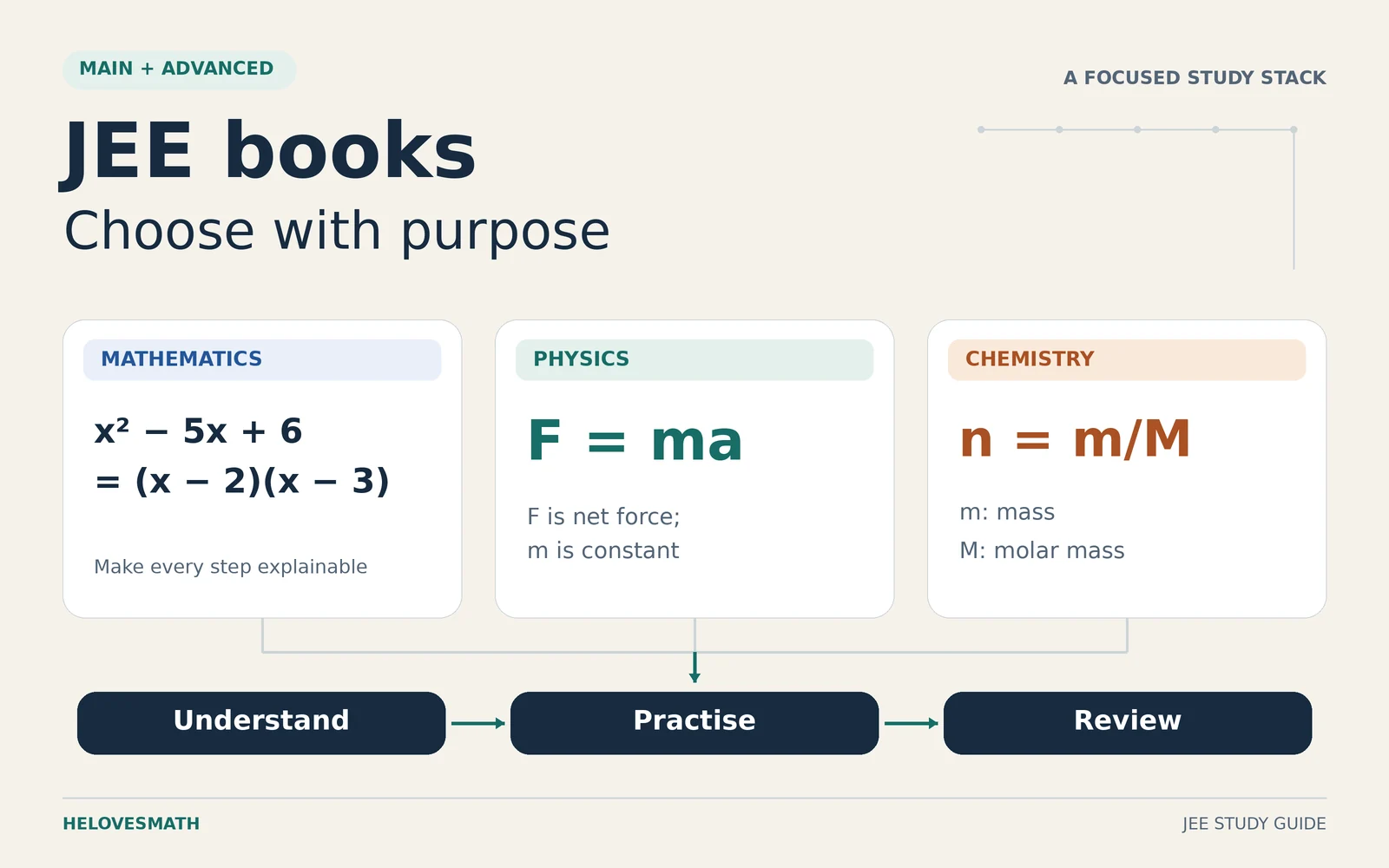
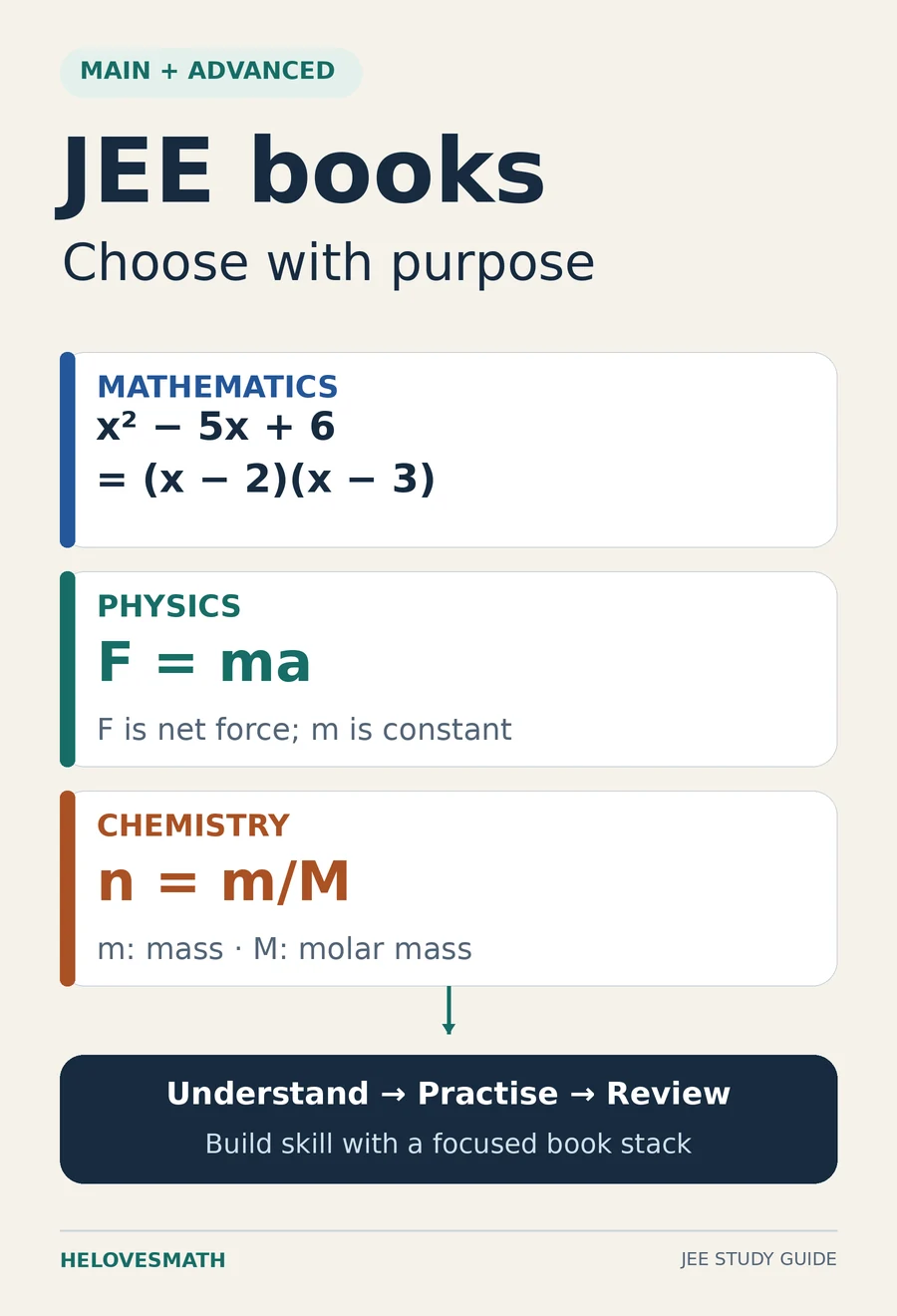
The best JEE books are the ones that fill a specific gap in your preparation. Start with the official syllabus, use NCERT and one coherent teaching resource to build understanding, then practise independently and review previous-year questions. Add a second problem book only when you can explain what it will improve.
A small, purposeful book shortlist
This is an editorial starting point, not an official endorsed list or a promise of a rank. A good coaching module or school resource may already supply the same explanations and graded exercises. Before buying, compare one familiar chapter and one difficult chapter: can you follow the worked reasoning, attempt the exercise without copying, and understand the solution afterwards?
| Resource | Best role in a study plan | What to check |
|---|---|---|
| NCERT Class XI & XII textbooks Physics, Chemistry, Mathematics | Definitions, core explanations, worked examples and foundation exercises. Official digital textbooks can be accessed free. | Map each chapter to the exam syllabus. A textbook’s contents or deletions do not independently define the JEE syllabus. |
| Concepts of Physics, Parts 1 & 2 H. C. Verma | Conceptual questions and a systematic physics foundation alongside the school text. | Check volume, edition and what any separate “solutions” bundle actually contains. The book title alone does not promise a complete worked-solutions package. |
| Understanding Physics D. C. Pandey, Arihant | A structured JEE-focused route through topic explanations and problem practice. | Choose the relevant volume or series deliberately; it need not duplicate a module you already use effectively. |
| Cengage JEE Mathematics series G. Tewani | Topic-wise theory, worked examples and practice across the mathematics syllabus. | The author’s surname is Tewani. Check which volumes a set contains, the edition and your available study time. |
| Physical-chemistry practice For example, Narendra Awasthi or R. C. Mukerjee’s Modern Approach to Chemical Calculations | Additional quantitative exercises after learning the concept and seeing a worked method. | Choose a resource with usable explanations for your level. A bank of difficult problems is not a substitute for teaching the model. |
| Previous-year questions (PYQs) Official papers; a carefully checked chapter-wise collection if useful | Apply learning, inspect actual question wording and identify repeated weaknesses. | Use the final official key for the correct paper/shift and follow that paper’s marking instructions. Older questions may lie outside a newer syllabus. |
Optional extension resources: I. E. Irodov’s Problems in General Physics, A. Das Gupta’s Problems Plus in IIT Mathematics, and Vikas Gupta/Pankaj Joshi’s Advanced Problems in Mathematics can provide further challenge. Select syllabus-relevant questions after you can solve standard material reliably. Finishing an entire advanced reference is not an admission requirement.
Other titles retained from this page’s earlier catalogue include Cengage’s New Pattern Physics, Wiley’s Halliday/Resnick/Walker JEE physics adaptation, Comprehensive Mathematics for JEE Advanced, S. K. Goyal’s mathematics problem books, Arihant’s Master Resource Book and Disha/Arihant PYQ collections. Compare their current contents and worked support rather than treating every title as another compulsory purchase. The original retailer links are retained, with access caveats, in the final reference section.
Use the syllabus as your map
Keep separate Main and Advanced checklists. For each official topic, note your learning source, the exercises you attempted without help, your mistakes and the next revision task. Marking a chapter “read” tells you much less than recording the kinds of questions you can solve.
For a book labelled for both examinations, distinguish a topic’s inclusion from a question’s difficulty. A difficult question is not automatically useful if it depends on material outside your target syllabus. Conversely, a topic missing from a particular textbook edition is not automatically removed from the examination.

How to use the books by subject
Physics: translate the situation before substituting numbers
Read the concept, draw a diagram, identify the system and list your assumptions. Then choose the physical law. An equation copied from a similar-looking example may fail when friction, direction, constraints or initial conditions change. Record units beside every quantity and ask whether the final result has the right dimensions and a sensible sign.
Use NCERT and, if helpful, H. C. Verma for the foundation. A JEE-focused sequence such as D. C. Pandey can organise further practice. Halliday/Resnick/Walker and selected Irodov problems are additional routes, not a requirement to work through several overlapping physics courses at once.
Mathematics: solve on a blank page and test restrictions
After studying a worked example, close the solution and solve it again from the problem statement. Explain why each transformation is allowed. Division can exclude a zero case; squaring can introduce extraneous roots; logarithms and square roots require domain checks. Keep those restrictions in your solution, not just in your final answer.
Use NCERT to secure foundations and a coherent series or module for graded practice. G. Tewani’s Cengage books are one such route. Extend with selected A. Das Gupta, S. K. Goyal or Gupta–Joshi problems when a specific topic needs more challenge. If basic algebra is blocking progress, use our algebra practice library before escalating difficulty.
Chemistry: separate three different kinds of work
- Physical chemistry: write the model, convert units and track the amount of substance before calculating. Narendra Awasthi and R. C. Mukerjee’s Modern Approach to Chemical Calculations are possible additional problem sources after the underlying concept is learned.
- Organic chemistry: explain bonding, electron movement, conditions and competing pathways rather than memorising an isolated product. Use the course sequence and syllabus to decide what depth is appropriate.
- Inorganic chemistry: organise trends, bonding explanations, observations and exceptions. Repeated recall is more useful when you can connect a fact to its chemical context.
NCERT is a practical starting point across chemistry, but “NCERT alone guarantees every chemistry mark” is too strong. Check coverage against the official syllabus and test your understanding with relevant questions. Morrison and Boyd’s Organic Chemistry is a broad reference; use selected sections when they resolve a specific gap. The original J. D. Lee Concise Inorganic Chemistry and the JEE-adapted edition associated with Sudarsan Guha are different products. Check the exact title and edition rather than buying solely by the name “J. D. Lee.”
Build a chapter plan you can actually finish
Starting a chapter
- Identify the exact syllabus outcomes and prerequisite skills.
- Read one explanation and annotate the assumptions in a worked example.
- Attempt a small varied set without looking at solutions.
- Review each error and choose the next task from its cause.
Revising a chapter
- Recall key ideas from memory before opening notes.
- Reattempt earlier mistakes on a blank page.
- Use unseen relevant PYQs under a chosen time limit.
- Record accuracy and reasoning quality; repeat the weak part.
There is no universal daily question count, reading speed or book-completion target. A useful plan leaves time for checking. For example, a 90-minute study session might reserve 20 minutes for concept review, 40 for independent attempts and 30 for analysis and a fresh attempt. This is an adjustable planning example, not a proven optimum.
When time is limited, first repair a prerequisite that blocks many questions. Do not start a large new reference because one test went badly. Look at whether the loss came from a concept gap, an unsuitable model, an algebra or unit error, or exam execution. Each requires a different response.

Three worked diagnostic examples
These original examples illustrate the kind of reasoning to look for in a book. They are not past JEE questions, a predicted paper or a measure of examination readiness.
1. Mathematics: a parameter and the discriminant
Question. For which real values of k does x² − 2kx + k + 2 = 0 have two distinct real roots?
The leading coefficient is 1, so the equation remains quadratic for every real k. Two distinct real roots require discriminant D > 0.
D = (−2k)² − 4(k + 2)
= 4(k² − k − 2)
= 4(k − 2)(k + 1)
The product is positive outside its roots, so k < −1 or k > 2. The endpoints give D = 0 and repeated roots; they must be excluded.
What to diagnose: if you included −1 and 2, revisit the meaning of “distinct.” If you selected −1 < k < 2, practise a sign chart. Check k = 0: x² + 2 = 0 has no real root, so the middle interval cannot be correct.
2. Physics: the force is not all available for acceleration
Question. A 2.0 kg block slides to the right on a horizontal surface. A horizontal 10 N force pulls it right. The kinetic-friction coefficient is 0.20; take g = 10 m/s². Find its acceleration while it continues sliding right.
There is no vertical acceleration and no vertical component of the pull, so the normal reaction is N = mg = 20 N. Kinetic friction opposes the motion: f = μN = 4.0 N to the left. With right positive, the resultant horizontal force is 10 − 4 = 6 N.
a = Fnet/m = 6 N ÷ 2.0 kg = 3.0 m/s² to the right
What to diagnose: 5.0 m/s² ignores friction. Using μmg without explaining the normal reaction risks failure on an incline or with an angled pull. The block is explicitly sliding, so this example does not require a static-friction test.
3. Chemistry: concentration uses final solution volume
Question. A solution contains 5.85 g NaCl in a final solution volume of 0.500 L (500 mL). Use molar mass M = 58.5 g/mol. What is its amount concentration in mol/L?
First find the amount: n = m/M = 5.85/58.5 = 0.100 mol. Convert the final volume: 500 mL = 0.500 L. Then divide amount by volume.
c = n/V = 0.100/0.500 = 0.200 mol/L
What to diagnose: 0.000200 comes from using millilitres as though they were litres. “Dissolve in 500 mL of water” would not specify the same final solution volume. Here the final volume is given; no assumption about volume additivity is needed.
Six short practice questions with explanations
Attempt these before revealing the answers. Use the same definitions and units as above.
1. For which real k does x² − 2kx + k + 2 = 0 have at least one real root?
Require D ≥ 0, so k ≤ −1 or k ≥ 2. The endpoints now qualify because a repeated real root is allowed.
2. What is the repeated root when k = 2?
The equation becomes x² − 4x + 4 = (x − 2)² = 0, so x = 2. The two roots coincide.
3. The same sliding block is pulled right by 14 N. What is its acceleration?
The normal reaction remains 20 N and kinetic friction remains 4 N. Hence a = (14 − 4)/2 = 5.0 m/s² to the right.
4. If the 10 N pull is removed while the block still slides right, what is its acceleration?
Friction is the only horizontal force: a = −4/2 = −2.0 m/s² with right positive. This applies while it slides right; do not extend the same kinetic-friction model after it stops.
5. The 0.100 mol of NaCl is diluted to a final volume of 1.00 L. What is c?
The amount is unchanged, so c = 0.100/1.00 = 0.100 mol/L. Doubling the final volume halves the concentration.
6. How much NaCl is needed for 0.250 L (250 mL) of a 0.200 mol/L solution, using M = 58.5 g/mol?
V = 0.250 L; n = cV = 0.200 × 0.250 = 0.0500 mol. Mass m = nM = 0.0500 × 58.5 = 2.925 g, or 2.93 g to three significant figures. The stated volume is the final solution volume.
Avoid these expensive study mistakes
- Buying every famous title: overlapping resources can consume the time needed to solve and review. Choose the job a new resource will do before choosing its author.
- Equating a cover year with official alignment: inspect the table of contents and the actual official syllabus. A recent label is not an NTA or IIT endorsement.
- Reading a solution as if you solved it: recognition is easier than producing the method independently. Close the solution and retry after a gap.
- Skipping units, domains or assumptions: a numerically tidy answer may still be invalid. Keep the restrictions visible.
- Using PYQs as a forecast: they show past assessment, not a guarantee of the next paper. Read each paper’s own marking instructions.
- Assuming books or coaching are compulsory purchases: access to explanations, practice and reliable feedback matters; there is no universal required commercial reading list.
Put your resources to work
Use our JEE previous-year paper collection and JEE Main paper archive to choose practice. Match year, paper and shift, then verify disputed answers against the official final key. For arithmetic involving powers of ten, the scientific-notation guide explains the method with worked examples.
Before paying for a book, verify the author, exact title, edition, included volumes, solution access and whether it is a legal copy. Use the official NCERT digital source where suitable. Prices, stock and sellers change; this guide does not verify a purchase offer or ask you to buy a complete stack.
JEE frequently asked questions
Search all 105 questions, or open a question to read its answer. Historical questions are retained for reference. Reviewed ; 2026 rules must not be assumed to apply to 2027.
105 of 105 questions shown
can i get admission in iit without jee
Yes, for some programmes. IIT BDes admissions can use UCEED, and IIT Madras’s BS Data Science programme has a qualifier-based entry route. Many regular IIT engineering seats allocated through JoSAA require JEE Advanced, but it is inaccurate to say every IIT degree requires JEE. Check the exact institute, degree and admission route; a non-JEE programme is not automatically equivalent to a residential BTech route.
Reference: UCEED 2026 BDes admissions; IIT Madras BS Data Science admissions; JoSAA official seat matrix.
how many candidates applied for jee mains 2021
A precise, consistently scoped 2021 unique-registration total has not been verified for this answer. The earlier approximate figure should not be treated as authoritative. Use NTA’s final 2021 Paper 1 result press release in its archive, and distinguish unique people across all four sessions from the sum of session registrations.
Reference: NTA archive of examination notices.
how many candidates applied for jee mains 2022
NTA reports 10,26,799 unique candidates registered for JEE Main 2022 Paper 1 across the two sessions. This is a registration count, not the number who appeared, and does not count each returning candidate twice.
Reference: NTA final Paper 1 results, participation and examination dates: 2022.
how many marks are required to clear jee advanced
There is no universal passing score. JEE Advanced uses category-specific subject and aggregate qualifying marks, published for that examination year. Meeting them earns a place on the relevant rank list; it does not guarantee an IIT seat. Admission also depends on rank, eligibility, preferences and available seats. Use that year’s official result notice, rather than treating an old percentage as a prediction.
Reference: IIT Kanpur: JEE Advanced 2025 results press release; JoSAA official seat matrix.
how many papers are there in jee mains
JEE Main has Paper 1 for B.E./B.Tech. and Paper 2A for B.Arch. / Paper 2B for B.Planning. Choose the paper or permitted combination relevant to your intended course. In the 2026 scheme, the B.Arch. drawing part was pen-and-paper; the other tested parts were computer-based.
Reference: JEE Main 2026 information bulletin (PDF).
how many people appear for jee
Specify the examination, year and denominator: registrations, attendance and unique candidates are different measures. For historical comparison, see Main 2024 unique attendance and Advanced 2024 attendance in both papers. Do not add these figures to estimate distinct people across the two exams.
how many people give jee mains
Participation changes each year; the linked figure is specifically for Main 2024. See how many students give jee mains 2024.
how many people write jee
“JEE” may refer to Main or Advanced. See how many people appear for jee.
how many seats in jee mains
JEE Main is an examination, so there is no single permanent “JEE Main seat count.” Seats vary by institution, programme, category and counselling year. Consult the JoSAA seat matrix for NITs, IIITs and other participating institutions; state and other admission systems may have additional seats. IIT seats allocated through JoSAA use JEE Advanced ranks.
Reference: JoSAA official seat matrix.
how many students appeared for jee advanced 2020
The official 2020 report records 1,50,838 candidates appearing in both papers. This is an attendance figure, not the registration or qualifying total.
Reference: JEE Advanced 2020 Joint Implementation Committee report.
how many students appeared for jee advanced 2022
The 2022 report’s category-wise summary records 1,55,538 candidates appearing in both papers. The report also tabulates foreign candidates separately, so retain the report’s table scope when comparing totals across years.
Reference: JEE Advanced 2022 Joint Implementation Committee report.
how many students appeared for jee advanced 2024
The official 2024 report states that 1,80,200 candidates appeared in both papers of JEE Advanced. The same report records 1,86,584 registrations and 48,248 qualified candidates. Those three counts measure different stages.
Reference: JEE Advanced 2024 Joint Implementation Committee report.
how many students appeared for jee mains 2022 session 2
For JEE Main 2022 Session 2, NTA reports 5,40,242 candidates appeared and 6,22,034 registered for Paper 1 (B.E./B.Tech.). These are Session 2 figures, not unique counts across the whole year.
Reference: NTA final Paper 1 results, participation and examination dates: 2022.
how many students appeared for jee mains 2024 session 1
NTA’s final 2024 Paper 1 release reports 11,70,048 appeared and 12,21,624 registered in Session 1. These final-release figures replace the slightly different earlier numbers used in the previous answer.
Reference: NTA final Paper 1 results and participation: 24 April 2024.
how many students appeared in jee advanced 2021
The 2021 official report’s summary table records 1,41,699 candidates appearing in both papers. When comparing nationality-specific or overall totals, use the same report’s definitions and separate nationality table rather than silently mixing scopes.
Reference: JEE Advanced 2021 Joint Implementation Committee report.
how many students give jee advanced
Attendance changes each year and is different from the Main shortlist or Advanced registration count. For a verified example, 1,80,200 candidates appeared in both papers in 2024. Use the corresponding official result release or annual report for another year.
Reference: JEE Advanced 2024 Joint Implementation Committee report.
how many students give jee mains 2024
NTA’s final 2024 Paper 1 release reports 14,15,110 unique candidates appeared across the two sessions. A candidate who attended both is counted once in this annual unique total.
Reference: NTA final Paper 1 results and participation: 24 April 2024.
how many students qualify jee mains
“Qualify JEE Main” can mean different things. For JEE Advanced 2026, the Indian-national/OCI/PIO (I) route shortlists the top 2,50,000 successful Paper 1 candidates, with possible extra candidates from ties, subject to all other eligibility conditions. This is not a count of guaranteed college admissions.
Reference: JEE Advanced 2026 eligibility: Indian nationals and OCI/PIO (I).
how many students registered for jee mains 2022
For the unique 2022 Paper 1 registration total, use the final NTA release. See how many candidates applied for jee mains 2022.
how many students registered for jee mains 2024
For Paper 1 in 2024, NTA’s final release gives 14,76,557 unique registrations across both sessions: 12,21,624 in Session 1 and 11,79,569 in Session 2. Do not add session totals: many candidates registered twice.
Reference: NTA final Paper 1 results and participation: 24 April 2024.
how many times jee advanced conducted in a year
JEE Advanced is normally conducted once per year, with two papers in that examination. Those papers are not two annual sessions or two attempts. For 2026, both papers were compulsory; consult your year’s brochure for the applicable schedule.
Reference: JEE Advanced 2026 information brochure.
how to apply for jee mains 2022
The 2022 application window is closed. See how to fill jee mains form 2022.
how to apply for jee mains 2023
You cannot register for the completed 2023 cycle now. See how to fill jee mains form 2023.
how to apply for jee mains 2024
The 2024 application cycle is closed. For a new examination year, start from the official portal and read that year’s bulletin, eligibility, deadlines and document specifications. Register as instructed, complete the application, upload the required files, pay the stated fee and save the confirmation page. An old 2024 form or timetable cannot be used for a later cycle.
Reference: JEE Main: official portal and candidate services.
how to apply jee mains 2023
You cannot register for the completed 2023 cycle now. See how to fill jee mains form 2023.
how to apply jee mains 2024
Applications for 2024 have closed. See how to apply for jee mains 2024.
how to apply jee mains 2024
Applications for 2024 have closed. See how to apply for jee mains 2024.
how to check answer key of jee main 2024
Use the official archived 2024 final answer key for your paper, session, date and shift. Compare question IDs carefully. Provisional keys and candidate-response login links were time-limited; the 2024 challenge window is closed. If the old link no longer works, check NTA’s notice archive rather than an unofficial login page.
Reference: NTA archive of examination notices.
how to check jee advanced results
Start from the official JEE Advanced website, choose the correct year’s result/candidate portal, and enter only the details that portal requests. Check marks and rank status, then save the official scorecard. A rank is awarded only under the applicable criteria and does not guarantee an IIT seat. Historical login links may expire.
Reference: JEE Advanced: official portal.
how to check jee main rank
Open the official final result/scorecard for your year and paper and look for the All India Rank and category rank, where applicable. A Session 1 NTA percentile score is not itself an AIR. In 2026, the better total NTA score across sessions was used for candidates taking both, not a mix of their best subject scores.
Reference: JEE Main 2026 information bulletin (PDF).
how to check jee main rank 2021
For a 2021 rank, use your official 2021 final rank-bearing scorecard or the corresponding archived NTA service if it still works. A current-year scorecard cannot show your 2021 rank. If the old login is unavailable, use NTA’s official help channel.
Reference: NTA archive of examination notices.
how to check jee main result 2022 session 1
The 2022 Session 1 results were declared. Start with the official portal’s 2022 candidate-services link for the correct paper, and use the credentials requested there. If that archived service has expired, use your saved scorecard or contact NTA through its official contact page; an old login is not guaranteed to remain available.
Reference: JEE Main: official portal and candidate services.
how to check jee main result 2023
JEE Main 2023 results are historical. Start from the official portal’s archived 2023 result service for the correct session and paper; if available, log in as instructed and save the scorecard. If the service has expired, use your saved copy or NTA’s official contact channel.
Reference: JEE Main: official portal and candidate services.
how to check jee main result 2025
JEE Main 2025 results have been declared. The official portal lists 2025 candidate-result services. Choose the correct paper and follow that official login; save your scorecard if the service remains available. See the difference between a session percentile and final rank.
Reference: JEE Main: official portal and candidate services.
how to check jee mains exam centre
Check the exact centre address on your admit card. See how to check my jee main exam centre.
how to check jee mains exam centre
Check the exact centre address on your admit card. See how to check my jee main exam centre.
how to check jee rank
For JEE Main, check the final rank-bearing scorecard. For JEE Advanced, use the Advanced results portal. Their ranks belong to separate examinations and are not interchangeable.
how to check my jee main exam centre
Your admit card gives the allotted centre’s name and full address, examination date, shift and reporting instructions. The advance city-intimation slip identifies the city and is not your admit card. Download the correct year/session admit card from the official portal and follow any later official correction.
Reference: NTA JEE Main 2026 information bulletin.
how to crack iit jee
Start with the official Main and Advanced syllabuses, build concepts chapter by chapter, then practise graded problems and previous papers. Use one main resource per subject before adding another. Take timed tests, record why you lost marks, and revisit those errors. Plan revision and rest realistically. No book, coaching course or timetable can guarantee an IIT rank.
Reference: Official JEE Advanced past question papers.
how to download jee main admit card
Use the official JEE Main portal’s admit-card link for the correct year and session. Enter only the details requested by that official login, download the card, verify your identity, date, shift and centre, and follow its printing and reporting instructions. A city-intimation slip is not a substitute. If details are wrong, use NTA’s published help channel.
Reference: JEE Main: official portal and candidate services.
how to fill jee mains form 2022
The 2022 application window is closed. To understand the historical process, consult its archived bulletin or application notice. For a later examination, use the new year’s form, requirements and deadlines, rather than an old 2022 or 2025 guide.
Reference: NTA archive of examination notices.
how to fill jee mains form 2023
The 2023 application window is closed. Its process involved registration, application details, required uploads, fee payment and confirmation. A later examination uses its own official form and bulletin, with potentially different requirements.
Reference: NTA archive of examination notices.
how to fill jee mains form 2025
JEE Main 2025 registration and applications are closed. The old process is historical: candidates registered, completed their details, uploaded required documents, paid the applicable fee and saved their confirmation. For a later cycle, use its own official instructions; document rules, fees and permitted choices can change.
Reference: JEE Main: official portal and candidate services.
how to know jee main rank
Your official final scorecard is the reliable place to check your JEE Main rank. See how to check jee main rank.
how to qualify for jee advanced
For the Indian-national/OCI/PIO (I) route, meet the year’s Main Paper 1 shortlisting requirement and every other Advanced eligibility condition, then complete Advanced registration on time. Shortlisting is permission to apply subject to those conditions; an IIT offer additionally requires the applicable rank, admission eligibility and counselling process. Review the year-specific eligibility summary.
Reference: JEE Advanced 2026 information brochure.
how to register for jee mains 2023
You cannot register for the completed 2023 cycle now. See how to fill jee mains form 2023.
how to register for jee mains 2025
Registration for the 2025 examination is closed. See how to fill jee mains form 2025.
how to register for jee mains 2025
Registration for the 2025 examination is closed. See how to fill jee mains form 2025.
how to see jee main result
Choose the official JEE Main result link for the correct year, session and paper, follow its login instructions and save the scorecard. For final AIR, use the rank-bearing final result; a session percentile is not a rank.
Reference: JEE Main: official portal and candidate services.
is admit card released for jee 2022
Yes. JEE Main and JEE Advanced 2022 are completed examination cycles, and their admit cards were issued for those examinations. An old download link may now be inactive. Consult the appropriate official archive if you need a historical record.
Reference: NTA archive of examination notices; JEE Advanced 2022 Joint Implementation Committee report.
is allen good for jee
Allen may be a suitable option, but assess the specific centre or online batch, assigned teachers, workload, doubt support and cost. Try a demonstration and speak with students from that batch if possible. Consider travel or relocation costs and whether the pace is manageable. A brand name or topper advertisement is not a guarantee of individual results.
is iit and jee same
No. IITs are institutions, while JEE is an examination system. JEE Advanced is used for many IIT undergraduate admissions through JoSAA, but IITs also offer programmes with other admission routes. See IIT admission without JEE.
Reference: JoSAA official seat matrix.
is jee 2025 syllabus released
Yes. The 2025 Main and Advanced syllabuses were published and the examinations are complete. Use the archived Main 2025 syllabus. The official Advanced 2026 syllabus expressly says it is unchanged from 2025. For a later examination year, check its own official release.
Reference: Official JEE Main 2025 syllabus; Official JEE Advanced 2026 syllabus, unchanged from 2025.
is jee advanced mcq or written
JEE Advanced is a computer-based examination, not a handwritten essay exam. Its papers can contain different objective and numerical response formats, with section-specific marking rules. Do not assume every question is single-correct MCQ, or that negative and partial marking are identical across sections; read the instructions on the actual paper.
Reference: JEE Advanced 2026 information brochure; Official JEE Advanced past question papers.
is jee advanced online or offline
JEE Advanced 2026 used a computer-based test at designated examination centres, with two compulsory papers. “Online” does not mean taking the examination at home. Check the brochure for your own examination year.
Reference: JEE Advanced 2026 information brochure.
is jee main 2022 result out
Yes. JEE Main 2022 is a completed examination cycle. The final Paper 1 result release is dated 8 August 2022; Paper 2 results had separate notices. Use archived services for historical scorecards.
Reference: NTA final Paper 1 results, participation and examination dates: 2022.
is jee main result out
For the completed 2026 cycle, NTA has published JEE Main result notices, including final Paper 1 and Paper 2 scores. Choose the exact year, session and paper on the official portal. This status was reviewed on 4 October 2026 and is not a result announcement for a future cycle.
Reference: JEE Main official public notices and result announcements.
is jee main session 2 result declared
For 2026, NTA has published Session 2/final result notices. Select your paper’s announcement, since Paper 1 and Paper 2 results are separate. For a different year, check that year’s official notice rather than applying a previous cycle’s status.
Reference: JEE Main official public notices and result announcements.
is jee mains 2023 result declared
The 2023 JEE Main results are historical and have been declared. See when is jee mains 2023 result.
is jee mains 2023 result declared
The 2023 JEE Main results are historical and have been declared. See when is jee mains 2023 result.
is jee mains admit card released
Admit cards for the completed 2026 cycle were released. For a future cycle, check its official notice and your examination date; an old admit-card link is not evidence that a new card is available. See how to download the correct admit card.
Reference: JEE Main official public notices and result announcements.
is jee mains result declared 2023
The 2023 JEE Main results are historical and have been declared. See when is jee mains 2023 result.
is jee syllabus reduced for 2024
The Main 2024 syllabus was revised, so an older textbook’s chapter list should not be treated as the examination specification. A blanket “JEE syllabus reduced” statement is misleading because Main and Advanced use separate lists. This answer does not endorse an unverified complete deletion list or imply that Advanced automatically followed Main changes. Compare the official documents for the exact examination years.
Reference: NTA archive of examination notices.
is jee tough
JEE can be demanding because it combines broad subject coverage, timed problem solving and competitive admissions. Difficulty varies by paper and by your preparation. Use official past papers to diagnose your current level, then build accuracy, concepts and speed gradually. Avoid claims that it is objectively the world’s hardest exam or that a fixed study-hour target guarantees success.
Reference: Official JEE Advanced past question papers.
is p block removed from jee 2025
No, p-block was not completely removed from JEE Main 2025. Its syllabus includes Groups 13–18, electronic configuration, general trends and the first element’s distinctive behaviour. Advanced has a separate syllabus with its own p-block coverage. Use the exact official topic list rather than a blanket “deleted chapter” claim.
Reference: Official JEE Main 2025 syllabus; Official JEE Advanced 2026 syllabus, unchanged from 2025.
is physics wallah good for jee
Physics Wallah may suit you if the specific teacher, pace and support match your needs. Judge an actual current batch: try a demo, inspect the syllabus coverage and tests, ask how doubts are handled, and check the full cost and refund terms. Popularity or advertised ranks do not establish whether a course is right for you. Decide against your budget and realistic weekly study time.
is solid state removed from jee 2025
For JEE Main 2025, “Solid State” is not listed as a Chemistry unit. It remains explicitly included in JEE Advanced: the 2026 syllabus states that it is unchanged from 2025. A Main omission must not be applied to Advanced preparation.
Reference: Official JEE Main 2025 syllabus; Official JEE Advanced 2026 syllabus, unchanged from 2025.
is unacademy good for jee
Unacademy may work for you if the selected educators, pace and study format are a good fit. Evaluate a current demo and the specific plan’s syllabus, tests, doubt support, access period, total price and cancellation/refund terms. Your ability to sustain the routine matters more than a platform-wide ranking.
may jee main date
If you mean the postponed May 2021 session, see its rescheduled dates. For another year, specify the year and paper and use the official schedule; there is no permanent “May JEE Main” date.
Reference: JEE Main official public notices and result announcements.
may jee mains 2021
The “May session” refers to the postponed fourth JEE Main session of 2021. NTA rescheduled it to 26, 27 and 31 August, and 1–2 September 2021. These are historical dates, not a current May examination schedule.
Reference: NTA notice rescheduling the May 2021 session.
what is difference between jee main and jee advanced
JEE Main, conducted by NTA, supports admission to participating NITs, IIITs and other institutions and is part of the Advanced eligibility route for Indian candidates. JEE Advanced is organized by IITs and supplies ranks for IIT programmes allocated through JoSAA. Their syllabuses, formats, eligibility conditions and counselling requirements differ. Main performance alone does not establish full Advanced eligibility.
Reference: NTA JEE Main 2026 information bulletin; JEE Advanced 2026 information brochure; JoSAA official seat matrix.
what is jee for
JEE supports undergraduate admissions in engineering, architecture and planning. The relevant route depends on the course and institution: Main Paper 1, Main Paper 2A/2B, or Advanced may apply. A score or rank does not replace the institution’s academic eligibility and counselling requirements.
Reference: NTA JEE Main 2026 information bulletin.
what is jee main exam
JEE Main is the National Testing Agency’s entrance examination used by participating institutions for undergraduate admissions. Its papers cover B.E./B.Tech., B.Arch. and B.Planning. Main Paper 1 performance is also one criterion in the Indian-national Advanced eligibility route; it is not the only condition.
Reference: JEE Main: official portal and candidate services; JEE Advanced 2026 eligibility: Indian nationals and OCI/PIO (I).
what is the difference between jee main and jee advanced
Main and Advanced are different examinations with different admission roles. See what is difference between jee main and jee advanced.
what is the meaning of jee
JEE stands for Joint Entrance Examination. The Main and Advanced examinations have different roles in undergraduate admissions.
Reference: JEE Main: official portal and candidate services.
what is the syllabus of jee
Use the official syllabus for your examination, year and paper. Main Paper 1 and Advanced assess Physics, Chemistry and Mathematics, but their topic lists are not identical. Main Paper 2A/2B include architecture/planning-related components. A textbook, coaching checklist or school-board syllabus is not a substitute for the official specification. See p-block and Solid State for examples of why Main/Advanced distinctions matter.
Reference: NTA JEE Main 2026 information bulletin; Official JEE Advanced 2026 syllabus, unchanged from 2025.
what is the use of jee exam
The exam’s use depends on the course and institution you want to enter. See what is jee for.
when is jee 2022
JEE Main 2022 Paper 1 was conducted on 24–30 June and 25–30 July 2022, according to NTA’s final result release. JEE Advanced 2022 was held on 28 August 2022. The cycle is complete; earlier tentative Main windows should not be presented as final examination dates.
Reference: NTA final Paper 1 results, participation and examination dates: 2022; JEE Advanced 2022 Joint Implementation Committee report.
when is jee exam 2022
The 2022 examinations have already taken place. See when is jee 2022.
when is jee exam 2023
The 2023 JEE cycle is complete. See when will jee 2023 be held.
when is jee mains
JEE Main 2026 was conducted in January and April. For a later cycle, use NTA’s official year-specific schedule and any amendments. No 2027 date is asserted here; previous years’ windows are not confirmation of a future examination date.
Reference: JEE Main official public notices and result announcements.
when is jee mains 2021 result
JEE Main 2021 results were declared during the 2021 cycle. The result date depends on the session and paper, so there is no single date covering all of them. For an exact historical date, consult the matching NTA result press release in the archive. This answer does not claim an unverified day-level chronology.
Reference: NTA archive of examination notices.
when is jee mains 2023 exam date
For JEE Main 2023 Paper 1, see the verified January/February and April dates. Check the appropriate Paper 2 notice if your question is about B.Arch. or B.Planning.
when is jee mains 2023 result
JEE Main 2023 results have been declared. For Paper 1, NTA’s final result announcement is dated 29 April 2023. Session 1 and Paper 2 had separate announcements; use the matching archived notice when you need their exact release dates.
Reference: NTA final Paper 1 results and examination dates: 2023.
when is jee mains 2023 session 2
For Paper 1, JEE Main 2023 Session 2 was held on 6, 8, 10, 11, 12, 13 and 15 April 2023. This is a historical schedule; Paper 2 had separate dates.
Reference: NTA final Paper 1 results and examination dates: 2023.
when jee 2025 will be held
The 2025 cycle is complete. JEE Main Paper 1 ran in January and April; JEE Advanced 2025 was scheduled for 18 May 2025 by IIT Kanpur. Use the relevant paper’s official records for historical details.
Reference: IIT Kanpur: JEE Advanced 2025 examination date notice.
when jee mains exam held in 2022
For JEE Main 2022 Paper 1, the actual dates in NTA’s final release are 24–30 June for Session 1 and 25–30 July for Session 2. Earlier announced windows were revised.
Reference: NTA final Paper 1 results, participation and examination dates: 2022.
when jee mains exam held in 2024
The 2024 JEE Main examinations have already taken place. See when will jee mains 2024 be held.
when jee mains result declared
There is no single recurring result date. NTA issues separate notices by year, session and paper; final ranks are not the same as an early-session score. Use the latest official result notice for your exact examination. Results for the completed 2026 cycle have been published.
Reference: JEE Main official public notices and result announcements.
when jee mains result declared 2025
The 2025 results have been declared. NTA’s final Paper 1 results are documented in its press release dated 18 April 2025. That document’s date is not a date for all papers or sessions; consult separate notices for Session 1 or Paper 2.
Reference: NTA final Paper 1 results and examination dates: 2025.
when will admit card of jee 2024 release
The 2024 examinations and admit-card releases are historical. For the exact Main or Advanced release schedule, consult that examination’s archived notices. Old candidate download links may no longer work and should not be used for a later year.
Reference: NTA archive of examination notices; JEE Advanced: official portal.
when will be jee mains 2023 result declared
The 2023 JEE Main results are historical and have been declared. See when is jee mains 2023 result.
when will jee 2022 be held
The 2022 examinations have already taken place. See when is jee 2022.
when will jee 2023 be held
JEE Main 2023 Paper 1 ran on 24, 25, 29, 30 and 31 January and 1 February, then 6, 8, 10, 11, 12, 13 and 15 April. Paper 2 had its own dates. JEE Advanced 2023 was held separately on 4 June 2023.
Reference: NTA final Paper 1 results and examination dates: 2023; JEE Advanced 2023 Joint Implementation Committee report.
when will jee mains 2023 result be declared
The 2023 JEE Main results are historical and have been declared. See when is jee mains 2023 result.
when will jee mains 2024 be held
The JEE Main 2024 cycle is complete. Main had a January/February session and an April session, with paper-specific dates. Use NTA’s archived examination and result notices for the exact paper, rather than treating the entire date window as dates on which every paper ran.
Reference: NTA archive of examination notices.
when will jee mains 2025 be held
JEE Main 2025 has already taken place. Paper 1 was held on 22, 23, 24, 28 and 29 January and 2, 3, 4, 7 and 8 April 2025. These are the actual Paper 1 dates listed in NTA’s final result release; other papers had separate schedules.
Reference: NTA final Paper 1 results and examination dates: 2025.
when will jee mains admit card release
NTA announces admit-card downloads for specified examination dates, sometimes in batches. Check the official notice for your own year/session/date; a fixed “3–4 days before” promise is unreliable. The city-intimation slip comes separately and is not the admit card.
Reference: JEE Main official public notices and result announcements.
when will jee result come 2023
The 2023 examinations and results are complete. For Main, see the Paper 1 result notice. For Advanced, use the 2023 result records from the official Advanced portal. Main and Advanced have separate result schedules.
Reference: JEE Advanced: official portal.
which online coaching is best for jee
There is no single best online coaching course for every student. Shortlist by your budget and current level, then compare actual teachers, pace, syllabus coverage, test quality, doubt-response process and access/refund terms. Try a demo before paying. Prefer a course you can follow consistently over promises based on selected topper results.
who are eligible for jee advanced
Eligibility depends on the examination year and the candidate’s applicable nationality/OCI/PIO route. See who is eligible for jee advanced.
who can give jee advance
Eligibility depends on the examination year and the candidate’s applicable nationality/OCI/PIO route. See who is eligible for jee advanced.
who conducts jee mains
The National Testing Agency (NTA) conducts JEE Main. It is separate from the IIT-led JEE Advanced examination.
Reference: National Testing Agency: official portal.
who is eligible for jee advanced
For JEE Advanced 2026, Indian nationals and OCI/PIO (I) candidates had to meet all five criteria: Main performance, age, attempts, first Class XII appearance, and earlier IIT admission. The rules allowed two attempts in consecutive years; the usual Class XII first-appearance years were 2025 or 2026, with a specified delayed-board-results exception. Age relaxations and previous-IIT-admission exceptions also matter. Foreign-national/OCI/PIO (F) rules differ. Read the complete applicable criteria; this summary must not be assumed to govern 2027.
Reference: JEE Advanced 2026 eligibility: Indian nationals and OCI/PIO (I); JEE Advanced 2026 foreign national and OCI/PIO eligibility.
who will conduct jee advanced 2025
IIT Kanpur was the organizing institute for JEE Advanced 2025. The exam and its results are historical. This does not identify the organizer for a future year.
Reference: IIT Kanpur: JEE Advanced 2025 examination date notice; IIT Kanpur: JEE Advanced 2025 results press release.
No questions match your search. Try another term or reset the search.
Sources & References
Reviewed 4 October 2026. Official examination documents govern eligibility, syllabus and results. Publisher pages establish book identity and contents; they do not independently prove learning outcomes. Recommendations and practice questions above are editorial work.
Official syllabuses, textbooks and book identities
- NTA: JEE Main 2026 syllabus — Official Main syllabus used for the dated coverage check; follow this source for the exam-year syllabus.
- JEE Advanced 2026 official syllabus — Official Advanced scope, separate from Main; its 2026 document states that the syllabus is unchanged from 2025.
- NCERT: official textbook PDFs — Legal free access to NCERT textbooks through the class, subject and book selector. Access check returned HTTP 502; the source may be temporarily inaccessible.
- Bharati Bhawan: official book catalogue — Verifies H. C. Verma’s Concepts of Physics and R. C. Mukerjee’s Modern Approach to Chemical Calculations; use for bibliographic identity, not live prices.
- Arihant: D. C. Pandey Understanding Physics — Publisher’s series listing and volume identities; target-year branding is not official syllabus approval.
- Cengage: G. Tewani JEE Advanced mathematics series — Publisher’s verified author name, subject volumes and edition listing.
- Shri Balaji: Problems in Physical Chemistry for JEE — Publisher identification of Narendra Avasthi’s physical-chemistry practice book; the publisher also uses the Awasthi spelling. Access check returned HTTP 403; the source may be temporarily inaccessible.
- Wiley: J. D. Lee Inorganic Chemistry JEE adaptation — Verifies the JEE adaptation and Sudarsan Guha credit; distinguishes it from the general original text.
- H. C. Verma: author bibliography — Author’s bibliography for Concepts of Physics Parts 1 and 2.
- Bharati Bhawan: Problems Plus in IIT Mathematics — Publisher’s description of the Asit Das Gupta problem book and its prerequisite level.
- Pearson: Morrison, Boyd and Bhattacharjee Organic Chemistry — Bibliographic identity of the broad organic-chemistry reference.
FAQ: official examination and admission records
- JEE Main: official portal and candidate services Access check returned HTTP 502; the source may be temporarily inaccessible.
- National Testing Agency: official portal Access check returned HTTP 502; the source may be temporarily inaccessible.
- NTA archive of examination notices Access check returned HTTP 502; the source may be temporarily inaccessible.
- NTA JEE Main 2026 information bulletin
- JEE Main 2026 information bulletin (PDF)
- JEE Main official public notices and result announcements
- JEE Advanced: official portal Direct access could not be completed during this review; availability is unconfirmed.
- JEE Advanced 2026 information brochure Direct access could not be completed during this review; availability is unconfirmed.
- JEE Advanced 2026 eligibility: Indian nationals and OCI/PIO (I)
- JEE Advanced 2026 foreign national and OCI/PIO eligibility
- JoSAA official seat matrix
- NTA final Paper 1 results, participation and examination dates: 2022 Direct access could not be completed during this review; availability is unconfirmed.
- NTA final Paper 1 results and examination dates: 2023
- NTA final Paper 1 results and participation: 24 April 2024 Direct access could not be completed during this review; availability is unconfirmed.
- NTA final Paper 1 results and examination dates: 2025
- NTA notice rescheduling the May 2021 session Access check returned HTTP 502; the source may be temporarily inaccessible.
- JEE Advanced 2020 Joint Implementation Committee report
- JEE Advanced 2021 Joint Implementation Committee report
- JEE Advanced 2022 Joint Implementation Committee report
- JEE Advanced 2023 Joint Implementation Committee report
- JEE Advanced 2024 Joint Implementation Committee report
- IIT Kanpur: JEE Advanced 2025 examination date notice
- IIT Kanpur: JEE Advanced 2025 results press release
- Official JEE Main 2025 syllabus
- Official JEE Advanced 2026 syllabus, unchanged from 2025
- Official JEE Advanced past question papers
- UCEED 2026 BDes admissions
- IIT Madras BS Data Science admissions
Earlier resource catalogue and retailer links
The following book listings preserve the resources already linked from this guide. All 16 Amazon shortlinks resolved to retailer error responses (HTTP 503) during this review. Their current edition, stock, seller and price could not be verified. They are not a confirmed shopping shortlist. Retailer links are affiliate links; check the exact product and terms yourself before purchasing. Free official NCERT access is listed above.
| S.No. | Book Name | Author | Earlier retailer link (access unverified) |
|---|---|---|---|
| 1 | Concepts of Physics by HC Verma Part I & II with Solutions | H. C. Verma | View earlier listing |
| 2 | Understanding Physics (Set of 5 Books) | DC Pandey | View earlier listing |
| 3 | New Pattern Physics for JEE Main and Advanced | Cengage India | View earlier listing |
| 4 | Wiley's Halliday / Resnick / Walker Physics for JEE (Main & Advanced) | Halliday, Resnick and Walker | View earlier listing |
| 5 | Problems in General Physics | I. E. Irodov | View earlier listing |
| 6 | Cengage Maths Set Of 5 Books | G. Tewani | View earlier listing |
| 7 | Advanced Problems in Mathematics for JEE (Main & Advanced) | Vikas Gupta & Pankaj Joshi | View earlier listing |
| 8 | Problems Plus in IIT Mathematics | A Das Gupta | View earlier listing |
| 9 | Master Resource Book in Mathematics for JEE Main | Arihant | View earlier listing |
| 10 | Chemistry NCERT Textbook Class 11 & 12 | NCERT | Class 11 listing, Class 12 listing |
| 11 | Problems in Physical Chemistry for JEE (Main & Advanced) | Narendra Awasthi | View earlier listing |
| 12 | Organic Chemistry | Morrison and Boyd | View earlier listing |
| 13 | Concise Inorganic Chemistry | J. D. Lee | View earlier listing |
| 14 | Errorless JEE Previous Years Chapterwise & Topicwise Solved Papers | Disha Experts | View earlier listing |
| 15 | Arihant 46 Years Physics, Chemistry, Mathematics Chapterwise Topicwise Solved Papers | Arihant | View earlier listing |
Preserved background reading: MyStudyCart’s discussion of NCERT chemistry. This is third-party opinion, not the examination authority or the basis for eligibility rules.