How the IB score is calculated
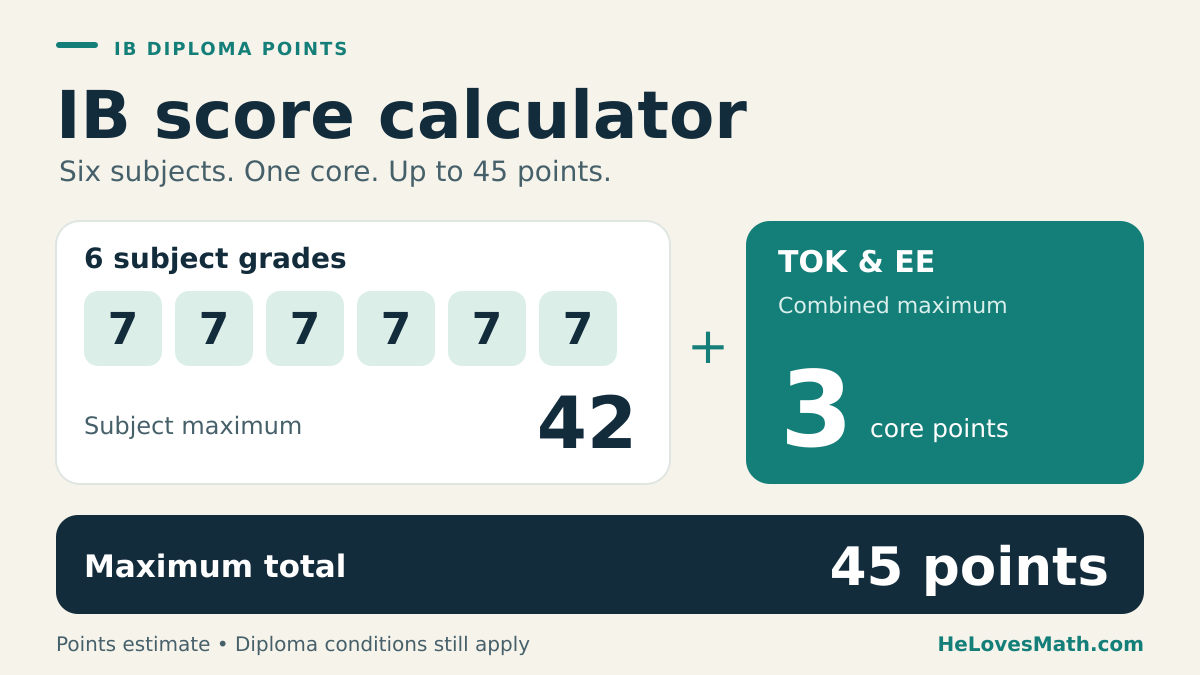
The Diploma Programme total combines six subject grades, each from 1 to 7, with the points awarded for the combination of TOK and EE grades. Six 7s make 42 subject points; the core can add 0, 1, 2 or 3. The maximum is 45.
HL and SL grades contribute equally to this total: an HL 6 and an SL 6 each contribute six points. However, the diploma has separate minimum totals for HL and SL. Creativity, activity, service (CAS) contributes no numerical points but must be completed. See the IB’s explanation of DP assessment.
How to use this calculator
- Enter the overall grade for each of your six contributing subjects, not a raw exam mark or an IA percentage.
- Choose the TOK and EE letter grades. Their combination determines the core points in the matrix below.
- Select Calculate IB Score to see subject points, core points and the total. Changing an input hides the old result until you recalculate.
- Use Reset to clear the form, or change one grade to compare a realistic alternative.
The calculation runs in your browser; you do not need to submit your name, school or results. An empty field means you have not entered a grade. N is different: it is an official no-grade result, not a prediction of zero.
TOK and EE core-points matrix
Find your TOK grade across the top and your EE grade down the left. The intersection gives your core points. The matrix is symmetric, so swapping the two grades gives the same points.
| EE ↓ / TOK → | A | B | C | D | E |
|---|---|---|---|---|---|
| A | 3 | 3 | 2 | 2 | F |
| B | 3 | 2 | 2 | 1 | F |
| C | 2 | 2 | 1 | 0 | F |
| D | 2 | 1 | 0 | 0 | F |
| E | F | F | F | F | F |
F means a failing condition, not zero points. An E in either TOK or EE prevents the diploma from being awarded. A D is different: A + D gives two points, B + D gives one, and C + D or D + D gives zero. N is not part of the A–E matrix.
Two easily confused combinations: A + B gives 3, while B + C gives 2. Source: the IB’s DP passing criteria and core-points matrix.
Worked IB score examples
Example 1: a predicted total of 39
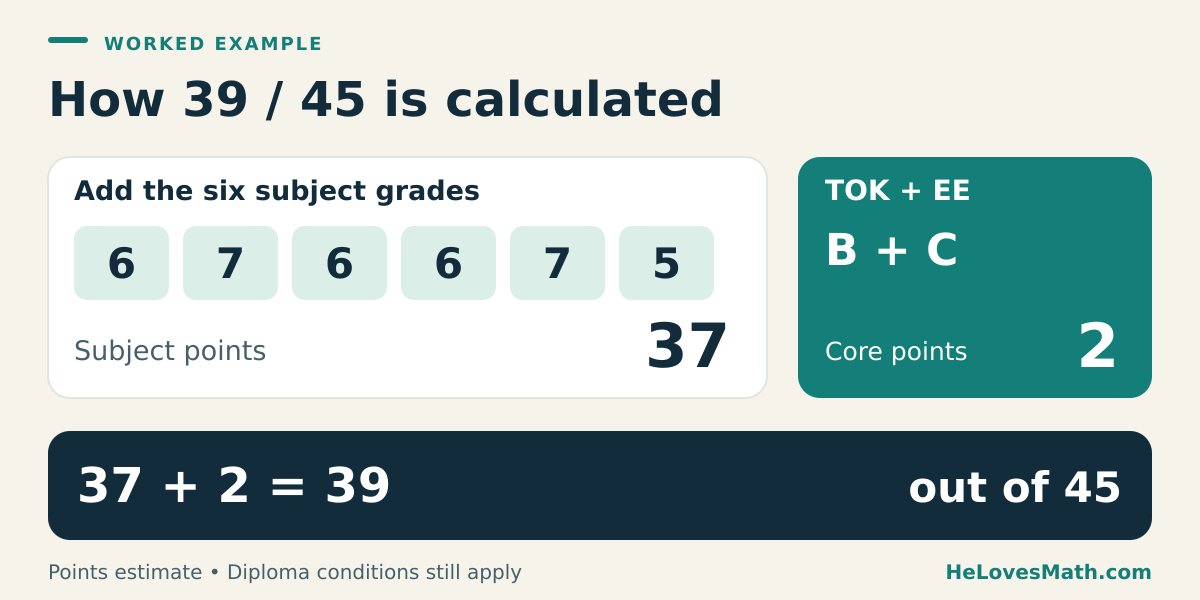
Suppose the six predicted subject grades are 6, 7, 6, 6, 7 and 5. Add them: 6 + 7 + 6 + 6 + 7 + 5 = 37. TOK B and EE C add 2 core points, making an estimated 39/45.
Example 2: exactly two grade 2s
Grades 2, 2, 7, 7, 7 and 7 total 32. TOK A and EE B add 3, producing 35/45. Exactly two grade 2s do not breach the IB’s grade-2 count rule. That rule permits up to two; three grade 2s breach it. The HL/SL distribution and all other conditions still matter, so this example does not establish diploma eligibility.
Example 3: 24 points is a minimum, not a complete decision
Six grades of 4 total 24. TOK C and EE D add zero, leaving 24/45. The total reaches the numerical minimum, but an incomplete CAS requirement would still prevent a diploma award. This calculator cannot check CAS or the registered course requirements.
Why the total does not decide the diploma
The IB requires a combination of conditions. Its published passing criteria include:
- At least 24 total points and completion of CAS
- A grade for every contributing subject, TOK and EE: no N
- TOK and EE each at D or above: no E
- No subject grade of 1
- No more than two subject grades of 2, across HL and SL together
- No more than three subject grades of 3 or below, including any 1s and 2s
- At least 12 HL points; if four HL subjects are taken, the highest three count for this threshold
- At least 9 SL points; if only two SL subjects are taken, at least 5 is required
This list explains why a points-only calculator must not display “diploma requirements met.” The tool flags the total, grade-count and E/N issues it can see, but does not collect subject levels or CAS status. It also cannot verify completion of all programme and assessment requirements. Your school’s DP coordinator can explain your official registered subjects and results.
Source: IB DP passing criteria and IB assessment principles and practices (printed page 132).
How IB predicted grades differ from final grades
A predicted grade is a teacher’s evidence-based estimate of the grade a student is expected to achieve. This calculator adds predictions you supply; it does not create an official predicted grade from homework, effort, mock marks or an IA percentage. Schools may use different evidence and reporting processes, so ask your teacher how a prediction was reached.
Final grades come through the IB assessment process and can differ from predictions. Subject assessment components, weightings and grade boundaries matter. There is no universal rule such as “70% always means a 6,” nor a single formula that converts an IA percentage into a final subject grade. See the IB’s guidance on student assessment and predicted grades.
Use scenarios to plan useful study
- Start with your school’s current predictions and record which subjects have uncertain estimates
- Compare a realistic lower and higher scenario instead of treating one total as guaranteed
- Ask for feedback on specific assessment criteria and practise the skills that cost marks
- Check university course requirements directly, including required HL subjects and individual grades as well as the overall total
For subject planning, read our guide to the six IB subjects and curriculum structure. For a practical next step after estimating your mathematics grade, use our IB Mathematics HL revision guide.
Frequently asked questions
Can I get the IB Diploma with two grade 2s?
The grade-2 count rule permits up to two. That alone does not confirm a diploma award: all the other conditions, including the total, HL/SL thresholds and CAS, must also be met.
Does a D in TOK or EE always mean zero core points?
No. D paired with A gives 2; D paired with B gives 1; D paired with C or D gives 0. E is a failing condition, not an ordinary zero.
Can the calculator predict my final result?
It can total a scenario based on the grades you enter. It cannot predict exam performance, assign an official school prediction or confirm a diploma award.
What is a good IB score for university?
It depends on the institution, course and application context. Compare your total and subject grades with the current published requirements for each course. No single score guarantees admission.
When are predicted grades submitted?
Schools and application systems have their own deadlines. Confirm the dates for your examination session and applications with your coordinator or adviser; a generic month-by-month calendar is not reliable for every student.
Why does the calculator not give a total for E or N?
An E in TOK or EE is a failing condition; N means no grade was awarded. Treating either as an ordinary zero would disguise important information. The calculator shows the available breakdown and explains the issue instead.
Quick practice: check your understanding
- Six grades of 5, with TOK A and EE B: what is the total?
- Subject points total 34, with TOK B and EE C: what is the total?
- Six grades of 7, with TOK E and EE A: should you treat this as an ordinary 42-point diploma result?
Show answers
1. 6 × 5 = 30, then 30 + 3 = 33/45. 2. B + C gives 2, so 34 + 2 = 36/45. 3. No. The E is a failing condition; the subject subtotal does not remove it.
HeLovesMath is an independent educational resource. “IB” refers to the International Baccalaureate. Always consult current official IB guidance and your school for your own examination session.