
Watts to Amps Calculator: Convert Electrical Power to Current
Use this watts to amps calculator to convert power in watts into current in amperes for DC circuits, single-phase AC circuits, and three-phase AC circuits. Enter watts, voltage, and power factor, then get the amp value with the exact formula used.
Watts to Amps Calculator
Choose the circuit type and enter electrical input power, voltage, and a known power factor for AC. Three-phase mode assumes a balanced load supplied by balanced sinusoidal voltage.
Use power and voltage from the same electrical side of the device.
Numerical range: nonzero inputs from 10−100 to 10100; power factor must also be at most 1. Zero power is allowed. Values outside this range are rejected.
Formula used:
1200 watts at 120 volts equals 10 amperes.
Watts to Amps Calculator Guide
A watts to amps calculator helps you convert electrical power into electrical current. This is useful when you are checking a device label, planning a circuit, estimating appliance load, comparing power supplies, or learning the relationship between watts, volts, and amps. On He Loves Math, this calculator is written for students, homeowners, technicians, makers, solar learners, battery users, and anyone who wants a clear power-to-current conversion without guessing.
Most people already know the wattage shown on a device label but still need to determine the current draw. A heater may be rated at 1500 W, a charger at 65 W, or an inverter at 2000 W. To find amperes, also identify the operating voltage and whether the circuit is DC, single-phase AC, or three-phase AC. For AC equipment, use the manufacturer’s power factor when it is available.
What Are Watts?
The watt is the SI unit of power: 1 watt is 1 joule per second. Power measures the rate at which energy is used or transferred. In simple terms, watts tell you how much electrical work a device is doing per second. A small LED bulb may use 9 watts. A laptop charger may use 45 to 100 watts. A microwave oven may use 1000 watts or more. A space heater may use 1500 watts. The higher the wattage, the more power the device needs.
Mathematically, power in a basic DC circuit is the product of voltage and current:
This relationship is the foundation of the watts to amps conversion. If you know the power and voltage, you can rearrange the formula to solve for current:
Here, is power in watts, is voltage in volts, and is current in amperes. The ampere, usually shortened to amp, measures the flow of electric charge.
What Are Amps?
An amp is a unit of electrical current. Current describes how much electric charge is flowing through a circuit. If voltage is like electrical pressure and watts describe the rate of energy use, amps describe the amount of current moving through wires and components. This matters because wires, switches, plugs, fuses, breakers, adapters, inverters, and power supplies all have current limits.
For example, if a device draws 2 amps, a 1 amp power adapter is not suitable. If a circuit carries more current than the wire or breaker is designed for, heat can build up. That is why amp calculations are important in electrical planning. However, this calculator does not replace local electrical code, manufacturer instructions, or professional inspection.
Why Voltage Matters in Watts to Amps Conversion
The same wattage can produce very different amp values depending on voltage. A 1200 W device at 120 V draws 10 A in a basic DC or resistive AC calculation. A load designed to consume 1200 W at 240 V draws 5 A under the same assumptions. This comparison is not permission to connect a 120 V appliance to 240 V; always use its rated supply. The power is the same, but the current is lower at higher voltage.
This is one reason higher-voltage systems can deliver the same power with less current. Lower current can reduce voltage drop and heat loss, but it also requires proper insulation, components, and safety practices.
DC Watts to Amps Formula
For direct current, the formula is straightforward:
Use this formula for DC systems such as batteries, DC power supplies, many electronics, solar battery systems, LED strips, robotics, Arduino projects, and vehicle accessory circuits. If a 12 V DC device uses 60 W, the current is:
This means the device needs approximately 5 amps while operating at that power level. In real projects, you should also consider startup current, wire length, voltage drop, connector ratings, and power supply margin.
Single-Phase AC Watts to Amps Formula
For single-phase alternating current, the formula includes power factor when the load is not purely resistive:
For a consuming AC load, power factor is real input power divided by apparent power. This calculator requires a known value greater than 0 and no more than 1; it does not interpret power factor as efficiency. Resistive loads such as simple heaters and incandescent bulbs often have a power factor close to 1. Inductive or electronic loads, such as motors, compressors, fluorescent lighting, and some power supplies, may have a lower power factor.
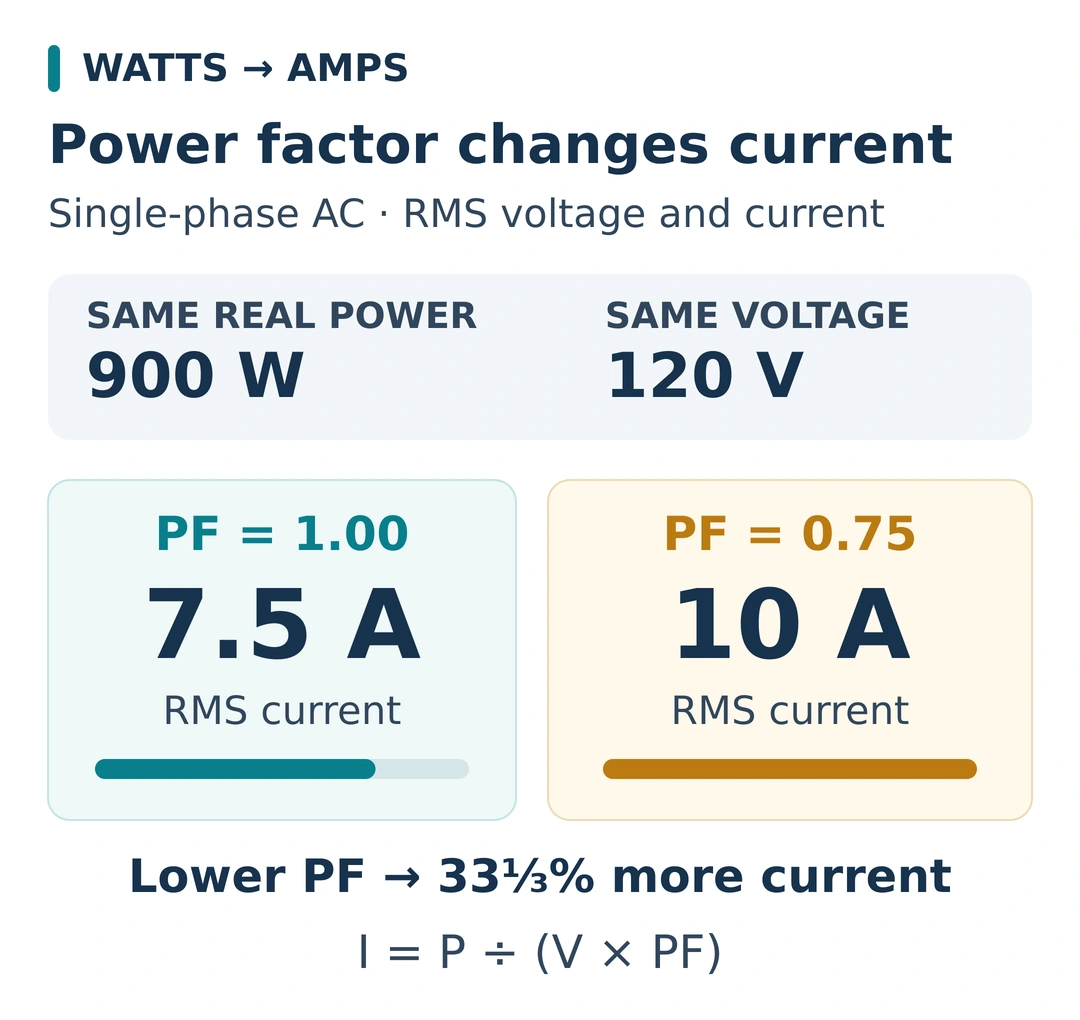
For example, a single-phase motor with 900 W of electrical input power, 120 V RMS, and true power factor 0.85 draws approximately:
If you ignored power factor and used , you would get 7.5 A. That difference matters when estimating current for AC equipment. When in doubt, check the device nameplate or technical datasheet.
Three-Phase AC Watts to Amps Formula
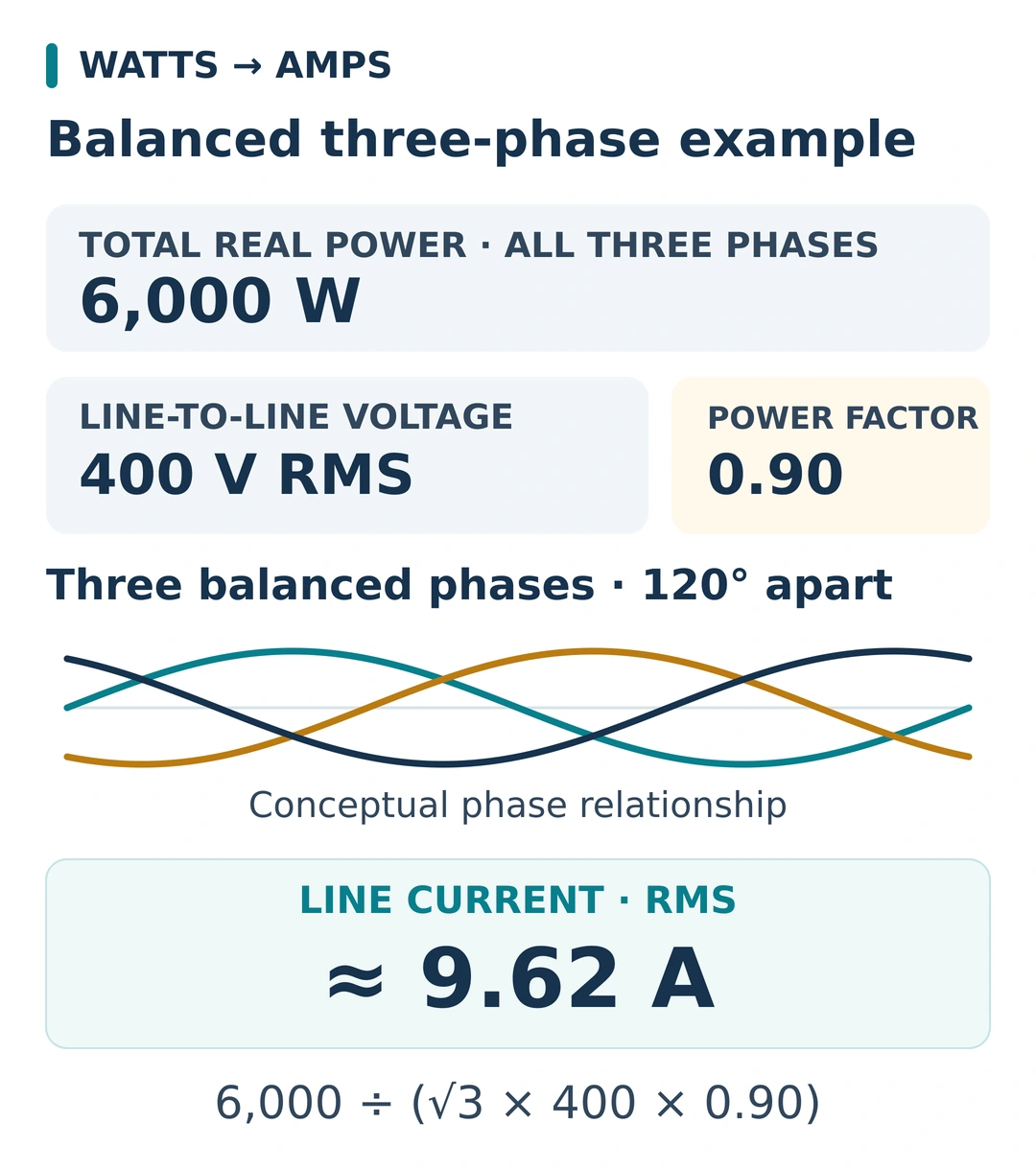
Three-phase systems are common in commercial buildings, industrial equipment, motors, pumps, HVAC systems, manufacturing facilities, and larger electrical installations. For a balanced three-phase load, enter total real electrical input power across all three phases and line-to-line RMS voltage. The result is RMS current in each line:
The value , approximately 1.732, appears because of the phase relationship in a three-phase system. The symbol means line-to-line RMS voltage, not line-to-neutral voltage. Do not multiply the calculated line current by three. For a balanced load taking 6000 W total at 400 V line-to-line RMS with power factor 0.9, the line current is:
Three-phase calculations should be handled carefully because equipment labels may show watts, kilowatts, horsepower, line-to-line voltage, line current, apparent power, or full-load amps. For design decisions, always use the manufacturer’s documentation and local electrical code.
How to Use This Watts to Amps Calculator
- Select the circuit type: DC, AC single-phase, or AC three-phase.
- Enter the device power in watts. If your device is listed in kilowatts, multiply kilowatts by 1000 first.
- Enter DC voltage or AC RMS voltage. Three-phase mode requires line-to-line voltage.
- Enter the known true power factor for AC loads. Use 1 only when that assumption is justified, such as an ideal resistive load. DC ignores this field.
- Click Calculate Amps to get the current in amperes and the formula used.
Choose the Correct Inputs Before Calculating
The arithmetic is short, but the result is only useful when the inputs describe the same electrical side of the device. Read the equipment label carefully before entering a wattage or voltage. If the label already gives current in amperes, treat that nameplate value as more specific than a general estimate from this calculator.
Identify DC, single-phase AC, or three-phase AC
Batteries, many solar systems, USB equipment, and vehicle accessories commonly use direct current. Homes usually supply single-phase alternating current to ordinary receptacles and appliances, although the available voltage differs by country. Larger motors, pumps, commercial equipment, and industrial installations may use three-phase AC. The circuit type changes the formula, so choosing the wrong mode can produce a result that looks precise but describes a different system.
Use the voltage at which the device actually operates
Voltage must come from the same side of the equipment as the wattage. A laptop adapter might accept 230 V AC from a wall outlet and deliver 20 V DC to the computer. Dividing the adapter’s DC output watts by the AC input voltage mixes two different sides of the conversion. Use AC input power with AC input voltage when estimating wall current, or DC output power with DC output voltage when estimating the delivered output current.
Distinguish input power from output power
Converters, chargers, inverters, motors, and power supplies are not perfectly efficient. If a device delivers 1000 W of useful output at 90% efficiency, its approximate input power is . The current drawn from the source should be based on input power, not only the advertised output. When a reliable manufacturer input rating is available, use it instead of estimating efficiency.
Enter power factor only for the relevant AC load
Power factor describes the relationship between real power and apparent power in an AC circuit. A resistive heater may operate close to , while a motor or other inductive load may have a lower value. For single-phase AC, reducing power factor from 1 to 0.8 increases the calculated current for the same watts and volts because . Do not guess a power factor when a dependable label or data sheet is available.
Do not use efficiency and power factor as if they were the same
Efficiency compares useful output power with input power. Power factor compares real power with apparent power in an AC system. A motor can have both an efficiency value and a power-factor value, and the two describe different effects. If the wattage entered is mechanical output power, input electrical power may first need an efficiency adjustment. The appropriate current calculation may then also need power factor.
Check whether watts means W, kW, or another rating
One kilowatt equals 1000 watts, so . Convert kilowatts to watts before using this calculator. Also check whether the label reports real power in watts, apparent power in volt-amperes, or energy use in watt-hours. Watts and volt-amperes are related through power factor, while watt-hours describe energy accumulated over time and cannot be entered as though they were watts.
Compare the answer with the nameplate current
After calculating, compare the result with any current rating printed on the device. Differences can occur because of efficiency, power factor, control electronics, operating modes, temperature, or rounding. Motors and compressors may also draw a brief starting current that is much higher than the normal running current. The calculator estimates current from the values supplied; it does not reproduce every condition included in a manufacturer’s tested rating.
Treat the result as an educational estimate
The result helps explain electrical relationships and supports preliminary comparisons, but it does not determine conductor size, breaker size, fuse selection, extension-cord suitability, or installation approval. Those decisions can depend on continuous-load rules, insulation temperature, cable length, voltage drop, enclosure conditions, local code, and equipment-specific instructions. Use qualified guidance for safety-critical work.
Worked Examples
Example 1: 100 watts to amps at 12 volts DC
A 100 W DC device running on a 12 V battery draws:
This is common in battery-powered systems. A 100 W load on a 12 V battery draws much more current than the same wattage on a 120 V or 240 V system.
Example 2: 1500 watts to amps at 120 volts
A 1500 W appliance at 120 V with a power factor of 1 draws:
This is why many high-wattage household appliances require circuits with sufficient amp capacity.
Example 3: 2000 watts to amps at 240 volts
A 2000 W DC load, or a single-phase AC load with power factor 1, at 240 V draws:
At the higher voltage, current is lower for the same wattage.
Example 4: 5000 watts to amps in a three-phase system
A balanced three-phase device taking 5000 W total electrical input at 400 V line-to-line RMS and power factor 0.9 draws this RMS line current:
This is the current in each line under the stated balanced-load assumptions. The arithmetic alone does not measure equipment efficiency.
Common Watts to Amps Conversion Table
This table is for steady DC or single-phase AC with power factor , using RMS voltage for AC. It is not a three-phase table. Values are rounded to two decimal places where needed. At the same power and voltage, a smaller positive AC power factor gives a larger current.
| Watts | Amps at 12 V | Amps at 120 V | Amps at 240 V |
|---|---|---|---|
| 50 W | 4.17 A | 0.42 A | 0.21 A |
| 100 W | 8.33 A | 0.83 A | 0.42 A |
| 500 W | 41.67 A | 4.17 A | 2.08 A |
| 1000 W | 83.33 A | 8.33 A | 4.17 A |
| 1400 W | 116.67 A | 11.67 A | 5.83 A |
| 1500 W | 125 A | 12.5 A | 6.25 A |
| 2000 W | 166.67 A | 16.67 A | 8.33 A |
| 3000 W | 250 A | 25 A | 12.5 A |
| 6000 W | 500 A | 50 A | 25 A |
Quick Answers for Common Wattages
A wattage does not have one fixed amp value because current also depends on voltage and circuit type. The answers below use for DC or a single-phase resistive load with power factor . Motors and other AC loads may draw more current when their power factor is below 1.
How many amps is 1000 watts?
At 120 V, 1000 W is . At 240 V, it is . On a 12 V DC system, the same power requires about , which shows why low-voltage systems carry much higher current for an equal wattage.
How many amps is 1400 watts?
At 120 V, 1400 W is about . At 240 V, it is about . Before using the result for equipment planning, check whether the label lists a power factor, input-current rating, or separate starting-current value.
How many amps is 1500 watts?
A 1500 W resistive appliance draws at 120 V or at 240 V. A space heater is a common example, but its nameplate current and the manufacturer’s instructions should guide real-world use.
How many amps is 6000 watts?
For DC or single-phase power at 240 V with , 6000 W is . For a balanced three-phase load taking 6000 W total at 400 V line-to-line RMS and power factor 0.9, use , which gives approximately . These results are not interchangeable because the circuit types are different.
Watts, Amps, Volts, and Ohms: The Core Relationship
For a resistive load in steady DC, or a purely resistive AC load using RMS voltage and current, the following power and resistance relationships apply:
Ohm’s Law connects voltage, current, and resistance:
By combining these equations, you can also express power as:
For a simple calculator page, the most important conversion remains watts to amps. But understanding these related formulas helps students and readers see why electricity is not just one number. Wattage, voltage, current, resistance, power factor, and circuit type all work together.
What Is Power Factor?
In AC, both phase displacement and waveform distortion can affect true power factor. Real power is measured in watts and apparent power in volt-amperes. Use true power factor, rather than assuming that a displacement factor or a motor efficiency is the same quantity. The single-phase expression uses RMS voltage and RMS current. Three-phase mode is a balanced-load estimate; it cannot determine individual currents in an unbalanced system.
The relationship can be summarized as:
Here, is real power in watts and is apparent power in volt-amperes. At a fixed voltage and real wattage, power factor 0.8 requires 1.25 times the current of power factor 1. This is not a statement that 20% of the energy is lost. If power factor is zero, real watts and voltage alone cannot determine reactive current, so the calculator asks for a valid positive power factor.
When Should You Use a Watts to Amps Calculator?
Use this calculator when you know the wattage of a device and need to estimate the current draw. This is helpful for checking power adapters, choosing inverter size, estimating battery drain, understanding appliance loads, planning a solar setup, comparing device labels, teaching electrical formulas, and building educational content around electricity. It is also useful for readers who search for quick conversions such as 500 watts to amps, 1000 watts to amps, 1500 watts to amps, and 2000 watts to amps.
For practical installations, do not stop at the calculated amp value. Real-world systems need safety margins. Motors can draw high starting current. Long wires can create voltage drop. Heat can affect rating. Breakers and fuses have specific curves. Local codes may require derating. This tool gives the mathematical current conversion, not a final engineering approval.
Common Mistakes When Converting Watts to Amps
1. Forgetting the voltage
Watts alone are not enough. You cannot accurately convert watts to amps without voltage. A 1000 W load at 12 V is very different from a 1000 W load at 240 V.
2. Ignoring power factor
For AC motors and inductive loads, power factor can change the current result. If the power factor is lower, current is higher.
3. Mixing watts and kilowatts
If your device rating is listed in kilowatts, convert it first:
4. Confusing amps with amp-hours
Amps measure current at a moment. Amp-hours measure battery capacity over time. A constant 5 A DC draw for 2 hours transfers 10 Ah of charge. Battery runtime also depends on voltage, usable capacity, discharge conditions, and any conversion losses; amp-hours are not a unit of energy.
5. Treating the result as a wiring recommendation
A calculated amp value is not the same as wire size, breaker size, or installation approval. Use this calculator for learning and estimation, then verify any real installation with qualified guidance.
Continue Learning About Electrical Power
Use the Ohm’s Law calculator to connect voltage, current, and resistance. The electrical power calculator helps when a different pair of electrical quantities is known, while the physics calculator collection provides related formula tools.
A calculated current is not a wire-size, fuse, or breaker recommendation. Real installations must follow local electrical rules and equipment instructions.
Check Your Understanding
1. A DC load takes 72 W at 24 V. What current flows?
Divide power by voltage: .
2. A single-phase load takes 1800 W at 230 V RMS with PF 0.8. Find RMS current.
Use the power factor: . Ignoring it would incorrectly give approximately 7.82609 A.
3. A balanced three-phase load takes 12000 W total at 400 V line-to-line RMS and PF 0.9. Find line current.
. Do not multiply the line current by three.
4. Can a motor’s 750 W shaft-output rating be entered as electrical input?
Not directly. If efficiency is 0.90, input power is . For single-phase 230 V RMS and PF 0.80, . Efficiency and power factor are separate adjustments.
Watts to Amps Calculator FAQs
How do I convert watts to amps?
Use the formula for steady DC or single-phase resistive AC, using RMS quantities for AC. For single-phase AC, use . For balanced three-phase AC, use , with total real input watts, line-to-line RMS voltage, and RMS line current.
How many amps is 1000 watts?
For DC or single-phase AC with power factor 1, it depends on voltage. Using RMS voltage for AC, at 120 V, 1000 W is . At 240 V, 1000 W is . At 12 V, 1000 W is .
Can I convert watts to amps without voltage?
These conversions require voltage; AC also needs the appropriate circuit type and power factor. The same wattage can correspond to different currents.
What power factor should I use?
DC does not use power factor. For AC, use the known true power factor from the equipment specifications or a suitable measurement. A value of 1 is an assumption appropriate for an ideal resistive load, not a fallback for missing data.
Is this calculator safe for breaker or wire sizing?
Use it for education and estimation only. Breaker sizing, wire sizing, continuous load rules, derating, and code compliance should be verified by a qualified electrician.
Sources & References
Formula and terminology references. These sources do not approve an installation or replace equipment instructions.
- OpenStax: Power in an AC Circuit — RMS quantities, average real power, and sinusoidal power factor.
- Tektronix: Fundamentals of AC Power Measurements — true power factor, apparent power, and waveform distortion.
- US Department of Energy: Energy Management for Motor-Driven Systems — electrical input power, shaft output, and motor efficiency.
- Schneider Electric Electrical Installation Guide: Definition of reactive power — balanced three-phase power and line quantities.
- NFPA Electrical Safety Checklist — practical warning signs and qualified-electrician guidance; requirements depend on jurisdiction.
- NIST: SI Units – Electric Current — ampere, coulomb, and related electrical units.