Independent AP scoring guide · Reviewed 4 October 2026
Is 70% enough for a 5 on an AP exam?
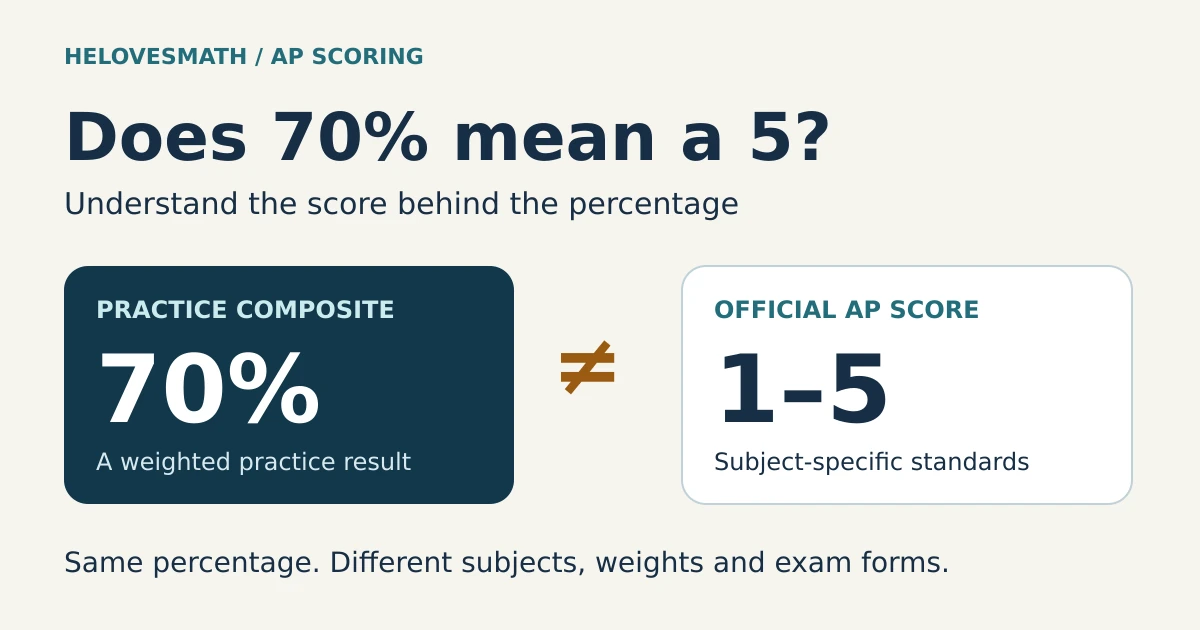
No: 70% does not automatically equal an AP score of 5. A subject-specific practice conversion may predict a 5, but the percentage alone is not enough to tell. There is no single raw-percentage cutoff that applies to every AP subject, every exam form, or every year. Your official AP score is based on the weighted combination of the scored parts of your specific exam and the performance standard set for that subject.
The safest interpretation is this: treat 70% as useful evidence about your preparation, not as a guaranteed score conversion. A student should check the current exam format, section weights, official scoring guidelines, and several complete timed practice results before estimating whether a 5 is realistic.
Why 70% does not have one universal AP score conversion
AP exams are not reported as classroom percentages. The final result is an AP score from 1 to 5. Most AP exams combine multiple-choice and free-response work, while some subjects also use portfolios, projects, performance tasks, or other through-course assessments. Those components can have different weights, so “70% correct” is incomplete unless you know which questions were included and how each part contributes to the composite.
College Board explains that an AP score is a weighted combination of results across the applicable exam components. It uses evidence-based standard setting to describe the performance required for scores of 2, 3, 4, and 5. That process draws on student-performance evidence, expectations from college faculty, college-comparability studies where appropriate, and psychometric analysis. The official explanation is listed in Sources & References.
This matters because the popular phrase “the AP curve” can create the wrong mental model. Your score is not simply determined by ranking you against the other students who happened to test that year. AP performance standards are intended to represent levels of achievement. Equating can adjust for small differences in difficulty between exam versions so that the reported score represents a comparable standard. It is more accurate to talk about score standards and equating than to imagine a fixed number of students being allowed to earn a 5.
Important distinction: a score calculator or online conversion table can offer a planning estimate, but it cannot issue an official AP score. Only College Board reports the official result after all applicable exam components have been scored and converted.First ask: 70% of what?
- Classroom grade: may include homework, labs and participation. It does not directly convert to an AP score.
- Multiple-choice percentage: describes that component only. Free responses or other assessed work may change the composite.
- Weighted composite: combines scored components using the applicable weights. It still needs the relevant score conversion.
- Percentile or score distribution: describes a student’s relative position or the proportion of students earning each score. If 20% of a group earn a 5, that does not mean 20% correct earns a 5, or that the cutoff is 80%.
Subject formats make the same percentage mean different things
A practice result of 70% may come from a full simulation, a multiple-choice section only, a set of free-response questions, or a mixture assembled by a teacher. Those are not interchangeable. If one section is worth more of the composite than another, the location of the missed points matters. A student who earns 70% in each correctly weighted section has a different evidence base from a student who earns 85% on one section and 55% on another without applying the official weights.
Subjects also assess different kinds of work. A calculation-heavy response may award points for intermediate reasoning. An essay rubric may award separate points for a defensible claim, relevant evidence, reasoning, or complexity. A portfolio subject evaluates submitted work under its own current requirements. Before converting anything, confirm that your practice material matches the current course and exam description for your subject.
Exam versions can require equating
Large assessment programs may use more than one exam form. Even when forms are designed to measure the same content and skills, one set of questions can be slightly more difficult than another. Equating is used to support comparable reported results across forms. This is another reason an unofficial statement such as “exactly 70% always earns a 5” is too strong.
What do AP scores from 1 to 5 mean?
The AP score scale communicates a recommendation about readiness for college credit and placement. It is not a percentage scale, and it is not the same as a letter grade on your high-school transcript.
| AP score | Recommendation | College-course grade equivalent shown by College Board |
|---|---|---|
| 5 | Extremely well qualified | A+ or A |
| 4 | Very well qualified | A-, B+, or B |
| 3 | Qualified | B-, C+, or C |
| 2 | Possibly qualified | No college-course grade equivalent listed |
| 1 | No recommendation | No college-course grade equivalent listed |
A 5 is the highest AP score. There is no AP score of 6. A 3 is described as “qualified,” but students should not assume that every college awards the same credit for a 3, 4, or 5. Individual colleges and universities set their own credit and placement policies, and policies can differ by subject, department, program, and year. Always verify the policy for the institution and course you care about.
Does a 3 mean you passed?
Students often call 3, 4, and 5 “passing scores” because they are commonly described as credit-qualifying results. However, “passing” is not a promise of college credit. A particular university might award credit for a 3 in one subject, require a 4 in another, use a 5 only for advanced placement, or award no course credit for a particular exam. The official score and the college’s policy answer different questions.
Does a 5 guarantee college credit?
No. A 5 is an excellent reported AP result, but the receiving institution decides what it will do with that score. Check whether the policy grants credit, placement into a later course, an exemption from a requirement, or no direct benefit. Students applying internationally should also verify how the institution uses AP scores in admission and placement decisions.
How a 70% weighted composite can be estimated
For planning, a teacher or student may calculate a normalised composite on a 0–100 scale. The examples below are hypothetical arithmetic exercises, not official AP cutoffs. An official exam may express its composite on a different point scale. Also follow any separate within-section weighting in its scoring model; do not assume that every free-response point or task has equal weight. For components whose percentages already reflect the applicable scoring model:
Section percentage = 100 × earned points ÷ available points
Write weights as decimals: 60% = 0.60.
The section weights must add to 1, or 100%. Use the current weights for the exact AP subject and exam version you are practicing. Do not invent equal weights unless the official format actually uses them.
Worked example: two equally weighted sections
Imagine a practice exam with two sections that each contribute 50% of the composite. A student earns 75% on the first section and 65% on the second. The planning estimate is:
0.50 × 75 + 0.50 × 65 = 37.5 + 32.5 = 70%
The estimated composite percentage is 70%. This calculation is mathematically correct under the stated assumptions, but it still does not prove that the student will receive an AP score of 5. To estimate the reported score, the student would also need a defensible subject-specific performance boundary for comparable material. That boundary can change when the practice source, exam form, scoring rubric, or standard differs.
Worked example: why section balance matters
Suppose a different exam uses a 60% weight for one component and 40% for another. If a student earns 80% on the first component and 55% on the second, the weighted estimate is:
0.60 × 80 + 0.40 × 55 = 48 + 22 = 70%
Again, the result is 70%, but the learning diagnosis is different. The second component is much weaker. Even if an unofficial calculator predicts a strong final score, the student should strengthen that weak component because small changes in question difficulty, time pressure, or rubric execution can reduce the composite.
Math check: a weighted practice composite is useful only when the section percentages and weights describe the same scoring model. If raw points are available, first convert each section to a percentage using 100 × earned points ÷ available points, then apply the appropriate weight.
Worked example: raw points are not always safe to pool
Suppose component A awards 24 out of 30 points and contributes 60% of a hypothetical assessment. Component B awards 18 out of 30 points and contributes 40%. Assume points within each component are equally weighted.
- Convert A: 100 × 24 ÷ 30 = 80%.
- Convert B: 100 × 18 ÷ 30 = 60%.
- Weight and add: 0.60 × 80 + 0.40 × 60 = 48 + 24 = 72%.
Simply pooling gives 42 ÷ 60 × 100 = 70%. That gives the two components equal weight because each has 30 available points, contrary to the stated 60/40 model. Use the scoring weights rather than counting every raw point as equally valuable across components.
Worked example: how much does a stronger weak section help?
Return to the 80% and 55% example with 60/40 weights. Raising the second component from 55% to 65% adds 0.40 × 10 = 4 percentage points to the composite. The new result is 48 + 26 = 74%. That is a 4-point increase in the composite, not 10 points, and it does not establish a particular AP score.
How to estimate whether your performance is near a 5
A responsible estimate uses several pieces of evidence rather than one percentage from one worksheet. Follow this process:
- Confirm the current exam format. Check the subject’s current course and exam description. Note the components, question types, timing, and section weights. An old practice book may reflect a format that has changed.
- Use complete, comparable practice material. A short quiz on one unit cannot represent a full AP exam. Prefer a timed full-length practice set or a carefully assembled simulation covering the tested content and skills.
- Score objective questions accurately. College Board states that multiple-choice scoring is based on the number of questions answered correctly. Incorrect and unanswered responses do not deduct points. Apply the answer key for the exact practice material.
- Use the correct free-response rubric. Award a point only when the response satisfies that point’s requirement. Give partial credit where the rubric allows it, and do not award points merely because the final answer looks reasonable.
- Apply section weights. Calculate the weighted composite with the current model. Keep the raw section results as well, because they reveal where improvement is needed.
- Compare cautiously. If you use a published estimate or third-party score calculator, check the exam year, source, and assumptions. Treat the result as a range, not an official conversion.
- Repeat under timed conditions. Several recent full simulations provide more useful evidence than one unusually strong or weak attempt; there is no official minimum number. Track the spread of the results and the causes of missed points.
Use a range instead of a single predicted score
A useful planning statement sounds like: “My recent timed composites place me near the estimated 4–5 boundary, so I should build a margin.” A weak statement sounds like: “I got exactly 70%, so I am guaranteed a 5.” The range-based interpretation accounts for ordinary variation in question mix, execution, and unofficial conversion models.
Build a safety margin
If your target is 5, do not stop studying when one estimate barely reaches an unofficial boundary. Aim to score consistently above that estimate. A safety margin protects you from a difficult topic mix, avoidable mistakes, rushed free responses, or a practice source that was easier than the real exam.
Review errors by cause
After each practice exam, classify missed points. Useful categories include content knowledge, misunderstanding the command word, incomplete justification, calculator or arithmetic error, time management, evidence selection, and failure to satisfy a rubric condition. The category tells you what to do next. Re-reading notes does not solve every kind of error.
How to score your practice work more reliably
A percentage is only as trustworthy as the scoring process behind it. If you check work casually, remember the answer while grading, or award yourself a point for an idea that the rubric does not accept, the result can look more reassuring than your actual exam readiness. Reliable self-scoring should be repeatable: another careful reader using the same materials should reach a similar result.
Scoring multiple-choice practice
Mark the response you actually selected under timed conditions. Do not change an answer after seeing the key and then count it as correct. Record unanswered items separately from incorrect attempts because the two patterns suggest different problems. An unanswered item may indicate pacing or uncertainty; a confident wrong answer may reveal a misconception. When a practice source contains questions that are no longer aligned with the current framework, do not quietly include or exclude them to improve the percentage. Note the limitation and choose a more comparable source for your next full simulation.
Scoring free-response practice
Read the scoring guideline one point at a time. Highlight the exact sentence, calculation, diagram feature, or piece of evidence in your response that earns each point. If you cannot point to qualifying work, do not award the point. Also read any dependency or consistency rules: some rubrics allow a later point after an earlier error when the later reasoning is consistent, while other points require a specific result or justification.
Free-response scoring is not the same as giving an essay an overall impression. A response that sounds polished can miss a required claim, unit, explanation, or connection. A short response can sometimes earn full credit when it meets every listed condition. Practice writing what the task demands rather than trying to make every answer longer.
Keep a simple score log
For each full practice attempt, record the date, source, exam format, time used, raw points by section, section percentages, applied weights, weighted composite, and major error categories. Add one sentence describing the testing conditions, such as whether you paused, used notes, or completed the work in a noisy room. This context prevents you from comparing a relaxed open-note attempt with a strict timed simulation as if they measured the same thing.
A score log also reveals trends. If the composite rises while timing remains stable and rubric errors decline, the improvement is more persuasive than a single high percentage. If the total stays flat but one weak section improves, the log still shows progress and helps you decide where the next study hour will have the greatest effect.
What should you do after scoring 70% on a practice AP exam?
First, celebrate the information: a full practice result gives you a real starting point. Then look below the headline percentage.
- Check coverage. Was the practice set genuinely representative of the complete course?
- Check timing. Did you finish each section under the official time limit without pausing?
- Check rubrics. Were free-response points awarded strictly and consistently?
- Check weighting. Did you combine sections using the current subject weights?
- Check consistency. Are recent results clustered near 70%, or is this an outlier?
- Check weak units and skills. A balanced 70% is different from a score supported by one strong section and one fragile section.
Turn the review into a short plan. Choose one content weakness, one exam-technique weakness, and one timing weakness. Practice each under conditions that resemble the exam, then complete another mixed set. Students working on calculus can continue with the AP Calculus AB past exam questions guide. For wider course material, browse the AP study resources.
Common myths about AP percentages and scores
Myth 1: AP exams are curved so only a fixed percentage of students can earn a 5
This is misleading. The score-setting process is intended to identify achievement levels. Equating supports comparability when exam versions differ slightly in difficulty. Another student’s success does not automatically take a 5 away from you.
Myth 2: Every AP subject uses the same 70% cutoff
False. Exam components, weights, scoring rubrics, and performance standards are subject-specific. A percentage estimate must be tied to a named subject and a defensible scoring model.
Myth 3: A 70% multiple-choice score means a 70% composite
Not necessarily. If the exam includes free response or another component, the multiple-choice section is only part of the composite. You must score and weight the other sections before calculating an overall estimate.
Myth 4: A predicted 5 guarantees college credit
No prediction is official, and even an official 5 does not impose a credit policy on a college. Verify the institution’s current policy and the exact course equivalency.
Myth 5: A classroom grade and an AP score measure the same thing
Your course grade may include homework, labs, participation, projects, corrections, and teacher-designed assessments. The AP score reports performance on the applicable AP assessment components. Strong course performance helps preparation, but the two results are not direct conversions.
When did 2026 AP scores come out?
College Board states that 2026 AP Exam scores became available starting Monday, July 6, 2026. Students checking results should use the same College Board account associated with My AP and their exam registration. Avoid creating a duplicate account, because duplicate accounts can delay access to records.
Use the official College Board AP score-reporting page listed in Sources & References to sign in and view results. If a score is missing, confirm that you are using the correct account and follow the support instructions shown in the score-reporting system.
Can you calculate the exact raw percentage from an official AP score?
Usually not. The official report shows the 1–5 score, not a complete item-by-item raw-score breakdown. Without the scored responses, section points, weights, and applicable conversion, you cannot reverse-engineer one exact raw percentage from the final score.
What matters more than chasing one cutoff?
The best preparation target is stable performance across the complete assessment. Students who focus only on a rumored cutoff can neglect topics or assume they have more margin than they really do. A better goal is to produce correct reasoning, satisfy free-response rubrics, manage time, and recover from unfamiliar questions.
Use your percentage diagnostically. If a timed composite is 70%, ask which additional points are most reachable. Correcting five recurring mistakes may be more valuable than studying an entirely new advanced topic. For comparison with another testing route, see the guide on how AP exams differ from the SAT.
Practice: calculate, then interpret
These original questions use hypothetical assessment models. All section percentages are already correctly scored; weights add to 100%. Try each question before opening its explanation.
1. Two sections count equally. Scores are 70% and 50%. What is the composite?
60%. Calculate 0.50 × 70 + 0.50 × 50 = 35 + 25 = 60. The 70% in one section is not the whole-exam result.
2. A score of 90% has weight 40%; a score of 60% has weight 60%. Find the composite.
72%. Calculate 0.40 × 90 + 0.60 × 60 = 36 + 36 = 72. The simple average, 75%, would use the wrong weights.
3. With equal section weights, you earn 32/40 and 21/30 points. Assume equal point weights within each section. Find the composite.
75%. The section results are 80% and 70%, so 0.50 × 80 + 0.50 × 70 = 75. Pooling 53/70 would give about 75.71%, which incorrectly weights the first section more heavily.
4. Under a 60/40 model, the first section is 80%. What second-section percentage reaches a 75% composite?
67.5%. Solve 0.60 × 80 + 0.40 × x = 75. Then 0.40x = 27, so x = 67.5. This is an algebraic target, not an AP 5 cutoff. If raw points are whole numbers, round the required point count upward to reach at least the target.
5. Under a 60/40 model, a 55% second-section score rises to 70%. How much does the composite rise?
6 percentage points. The section improves by 15 points, weighted at 0.40: 0.40 × 15 = 6. If the first section stays at 80%, the composite rises from 70% to 76%.
6. A score-distribution table says 20% of candidates earned a 5. Can you infer the raw-percentage cutoff?
No. The 20% describes a share of candidates, not a percentage of available exam points. You need the relevant exam’s composite scoring model and score boundary. Neither 20% nor 80% correct follows from that distribution.
Frequently asked questions about a 70% AP practice score
Is 70% definitely a 5 on every AP exam?
No. There is no universal 70%-to-5 conversion across all subjects and years. Use subject-specific weights, current rubrics, and several full practice results.
Can 70% be a 5 on some AP exams?
It can be consistent with a 5 under some subject-specific scoring estimates, but an unofficial estimate is not a guarantee. The applicable composite standard determines the reported score.
Is an AP exam graded against other students?
It is more accurate to describe AP scores as standards-based. Evidence-based standard setting defines performance levels, while equating supports comparable scores across exam versions.
What is the highest possible AP score?
5 is the highest AP score. There is no score of 6.
Is a 3 a passing AP score?
A 3 is described by College Board as “qualified” and is commonly treated as credit-qualifying, but each college decides whether it awards credit or placement.
Does a 5 always earn college credit?
No. Colleges and universities set their own policies. Check the current subject-specific policy for each institution.
Should I trust an online AP score calculator?
Use it as a planning estimate only. Check the exam year, section weights, source, and assumptions, and do not present the prediction as an official result.
How many practice exams should I take?
There is no universal required number. Several well-reviewed, timed simulations are more informative than one attempt because they reveal consistency and recurring weaknesses.
Does College Board deduct points for wrong multiple-choice answers?
No. College Board states that your multiple-choice score is based on the number answered correctly. Incorrect answers do not deduct points; unanswered questions earn no points. Do not subtract a guessing penalty from an AP practice score.
When were 2026 AP scores released?
College Board says 2026 AP scores became available starting Monday, July 6, 2026.
Why can two 70% practice results mean different things?
The practice sources may differ in difficulty, coverage, timing, rubric accuracy, and section weighting. A full, current, strictly scored simulation is more useful than a short quiz percentage.
What should I improve first after a 70% result?
Start with recurring, recoverable errors: missed rubric requirements, weak high-frequency topics, avoidable arithmetic mistakes, and time-management problems. Then repeat a mixed timed set.
How to interpret your estimate in the final weeks
As the exam approaches, use score estimates to guide decisions rather than to predict the future with false precision. If your recent results sit comfortably above a credible estimated boundary, maintain the strengths that created that margin and keep reviewing weaker areas. If results move between two score bands, prioritize the points you can recover consistently: finishing every required part, showing essential reasoning, checking units, and answering the command actually given.
Do not respond to one disappointing simulation by changing your entire study plan. First identify whether the score fell because of unfamiliar content, a strict but correct rubric, poor pacing, fatigue, or careless errors. Repeat a smaller mixed set after targeted review. If the same problem appears again, it deserves focused practice. If it does not, keep monitoring it without abandoning the broader course.
Likewise, do not respond to one unusually high result by assuming the work is finished. Confirm the performance with a different, current practice source under the same time limits. Stable performance across different question sets is stronger evidence than repeating a familiar test whose answers you partly remember.
On the day before the exam, a percentage forecast is less useful than a calm execution plan. Prepare permitted materials, review the timing structure, decide how you will move on from a stalled question, and sleep adequately. During the exam, collect the points available on the page in front of you. You cannot control the final conversion while testing, but you can control whether your response is complete, readable, supported, and submitted on time.
Bottom line
A 70% practice result needs context before it can support any AP score estimate. Calculate the weighted composite correctly, use current subject-specific information, score free responses strictly, and judge readiness across several timed attempts. The goal is not to discover a magic percentage; it is to build enough knowledge, reasoning, and exam control to perform above the required standard on test day.
Sources & References
Official College Board references checked 4 October 2026. External links open in a new tab. The worked examples, practice questions and diagrams on this page are original teaching material, not College Board score-conversion tables.
- AP scoring and evidence-based standard setting
- AP score scale and college-course grade equivalents
- How equating supports comparable scores across exam versions
- Multiple-choice scoring: no deduction for incorrect answers
- AP Calculus AB: current exam format and 2027 changes
- AP Calculus AB: released questions and scoring guidelines
- AP score distributions: percentages of students in each score category
- View AP scores and resolve missing-score questions
HeLovesMath is an independent educational site and is not affiliated with or endorsed by College Board. Colleges set their own credit and placement policies.