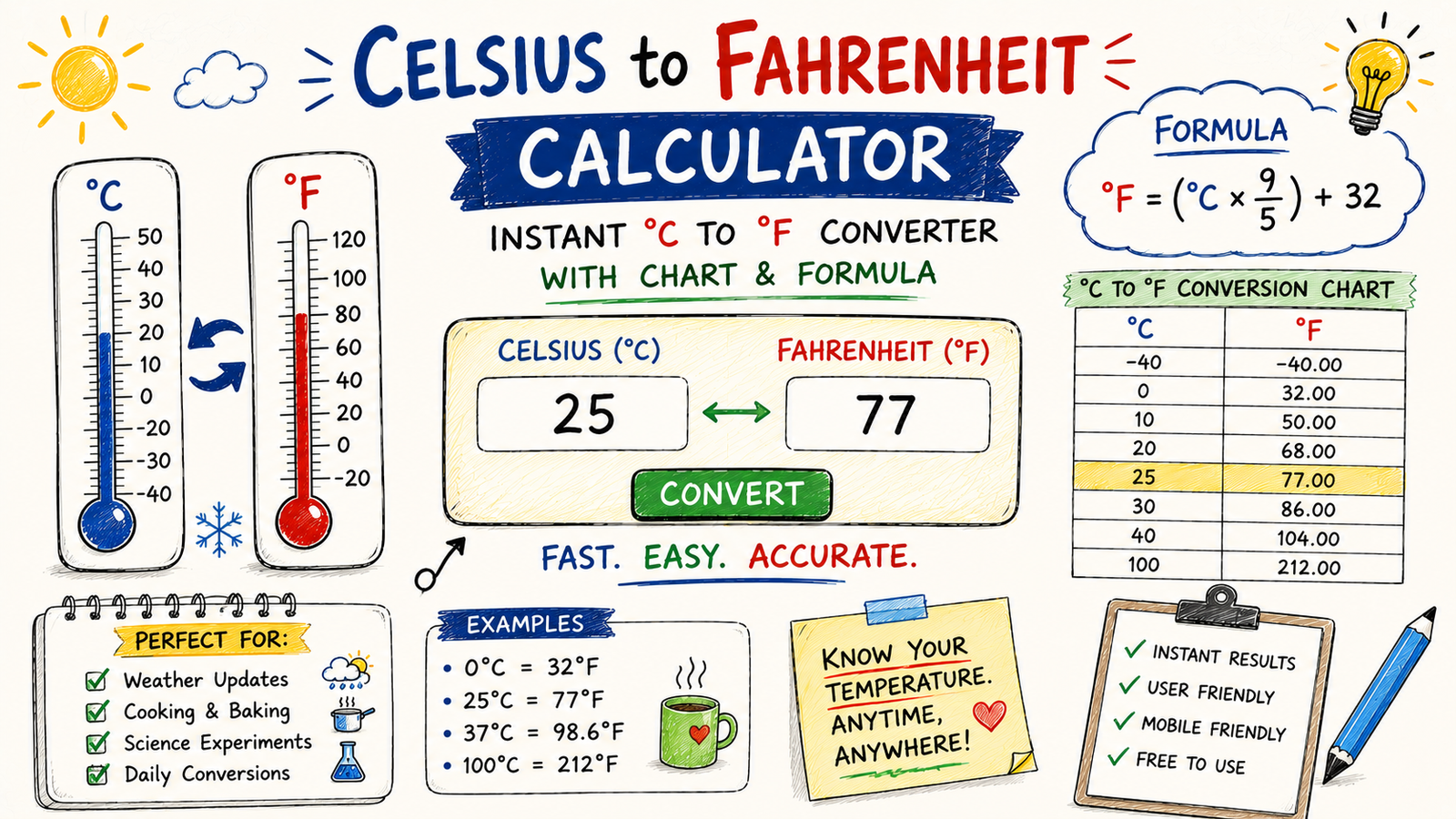
Celsius to Fahrenheit Calculator
Instantly convert any temperature from °C to °F with our smart calculator — complete with formula, step-by-step guide, and full conversion chart.
🌡️ Temperature Converter
Enter a value in either field — both update instantly
The Core Formula
Celsius to Fahrenheit Formula
Equivalent forms of the same formula:
What Is the Celsius to Fahrenheit Conversion?
Temperature is one of the most universally measured physical quantities on Earth, yet the world is split between two dominant scales: Celsius (°C) and Fahrenheit (°F). While nearly every nation on the planet uses Celsius for everyday weather, medicine, and science, the United States — the world's third most populous country — continues to use Fahrenheit as its primary scale for daily life.
This creates a real and constant need for conversion. Whether you're a student reading an American textbook, a chef following a recipe from the US, a traveler checking a weather app in a different country, a nurse interpreting medication storage guidelines from an American pharmaceutical company, or simply a curious learner who wants to understand both systems — knowing how to convert Celsius to Fahrenheit is an essential, practical skill.
Our Celsius to Fahrenheit calculator at the top of this page performs the conversion instantly and accurately. But this guide goes much further — we'll teach you the complete mathematical formula, its derivation from first principles, step-by-step worked examples, quick mental math tricks, real-world reference points, historical context, and a complete conversion chart from −100°C all the way to 200°C.
The Origins of the Celsius Scale
The Celsius scale was introduced in 1742 by Anders Celsius (1701–1744), a Swedish astronomer and professor at Uppsala University. Celsius was motivated by a desire to create a temperature scale that was logically tied to the physical properties of water — the most abundant and important liquid on Earth — under standard atmospheric conditions.
In a delightful historical twist, Celsius's original scale was the reverse of what we use today. He set the boiling point of water at 0° and the freezing point at 100°. It was the Swedish botanist Carolus Linnaeus who, in 1745 (the year after Celsius died), proposed flipping the scale so that 0 represented freezing and 100 represented boiling — the intuitive arrangement where higher numbers mean hotter temperatures. This flipped version was quickly adopted by the scientific community.
For over 200 years, the scale was known as the centigrade scale, from the Latin centum (100) and gradus (steps), referring to the 100-degree span between the two water reference points. In 1948, the 9th General Conference on Weights and Measures (CGPM) formally renamed it the Celsius scale in honor of its inventor — and to avoid confusion with the angular centigrade unit used in surveying.
Today, Celsius is part of the International System of Units (SI) and is the official temperature scale of science, medicine, and everyday life in virtually every country on Earth except the United States.
📅 Key Dates in Celsius History
The Origins of the Fahrenheit Scale
The Fahrenheit scale predates Celsius by 18 years. It was devised in 1724 by Daniel Gabriel Fahrenheit (1686–1736), a German-Polish instrument maker who is also credited with inventing the mercury-in-glass thermometer in 1714 — the first truly reliable temperature-measuring instrument.
Fahrenheit established three reference points for his scale. He set 0°F as the temperature of a reproducible brine solution (ice, water, and ammonium chloride salt). He set 32°F as the freezing point of pure water. And he originally defined 96°F as the temperature of the human body (later revised to 98.6°F through more precise measurement). The boiling point of water on this scale happens to fall at 212°F.
The Fahrenheit scale remains the primary everyday temperature scale in the United States, as well as the Bahamas, Cayman Islands, Liberia, Palau, and a few US territories. For the rest of the world, Fahrenheit is encountered mainly through American media, recipes, and technical documentation — making conversion a necessary, everyday skill.
The Celsius to Fahrenheit Formula — Explained in Full Mathematical Detail
The relationship between Celsius and Fahrenheit is linear. That means it can be expressed as a straight-line equation of the form \(y = mx + b\), where y is °F, x is °C, m is the slope (scale factor), and b is the y-intercept (offset). Converting between the two scales requires accounting for exactly two things:
Factor 1 — The Scale Factor (Degree Size)
One Celsius degree is larger than one Fahrenheit degree. Between the freezing and boiling points of water, the Celsius scale uses exactly 100 degrees, while the Fahrenheit scale uses exactly 180 degrees. Therefore the ratio is \(\frac{180}{100} = \frac{9}{5} = 1.8\). This means every 1°C increase corresponds to a 1.8°F increase — so we must multiply by 9/5.
Factor 2 — The Offset (Zero-Point Difference)
The two scales have different zero points. Celsius places its zero at the freezing point of water (0°C), while Fahrenheit places 32°F at that same physical point. So once we've scaled the degrees, we must add 32 to shift the result to the correct Fahrenheit zero point.
The Standard Formula
Read as: "Fahrenheit equals Celsius multiplied by nine-fifths, plus thirty-two."
Deriving the Formula From First Principles
We begin with two universally agreed physical reference points:
• Freezing point of water: \(0°C = 32°F\)
• Boiling point of water: \(100°C = 212°F\)
Using the slope-intercept form \(°F = m \cdot °C + b\), we calculate the slope \(m\) first:
The Inverse Formula (Fahrenheit → Celsius)
By rearranging the Celsius-to-Fahrenheit formula algebraically:
Relationship to Kelvin
The Kelvin scale — the SI base unit for thermodynamic temperature — starts at absolute zero (−273.15°C). Converting Celsius to Kelvin, and then to Fahrenheit:
Step-by-Step: How to Convert Celsius to Fahrenheit
Let's walk through the conversion carefully using the example of 25°C — a warm, pleasant day in most parts of the world.
Identify Your Celsius Temperature
Write down the temperature you wish to convert from Celsius to Fahrenheit.
Multiply by 9/5
Multiply your Celsius value by \(\frac{9}{5}\) (which equals 1.8). This step converts the scale of the degrees — scaling up from the larger Celsius degree size to the smaller Fahrenheit degree size.
Add 32
Add 32 to the result from Step 2. This adjusts for the zero-point offset between the two scales — since 0°C corresponds to 32°F, not 0°F.
Final Answer
The result is your temperature in Fahrenheit!
✅ A warm, beautiful day — equivalent to 77°F in American weather forecasts.
8 Fully Worked Celsius to Fahrenheit Examples
Each example below shows every step, so you can follow along and build your own mental model of the conversion.
Example 1: Freezing Point of Water — 0°C
\[\left(0 \times \frac{9}{5}\right) + 32 = 0 + 32 = \mathbf{32°F}\]📌 This is the fundamental anchor — ice forms at 32°F / 0°C.
Example 2: Boiling Point of Water — 100°C
\[\left(100 \times \frac{9}{5}\right) + 32 = 180 + 32 = \mathbf{212°F}\]📌 The upper reference point — water boils at 212°F at sea level.
Example 3: Normal Body Temperature — 37°C
\[\left(37 \times \frac{9}{5}\right) + 32 = 66.6 + 32 = \mathbf{98.6°F}\]📌 The classic body temperature figure used in medical references worldwide.
Example 4: A Cold Winter Day — −10°C
\[\left(-10 \times \frac{9}{5}\right) + 32 = -18 + 32 = \mathbf{14°F}\]📌 Noticeably cold — well below freezing and icy conditions expected.
Example 5: A Comfortable Room — 22°C
\[\left(22 \times \frac{9}{5}\right) + 32 = 39.6 + 32 = \mathbf{71.6°F}\]📌 The sweet spot for indoor comfort — air conditioning often targets this range.
Example 6: Oven Temperature (Baking) — 180°C
\[\left(180 \times \frac{9}{5}\right) + 32 = 324 + 32 = \mathbf{356°F}\]📌 Standard "moderate oven" setting for cakes, cookies, and most baked goods.
Example 7: A Sweltering Summer Day — 40°C
\[\left(40 \times \frac{9}{5}\right) + 32 = 72 + 32 = \mathbf{104°F}\]📌 Dangerously hot outdoor conditions — heat stroke risk is high above 40°C.
Example 8: The Intersection Point — −40°C
\[\left(-40 \times \frac{9}{5}\right) + 32 = -72 + 32 = \mathbf{-40°F}\]📌 Remarkable! The only temperature where both scales give the exact same reading.
The −40° Intersection: When Celsius Equals Fahrenheit
One of the most mathematically satisfying facts about these two scales is that they converge at exactly −40 degrees. This means −40°C and −40°F are the same temperature. Let's prove this algebraically by setting the two scales equal and solving:
∴ Celsius = Fahrenheit at exactly \(\mathbf{-40°}\)
This temperature (−40°C/°F) is encountered in extreme polar environments — the coldest inhabited places on Earth (parts of Siberia, northern Canada, and Greenland occasionally reach this level). It is also used in some industrial refrigeration contexts. But for most of us, it is a beautiful pure-math fact: the one and only fixed point of the linear transformation between these two scales.
Quick Mental Math Tricks — No Calculator Needed
When you don't have a calculator handy, these mental shortcuts give you a fast, workable estimate for converting Celsius to Fahrenheit.
🧠 Trick #1: Double and Add 30 (Best for Weather)
Example: Convert 15°C → (15×2)+30 = 60°F (Actual: 59°F — spot on!)
Works well in the range −10°C to 40°C. Error is usually within ±3°F.
🧠 Trick #2: Subtract 30, Halve the Result (Reverse Check)
Example: Convert 86°F → (86−30)/2 = 28°C (Actual: 30°C — close enough for a quick check)
Use this to convert back from Fahrenheit when checking your work.
🧠 Trick #3: The "1°C = 1.8°F" Mental Rule
Since 1°C = 1.8°F ≈ 2°F (approximately), a change of 10°C is roughly equal to a change of 18°F. This is useful for understanding temperature differences — e.g., "today is 10°C warmer than yesterday" in Celsius is "about 18°F warmer" in Fahrenheit.
Best for: understanding relative changes, not absolute conversions.
🧠 Trick #4: Anchor Points Memory Method
Memorize 5 key anchor points, then estimate by interpolation:
Freezing
Cool Room
Body Temp
Boiling
Equal Point
Real-World Temperature Reference Points
Context makes conversions stick. Here's a comprehensive table of important real-world temperatures in both scales:
| Context / Situation | °C | °F | Kelvin |
|---|
Celsius vs. Fahrenheit — A Complete Comparison
Both scales measure the same physical phenomenon. Here is everything you need to know about how they compare:
| Property | Celsius (°C) | Fahrenheit (°F) |
|---|---|---|
| Invented by | Anders Celsius, 1742 | Daniel Fahrenheit, 1724 |
| Zero point | Freezing point of water | Ice-water-salt brine |
| Freezing point of water | 0°C | 32°F |
| Boiling point of water | 100°C | 212°F |
| Body temperature | 37°C | 98.6°F |
| Degree size | 1°C = 1.8°F (larger) | 1°F = 0.556°C (smaller) |
| Degrees freeze→boil | 100° | 180° |
| Countries using it | ~195 countries (worldwide standard) | USA, Bahamas, Liberia + territories |
| SI unit? | Yes (derived SI unit) | No |
| Used in science? | Yes (with Kelvin) | Very rarely |
| Formula to the other | \(°F = \frac{9}{5}°C + 32\) | \(°C = \frac{5}{9}(°F - 32)\) |
Real-World Applications of Celsius to Fahrenheit Conversion
The ability to convert between these two scales has practical, everyday relevance across many domains. Here are six major areas where this knowledge matters:
🍳 Cooking and Baking
This is probably the most immediately practical application for most people. European and UK recipes almost universally use Celsius for oven temperatures. American and Canadian recipes use Fahrenheit. If you're baking a French pastry at 180°C and your oven dial shows Fahrenheit, you need to know that's 356°F (often rounded to 350°F). Understanding the conversion prevents burnt meals, failed soufflés, and undercooked roasts. Common oven temperature ranges: 150°C = 302°F (very low), 180°C = 356°F (moderate), 200°C = 392°F (moderately hot), 220°C = 428°F (hot), 250°C = 482°F (very hot).
🌍 International Travel and Weather
An American traveling to Europe or Asia will encounter Celsius weather forecasts everywhere. When the Barcelona weather forecast shows 32°C, Americans need to know that's 89.6°F — a hot day requiring summer clothing and sun protection. Conversely, a European visiting the United States in January who sees "28°F" on a weather screen needs to know that's −2.2°C — well below freezing and requiring heavy winter gear. Knowing the conversion — or having a reliable calculator — prevents serious discomfort and even safety issues in extreme weather.
🏥 Medicine and Healthcare
In clinical settings, temperature is a critical vital sign. The definition of fever, hypothermia, and heat stroke all depend on precise temperature thresholds. WHO and international clinical guidelines typically state temperatures in Celsius (e.g., fever is defined as >38°C, or 100.4°F). American clinical protocols often use Fahrenheit. Healthcare professionals practicing across systems, international medical students, or parents using thermometers from different countries must understand both scales. The margin for error is narrow: 38°C (100.4°F) is a significant fever; 40°C (104°F) is dangerous; 41.7°C (107°F) can be fatal.
🔬 Science and Engineering
Global scientific literature — chemistry, physics, biology, materials science, meteorology — uses Celsius (or Kelvin) almost exclusively. American engineers working with international partners, students studying from international textbooks, or professionals reading data sheets from European or Asian manufacturers must be comfortable with both scales. Critical process temperatures such as glass transition temperatures, melting points, flash points of chemical substances, and reaction temperatures are all typically stated in °C in scientific publications.
🏠 Home and HVAC
Thermostats, heating systems, air conditioning units, refrigerators, and water heaters may be calibrated in either scale depending on the country of origin. A homeowner in the US installing a European HVAC system, or a European installing an American water heater, needs to convert between scales to set the correct temperatures. Refrigerators are ideally kept at 1–4°C (34–39°F); freezers at −18°C (0°F); hot water heaters at 60°C (140°F) to prevent bacterial growth.
📚 Education and Mathematics
Temperature conversion is a standard topic in middle and high school math curricula worldwide. It teaches linear functions, substitution, order of operations, and working with fractions — all in a concrete, real-world context that students instantly relate to. The formula \(°F = \frac{9}{5}°C + 32\) is one of the most famous examples of a real-world linear equation of the form \(y = mx + b\), making it a perfect teaching tool for algebra.
The Three Temperature Scales: Celsius, Fahrenheit, and Kelvin
For a complete picture of temperature measurement, every student of science should understand all three major scales and how they relate to each other. Here is a summary of all six inter-conversion formulas:
All Six Temperature Conversion Formulas
\[°F = \frac{9}{5} \cdot °C + 32 \qquad \Leftrightarrow \qquad °C = \frac{5}{9}(°F - 32)\] \[K = °C + 273.15 \qquad \Leftrightarrow \qquad °C = K - 273.15\] \[K = \frac{5}{9}(°F + 459.67) \qquad \Leftrightarrow \qquad °F = \frac{9}{5}K - 459.67\]| Landmark | °C | °F | K |
|---|---|---|---|
| Absolute Zero | −273.15 | −459.67 | 0 |
| F = C Intersection | −40 | −40 | 233.15 |
| Freezing of Water | 0 | 32 | 273.15 |
| Room Temperature | 22 | 71.6 | 295.15 |
| Body Temperature | 37 | 98.6 | 310.15 |
| Boiling of Water | 100 | 212 | 373.15 |
| Surface of the Sun | ~5,505 | ~9,941 | ~5,778 |
Visual Scale: Celsius vs. Fahrenheit Side by Side
The visual below maps key temperatures on both scales simultaneously — giving you an intuitive feel for where the values line up:
Why Temperature Conversion Is a Cornerstone of Math Education
The Celsius-to-Fahrenheit conversion formula is one of the most powerful teaching tools in mathematics education, because it brings together multiple foundational concepts in a single, real-world-relevant problem:
1. Linear Equations in the Form y = mx + b
The formula \(°F = \frac{9}{5}°C + 32\) is a textbook example of a linear equation. The slope \(m = \frac{9}{5}\) represents how fast Fahrenheit increases relative to Celsius, and the y-intercept \(b = 32\) represents the value of °F when °C = 0. Students can graph this line, identify the slope and intercept, and understand linear transformations viscerally through a physical phenomenon.
2. Order of Operations (PEMDAS / BODMAS)
The Celsius-to-Fahrenheit formula requires multiplication before addition: \(\frac{9}{5} \times °C\) must be computed before adding 32. The Fahrenheit-to-Celsius formula requires subtraction before multiplication: \(°F - 32\) must be done before multiplying by \(\frac{5}{9}\). Both formulas are ideal for teaching PEMDAS/BODMAS in context, where the stakes of getting the order wrong are immediately obvious (you get a wrong temperature answer).
3. Fraction Multiplication and Decimal Conversion
The conversion multiplier \(\frac{9}{5} = 1.8\) requires students to work with improper fractions and their decimal equivalents. Students learn that multiplying by \(\frac{9}{5}\) is the same as multiplying by 1.8, which is the same as multiplying by 9 and then dividing by 5. These are fundamental fraction operations practiced here in a concrete, meaningful context.
4. Solving Systems of Equations
Finding the intersection point (−40°C = −40°F) requires solving a linear equation by substitution — a key algebra skill. Setting \(°F = °C = x\) and solving \(x = \frac{9}{5}x + 32\) demonstrates equation solving with variable on both sides. This is directly assessed in standardized tests including the SAT, ACT, GCSE, and A-Level mathematics.
5. Negative Numbers and Real-Number Operations
Many temperatures below 0°C produce negative Fahrenheit values that are not below 0°F (e.g., −5°C = 23°F), while others do (e.g., −30°C = −22°F). This requires careful handling of negative number arithmetic and reinforces the concept of the number line, signed integers, and operations with negative numbers in a vivid, physically intuitive context.
Complete Celsius to Fahrenheit Conversion Chart
From −100°C to 200°C — the most comprehensive °C to °F reference table online
| °Celsius | °Fahrenheit | Kelvin | Notes |
|---|
* Fahrenheit values rounded to 2 decimal places where applicable
Oven Temperature Conversion Chart (°C to °F)
Cooking conversions are among the most searched temperature conversions online. Here is a complete baking and roasting oven temperature reference:
| Oven Description | °C | °F | Best For |
|---|
📝 Expert Tips for Students and Exam Takers
Master these points to ace your temperature conversion questions:
✅ Always multiply BEFORE you add
The formula is \(°F = (°C \times \frac{9}{5}) + 32\). The multiplication step must come first. Never add 32 before multiplying — you'll get a completely wrong answer.
✅ The multiplier is exactly \(\frac{9}{5}\) — not \(\frac{5}{9}\)
Students often confuse the two fractions. Remember: when going C → F (small to big country, small to big degree scale), you multiply by the larger fraction \(\frac{9}{5}\). When going F → C, you multiply by \(\frac{5}{9}\).
✅ Sanity-check with known anchor points
After computing, verify: Does 0°C give 32°F? Does 100°C give 212°F? If your formula is correct, these must always hold. Use them to catch errors instantly.
✅ Use the intermediate form for negative Celsius values
For negative °C, write out each step: \(-20°C\): Step 1: \(-20 \times 1.8 = -36\). Step 2: \(-36 + 32 = -4°F\). Writing it in two steps prevents sign errors that commonly trip students up.
Frequently Asked Questions
🌿 Brought to you by HeLovesMath.com
Your trusted resource for math tools, calculators, and step-by-step guides.