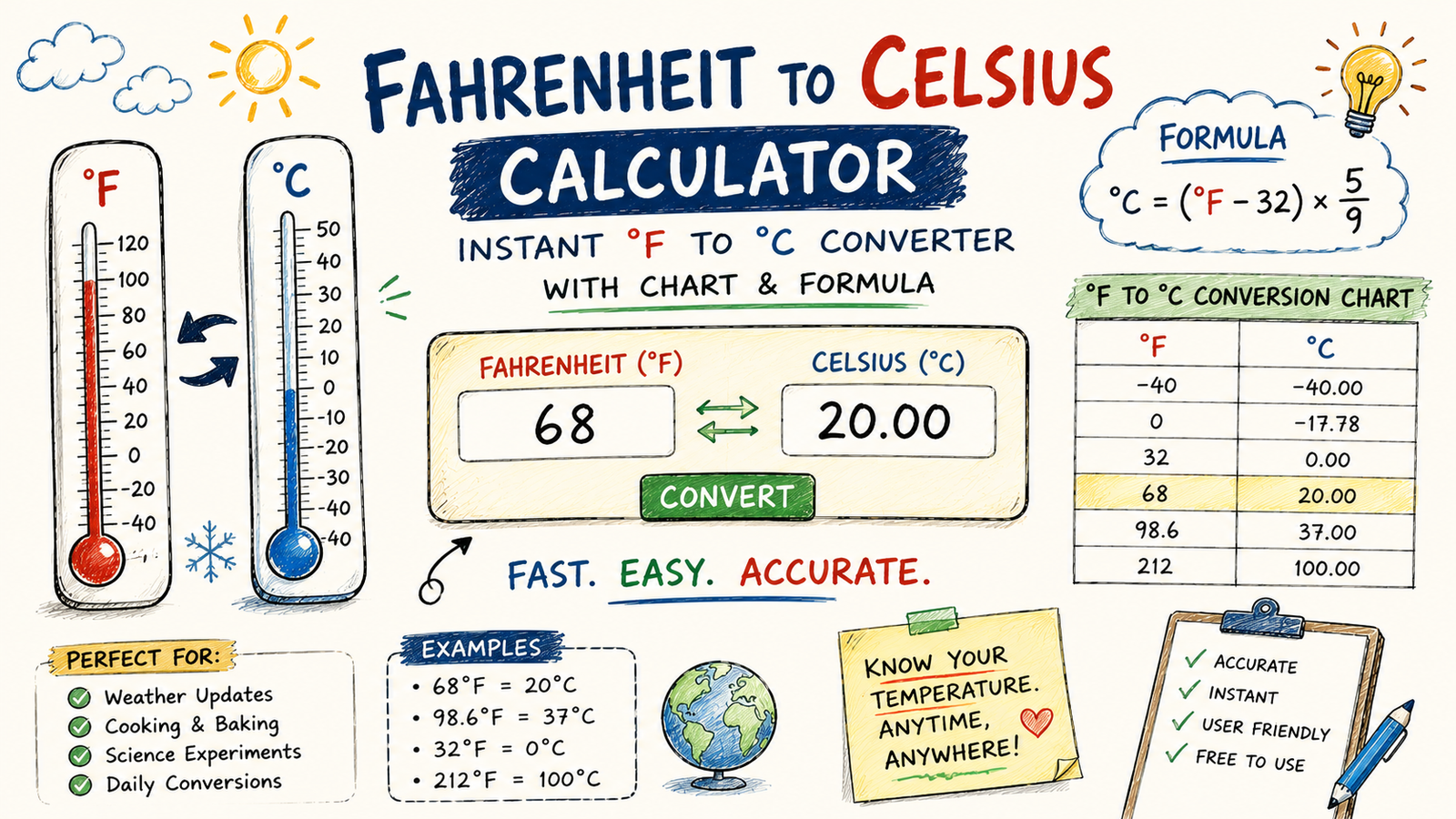
Fahrenheit to Celsius Calculator
Instantly convert any temperature from °F to °C with our smart calculator. Includes formula, step-by-step guide & full conversion chart.
🌡️ Temperature Converter
Enter a value in either field to convert instantly
The Core Formula
Fahrenheit to Celsius Formula
Equivalent forms of the same formula:
What is the Fahrenheit to Celsius Conversion?
Temperature is one of the most fundamental measurements in science, cooking, medicine, and everyday life. Yet the world is divided between two primary temperature scales — Fahrenheit (°F) and Celsius (°C) — which means that converting between them is a skill that millions of people need every single day.
Whether you're a student checking a science formula, a traveler trying to understand the weather forecast in a foreign country, a chef following a recipe from an international cookbook, or a nurse interpreting a patient's body temperature, understanding how to convert Fahrenheit to Celsius is genuinely useful knowledge.
Our Fahrenheit to Celsius calculator above does the work instantly — but in this comprehensive guide, we'll walk you through everything: the history of both scales, the exact mathematical formulas, step-by-step worked examples, memory tricks, real-world reference points, and a complete conversion chart from −100°F to 300°F.
The History of the Fahrenheit Scale
The Fahrenheit scale was invented in 1724 by the German-Polish physicist Daniel Gabriel Fahrenheit (1686–1736). Fahrenheit was a brilliant instrument maker who is also credited with inventing the mercury thermometer in 1714 — a tool that made precise temperature measurement possible for the first time.
When Fahrenheit set about defining his scale, he chose three reference points. The first was the temperature of a mixture of ice, water, and ammonium chloride (a common salt), which he labeled as 0°F. The second was the temperature of a mixture of just ice and water, which he set at 32°F. The third — and perhaps most charming — was the temperature of the human body, which Fahrenheit originally set at 96°F (later refined to 98.6°F based on more accurate readings).
By defining these three anchor points, Fahrenheit created a scale where water freezes at exactly 32°F and boils at exactly 212°F under standard atmospheric conditions. The difference between these two points is 180 degrees — which is precisely 180/100 = 1.8 times the difference between the same points on the Celsius scale.
Today, the Fahrenheit scale is the official temperature measurement standard in the United States and is also used in the Bahamas, the Cayman Islands, Liberia, and a few US territories such as Puerto Rico and Guam. For the vast majority of the world, however, Fahrenheit is a secondary scale encountered mainly through American media, recipes, and weather reports.
📅 Fahrenheit Scale Timeline
The History of the Celsius Scale
The Celsius scale was proposed in 1742 by Swedish astronomer Anders Celsius (1701–1744). Celsius was a professor of astronomy at Uppsala University in Sweden, and he originally defined his scale with a reference to the physical properties of water under standard atmospheric pressure.
Here is an interesting historical twist: Celsius actually originally defined his scale with water boiling at 0° and freezing at 100° — the exact reverse of what we use today! It was Carolus Linnaeus, the famous botanist, who in 1745 flipped the scale to its current orientation, where 0°C is freezing and 100°C is boiling, making higher numbers correspond to hotter temperatures.
For many years, the scale was known as the centigrade scale (from Latin centum = 100, gradus = steps), because there are exactly 100 degrees between the freezing and boiling points of water. In 1948, the International Committee on Weights and Measures officially renamed it the Celsius scale in honor of Anders Celsius, to avoid confusion with the angular measurement "grade" used in surveying.
Today, Celsius is used as the primary temperature scale by nearly every country in the world and is the standard scale in all scientific disciplines (alongside the Kelvin scale for absolute temperature). The metric system (SI) uses the Celsius degree as its base unit for temperature in non-scientific contexts.
The Fahrenheit to Celsius Formula — Explained in Depth
The relationship between Fahrenheit and Celsius is linear — meaning if you plot one against the other on a graph, you get a straight line. This is because they measure the same physical phenomenon (thermal energy) but on different scales with different zero points and different degree sizes.
To convert from one scale to the other, we need to account for two things:
1. The Offset (Zero-Point Difference)
The zero point on the Fahrenheit scale (0°F) does not correspond to the zero point on the Celsius scale (0°C). In fact, 0°C = 32°F. So the "offset" between the two zero points is exactly 32 Fahrenheit degrees. This is why the formula begins by subtracting 32.
2. The Scale Factor (Degree Size Difference)
One degree Fahrenheit is not the same "size" as one degree Celsius. Because there are 180°F between the freezing and boiling points of water, but only 100°C between the same points, one Fahrenheit degree is smaller than one Celsius degree. Specifically: \(1°C = \frac{9}{5} = 1.8°F\), or equivalently, \(1°F = \frac{5}{9} ≈ 0.556°C\). This is why the formula multiplies by 5/9.
The Standard Formula
Read as: "Celsius equals Fahrenheit minus 32, multiplied by five-ninths."
Deriving the Formula From First Principles
We know two fixed reference points that are true on both scales:
• Freezing point of water: \(0°C = 32°F\)
• Boiling point of water: \(100°C = 212°F\)
Using the standard formula for a linear equation \(y = mx + b\), where \(y\) is °C and \(x\) is °F:
The Reverse Formula — Celsius to Fahrenheit
By algebraically rearranging the Fahrenheit-to-Celsius formula, we get the reverse conversion:
Or equivalently: \(°F = (°C \times 1.8) + 32\)
Conversion to Kelvin
The Kelvin scale is the SI base unit for thermodynamic temperature, widely used in physics and chemistry. Its zero point — called absolute zero — is the theoretical lowest possible temperature, equivalent to −273.15°C or −459.67°F.
Step-by-Step: How to Convert Fahrenheit to Celsius
Let's walk through the conversion process with a concrete example. We'll convert 98.6°F (normal human body temperature) to Celsius.
Write Down the Temperature in Fahrenheit
Identify the Fahrenheit value you want to convert.
Subtract 32 from the Fahrenheit Value
This step removes the zero-point offset between the two scales. The freezing point of water in Fahrenheit is 32°F, so we must subtract 32 to "re-zero" the scale.
Multiply by 5/9
Multiply the result from Step 2 by the fraction \(\frac{5}{9}\) (approximately 0.5556). This adjusts the scale of the degrees — since one Celsius degree is 1.8 times larger than one Fahrenheit degree.
Final Answer
The result from Step 3 is your temperature in Celsius.
✅ This is the average normal human body temperature!
Worked Conversion Examples
Practice is the best teacher. Here are eight fully worked examples of common Fahrenheit-to-Celsius conversions, showing every step.
Example 1: Freezing Point of Water — 32°F
\[(32 - 32) \times \frac{5}{9} = 0 \times \frac{5}{9} = \mathbf{0°C}\]📌 This is the definition anchor — freezing point at standard pressure.
Example 2: Boiling Point of Water — 212°F
\[(212 - 32) \times \frac{5}{9} = 180 \times \frac{5}{9} = \mathbf{100°C}\]📌 The second anchor point — boiling at sea level.
Example 3: Room Temperature — 72°F
\[(72 - 32) \times \frac{5}{9} = 40 \times 0.5\overline{5} \approx \mathbf{22.2°C}\]📌 Comfortable indoor room temperature.
Example 4: Fever Temperature — 104°F
\[(104 - 32) \times \frac{5}{9} = 72 \times \frac{5}{9} = \mathbf{40°C}\]📌 A high fever — this requires immediate medical attention.
Example 5: Cold Winter Day — 14°F
\[(14 - 32) \times \frac{5}{9} = (-18) \times \frac{5}{9} = \mathbf{-10°C}\]📌 A frigid winter day in northern regions.
Example 6: Hot Summer Day — 95°F
\[(95 - 32) \times \frac{5}{9} = 63 \times \frac{5}{9} = 35\mathbf{°C}\]📌 A very hot summer afternoon, common in tropical climates.
Example 7: Oven Temperature — 350°F (Baking)
\[(350 - 32) \times \frac{5}{9} = 318 \times \frac{5}{9} \approx \mathbf{176.7°C}\]📌 Classic moderate oven temperature for cakes and cookies.
Example 8: The Intersection Point — −40°F
\[(-40 - 32) \times \frac{5}{9} = (-72) \times \frac{5}{9} = \mathbf{-40°C}\]📌 Remarkable! This is the only temperature where °F and °C are exactly equal.
The Fascinating −40° Intersection Point
One of the most mathematically elegant facts about the Fahrenheit-Celsius relationship is that both scales converge at exactly −40 degrees. This is the one and only temperature where \(°F = °C\).
We can prove this algebraically by setting the two expressions equal and solving for the unknown temperature:
∴ The two scales are equal at \(\mathbf{-40°}\)
This temperature — −40°F/°C — is extremely cold by everyday standards. It is occasionally reached in places like Siberia, northern Canada, and Antarctica. It is also well below the temperature at which most thermometers used in weather forecasting operate, making it largely a mathematical curiosity for most people. But for scientists, meteorologists, and mathematicians, it's a satisfying proof of the linear relationship between the two scales.
Quick Mental Math Tricks for Estimation
You won't always have a calculator handy. These mental math shortcuts give you a fast, reasonably accurate estimate.
🧠 Trick #1: Subtract 30, Divide by 2 (Rough Estimate)
Example: Convert 80°F → \(\frac{80-30}{2} = 25°C\) (Actual: 26.7°C — close enough!)
Best for: Quickly understanding weather forecasts. Works well in the 40°F–100°F range.
🧠 Trick #2: Double Celsius + 30 (Fahrenheit Estimate)
Example: Convert 20°C → \((20 \times 2) + 30 = 70°F\) (Actual: 68°F — very close!)
Best for: Mentally checking Celsius forecasts when you think in Fahrenheit.
🧠 Trick #3: Memorize 5 Key Benchmarks
The best long-term trick is to memorize these five essential reference points:
Freezing
Cool Room
Body Temp
High Fever
Boiling
Real-World Temperature Reference Points
Understanding temperature conversions is far more meaningful when tied to real-world events and situations. Here is an extensive reference table of important temperatures in both scales:
| Context / Situation | °F | °C | K (Kelvin) |
|---|
Fahrenheit vs. Celsius — Comparing the Two Scales
Both scales are completely valid and accurate for measuring temperature — they simply use different zero points and degree sizes. Here is a side-by-side comparison of their key characteristics:
| Property | Fahrenheit (°F) | Celsius (°C) |
|---|---|---|
| Invented by | Daniel Fahrenheit (1724) | Anders Celsius (1742) |
| Freezing point of water | 32°F | 0°C |
| Boiling point of water | 212°F | 100°C |
| Normal body temperature | 98.6°F | 37°C |
| Degree size | 1°F = 0.556°C (smaller) | 1°C = 1.8°F (larger) |
| Degrees between freeze/boil | 180°F | 100°C |
| Primary users | USA, Bahamas, Liberia | Almost all other nations |
| Used in science? | Rarely | Yes (along with Kelvin) |
| Relationship to Kelvin | \(K = (°F + 459.67) \times \frac{5}{9}\) | \(K = °C + 273.15\) |
Real-World Applications of Fahrenheit to Celsius Conversion
Understanding how to convert between these two temperature scales has practical uses across a wide variety of fields:
🌤️ Weather & Travel
When traveling from the USA to any other country (or vice versa), weather forecasts will use different scales. A forecast of 28°C in Paris means 82.4°F — a warm, comfortable day. Without knowing how to convert, you might pack the wrong clothes entirely. Similarly, hurricane and heat wave warnings may be issued in one scale but need to be understood in another.
👨⚕️ Medicine & Health
Medical contexts frequently require temperature conversions. A patient's fever of 101.3°F is 38.5°C. Understanding these equivalences is critical for healthcare providers working with international patients, travelers seeking medical care abroad, or parents using thermometers from different countries. Medical literature often reports temperature thresholds in Celsius (e.g., sepsis protocols may reference temperatures above 38.3°C), requiring fluency in both scales.
🍳 Cooking & Baking
Recipes from the UK, Europe, and most of the world use Celsius. American recipes use Fahrenheit. If you're following a British recipe that calls for 180°C, that's 356°F — or roughly the "moderate" oven setting of 350°F. A German recipe calling for 200°C translates to 392°F, often described as a "moderately hot" oven. Getting these conversions wrong can mean the difference between a perfect roast and a burnt disaster.
🔬 Science & Engineering
In chemistry, physics, and materials science, most data is published in Celsius (and Kelvin). American engineers working with international standards, or students studying from foreign textbooks, must be comfortable converting. For example, the critical temperature of superconducting materials, the melting points of metal alloys, the flash points of fuels — all require accurate temperature scale fluency. The relationship \(°C = \frac{5}{9}(°F - 32)\) is as fundamental to physical science as any constant.
🏭 Industry & Manufacturing
Industrial processes such as steel manufacturing, semiconductor fabrication, food processing, and chemical production all involve tight temperature tolerances. A steel annealing process that requires 1500°F needs to be understood as 815.6°C when following ISO standards. Industrial thermostats, furnace controllers, and process instruments may be calibrated in either scale depending on their origin and the standards used in that country.
Complete Fahrenheit to Celsius Conversion Chart
From −100°F to 300°F — the most comprehensive reference chart available
| °Fahrenheit | °Celsius | Kelvin | Notes |
|---|
* Celsius values rounded to 2 decimal places
Why Understanding Temperature Conversion Matters in Math Education
Temperature conversion is more than a practical life skill — it's an excellent mathematical exercise that teaches several important concepts simultaneously:
1. Linear Functions and Straight-Line Graphs
The formula \(°C = \frac{5}{9}(°F - 32)\) is a classic linear function of the form \(y = mx + b\), where \(m = \frac{5}{9}\) and \(b = -\frac{160}{9}\). Students can plot this function on a coordinate plane, identify the slope and intercept, and understand how linear transformations work.
2. Algebraic Manipulation and Solving Equations
Deriving the inverse formula (Celsius to Fahrenheit) from the original formula requires algebraic rearrangement — isolating a variable, multiplying both sides, adding constants. This is foundational algebra practiced in middle and high school curricula worldwide.
3. Fractions, Decimals, and Ratio
The core of the conversion involves multiplying by the fraction \(\frac{5}{9}\). This connects directly to fraction operations, converting fractions to decimals (\(\frac{5}{9} = 0.5\overline{5}\)), and understanding ratio (the ratio of a Celsius degree to a Fahrenheit degree is always 9:5).
4. Negative Numbers and Operations
Many Fahrenheit values below 32°F produce negative Celsius values, requiring students to correctly handle subtraction with negative results and multiply negative numbers by positive fractions. The intersection at −40° also requires solving a linear equation — great exam material.
5. Real-World Context for Abstract Math
One of the most common questions students ask is "When will I use this in real life?" Temperature conversion is a perfect answer. Cooking, medicine, meteorology, chemistry — the formula \(°C = \frac{5(°F-32)}{9}\) appears in everyday life, making the abstract concept of linear functions immediately tangible and relevant.
Visual: Temperature Scale Comparison
The visual below shows how key temperatures line up across both scales, giving you an intuitive feel for the relationship:
Advanced: The Three Temperature Scales Compared (Fahrenheit, Celsius, Kelvin)
For students of physics, chemistry, or thermodynamics, it's important to understand all three major temperature scales together. The third scale — Kelvin (K) — is the foundation of thermodynamic temperature and is the SI base unit for temperature.
Unlike Fahrenheit and Celsius, Kelvin starts at absolute zero — the point at which all thermal motion of atoms theoretically ceases. This has deep implications in quantum mechanics, thermodynamics, and cosmology.
The Three Conversion Formulae
\[K = °C + 273.15\] \[°C = K - 273.15\] \[K = (°F + 459.67) \times \frac{5}{9}\] \[°F = K \times \frac{9}{5} - 459.67\]Key Kelvin reference points:
0 K (−273.15°C / −459.67°F) — Absolute Zero: the theoretical lowest possible temperature
273.15 K (0°C / 32°F) — Freezing point of water
310.15 K (37°C / 98.6°F) — Normal human body temperature
373.15 K (100°C / 212°F) — Boiling point of water at 1 atm
5778 K (5504.85°C / 9940.73°F) — Surface temperature of the Sun
Frequently Asked Questions (FAQs)
📝 Pro Tips for Students & Test-Takers
Memorize these points to ace your math and science exams:
✅ The formula has exactly TWO operations after identifying the Fahrenheit value:
First subtract 32, then multiply by 5/9. The order matters — do NOT multiply first!
✅ Remember: \(\frac{5}{9} \approx 0.556\), NOT 0.5 (don't round to half!)
Using 0.5 instead of 0.556 is one of the most common errors students make. Use the exact fraction 5/9 when possible.
✅ For the reverse (C to F): First multiply by 9/5, THEN add 32
Students often accidentally subtract 32 at the end instead of adding it. Remember: the offset is always "add" when going from C to F, and "subtract" when going from F to C.
✅ Use dimensional analysis to check your work
Always sanity-check: Is your answer in the right ballpark? If it's a summer temperature and your Celsius answer comes out below zero, something went wrong. Ice melts at 0°C/32°F; use that as a reference boundary.
🌿 Brought to you by HeLovesMath.com
Your trusted resource for math tools, calculators, and step-by-step guides.