Math Times Tables
Your complete interactive resource for mastering math times tables from 1 to 12. View the full multiplication chart, practise with a randomised quiz, study individual tables, or challenge yourself with a 20-question speed test — all in one place, completely free.
Trusted by thousands of students, parents, and teachers because He Loves Math makes learning feel accessible, clear, and genuinely effective.
Quick Answer: The Multiplication Formula
Every fact in a times table is an application of the definition of multiplication as repeated addition:
The commutative property means order does not matter:
This single property halves the number of unique facts in a 12×12 chart — from 144 down to just 78. Know one, and you automatically know its pair.
Interactive Math Times Tables Tool
Choose a mode below. Complete Chart shows the full grid. Practice Quiz tests selected tables with instant feedback. Individual Tables lists any single table. Speed Test challenges you to answer 20 questions as fast as possible.
Loading times tables chart…
What Are Math Times Tables?
Math times tables — also called multiplication tables or maths times — are organised lists or grids showing the products of multiplying a given number by a series of whole numbers, typically 1 through 12. The standard 12×12 times table grid contains 144 cells, each holding the product of a row number and a column number. These 144 facts are the pre-computed answers to every multiplication involving numbers from 1 to 12.
The concept dates at least to ancient Babylon (around 1800 BCE), where clay tablets show multiplication tables used for commerce, taxation, and astronomy. The particular format of a 12×12 grid became standard in England and much of Europe during the medieval period, partly because of the traditional importance of the number 12 in weights, measures, and currency (12 pence to a shilling, 12 inches to a foot, 12 months in a year).
Today, times tables remain the foundational calculation tool taught in primary schools worldwide. They are not merely arithmetic facts to memorise — they are the cognitive infrastructure on which all higher mathematics is built, from fractions and percentages to algebra, calculus, and statistics.
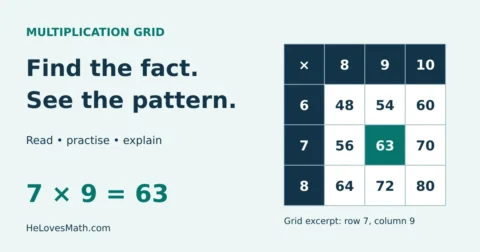
Key insight: Because of the commutative property \( a \times b = b \times a \), a 12×12 grid contains only 78 unique facts (66 non-square pairs plus 12 square numbers). If you know 7 × 9 = 63, you already know 9 × 7 = 63. This insight alone cuts the memorisation workload nearly in half.
The Mathematics Behind Times Tables
Understanding the mathematical properties that govern times tables makes memorisation both faster and more resilient. Rather than learning isolated facts, you learn a connected web of relationships. Here are the four most important mathematical properties at work in every times table.
1. Multiplication as Repeated Addition
So \( 7 \times 4 = 7 + 7 + 7 + 7 = 28 \). This definition makes the tables learnable by skip-counting — a skill most children already know.
2. Commutativity
The 12×12 grid is symmetric along its main diagonal. Every fact above the diagonal has a mirror below it. Memorising one cell gives you two facts for free.
3. Distributive Property (The Key to Tricks)
This property is the mathematical basis for every "split the number" trick. For example, to calculate \( 7 \times 13 \), split 13 = 10 + 3:
This is also why the 4 times table is just double the 2 times table, and the 8 times table is double the 4 times table — because \( 4 \times n = 2 \times 2 \times n \) and \( 8 \times n = 2 \times 4 \times n \).
4. Square Numbers
The 12 square numbers on the main diagonal of the chart are anchor facts — memorise these first, and all off-diagonal facts become easier to estimate by proximity.
Patterns in Every Times Table
Every times table has at least one recognisable pattern. Learning to see these patterns transforms multiplication from rote memorisation into pattern recognition — a much more durable skill.
× 1 — Identity
Any number times 1 equals itself: \( n \times 1 = n \). Nothing changes.
× 2 — All Even
Every product is even. The sequence is the counting numbers doubled: 2, 4, 6, 8, 10…
× 3 — Digit Sum
The digits of each product sum to a multiple of 3: 12 (1+2=3), 27 (2+7=9), 36 (3+6=9).
× 4 — Double of 2s
The 4 times table is exactly double the 2 times table. \( 4 \times n = 2 \times (2 \times n) \).
× 5 — Ends in 0 or 5
All products end in either 0 or 5, alternating: 5, 10, 15, 20, 25, 30…
× 6 — Even + Same
When 6 is multiplied by an even number, the units digit matches the multiplier: \( 6 \times 4 = 24 \).
× 9 — Digit Sum = 9
The digits of every product from 9×1 to 9×10 sum to 9: 18 (1+8), 27 (2+7), 36 (3+6)…
× 10 — Add Zero
Multiply any number by 10 by writing a zero after it: \( 10 \times n = n0 \).
× 11 — Double Digit
For single digits, the answer repeats the digit: \( 11 \times 3 = 33 \), \( 11 \times 7 = 77 \). For 11 × 11 and 11 × 12, use the distributive law.
× 12 — Tens + Twos
Split: \( 12 \times n = 10 \times n + 2 \times n \). So \( 12 \times 7 = 70 + 14 = 84 \).
Which Times Table Should You Learn First?
Not all times tables are equally difficult. Learning them in a thoughtful sequence means each new table feels manageable because it builds on what you already know.
| Stage | Tables | Why These First | Key Pattern |
|---|---|---|---|
| Stage 1 (Easiest) | × 1, × 2, × 5, × 10 | Clear rules, strong patterns, often already known | Even numbers / ends 0 or 5 / add zero |
| Stage 2 (Medium) | × 3, × 4, × 6, × 9 | Digit sum rules and doubling strategies help greatly | Digit sums / double of 2s / 9s trick |
| Stage 3 (Hardest) | × 7, × 8, × 11, × 12 | Fewer shortcuts; rely on distributive law and anchor facts | 7 × 8 = 56; 8s double 4s; 12n = 10n + 2n |
By the time a learner reaches Stage 3, they already know the commutative pairs of many hard facts from Stage 1 and 2. For example, \( 7 \times 3 \) is already known when they mastered the 3 times table in Stage 2 — so they only need to learn \( 7 \times 7 = 49 \) and the pairs involving 8, 11, and 12 as genuinely new facts.
Quick Tricks and Mental Shortcuts
The 9s Finger Trick
Hold all ten fingers in front of you. To calculate \( 9 \times n \): fold down finger number n from the left. Count the fingers to the left of the folded finger — this is the tens digit. Count the fingers to the right — this is the units digit.
Doubling Strategy for 4s and 8s
Example: \( 8 \times 7 \). Double 7 = 14. Double 14 = 28. Double 28 = 56. So \( 8 \times 7 = 56 \).
The Distributive Split for 7s and 12s
Example: \( 7 \times 8 = (5 \times 8) + (2 \times 8) = 40 + 16 = 56 \).
Proven Learning Strategies
Research in cognitive psychology consistently supports certain learning methods over others for building automaticity — the ability to recall facts instantly without conscious calculation.
- Spaced repetition. Practice facts at increasing intervals rather than all at once. Review a new table daily for a week, then every few days, then weekly. Spacing prevents rapid forgetting and builds long-term retention.
- Interleaved practice. After learning table A and table B separately, practice them together in random order. This forces your brain to distinguish between facts and strengthens retrieval pathways more than blocked practice.
- Retrieval practice (quiz yourself). Attempting to recall a fact from memory — rather than re-reading it — is the single most effective study technique. Use the Practice Quiz mode above to implement this immediately.
- Immediate corrective feedback. When you answer incorrectly, see the right answer immediately and repeat it. Delayed feedback dramatically reduces the learning value of each practice session.
- Build automaticity with speed tests. Once you can answer correctly at your own pace, begin timed practice. Automaticity — not just accuracy — is the goal, because it frees mental resources for higher-order thinking during multi-step problems.
Complete Times Tables 1 to 12 — Reference Lists
The lists below show every fact for each table up to × 12. Use these for reference, printable practice, or reading aloud — a particularly effective memorisation technique for auditory learners.
1 and 2 Times Tables
1×: 1, 2, 3, 4, 5, 6, 7, 8, 9, 10, 11, 12
2×: 2, 4, 6, 8, 10, 12, 14, 16, 18, 20, 22, 24
3 and 4 Times Tables
3×: 3, 6, 9, 12, 15, 18, 21, 24, 27, 30, 33, 36
4×: 4, 8, 12, 16, 20, 24, 28, 32, 36, 40, 44, 48
5 and 6 Times Tables
5×: 5, 10, 15, 20, 25, 30, 35, 40, 45, 50, 55, 60
6×: 6, 12, 18, 24, 30, 36, 42, 48, 54, 60, 66, 72
7 and 8 Times Tables
7×: 7, 14, 21, 28, 35, 42, 49, 56, 63, 70, 77, 84
8×: 8, 16, 24, 32, 40, 48, 56, 64, 72, 80, 88, 96
9 and 10 Times Tables
9×: 9, 18, 27, 36, 45, 54, 63, 72, 81, 90, 99, 108
10×: 10, 20, 30, 40, 50, 60, 70, 80, 90, 100, 110, 120
11 and 12 Times Tables
11×: 11, 22, 33, 44, 55, 66, 77, 88, 99, 110, 121, 132
12×: 12, 24, 36, 48, 60, 72, 84, 96, 108, 120, 132, 144
Real-World Uses of Times Tables
Times tables are not an abstract school exercise — they appear constantly in daily life. Recognising these applications motivates learners of all ages to invest the practice time required for fluency.
- Shopping and budgeting: "If each item costs £3 and I want 7, that's £21." Instant multiplication prevents over-spending and shortens checkout.
- Cooking and recipes: Doubling or halving a recipe requires multiplying every ingredient. "The recipe serves 4 but I need 12 — multiply everything by 3."
- Time management: "The film is 2 hours 15 minutes and I have 5 errands at 8 minutes each — is there time?" Quick multiplication estimates.
- Sports statistics: Points per game × number of games played; miles per hour × hours driven.
- DIY and construction: Area calculations (\( \text{length} \times \text{width} \)) for flooring, tiling, and painting.
- Understanding fractions and percentages: Simplifying \( \frac{24}{36} \) requires knowing that 24 = 6 × 4 and 36 = 6 × 6 — fluent times tables make this instant.
- Algebra: Factorising \( x^2 + 7x + 12 \) needs you to recognise that 3 × 4 = 12 and 3 + 4 = 7. Times tables proficiency makes algebra dramatically easier.
Frequently Asked Questions
What are math times tables?
Math times tables are organised lists or grids showing the products of multiplying a given number (the multiplier) by each of the whole numbers from 1 to 12. A complete 12×12 times table chart shows all 144 multiplication facts in a single grid. They are also called multiplication tables, maths times, or times tables charts.
Which times tables should I learn first?
Begin with ×1, ×2, ×5, and ×10 — these have clear, obvious patterns. Move on to ×3, ×4, ×6, and ×9 once those are solid. Finish with ×7, ×8, ×11, and ×12, which require the most deliberate practice. This sequence means each new table builds on already-known facts rather than introducing everything at once.
How long does it take to memorise all times tables?
Most learners achieve full fluency with all 12 times tables in 6–12 weeks of consistent daily practice. Fifteen minutes a day of focused retrieval practice (quizzing yourself, not re-reading) is more effective than occasional long sessions. Children who practise daily typically outperform those who study only at homework time.
What is the quickest trick for the 9 times table?
Use the finger trick: hold all ten fingers out. To calculate 9 × n, fold down finger number n from the left. The count of fingers to the left gives the tens digit; the count to the right gives the units digit. Alternatively, remember that for 9 × n (where 1 ≤ n ≤ 10), the tens digit is (n − 1) and the units digit is (10 − n).
What is the commutative property and how does it help?
The commutative property states that \( a \times b = b \times a \). In a 12×12 times table chart, this means the grid is symmetric about the main diagonal. Every fact above the diagonal is mirrored below it. Because of this, a 12×12 chart contains only 78 unique facts rather than 144 — dramatically reducing how much you actually need to memorise.
What is the distributive property and how is it used in times tables?
The distributive property says \( a \times (b + c) = a \times b + a \times c \). This lets you split a hard fact into two easy ones. For example, \( 7 \times 8 = 7 \times (5 + 3) = 35 + 21 = 56 \). It is the mathematical foundation for tricks like "the 4s are double the 2s" (\( 4n = 2 \times 2n \)) and "the 12s are the 10s plus the 2s" (\( 12n = 10n + 2n \)).
Are there patterns I can use to learn times tables faster?
Yes — every table has at least one. The 2s are all even. The 5s end in 0 or 5. The 9s produce digit pairs summing to 9 (18, 27, 36…). The 10s just append a zero. The 11s repeat the single digit up to 9 (11×7=77). The 4s are double the 2s and the 8s are double the 4s. Recognising these patterns means you are using mathematical reasoning rather than pure memorisation.
How do I help my child learn times tables at home?
Keep practice sessions short (10 minutes maximum) and daily. Display a times table chart where your child studies. Use the Practice Quiz and Speed Test modes on He Loves Math for instant feedback. Test them casually at dinner or in the car — random retrieval practice is the single most powerful memory technique. Celebrate milestones: mastering each new table is a genuine achievement worth acknowledging.
Related Tools and Guides on He Loves Math
Further reading: Multiplication table — Wikipedia · BBC Bitesize — Times Tables
Keep Learning with He Loves Math
He Loves Math is dedicated to making mathematics approachable, beautiful, and genuinely enjoyable for learners of every age. From times tables to calculus, every tool and guide is built to help you understand rather than just calculate.