dBm to mW Conversion Calculator
Convert dBm to milliwatts instantly. Enter a power level in dBm, and the calculator returns the equivalent power in mW using the standard logarithmic power formula.
dBm to mW Calculator
Enter a dBm value between −1,000,000 and +1,000,000. Positive dBm means more than 1 mW; negative dBm means less than 1 mW. Results update as you type.
Use a decimal point or scientific input such as 2e1. Decimal places apply to ordinary results, or to the coefficient in scientific notation. Tiny powers stay nonzero.
Formula used: p = 10L/10
Equivalent power: 0.001 W
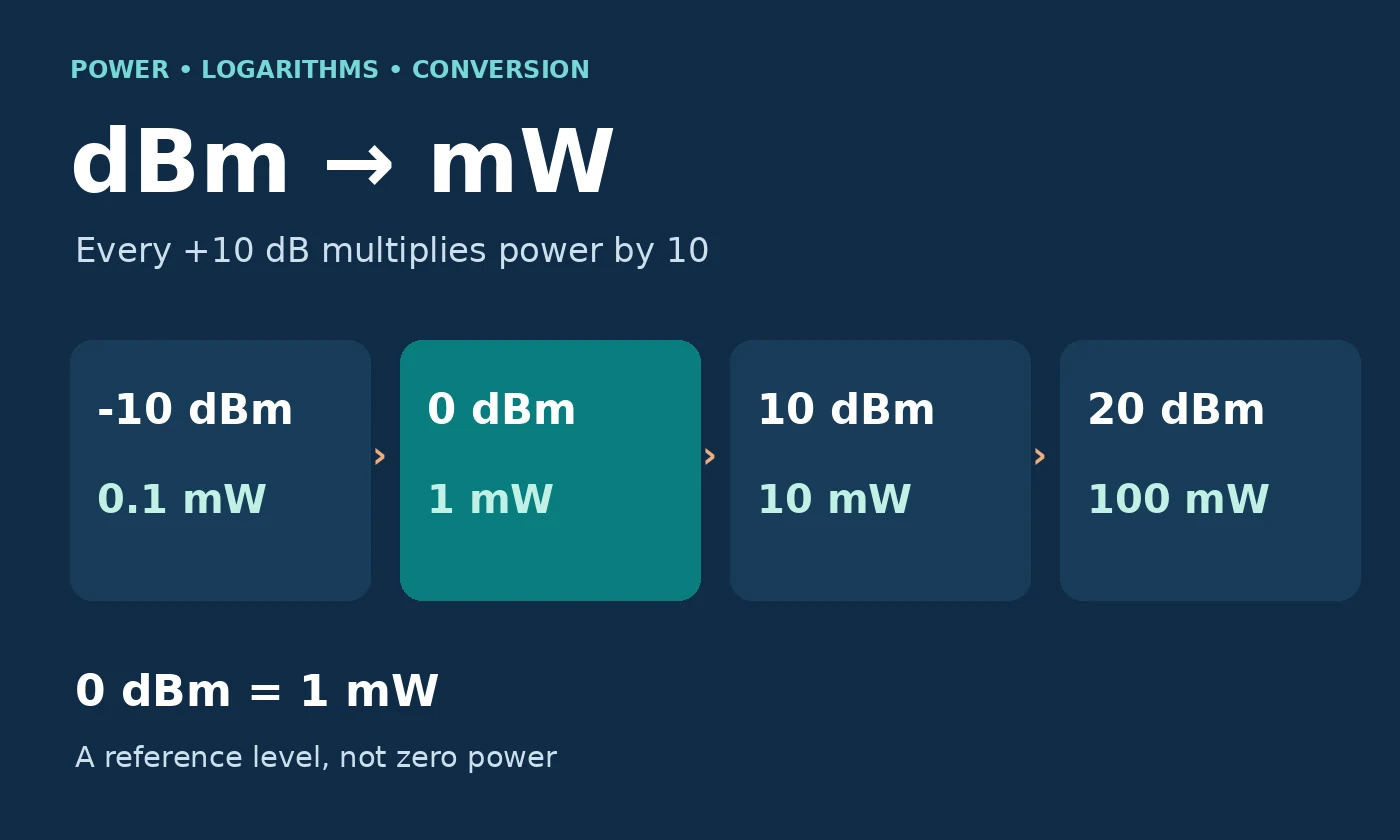
0 dBm equals 1 mW because dBm is referenced to 1 milliwatt.
dBm to mW Conversion Guide
A dBm to mW conversion changes a logarithmic power value into a linear power value. The unit dBm is widely used in radio, wireless networking, antennas, signal measurement, fiber optics, RF engineering, audio equipment, and electronic test instruments. The unit mW means milliwatts. A milliwatt is one thousandth of a watt. Because dBm is based on a logarithmic scale, the numbers do not increase in the same way normal linear units increase. That is why a calculator is useful.
The most important reference point is simple: 0 dBm=1 mW. A value above 0 dBm is more than 1 mW. A value below 0 dBm is less than 1 mW. For example, 10 dBm is 10 mW, 20 dBm is 100 mW, and 30 dBm is 1000 mW. On the negative side, -10 dBm is 0.1 mW, -20 dBm is 0.01 mW, and -30 dBm is 0.001 mW. These jumps happen because every 10 dB increase represents a tenfold power increase.
What Does dBm Mean?
dBm means decibels relative to one milliwatt. It is written as dBm because the “m” tells you the reference power is 1 milliwatt. The decibel part shows that the scale is logarithmic. A plain dB value usually describes a ratio, gain, loss, or difference between two quantities. A dBm value describes an absolute power level because it is tied to a fixed reference.
This reference point makes dBm useful for signal work. Instead of writing tiny or large power values with many zeros, engineers and learners can use compact dBm values. A weak received wireless signal might be around -70 dBm. A stronger radio output may be 20 dBm or 30 dBm. The dBm number is easier to compare, especially when signals span a very large range.
What Does mW Mean?
mW means milliwatt. It is a linear unit of power. One milliwatt is equal to one thousandth of one watt:
When power is written in mW, ordinary multiplication and division apply. For example, 10 mW is ten times 1 mW. 100 mW is ten times 10 mW. 1000 mW is one watt. The linear scale is easier to understand for physical power, but it can become inconvenient when values are extremely small or extremely large. That is where dBm becomes useful.
Why dBm Uses a Logarithmic Scale
Signals in electronics and communication systems can vary across huge ranges. A receiver may detect extremely small power levels, while a transmitter may output much larger power levels. Writing all these numbers in watts or milliwatts can become awkward. A logarithmic scale compresses that range into a more manageable form.
A 10 dB increase means the power is multiplied by 10. A 20 dB increase means the power is multiplied by 100. A 30 dB increase means the power is multiplied by 1000. This is why the dBm to mW formula uses a power of 10:
The exponent L/10 controls how many powers of 10 are applied. For 30 dBm, the exponent is 3, so the result is 103=1000. For -30 dBm, the exponent is -3, so the result is 10-3=0.001.

How to Convert dBm to mW
To convert dBm to milliwatts, divide the dBm value by 10, then raise 10 to that result. The formula is:
For example, convert 20 dBm to mW:
So 20 dBm equals 100 mW. Now convert -20 dBm to mW:
So -20 dBm equals 0.01 mW. Positive dBm values quickly become larger mW values, while negative dBm values become fractional mW values.
How to Convert mW to dBm
The reverse conversion changes milliwatts back into dBm. The formula is:
For example, convert 100 mW to dBm:
Convert 0.01 mW to dBm:
The reverse formula requires p > 0. Zero power has no finite dBm value: the level tends to −∞ as power approaches zero. Negative power has no real dBm value under this definition. These two formulas are opposites. If you convert dBm to mW and then convert the mW value back to dBm, you should return to the original dBm value, allowing for small rounding differences.
Key Reference Values
Memorizing a few reference values makes dBm easier to understand. The center point is 0 dBm, which equals 1 mW. Every 10 dB increase multiplies power by 10. Every 10 dB decrease divides power by 10. This gives a quick mental map:
| dBm | mW | Meaning |
|---|---|---|
| -40 dBm | 0.0001 mW | Very small power level |
| -30 dBm | 0.001 mW | One thousandth of 1 mW |
| -20 dBm | 0.01 mW | One hundredth of 1 mW |
| -10 dBm | 0.1 mW | One tenth of 1 mW |
| 0 dBm | 1 mW | Reference power |
| 10 dBm | 10 mW | Ten times 1 mW |
| 20 dBm | 100 mW | One hundred times 1 mW |
| 30 dBm | 1000 mW | Equal to 1 watt |
| 40 dBm | 10000 mW | Equal to 10 watts |
Worked Examples
Example 1: Convert 0 dBm to mW
This is the reference value. Any dBm calculation is measured relative to 1 mW.
Example 2: Convert 15 dBm to mW
15 dBm is halfway between 10 dBm and 20 dBm on the logarithmic scale. It is not halfway between 10 mW and 100 mW on a linear scale.
Example 3: Convert -50 dBm to mW
This is a very small power value. Negative dBm values are common when describing received signal strength.
Example 4: Convert 27 dBm to mW
27 dBm is about half a watt. Since 30 dBm equals 1 watt, 27 dBm is lower but still much larger than 20 dBm.
Example 5: A weak −70 dBm signal
Divide by ten: −70/10 = −7. Then P = 10−7 mW = 0.0000001 mW. Divide by 1000 to express it in watts: 10−10 W = 0.1 nW. The negative sign belongs to the logarithmic level, not the physical power.
Example 6: A 3 dB cable loss
Start with 20 dBm, which is 100 mW. Subtract the 3 dB loss: 20 − 3 = 17 dBm. Convert only at the end: 101.7 ≈ 50.1187 mW. This is close to half the starting power. Exactly halving it would require a loss of 10 log10(2) ≈ 3.0103 dB.

Common Uses of dBm to mW Conversion
dBm to mW conversion is common in Wi-Fi, cellular networks, Bluetooth systems, radio transmitters, RF amplifiers, antennas, microwave links, coaxial cable measurements, signal generators, spectrum analyzers, and optical communication equipment. In many of these systems, the signal may pass through gains and losses. A cable may create loss, an amplifier may add gain, and an antenna may have a rated gain. dB values make those gains and losses easier to add and subtract.
For example, a transmitter output might be 20 dBm. If the cable has a 3 dB loss, the remaining signal level becomes 17 dBm before antenna gain is considered. If you want the final linear power, you can convert that dBm value into mW. This is why technicians and learners often move between dBm and mW.
dBm Is Not the Same as dB
A common mistake is treating dBm and dB as identical. They are related, but they are not the same. dB is usually a ratio. It tells how much larger or smaller one value is compared with another. dBm is an absolute power level because the reference is fixed at 1 mW.
For example, 3 dB can describe a gain or loss ratio. A 3 dB increase is roughly double the power. But 3 dBm is a specific power level:
So 3 dBm is approximately 2 mW. The “m” in dBm matters because it gives the reference.
Quick Rules for dBm
- 0 dBm equals 1 mW.
- 10 dBm equals 10 mW.
- 20 dBm equals 100 mW.
- 30 dBm equals 1000 mW, or 1 W.
- Each 10 dB increase multiplies power by 10.
- Each 3 dB increase is approximately double the power.
- Each 3 dB decrease is approximately half the power.
The 3 dB rule is approximate because the exact power ratio for 3 dB is 100.3, which is about 1.995. That is close enough to 2 for many quick estimates.
Why Negative dBm Values Are Common
Negative dBm values do not mean negative power. They mean the power is less than 1 mW. In wireless and RF systems, received signals are often tiny. A −30 dBm reading represents more received power than −60 dBm, which represents more than −85 dBm. These numbers alone cannot guarantee a working connection or a particular data rate. Receiver sensitivity, bandwidth, interference, noise level and modulation also matter.
For example:
That is one millionth of a milliwatt. The logarithmic dBm scale makes such small numbers easier to read and compare.
Power ratios, dBW and voltage: keep the reference clear
Subtract two dBm levels to get their power ratio in dB: ΔL = L₂ − L₁ and P₂/P₁ = 10ΔL/10. The same change gives the same multiplier wherever you start. Adding 10 dB to −70 dBm gives −60 dBm and ten times the power, just as going from 20 to 30 dBm does.
dBW uses 1 W as its reference. Since 1 W = 1000 mW, L(dBW) = L(dBm) − 30. Thus 30 dBm = 0 dBW = 1 W. The letters after dB specify the reference; never drop them when reporting an absolute level.
The factor 10 belongs to power ratios. The familiar 20 log10(V₂/V₁) expression describes a voltage ratio as a power ratio only when the same resistance applies. For RMS voltage across a resistance, P = V²/R. A dBm-to-mW conversion itself needs no impedance; a dBm-to-voltage calculation does. For reactive loads and mismatched RF systems, use the appropriate power and impedance model.
Adding or averaging measured powers
Do arithmetic on linear powers before converting back to dBm. Two independent or uncorrelated 1 mW contributions sum to 2 mW, or about 3.0103 dBm, not 0 dBm + 0 dBm = 0 dBm. Coherent signals may interfere; their combined power also depends on phase and the combining network, so simple power addition is not a universal circuit rule.
For two equally weighted readings of 0 dBm and 10 dBm, the mean linear power is (1 + 10)/2 = 5.5 mW, equivalent to about 7.4036 dBm. Averaging the labels gives 5 dBm, a different statistic corresponding to the geometric mean of the powers. Instrument averaging modes therefore matter.
Rounding is not measurement accuracy
A calculator can show eight decimal places without knowing the instrument uncertainty. A ±1 dB interval corresponds to multiplying the power by about 0.7943 and 1.2589, so equal dB offsets produce asymmetric changes in linear power. Keep enough digits during calculation, then round to match the measurement context.
Step-by-Step Use
- Enter the dBm value in the calculator input box.
- Choose how many decimal places you want in the result.
- Click the conversion button or let the calculator update automatically.
- Read the mW result and the formula shown below the result.
- Use the examples and table to check whether the value looks reasonable.
Accuracy and Rounding
The formula gives the mathematical value. The displayed result may be rounded to the number of decimal places you choose. This calculator automatically uses scientific notation for tiny powers and very large powers. For example, −70 dBm gives 1 × 10⁻⁷ mW, never 0 mW. In the result, 1e-7 means 1 × 10⁻⁷. For scientific notation, the selected decimal places describe the coefficient, not zeros after the decimal point in the expanded number.
For normal learning and quick conversion, four to six decimal places are usually enough. For lab measurements, use the precision required by your instrument, uncertainty range, and reporting standard.
Helpful Related Formulas
Here w is the numerical power in watts and p is the numerical power in milliwatts: w = P/(1 W), p = P/(1 mW).
To convert milliwatts to watts:
To convert watts to milliwatts:
To convert dBm directly to watts:
These formulas are useful when a device gives output power in watts but a system budget uses dBm, or when a signal analyzer reports dBm but a specification asks for watts or milliwatts.
Common Mistakes
1. Treating dBm as a linear unit
dBm does not increase linearly. A jump from 10 dBm to 20 dBm is not a small addition of 10 mW. It is a tenfold increase in power from 10 mW to 100 mW.
2. Confusing dB and dBm
dB describes a ratio. dBm describes an absolute power level referenced to 1 mW.
3. Forgetting that negative dBm is still positive power
-30 dBm is not negative energy. It is 0.001 mW, which is a small but positive power value.
4. Using too few decimal places
Do not interpret a rounded display of 0 as zero physical power. Use scientific notation for weak signals; this calculator does so automatically.
5. Ignoring measurement context
In real systems, frequency, impedance, cable loss, antenna gain, bandwidth, and instrument calibration may affect how a power reading should be interpreted.
Related learning tools
Use our scientific calculator to check powers and logarithms, or review scientific notation examples for very small values.
Try it yourself
Work in mW when adding or averaging powers. Open each question for the method and answer.
Convert −20 dBm to mW.
10^(−20/10) = 0.01; the power is 0.01 mW.
Convert 40 dBm to watts.
10^4 = 10,000, so the power is 10,000 mW. Divide by 1000: 10 W.
Convert 2 mW to dBm.
10 log₁₀(2) ≈ 3.0103 dBm. This is slightly above 3 dBm.
A −60 dBm signal is how many times stronger in power than −80 dBm?
The difference is 20 dB. The ratio is 10^(20/10) = 100.
A 10 dBm source experiences 6 dB loss. What is the output?
Subtract 6 dB from 10 dBm to get 4 dBm. Since 10^0.4 ≈ 2.5119, the power is approximately 2.5119 mW.
Does 0 dBm mean no power?
No. It means 1 mW. Zero power has no finite dBm value.
Convert −90 dBm to watts.
10^−9 mW divided by 1000 = 10^−12 W = 1 pW.
For equal-duration readings of 0 and 20 dBm, find the average linear power and its dBm level.
The powers are 1 and 100 mW. Their mean is 50.5 mW; 10 log₁₀(50.5) ≈ 17.0329 dBm. The arithmetic mean of the two dBm labels, 10 dBm, is a different statistic.
dBm to mW FAQs
What is the formula for dBm to mW?
The formula is p=10L/10. Divide the dBm value by 10, then raise 10 to that value.
How many mW is 0 dBm?
0 dBm equals 1 mW. This is the reference point for the dBm scale.
How many mW is 20 dBm?
20 dBm equals 100 mW because 1020/10=102=100.
How many mW is 30 dBm?
30 dBm equals 1000 mW, which is the same as 1 watt.
Can dBm be negative?
Yes. A negative dBm value means the power is less than 1 mW. It does not mean the power itself is negative.
What is the difference between dB and dBm?
dB is a ratio or relative change. dBm is an absolute power level referenced to 1 milliwatt.
Sources & References
Definitions and measurement guidance checked October 4, 2026. Explanations, examples, practice and diagrams above are original.
- Rohde & Schwarz: dB Calculator application note (PDF), section 6.2: dBm, dBW and power conversion.
- Keysight E7400A EMC Spectrum Analyzer User’s Guide (publisher PDF page), page 75: log and power averaging.
- Keysight: About decibels: reference levels and the equal-impedance voltage rule.
- Original calculator collection link.
- National Institute of Standards and Technology: original general measurement-resource link.
- International Telecommunication Union: original general telecommunications-resource link.