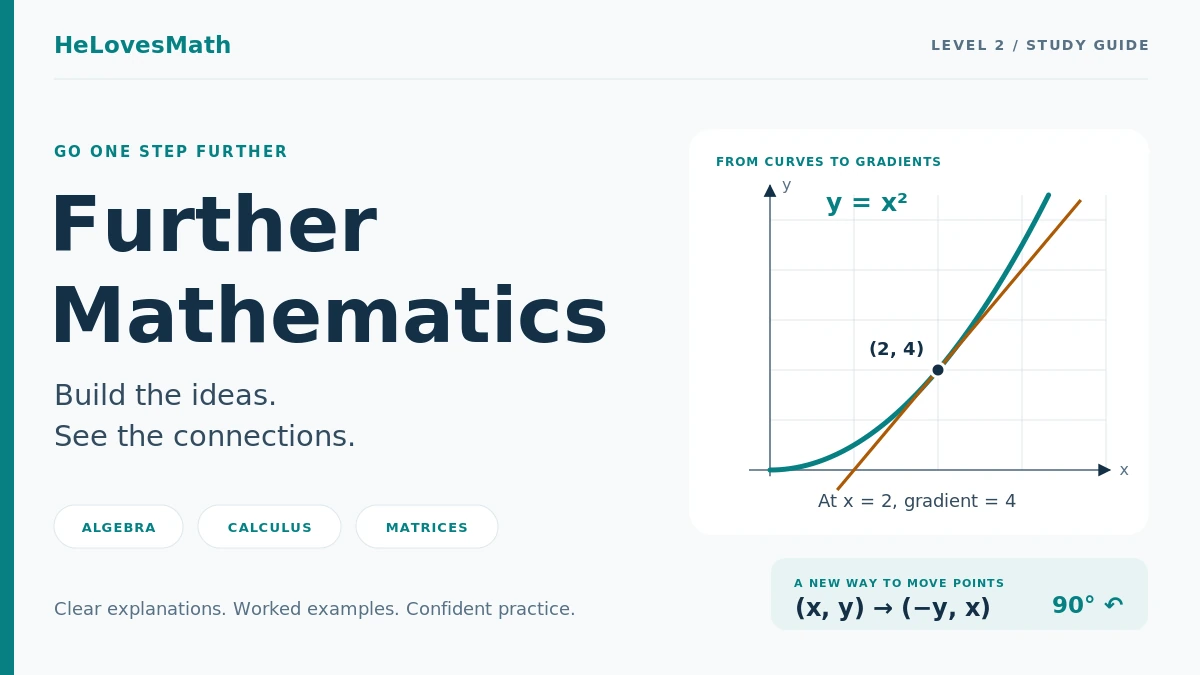
HeLovesMath • Study guide and resource directory
AQA Level 2 Further Mathematics: learn, practise, check
Build the algebra, calculus and matrix skills behind Level 2 Further Maths, then choose from 69 activities with editable Word files, printable worksheets and answers.
Start with a worked example, try the short self-check without looking at the answer, then use the searchable directory for focused practice. The linked worksheet collection is by Dr Austin Maths; the explanations, worked examples and self-check below are original HeLovesMath material.
What is AQA Level 2 Further Mathematics?
This guide supports the AQA Level 2 Certificate in Further Mathematics, specification 8365. It is an additional, untiered qualification that builds on GCSE Mathematics. AQA describes its intended learners as students already achieving, or expected to achieve, GCSE Maths grades 7–9 and considering further mathematics study. It can be taught alongside GCSE Maths or afterwards. Check your course code before choosing papers: A-level Further Mathematics and other additional-maths qualifications have different requirements. Qualification source
Use the resource library as a practice menu: choose a topic, attempt the questions independently, and explain why your method works. The examples below model that process; they are original teaching examples, not AQA past-paper questions or official mark schemes.
Assessment at a glance
- Paper 1: non-calculator, 1 hour 45 minutes, 80 marks
- Paper 2: calculator, 1 hour 45 minutes, 80 marks
- Each paper contributes 50%; both are taken in the same examination series
- Either paper may assess any part of the specification, so do not split revision into “Paper 1 topics” and “Paper 2 topics”
Grades run from 5 to 9, with an allowed grade 4; performance below that threshold is unclassified. The overall total determines the grade, rather than a separate pass requirement on each paper. Specification, section 5.3
The six curriculum areas
- Number: counting and exact surds
- Algebra: functions, polynomials, equations, inequalities, sequences and proof
- Coordinate geometry: lines and circles
- Calculus: gradients, tangents, normals and optimisation
- Matrix transformations: multiplication and compositions
- Geometry: proof, trigonometry and spatial problems
Keep the scope precise: coordinate geometry is two-dimensional, although geometry includes 3D problems. Differentiation covers integer powers, including negative powers. Trigonometric equations use single angles in degrees. Matrix calculations use 2 × 2 and 2 × 1 matrices, with the specified rotations, reflections and origin-centred enlargements. Integration, complex numbers and general matrix inverses are not listed in this specification. Check the complete specification
Six original worked examples
These examples explain the method; they are not official exam questions or a mark scheme. Show intermediate steps so you can locate an error rather than just compare a final answer.
1. Number: rationalise a denominator
Question: Write (5 + √3)/(2 − √3) in the form a + b√3, where a and b are integers.
- The conjugate of 2 − √3 is 2 + √3. Multiply both numerator and denominator by it.
- The denominator becomes (2 − √3)(2 + √3) = 4 − 3 = 1.
- The numerator becomes (5 + √3)(2 + √3) = 10 + 5√3 + 2√3 + 3 = 13 + 7√3.
Answer: 13 + 7√3.
Check: (13 + 7√3)(2 − √3) = 26 − 21 + (14 − 13)√3 = 5 + √3, recovering the original numerator.
Watch for: multiplying only the denominator changes the value of the fraction. The same non-zero factor must multiply top and bottom.
2. Algebra: composition, domain and inverse
Question: Let f(x) = (x − 2)2 + 1 for x ≥ 2, and let g(x) = 3x + 2 for all real x. Find fg(x), its domain, and f−1(x).
- fg(x) means f(g(x)): apply g first. Substituting gives f(3x + 2) = ((3x + 2) − 2)2 + 1 = 9x2 + 1.
- The input to f must be at least 2. Therefore 3x + 2 ≥ 2, so the composite domain is x ≥ 0.
- To invert f, start with y = (x − 2)2 + 1. Because x ≥ 2, x − 2 is non-negative, so x − 2 = √(y − 1).
- Rearrange and rename the input: f−1(x) = 2 + √(x − 1), with domain x ≥ 1.
Answer: fg(x) = 9x2 + 1 for x ≥ 0; f−1(x) = 2 + √(x − 1) for x ≥ 1.
Check: f(5) = 10 and f−1(10) = 5. The original domain selects the positive square-root branch; adding “±” would fail to define the required inverse function.
3. Coordinate geometry: a tangent to a translated circle
Question: Find the equation of the tangent to (x − 1)2 + (y + 2)2 = 25 at P(4, 2).
- The centre is C(1, −2) and the radius is 5.
- Check P lies on the circle: (4 − 1)2 + (2 + 2)2 = 9 + 16 = 25.
- The radius CP has gradient (2 − (−2))/(4 − 1) = 4/3.
- A tangent is perpendicular to the radius, so its gradient is −3/4.
- Use the point P: y − 2 = (−3/4)(x − 4). Multiplying by 4 and rearranging gives 3x + 4y = 20.
Answer: 3x + 4y = 20.
Check: P satisfies 3(4) + 4(2) = 20, and (4/3)(−3/4) = −1. A line through the correct point is not sufficient unless its direction is also correct.
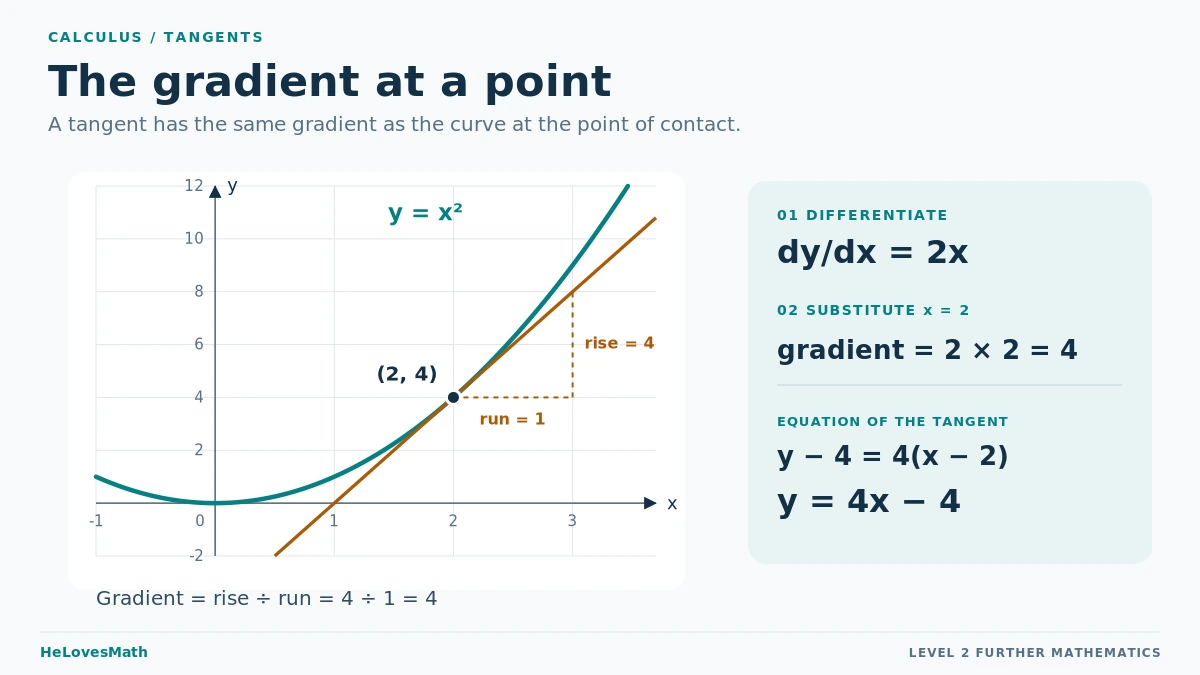
4. Calculus: tangent and normal to y = x²
Question: Find the tangent and normal to y = x2 at the point where x = 2.
- Find the point on the curve: y = 22 = 4, so P is (2, 4).
- Differentiate: dy/dx = 2x. At x = 2, the tangent gradient is 4.
- Tangent: y − 4 = 4(x − 2), giving y = 4x − 4.
- The normal is perpendicular to the tangent, so its gradient is −1/4.
- Normal: y − 4 = (−1/4)(x − 2), giving x + 4y = 18.
Answers: tangent y = 4x − 4; normal x + 4y = 18.
Check: both lines pass through (2, 4), and their gradients multiply to −1. Also, x2 − (4x − 4) = (x − 2)2, which is zero at the contact point.
Watch for: dy/dx gives a gradient, not the y-coordinate. If a tangent is horizontal, its normal is vertical; do not try to divide by zero.
5. Matrices: why the order of transformations matters
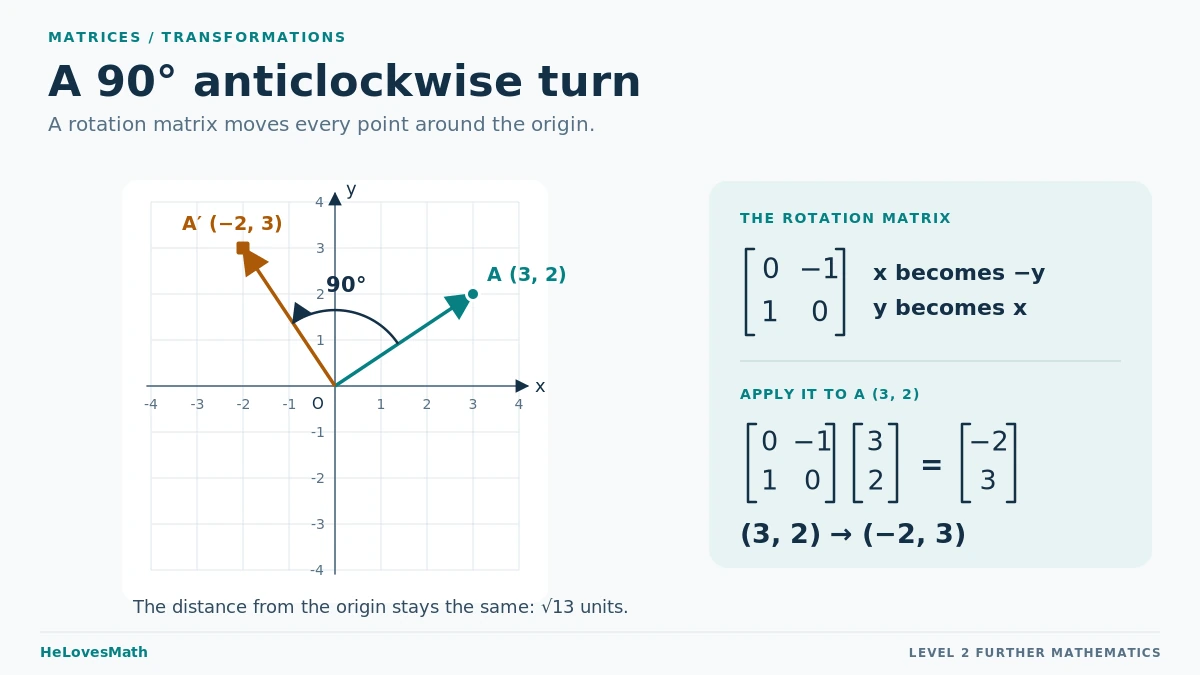
Question: Rotate P(3, 2) through 90° anticlockwise about the origin, then reflect it in the y-axis. Find the image and the combined matrix.
Write R = [[0, −1], [1, 0]] for the rotation and S = [[−1, 0], [0, 1]] for the reflection. In this notation, each inner bracket is one row of the matrix. Points are represented by column vectors.
- R sends (x, y) to (−y, x), so P becomes (−2, 3).
- S sends (x, y) to (−x, y), so (−2, 3) becomes (2, 3).
- Because R acts first on a column vector, the combined matrix is SR.
- Multiplying row by column gives SR = [[0, 1], [1, 0]]. This sends (x, y) to (y, x), a reflection in y = x.
Answer: the image is (2, 3), and the combined matrix is [[0, 1], [1, 0]].
Check: reversing the order gives RS = [[0, −1], [−1, 0]], which sends P to (−2, −3). Here SR ≠ RS: the order changes the result.
6. Trigonometry: solve a quadratic in sin θ
Question: Solve 2 sin2 θ − sin θ − 1 = 0 for 0° ≤ θ ≤ 360°.
- Treat sin θ as the unknown while factorising: (2 sin θ + 1)(sin θ − 1) = 0.
- Therefore sin θ = −1/2 or sin θ = 1.
- sin θ = 1 gives θ = 90° in the stated interval.
- For sin θ = −1/2, the reference angle is 30°. Sine is negative in the third and fourth quadrants, giving θ = 210° and 330°.
Answer: θ = 90°, 210°, 330°.
Check: substituting sin θ = 1 or −1/2 makes the original expression zero. Neither endpoint 0° nor 360° is a solution. A single inverse-sine calculator value would not give the full solution set.
See the tangent gradient
See the matrix as a movement
Eight-question self-check
Try each question before revealing its solution. Work in exact form unless rounding is requested. This is a short skill check, not a grade predictor or a complete specification test.
Question 1
Counting: How many four-digit odd numbers can be formed from 0, 1, 2, 3, 4 and 5 without repeating a digit?
Show answer 1
144. There are 3 choices for the odd units digit. The thousands digit has 4 choices because it cannot be zero or the chosen units digit. The remaining positions have 4 and 3 choices. Total: 3 × 4 × 4 × 3 = 144.
Question 2
Factor theorem: Show that 2x − 3 is a factor of 2x3 − 3x2 − 8x + 12. Factorise fully and solve 2x3 − 3x2 − 8x + 12 = 0.
Show answer 2
(2x − 3)(x − 2)(x + 2); x = −2, 3/2, 2. Substituting x = 3/2 gives 0, so the factor theorem applies. Division by 2x − 3 leaves x2 − 4, which is a difference of two squares.
Question 3
Binomial expansion: Find the coefficient of x2 in (3 − 2x)4.
Show answer 3
216. The x2 term is 6 × 32 × (−2x)2 = 216x2. The relevant Pascal coefficient is 6; the squared negative gives a positive contribution.
Question 4
Quadratic inequality: Solve 2x2 − 7x + 3 ≤ 0.
Show answer 4
1/2 ≤ x ≤ 3. Factorise to (2x − 1)(x − 3) ≤ 0. The upward-opening quadratic is non-positive between its roots. Include both roots because equality is allowed.
Question 5
Sequence limit: For un = (5n − 2)/(2n + 3), n = 1, 2, 3, …, find u3 and the limiting value as n grows without bound. Does any term equal that limiting value?
Show answer 5
u3 = 13/9; limit = 5/2; no term equals it. Dividing numerator and denominator by n gives (5 − 2/n)/(2 + 3/n), approaching 5/2. Equality would require 2(5n − 2) = 5(2n + 3), or −4 = 15, which is impossible.
Question 6
Stationary points: Find and classify the stationary points of y = x3 − 6x2 + 9x + 1.
Show answer 6
Local maximum (1, 5); local minimum (3, 1). dy/dx = 3x2 − 12x + 9 = 3(x − 1)(x − 3), so x = 1 or 3. The second derivative is 6x − 12: it is −6 at x = 1 and 6 at x = 3. Substituting into y supplies the coordinates.
Question 7
Matrices: Let M = [[0, −2], [2, 0]]. Find the image of (−1, 4), describe M geometrically, and find M2.
Show answer 7
Image (−8, −2); 90° anticlockwise rotation with enlargement scale factor 2, both centred at the origin; M2 = [[−4, 0], [0, −4]]. Multiplying gives (−2 × 4, 2 × (−1)) = (−8, −2). Applying M twice gives a 180° rotation and scale factor 4.
Question 8
Triangle geometry: Two sides of a triangle are 7 cm and 9 cm, with included angle 60°. Find the exact length of the third side and the exact area.
Show answer 8
Third side √67 cm; area 63√3/4 cm2. The cosine rule gives c2 = 72 + 92 − 2(7)(9)cos 60° = 67. Area = (1/2)(7)(9)sin 60° = 63√3/4.
Common errors worth checking
- Functions: fg(x) means f(g(x)); it does not mean f(x) × g(x). An inverse function reverses a mapping, whereas 1/f(x) is a reciprocal.
- Domains: an algebraic formula alone does not settle which inputs are permitted. Preserve restrictions when composing, inverting or cancelling factors.
- Factor theorem: test x = a for a factor x − a. For 2x − 3, the test input is 3/2, not 3.
- Quadratic inequalities: finding the roots is only the first step. Decide which interval satisfies the inequality and whether the endpoints are included.
- Gradients: use the negative reciprocal for perpendicular non-horizontal, non-vertical lines. Handle horizontal and vertical lines separately.
- Stationary points: dy/dx = 0 identifies candidates; it does not prove every candidate is a maximum or minimum. Classify using a valid second-derivative test or a change of gradient sign.
- Matrices: with column vectors, the rightmost matrix acts first. Multiplication usually cannot be reordered.
- Trigonometry: use degrees for these questions and find every solution within the interval, including possible endpoints. Do not divide by sin θ or cos θ without checking whether zero values could be solutions.
- Limits: a sequence can approach a value without ever reaching it.
- Proof: a few successful numerical examples support a conjecture but do not prove a statement for every integer or every permitted input.
Turn a worksheet into a useful revision session
- Choose a narrow target: for example, inverse-function domains or the order of two matrix transformations.
- Attempt before checking: write a complete method, with enough working for someone else to follow.
- Explain one error: identify the exact line where the reasoning stopped being valid, then repair it.
- Transfer the skill: change a sign, a domain or the transformation order and predict what should change.
- Revisit later: answer a fresh question without the worked example beside you, then mix it with another topic.
Once individual skills are secure, use complete 8365 papers and their mark schemes from the official assessment collection. Retain the resource author’s attribution when using or sharing any linked worksheet; these new explanations do not change ownership of those resources.
Strengthen the prerequisites
If the algebra steps are the sticking point, practise algebra worksheets with answers. For angle facts and circle reasoning, use the geometry worksheet guide. The broader maths revision collection helps you revisit GCSE foundations.
Level 2 Further Mathematics FAQ
Who are these Level 2 Further Mathematics resources for?
They support high-attaining GCSE learners studying AQA 8365, as well as focused enrichment. AQA describes its intended learners as students achieving or expected to achieve GCSE Mathematics grades 7–9. Confirm the specification with your teacher before using a worksheet as exam preparation.
What types of files are included on this page?
Each of the 69 preserved activities has an editable Word link, a printable PDF worksheet and a separate answers link. These are third-party teaching materials. The directory includes specific cautions where sampled answers need correction or completion.
What topics are covered in Level 2 Further Mathematics?
The qualification covers number, algebra, coordinate geometry, calculus, matrix transformations and geometry. This directory divides its resources into nine smaller topic groups to help you find practice.
Sources & References
Official AQA references support the course guidance. The resource directory below preserves the original Dr Austin Maths destinations. All external links open in a new tab; files stay on their original hosts.
- AQA 8365: qualification introduction — intended learners, untiered status and relationship to GCSE Mathematics.
- AQA 8365: assessment at a glance — paper durations, marks, calculator arrangements and coverage.
- AQA 8365 specification, version 1.4 (PDF) — full content, assessment and grading requirements.
- AQA formulae-sheet announcement, 1 September 2026 — explicitly confirms provision for Level 2 Further Mathematics in 2027.
- AQA 8365 formulae sheet for June 2027 (PDF) — check the printed exam year before using an insert.
- AQA 8365 assessment resources — official question papers, mark schemes and related assessment material.
- AQA All About Maths: 8365 resources — official teaching support and links explaining changes from legacy 8360.
Qualification information checked on 5 October 2026. Confirm exam-year arrangements with AQA and your centre. The worked examples and self-check questions on this page are original teaching material and are not official AQA assessment items.
Dr Austin Maths worksheet directory
All 69 activities and their 207 Word, PDF and answer links are retained. Choose a topic or search by skill and activity type. The files are third-party teaching resources, not AQA exam papers; verify the particular worksheet fits your lesson and compare your method as well as the printed answer.
Access checked on 5 October 2026: all 207 original links returned the expected PDF or Word file. One complete Word/worksheet/answer set per topic was checked for matching identity and sampled mathematics. This is not a full proofread of every worksheet. Specific corrections and wording notes appear beside five affected activities below; keep checking your method and the original question.
Showing 69 activities in 9 topic areas.
No matching resources. Try one topic word, such as matrices, or clear the search.
Counting and Surds
Resources on the product rule for counting and rationalising the denominator.
3 activities
Product Rule for Counting Practice Strips
Practice Strips
Answer-check note: the final student-selection problem does not assign ordered roles. Selecting two from 24 gives (24 × 23) ÷ 2 = 276; choosing two from each of classes of 24 and 26 gives 276 × 325 = 89,700. The linked answer sheet counts the choices as ordered. Use the unordered answers for the wording shown.
Product Rule for Counting Match-Up
Match-Up
Rationalising the Denominator Proof Practice Strips
Practice Strips
Sequences and Limits
Nth term, quadratic sequences, generating sequences, and limits of sequences.
7 activities
Using the Nth Term of Sequences Practice Grid
Practice Grid
Using the Nth Term of Quadratic Sequences Practice Grid
Practice Grid
Generating Quadratic Sequences Practice Strips
Practice Strips
Nth Term of a Quadratic Sequence Fill In The Blanks
Fill In The Blanks
More Nth Term of a Quadratic Sequence Fill In The Blanks
Fill In The Blanks
Nth Term of a Quadratic Sequence Practice Strips
Practice Strips
Limit of a Sequence Practice Strips
Practice Strips
Factorising and Factor Theorem
More complex factorising, factor theorem skills, and cubic factorisation.
7 activities
More Complex Factorising Practice Strips
Practice Strips
More Complex Factorising Match-Up
Match-Up
Using the Factor Theorem Match-Up
Match-Up
Factor Theorem Practice Strips
Practice Strips
Complete the last answer: the requested third factor is (x + 5). The factorisation is (x + 2)(x − 4)(x + 5) = x³ + 3x² − 18x − 40; the linked sheet gives the coefficients but stops before stating the factor.
Harder Factor Theorem Practice Strips
Practice Strips
Factorising Cubics Name the Film
Name the Film
Factor Theorem Fill In The Blanks
Fill In The Blanks
Expanding Brackets and Binomial Expansion
Pascal's Triangle, harder brackets, binomial expansion, and finding coefficients.
8 activities
Expanding Harder Brackets Practice Strips
Practice Strips
Expanding Brackets and Pascal's Triangle Activity
Activity
Using Pascal's Triangle Practice Strips
Practice Strips
Binomial Expansion Practice Grid
Practice Grid
More Binomial Expansion Practice Grid
Practice Grid
Finding Coefficients in Binomial Expansions Practice Strips
Practice Strips
Binomial Expansion Practice Strips
Practice Strips
Binomial Expansion Crack the Code
Crack the Code
Indices, Simultaneous Equations and Functions
Indices, non-linear and three-variable simultaneous equations, exponential graphs, and piecewise functions.
7 activities
Solving Equations with Indices Practice Strips
Practice Strips
Answer-check notes: first strip (f) has real solutions x = −8 and 8. Second strip (d) has x = 3/2 only because the square-root expressions require x > 0. Second strip (f) gives x = 16⁴ = 65,536, not 16. Substitute into the original equation to check the domain and value.
Harder Non-Linear Simultaneous Equations Practice Strips
Practice Strips
Solving Three Simultaneous Equations Practice Strips
Practice Strips
Solving Three Simultaneous Equations Crack the Code
Crack the Code
Exponential Functions and Graphs Practice Strips
Practice Strips
Finding Equations of Exponential Graphs Practice Grid
Practice Grid
Piecewise Functions Practice Strips
Practice Strips
Coordinate Geometry and Circles
Equation of a circle, tangents, ratio division, and circle geometry problems.
8 activities
Equation of a Circle Practice Strips
Practice Strips
Equation of a Circle Fill In The Blanks
Fill In The Blanks
Equation of a Tangent to a Circle Practice Strips
Practice Strips
Wording notes: in strip 2(b), use the stated point B(−3, −2) as the tangent point. In strip 3(b), read the displayed expression as the circle’s equation; its centre is (3, −2). The sampled answers use these intended meanings.
Equation of a Tangent to a Circle Fill in the Blanks
Fill In The Blanks
Radius and Diameter of a Circle Fill in the Blanks
Fill In The Blanks
Circle Geometry Problems Practice Strips
Practice Strips
Dividing a Line Segment in a Ratio Fill in the Blanks
Fill In The Blanks
Dividing a Line Segment in a Ratio Practice Strips
Practice Strips
Calculus
Differentiation, gradient functions, stationary points, second derivatives, and tangents and normals.
9 activities
Differentiation by Rule Practice Strips
Practice Strips
Harder Differentiation by Rule Practice Strips
Practice Strips
Harder Differentiation Match-Up
Match-Up
Using the Gradient Function
Fill In The Blanks
Stationary Points Practice Strips
Practice Strips
Stationary Points Fill In The Blanks
Fill In The Blanks
Applied Calculus Problems Practice Strips
Practice Strips
Second Derivatives Practice Strips
Practice Strips
Equations of Tangents and Normals Practice Strips
Practice Strips
Matrices and Transformations
Introduction to matrices, multiplication, identity matrices, and transformation matrices.
12 activities
Introduction to Matrices Practice Strips
Practice Strips
Matrix Multiplication Fill in the Blanks
Fill In The Blanks
Matrix Multiplication Practice Strips
Practice Strips
Matrix Multiplication Crack the Code
Crack the Code
Using the Identity Matrix Practice Strips
Practice Strips
Reflections Using Matrices Practice Grid
Practice Grid
Rotations Using Matrices Practice Grid
Practice Grid
Enlargements Using Matrices Practice Grid
Practice Grid
Reflection and Rotation Matrices Practice Strips
Practice Strips
Combining Matrix Transformations Practice Strips
Practice Strips
Matrix Transformations Match-Up
Match-Up
Harder Transformations Using Matrices Practice Grid
Practice Grid
Trigonometry
Exact trig values, trig identities, proofs, and trigonometric equations.
8 activities
Exact Trigonometric Ratios Match-Up
Match-Up
Exact Trigonometric Ratios Practice Grid
Practice Grid
Exact Trigonometric Ratios Crack the Code
Crack the Code
Trigonometric Ratios Decode the Joke
Decode the Joke
Trigonometric Identities Match-Up
Match-Up
Trigonometric Proof Practice Strips
Practice Strips
Solving Trigonometric Equations Practice Strips
Practice Strips
Answer-check note: in the final strip (a), 2cos²θ + 3sinθ = 3 gives (2sinθ − 1)(sinθ − 1) = 0. For 0° ≤ θ < 360°, the solutions are 30°, 90°, 150°. Replace the answer sheet’s 0° with 90°.
Solving Trigonometric Equations Name the Film
Name the Film