
Stoichiometry Calculator
Convert mass to moles, apply a balanced-equation ratio and interpret the result. Choose one of eight modes below for molar mass, limiting reactants, yield, empirical formulas, solutions or gases. Enter formulas without reaction coefficients, and check the assumptions alongside each answer.
Calculate Stoichiometry Values
Select a mode, enter the known chemical quantities, and calculate the unknown value using mole ratios from a balanced equation.
Molar Mass Calculator
Mole-to-Mole Stoichiometry
Mass-to-Mass Stoichiometry
Limiting Reactant Calculator
Percent Yield Calculator
Empirical Formula Calculator
Enter element symbols and masses or percentages. If using percentages, treat each value as grams in a 100 g sample.
Solution Stoichiometry Calculator
Gas Stoichiometry Calculator
Stoichiometry starts with a balanced equation
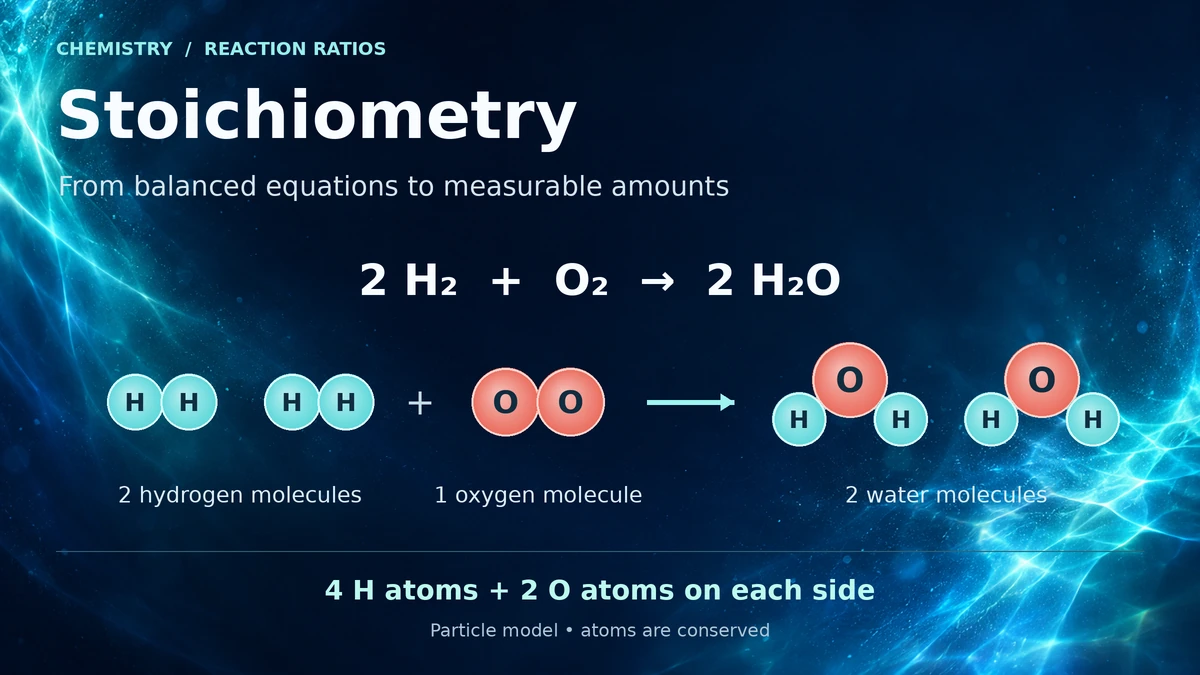
Stoichiometry connects measured quantities to the proportions in a chemical reaction. For the equation 2H₂ + O₂ → 2H₂O, two moles of hydrogen react with one mole of oxygen to make two moles of water. The same relationship describes two hydrogen molecules and one oxygen molecule forming two water molecules. It does not say that two grams of hydrogen react with one gram of oxygen.
A coefficient is the number before a chemical formula; a subscript is part of the substance's identity. You may change coefficients to balance an equation. Changing H₂O to H₂O₂ changes water into a different substance. Count each element on both sides before using the calculator. The chemical equation balancer provides a separate place to check that step.
The eight modes above keep the units visible through each calculation. They cover molar mass, mole ratios, mass-to-mass conversion, two-reactant limiting problems, three forms of the yield equation, empirical formulas, solution concentrations and ideal gases. They are educational models, not a determination that a proposed reaction actually occurs.
How to use the calculator without losing the chemistry
- Write and balance the reaction. Check its chemical plausibility using your course material. The tool applies the coefficients you enter; it cannot verify a complete reaction from separate fields.
- Choose the information you have. Mass-to-Mass takes grams. Solution Stoich takes molarity in mol/L and volume in mL. Gas Stoich takes litres, absolute pressure in atm and temperature in kelvin.
- Enter coefficients separately from formulas. For 2H₂ + O₂ → 2H₂O, enter H2 and H2O as formulas and 2 and 2 as coefficients. The coefficient of O2 is 1 even when the equation leaves it unwritten.
- Read the step table. Verify formula atom counts, molar masses, mole conversion and ratio before accepting the final answer.
- Round at the end. The decimal selector changes display precision. It does not infer experimental significant figures. Keep guard digits during intermediate work and apply the rounding required by the question.
Formula syntax: H2O, Ca(OH)2, Al2(SO4)3 and CuSO4·5H2O are accepted, as are Unicode subscripts such as H₂O. Matched parentheses, square brackets and braces work for nested groups. A dot or middle dot separates hydrate components; in this parser a period always means a hydrate separator, never a decimal subscript. Element capitalization matters: Co is cobalt; CO contains carbon and oxygen.
Use positive whole-number atom counts. Do not enter ionic charge symbols, isotope notation, state labels such as (aq), reaction arrows or a leading reaction coefficient in a formula field. For an ordinary ion, its element composition can be entered without the charge for an approximate classroom molar mass; the tool neither checks charge balance nor models electron-mass corrections. Isotope-specific and non-stoichiometric materials need a different mass model.
The mass display selector changes calculated mass outputs to g, kg or mg. Inputs explicitly labelled “in g” remain grams. In Percent Yield, the selected unit applies to both actual and theoretical yield; convert them to the same unit before entering them. Editing an input or switching a mode clears the old answer so it cannot be mistaken for a fresh calculation.
Input range and precision conventions
Required numeric entries must be finite. Quantities accept zero or magnitudes from 10⁻⁵⁰ through 10⁵⁰, subject to the mode's non-negative or positive requirement. Coefficients range from 10⁻¹² to 10⁶. Formula length is limited to 250 characters, nesting to 12 groups, and a parsed element count to one million. These are computational safeguards, not physical claims. Tiny nonzero results use scientific notation. If that notation is unfamiliar, see the scientific notation examples.
The four-step stoichiometry method
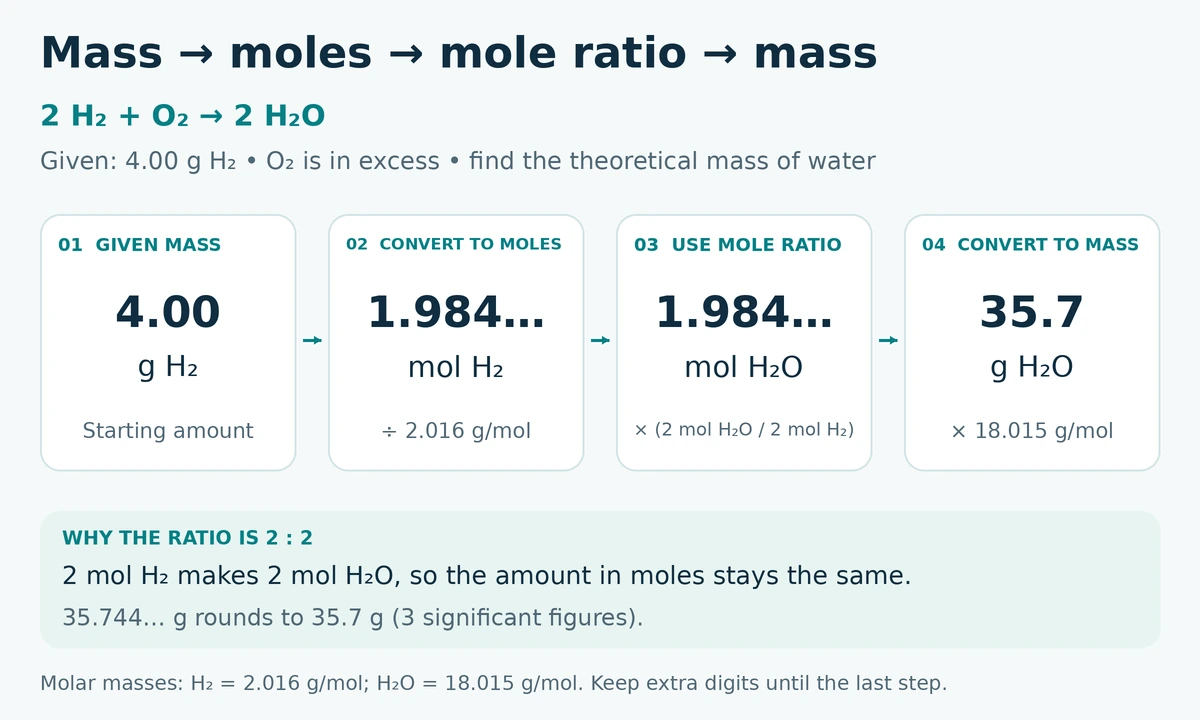
For known substance A and target substance B, use the route mass A → moles A → moles B → mass B. With mass m in grams, molar mass M in g/mol, amount n in mol and positive balanced-equation coefficients ν:
Mass to moles: nA = mA / MA
Mole ratio: nB = nA × νB / νA
Moles to mass: mB = nB × MB
All in one: mB = (mA / MA) × (νB / νA) × MB
Watch the units cancel: g A × mol A/g A × mol B/mol A × g B/mol B leaves g B. A ratio with the target substance on top and the known substance below is much easier to check than an unexplained multiplier. OpenStax's reaction-stoichiometry chapter uses this balanced-equation approach; the worked examples below show each stage explicitly.
Molar mass: count every atom once
For water, M(H₂O) = 2(1.008) + 15.999 = 18.015 g/mol. For calcium hydroxide, the final 2 applies to the entire OH group: Ca(OH)₂ contains one Ca, two O and two H, giving 40.078 + 2(15.999 + 1.008) = 74.092 g/mol.
Al₂(SO₄)₃ contains two aluminium atoms, three sulfur atoms and twelve oxygen atoms. A hydrate dot adds the following component: CuSO₄·5H₂O includes five water units for each copper(II) sulfate unit. It is not an instruction to multiply the molar mass of CuSO₄ by the molar mass of water.
The calculator uses rounded educational atomic weights based on the CIAAW abridged table. Natural isotopic composition and the table supplied in an examination can change the last digits. Results shown to six decimal places do not make the underlying atomic weights that precise. Elements without a standard atomic weight require isotope-specific information and are not assigned a silent mass-number substitute.
Coefficients compare amounts, not masses
Multiplying every coefficient by the same positive factor does not change a reaction ratio. The equations 2H₂ + O₂ → 2H₂O and 4H₂ + 2O₂ → 4H₂O therefore give the same answer. For a target of water from oxygen, the ratio is 2 mol H₂O per 1 mol O₂. For hydrogen from oxygen, it is 2 mol H₂ per 1 mol O₂.
If only one reactant amount is given, the usual classroom assumption is that every other required reactant is available in excess. State that assumption. Otherwise a single-reactant calculation may predict more product than the real mixture can produce.
Mass-to-mass conversions and conservation checks
Grams must pass through moles because substances have different molar masses. For 4.00 g H₂ and excess oxygen, the theoretical water mass is (4.00/2.016) × (2/2) × 18.015 = 35.744… g, or 35.7 g to three significant figures. A product mass larger than the hydrogen mass is reasonable because oxygen supplies the rest of the product's mass.
Conservation of mass applies to the complete system: all consumed reactants, all products and any remaining reactants. Do not compare one product only with one reactant and infer that mass was created. Nor should a yield calculation assume every product atom originated in the substance whose mass was supplied.
Find the limiting reactant by comparing reaction extent
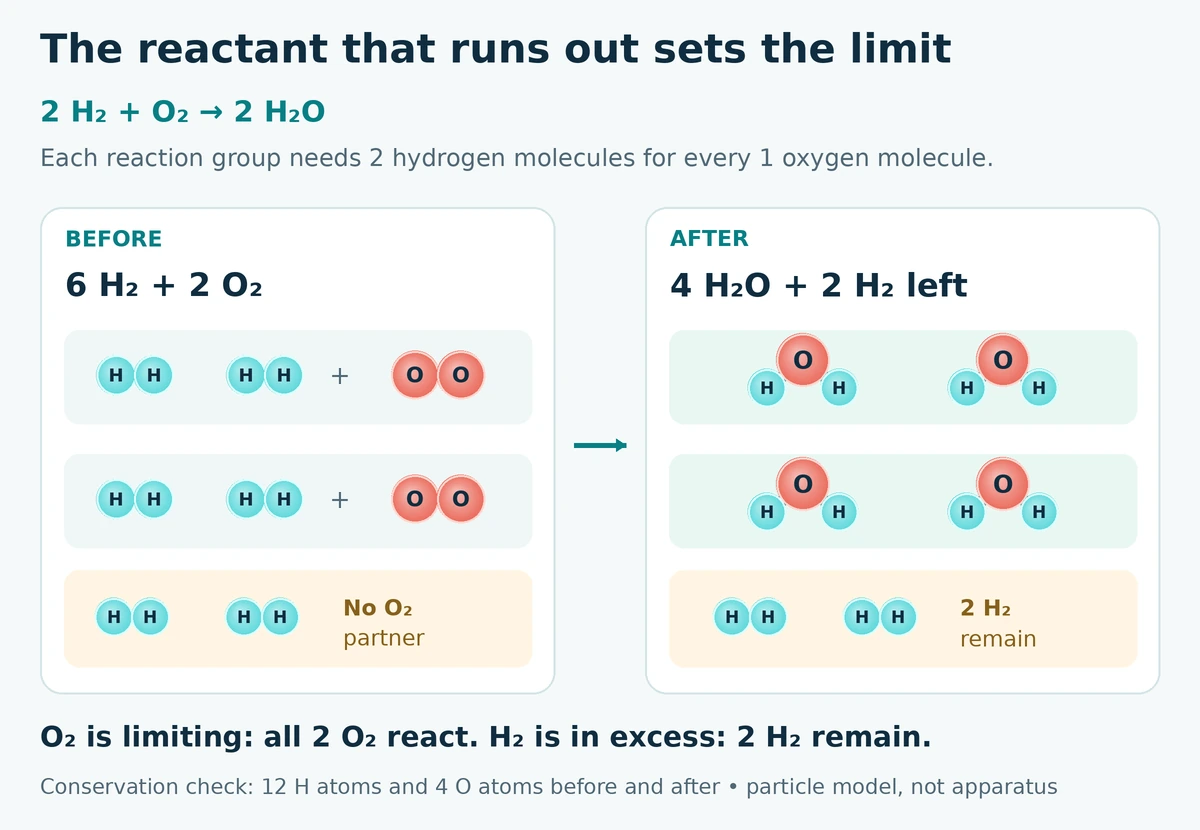
For each reactant, divide its available moles by its coefficient: ξA = nA/νA and ξB = nB/νB. The smaller value gives the maximum reaction extent. Product moles equal ξmin × νproduct. Remaining reactant A equals nA − ξminνA, and similarly for B.
The lighter sample is not necessarily limiting. Compare equivalent reaction extents, not grams or unadjusted moles. If the extents match, the inputs are stoichiometric: neither reactant is in excess in this idealized model. The tool identifies a numerical tie within a relative tolerance of 10⁻¹², which is not a claim about experimental uncertainty.
This mode compares two entered reactants. It assumes any additional reactants are in sufficient supply, the stated reaction goes to completion and competing reactions are absent. It does not predict equilibrium, reaction rate or a safe mixing procedure.
Theoretical yield, actual yield and percent yield
Theoretical yield is the amount predicted from the balanced reaction and available limiting reactant under the stated ideal assumptions. Actual yield is what is measured or recovered. Their ratio is:
Percent yield = actual yield / theoretical yield × 100%
Actual yield = theoretical yield × percent yield / 100
Theoretical yield = actual yield / (percent yield / 100)
Both amounts must refer to the same product and use compatible units. The calculator disables the field being solved so an old value in it cannot affect the result. A zero actual yield with a positive theoretical yield is 0%; trying to infer an unknown theoretical yield from 0% cannot determine a unique answer.
A result above 100% is a reason to investigate. Retained water, solvent, impurities, an incorrect theoretical basis, unit mismatch or measurement error can inflate a measured mass. Report and explain the discrepancy rather than clipping the result to 100%. Product loss, incomplete reaction and side reactions can reduce actual yield. The calculator performs the comparison; it does not diagnose the experiment.
Empirical formulas need evidence, not forced rounding
An empirical formula expresses the simplest whole-number atom ratio. Divide each measured element mass by that element's atomic weight, then divide every resulting mole value by the smallest. A C:H:O ratio close to 1:2:1 suggests CH₂O. It does not establish a molecular formula: C₂H₄O₂ and C₆H₁₂O₆ have the same simplest ratio.
For percentages, use a hypothetical 100 g sample: 40.0% means 40.0 g. Use all relevant elements and one consistent basis; percentages should account for the whole analyzed material within the stated uncertainty. The tool also accepts raw masses, so it cannot automatically require that your entries add to 100.
Do not round 1:1.5 to 1:2. Multiply all ratios by 2 to obtain 2:3. The calculator searches common multipliers from 1 through 12, accepts a maximum absolute discrepancy of 0.02 in each normalized ratio, then reduces common factors. It labels a successful fit as a candidate empirical formula. The tolerance is a transparent numerical heuristic, not an uncertainty analysis or proof of compound identity. No acceptable small ratio produces a request to recheck the data, not a fabricated rounded formula.
Enter each element once with a positive amount. Combine duplicate rows and include both fields in every row you use. An isotopically enriched sample, omitted element or impure sample can make even a neat ratio misleading.
Solutions and gases: keep the conventions explicit
For concentration c in mol/L and solution volume V in litres, n = cV. Convert millilitres to litres by dividing by 1000. A 0.500 mol/L solution with volume 100.0 mL contains 0.0500 mol solute. The balanced-equation ratio then connects that amount to the target. This calculation assumes that the other reactant is sufficient and that the relevant stoichiometric reaction is complete; it does not automatically identify a titration endpoint.
For an ideal gas, n = PV/(RT). This tool uses P in atm, V in L, T in K and R = 0.082057366080960 L·atm·mol⁻¹·K⁻¹, derived from the SI gas constant listed by NIST. Temperature must be absolute: T(K) = t(°C) + 273.15. Pressure must be absolute, not gauge pressure. The model ignores non-ideal-gas corrections and water-vapour corrections for wet gases.
STP is not a unique classroom convention. At 273.15 K and 1 atm (101.325 kPa), ideal molar volume is about 22.41397 L/mol. At 273.15 K and 100 kPa, the IUPAC standard-gas convention, it is about 22.71095 L/mol. Both choices are explicit in the mode selector. Follow the conditions stated in your question rather than treating “22.4 L” as universal. At room temperature, use the actual temperature and pressure or the molar volume specified by the course.
For a separate exploration of pressure, volume and temperature relationships, use the gas laws calculator. Gas stoichiometry still requires the mole ratio after the gas amount is found.
Eight worked examples
1. Mole ratio: hydrogen to water
For 2H₂ + O₂ → 2H₂O, start with 2.00 mol H₂ and excess O₂. The target-to-known ratio is 2/2, so n(H₂O) = 2.00 × 2/2 = 2.00 mol. If the known amount were oxygen instead, the factor would be 2/1. The substance labels decide which ratio to use.
2. Mass-to-mass: 4.00 g hydrogen
With oxygen in excess, n(H₂) = 4.00/2.016 = 1.984126… mol. Water moles are the same because the coefficients are 2:2. Multiply by 18.015 g/mol: 35.7 g H₂O to three significant figures. The calculator display at three decimal places is 35.744 g. Do not round 1.984126… to 2 before finishing.
3. Percent yield: measured versus predicted
A theoretical yield of 18.0 g and actual yield of 15.0 g give (15.0/18.0) × 100 = 83.3%. Reversing those quantities gives 120%, which answers a different ratio. Both quantities must describe the same product on the same mass basis.
4. Solution reaction: 100 mL at 0.50 mol/L
For HCl + NaOH → NaCl + H₂O, let 100 mL of 0.50 mol/L HCl react with excess NaOH. Convert volume: 100/1000 = 0.100 L. Then n(HCl) = 0.50 × 0.100 = 0.050 mol, so the 1:1 ratio predicts 0.050 mol NaCl. At M(NaCl) = 58.440 g/mol, the calculated mass is 2.922 g before final experimental rounding.
5. Limiting reactant: six moles and two moles
Mix 6.00 mol H₂ and 2.00 mol O₂ in the water reaction. Compare 6.00/2 = 3.00 with 2.00/1 = 2.00. Oxygen limits the reaction. Product = 2.00 × 2 = 4.00 mol H₂O; hydrogen left = 6.00 − 2 × 2.00 = 2.00 mol H₂. Using the same atomic weights, the theoretical water mass is 72.060 g before rounding.
6. Hydrate molar mass: count the water too
CuSO₄·5H₂O contains Cu₁S₁O₉H₁₀. The anhydrous part has mass 63.546 + 32.06 + 4(15.999) = 159.602 g/mol; five waters add 5(18.015) = 90.075 g/mol. Total: 249.677 g/mol. A 24.9677 g sample is 0.100000 mol using these rounded atomic weights.
7. Empirical formula: do not round 1.5 away
A hypothetical pure sample contains 11.169 g Fe and 4.7997 g O. The mole amounts are 11.169/55.845 = 0.200 mol Fe and 4.7997/15.999 = 0.300 mol O. Dividing by 0.200 gives 1:1.5. Multiplying both by 2 gives 2:3, so the candidate empirical formula is Fe₂O₃.
8. Gas amount: the same volume at different standard pressures
Take 22.413969545 L O₂ at 273.15 K and 1 atm. The ideal-gas law gives about 1.000 mol O₂; excess H₂ can therefore produce 2.000 mol H₂O. If the same gas volume instead had pressure 100 kPa at the same temperature, it would contain about 0.986923 mol O₂ and produce 1.973847 mol H₂O. A stated volume alone is insufficient without conditions.
Ten practice problems with explained answers
Use the calculator's stated atomic weights. Assume each balanced reaction proceeds completely and any unlisted co-reactant is sufficient. Try each question before opening its answer. Extra digits below show the calculation; round the final measurement as your course requires.
Grouped formula: Find the molar mass of Ca3(PO4)2.
Show answer and reasoning
The atom counts are Ca3P2O8. Add 3(40.078) + 2(30.974) + 8(15.999) = 310.174 g/mol. The outer 2 multiplies the whole phosphate group.
Hydrate: Find the molar mass of MgSO4·7H2O.
Show answer and reasoning
Count Mg1S1O11H14. Then 24.305 + 32.06 + 11(15.999) + 14(1.008) = 246.466 g/mol. Seven water units contribute seven oxygen atoms in addition to the four in sulfate.
Mole ratio: In N2 + 3H2 → 2NH3, how much ammonia forms from 4.50 mol hydrogen?
Show answer and reasoning
Use the target-to-known coefficient ratio: 4.50 × 2/3 = 3.00 mol NH3. Its calculated mass is 3.00 × 17.031 = 51.093 g, or 51.1 g to three significant figures.
Mass conversion: For CaCO3 → CaO + CO2, what mass of carbon dioxide follows from 25.0 g calcium carbonate?
Show answer and reasoning
Moles CaCO3 = 25.0/100.086 = 0.2497851847 mol. The ratio is 1:1, so multiply by 44.009 g/mol: 10.99279620 g. The final answer is 11.0 g CO2 to three significant figures.
Limiting and excess: In 4Al + 3O2 → 2Al2O3, combine 5.40 g aluminium and 9.00 g oxygen. Identify the limiting reagent, the theoretical product mass and the oxygen left.
Show answer and reasoning
Compare (5.40/26.982)/4 = 0.05003335557 with (9.00/31.998)/3 = 0.09375585974. Aluminium limits. Product moles = 2(0.05003335557); multiplying by 101.961 g/mol gives 10.20290193 g, or 10.2 g Al2O3. Oxygen left = 9.00 − 3(0.05003335557)(31.998) = 4.197098065 g, or 4.20 g O2.
Exact proportions: In 2H2 + O2 → 2H2O, use 3.00 mol hydrogen and 1.50 mol oxygen. Which is in excess, and how much water forms?
Show answer and reasoning
The two reaction extents are 3.00/2 = 1.50 and 1.50/1 = 1.50. Neither reactant is in excess in this ideal model. Product = 1.50 × 2 = 3.00 mol H2O. Its mass is 54.045 g, or 54.0 g to three significant figures.
Percent yield: A reaction gives 12.6 g product against a theoretical yield of 15.0 g. Find the percent yield.
Show answer and reasoning
Percent yield = 12.6/15.0 × 100 = 84.0%. Use actual yield on top and theoretical yield below, with the same product and units.
Empirical formula: A compound contains 28.014 g nitrogen and 79.995 g oxygen. Find its simplest atom ratio.
Show answer and reasoning
The amounts are 28.014/14.007 = 2.0000 mol N and 79.995/15.999 = 5.0000 mol O. Dividing by the smaller gives 1:2.5. Multiply both by 2 to get 2:5, giving N2O5.
Solution ratio: For H2SO4 + 2NaOH → Na2SO4 + 2H2O, what amount and mass of NaOH are required by 35.0 mL of 0.200 mol/L sulfuric acid?
Show answer and reasoning
Convert 35.0 mL to 0.0350 L. Acid amount = 0.200 × 0.0350 = 0.00700 mol. Multiply by 2/1: 0.0140 mol NaOH. Its mass is 0.01400 × 39.997 = 0.559958 g, or 0.560 g.
Name the gas convention: In 2H2 + O2 → 2H2O, 11.207 L oxygen is measured at 273.15 K and 1 atm. How much water is theoretically possible? What changes if the same volume is instead measured at 100 kPa?
Show answer and reasoning
At 1 atm, n(O2) = 11.207/22.413969545 = 0.5000006794 mol. The 2/1 ratio gives 1.000001359 mol H2O and 18.01502448 g, reported as 18.015 g to five significant figures. The rounded 22.414 L/mol shortcut gives exactly 1.0000 mol water within that approximation.
At 100 kPa, use 22.710954641 L/mol instead. Water amount becomes 0.9869246077 mol and mass 17.77944681 g, or 17.779 g. Pressure changes the gas amount even when the volume and coefficient ratio stay the same.
Common mistakes and a quick self-check
- Using grams as coefficient units: convert to moles first
- Changing subscripts to balance: preserve chemical formulas and adjust coefficients
- Choosing the smallest mass as limiting: compare moles divided by coefficients
- Ignoring a hydrate multiplier: count every water atom as well as the anhydrous compound
- Using mL directly in n = cV: convert to litres when concentration is mol/L
- Using Celsius or gauge pressure in PV = nRT: use kelvin and absolute pressure
- Equating display decimals with significant figures: decide precision from the given data
- Forcing an empirical formula: examine residuals, missing elements and uncertainty
Before submitting an answer, name the substance, attach the unit, state any excess-reactant or ideal-gas assumption, and check its scale. A scientific calculator is useful for independently checking a single step without copying an entire unexamined result.
Stoichiometry questions
Does this calculator balance chemical equations?
No. It applies coefficients you supply. Balance and check the complete reaction first; otherwise correct arithmetic can still produce the wrong chemical answer.
Why can a product weigh more than the measured reactant?
Other reactants contribute mass. Water made from hydrogen also contains oxygen. Check the mass balance for all consumed reactants and all products, not just one starting sample.
What if both reactants run out together?
The input amounts are stoichiometric for that reaction. The tool reports stoichiometric amounts rather than arbitrarily naming A as the unique limiting reactant.
Can I calculate a zero yield?
Yes, zero actual yield divided by a positive theoretical yield is 0%. But 0% and zero actual yield do not identify a unique theoretical yield; that inverse problem is underdetermined.
Is an empirical formula also the molecular formula?
Not necessarily. An empirical formula gives the simplest ratio. A molecular formula additionally needs a molar mass or equivalent independent information; multiplying the empirical subscripts by a whole number can produce different molecular formulas.
Should I use 22.414 or 22.711 L/mol?
At 273.15 K, approximately 22.414 applies to an ideal gas at 1 atm, whereas approximately 22.711 applies at 100 kPa. Select the conditions specified in the question. Neither value applies universally at room temperature.
Why does my textbook give a slightly different last digit?
Atomic-weight rounding, natural isotopic composition and significant-figure rules can differ. Use the examination's supplied periodic table when required and retain intermediate precision.
Can this decide a safe laboratory or industrial procedure?
No. It does not evaluate hazards, kinetics, equilibrium, purity, heat release, pressure equipment or regulatory requirements. These are educational calculations, not laboratory safety or professional process validation.
Important note
Use this resource for chemistry learning. It is not a substitute for laboratory validation, safety analysis, professional chemical-process design, pharmaceutical formulation or regulatory compliance. A balanced equation and numerical result do not show that mixing chemicals is safe.
Sources & References
Methods and conventions checked against the following references on 5 October 2026. Existing worked examples are retained and expanded; additional examples, practice questions and teaching figures were prepared for this guide.