
Find the original OxfordAQA International AS Mathematics specimen papers and mark schemes for P1 and PSM1, then use the worked examples and short diagnostic below to turn a practice attempt into a focused revision plan.
Which OxfordAQA AS Mathematics paper do you need?
Check the qualification and unit code on your course documents before downloading. For 9660, AS Mathematics has two compulsory units. Both permit a scientific calculator, and each is worth half of the AS assessment. PSM1 includes both statistics and mechanics; they are not alternative AS options.
P1 · MA01
Pure Mathematics
90 minutes · 80 marks · 50% of AS
Work on algebra, coordinate geometry, differentiation, integration, and sequences and series in the P1 specification.
PSM1 · MA02
Pure, Statistics and Mechanics
90 minutes · 80 marks · 50% of AS
The paper allocates 40 marks to pure mathematics, 20 to statistics and 20 to mechanics. It also assumes familiarity with P1 knowledge.
The two units together contribute 40% of the full 9660 A-level assessment, but AS revision should still cover both units in full. P2 and the later S2/M2 choice belong to the A2 stage, not this two-paper AS collection.
A practical way to use a specimen paper
- Check the pairing. Match MA01 with its MA01 scheme, or MA02 with MA02. A specimen is a sample assessment, so its filename’s publication year is not a live exam session.
- Attempt before reading solutions. For a timed attempt, allow the full 90 minutes and use the formulae/statistical-tables booklet specified by the paper. The booklet does not include every formula you must know. For topic repair, start untimed and record where you needed help.
- Show the mathematical route. Define variables, write the formula you use, substitute values and state units. A calculator display does not communicate all of that reasoning.
- Mark against the matching scheme. Distinguish a method error from an arithmetic slip or a missing conclusion. Follow the particular question’s marking instructions rather than awarding yourself marks just because the final value matches.
- Repair and retest. Redo the failed step with the solution closed, try a fresh question of the same type, then reattempt the original later without notes.
In the specimen schemes, M indicates a method mark, A an accuracy mark dependent on method, and B an independent mark. A follow-through instruction applies only where the scheme allows it. “Show” calls for a logical argument; “solve” calls for every solution in the required domain. Specimen schemes are guidance and did not undergo the standardisation process used for a live exam.
For an 80-mark paper in 90 minutes, 90 ÷ 80 = 1.125 minutes per mark is only a rough planning average. Different questions require different amounts of reading and reasoning. Leave time to check signs, domains, units and whether you answered every part.
Use our algebra worksheets to repair manipulation skills, probability worksheets for foundational probability practice, and the scientific calculator guide to check numerical work. These support revision; they are not substitutes for the exact OxfordAQA specification.
Six worked examples: build the method before the timer
These are original teaching examples, not copied exam questions or predictions. They sample useful 9660 AS skills; they do not cover the whole syllabus.
1. A quadratic, its roots and a tangent
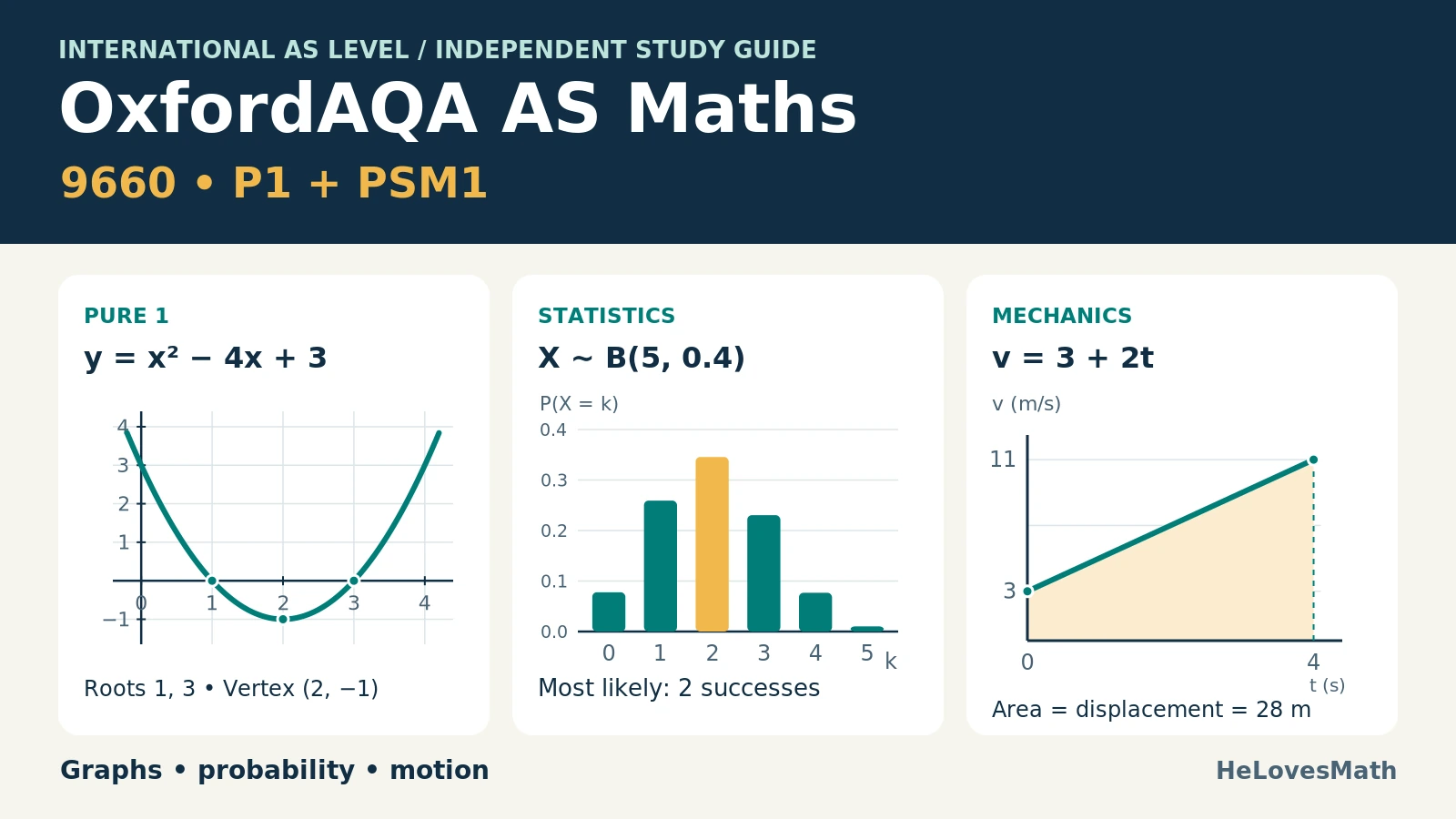
Let y = x² − 4x + 3. Factorising gives y = (x − 1)(x − 3), so the x-intercepts are (1, 0) and (3, 0). Completing the square gives y = (x − 2)² − 1, so the minimum is at (2, −1).
For the tangent at x = 3, differentiate first: dy/dx = 2x − 4. The gradient there is 2, and the point on the curve is (3, 0).
y − 0 = 2(x − 3), so y = 2x − 6.
Check: the tangent and curve both pass through (3, 0). The derivative gives a gradient, not the y-coordinate.

2. A definite integral
Evaluate the integral of 3x² + 2x from x = 0 to x = 2. An antiderivative is x³ + x².
[x³ + x²] from 0 to 2 = (8 + 4) − (0 + 0) = 12.
The integrand is non-negative on this interval, so 12 is also the area between the graph and the x-axis in square coordinate units. In general, a definite integral is signed area; sections below the axis subtract.
3. A circle and a vertical line
The circle (x − 2)² + (y + 1)² = 25 has centre (2, −1) and radius 5. To find intersections with x = 2, substitute that value:
(y + 1)² = 25 → y + 1 = ±5 → y = 4 or −6.
The points are (2, 4) and (2, −6). Keep both square-root branches. The sign inside the bracket is opposite to the coordinate of the centre.
4. A binomial probability
Suppose five independent trials each have success probability 0.4. For X, the number of successes, X follows B(5, 0.4). Find the probability of exactly two successes.
P(X = 2) = C(5, 2) × 0.4² × 0.6³
= 10 × 0.16 × 0.216 = 0.3456.
The factor C(5, 2) counts the ten possible positions of the two successes. This model needs a fixed number of independent trials with the same success probability; it is not automatically appropriate for sampling without replacement.
5. Read acceleration and displacement from a graph
A particle moves in a straight line with initial velocity 3 m/s and constant acceleration 2 m/s² for four seconds. Taking its direction of motion as positive:
v = u + at = 3 + 2 × 4 = 11 m/s
s = ut + ½at² = 3 × 4 + ½ × 2 × 4² = 28 m.
The gradient of the velocity–time line is (11 − 3) ÷ 4 = 2 m/s². Its signed area is ½(3 + 11) × 4 = 28 m. Velocity stays positive, so distance and displacement are equal in this example.

6. Solve a trigonometric equation within an interval
Solve sin θ = ½ for 0 ≤ θ < 2π. The reference angle is π/6. Sine is positive in quadrants I and II, giving:
θ = π/6 or 5π/6.
In degrees these are 30° and 150°, but the requested interval is in radians. An inverse-sine button returns the principal value; it does not list every solution in the interval.
Eight quick diagnostic questions, with worked answers
Try each question before opening its answer. Note whether you can explain the method without a calculator or a worked solution in front of you.
1. Solve x² − 5x + 6 = 0.
Factorise: (x − 2)(x − 3) = 0. A product is zero when at least one factor is zero, so x = 2 or x = 3. Substitution checks both roots.
2. For y = x³ − 3x², find the tangent at x = 2 and classify the stationary point.
dy/dx = 3x² − 6x, which is 0 at x = 2. The curve value is 8 − 12 = −4, so the horizontal tangent is y = −4. The second derivative is 6x − 6 = 6 at x = 2, which is positive: (2, −4) is a local minimum.
3. Integrate 2x + 3 from x = 1 to x = 4.
An antiderivative is x² + 3x. Subtract the lower-limit value from the upper: (16 + 12) − (1 + 3) = 24. Do not forget the lower limit.
4. An arithmetic sequence starts 7, 10, 13, … . Find its tenth term and the sum of its first ten terms.
The common difference is 3. The tenth term is 7 + 9 × 3 = 34. The sum is 10(7 + 34)/2 = 205. There are nine steps from the first term to the tenth.
5. Find the centre and radius of x² + y² − 6x + 4y − 12 = 0.
Complete both squares: (x − 3)² − 9 + (y + 2)² − 4 = 12, hence (x − 3)² + (y + 2)² = 25. The centre is (3, −2) and the radius is 5.
6. If X follows B(4, 0.25), find P(X = 1).
P(X = 1) = C(4, 1) × 0.25 × 0.75³ = 4 × 0.25 × 0.421875 = 0.421875. Exactly one success means three failures as well.
7. A particle has u = 4 m/s and constant a = −2 m/s² for 3 s. Find its final velocity, displacement and distance travelled.
v = 4 − 2 × 3 = −2 m/s; s = 4 × 3 − ½ × 2 × 3² = 3 m. The particle turns at t = 2 s. It travels 4 m forward, then 1 m back, so the distance is 5 m. Displacement keeps direction; distance does not.
8. Solve cos θ = −½ for 0 ≤ θ < 2π.
The reference angle is π/3. Cosine is negative in quadrants II and III, so θ = 2π/3 or 4π/3. Both solutions lie in the stated interval.
Common mistakes worth checking
- Mixing exam boards: OxfordAQA International 9660 is not UK AQA 7356/7357, Edexcel International or Cambridge 9709. Similar topic names do not guarantee the same content or paper structure.
- Treating raw percentages as fixed grades: specimen marks are useful feedback, but a particular raw percentage does not guarantee a grade in a future series. Use the board’s series-specific results information when relevant.
- Only checking final answers: keep exact expressions during working, follow any stated accuracy requirement, and check whether rounding changed a later result.
- Using the wrong angular mode: radians and degrees are different units. Read the interval and set your calculator consistently.
- Confusing distance with displacement: a negative velocity indicates direction, not a negative distance travelled.
Sources & References
Official OxfordAQA materials remain hosted by their publisher. HeLovesMath provides an independent revision guide and does not claim endorsement. All external resources below open in a new tab. Some live-series resources in the official resource finder may require school access.
Original 9660 specimen papers and matching mark schemes
Collection: four PDF links, two complete paper/scheme pairs. The question papers say “Specimen 2018”. The “2017” text in the mark-scheme filenames is a document identifier, not a separate live examination series. Public access was checked on 5 October 2026; availability can change.
PSM1 · MA02: Pure, Statistics and Mechanics
Unit PSM1: Pure, Statistics and Mechanics (QP) — specimen PDFUnit PSM1: Pure, Statistics and Mechanics (MS) — specimen PDFP1 · MA01: Pure Mathematics
Unit P1: Pure Mathematics (QP) — specimen PDFUnit P1: Pure Mathematics (MS) — specimen PDFSpecification, current resources and course transition
Access note (5 October 2026): the 9660 overview and resource finder returned access errors in our direct link check, although their content was available in research. The four specimen PDFs and specification PDF opened successfully. Always check that an additional paper says Mathematics 9660, rather than Further Mathematics 9665.
- OxfordAQA 9660 qualification and assessment overview
- 9660 specification, version 5.2 (PDF)
- Revised 9760 qualification: first teaching and examination dates
- OxfordAQA 9660 mathematical command words (PDF)
- OxfordAQA Mathematics resource finder: exam insert, papers and teaching support
The explanation, diagrams and eight-question diagnostic above are original HeLovesMath teaching material. The linked specimen documents and official guidance belong to OxfordAQA and its licensors.