
Try each part before reading its solution. Questions 1–2 require a graphing calculator in radian mode; Questions 3–4 do not allow a calculator. Write the mathematical setup even when a calculator gives the number. Keep unrounded values in your calculations and give final decimal answers to three places unless the question says otherwise.
This guide covers the single released 2026 Precalculus free-response set linked on AP Central, checked October 11, 2026. It is not a complete exam and contains no unreleased multiple-choice questions. Questions 1–2 form Section II Part A (30 minutes); Questions 3–4 form Part B (30 minutes). Each question is worth 6 points. The explanations are original HeLovesMath work, checked against the official scoring guidelines.
For more practice, try our 2025 AP Precalculus solutions or browse our AP Precalculus past-exam collection.
Function Composition, Logarithms, and Inverses
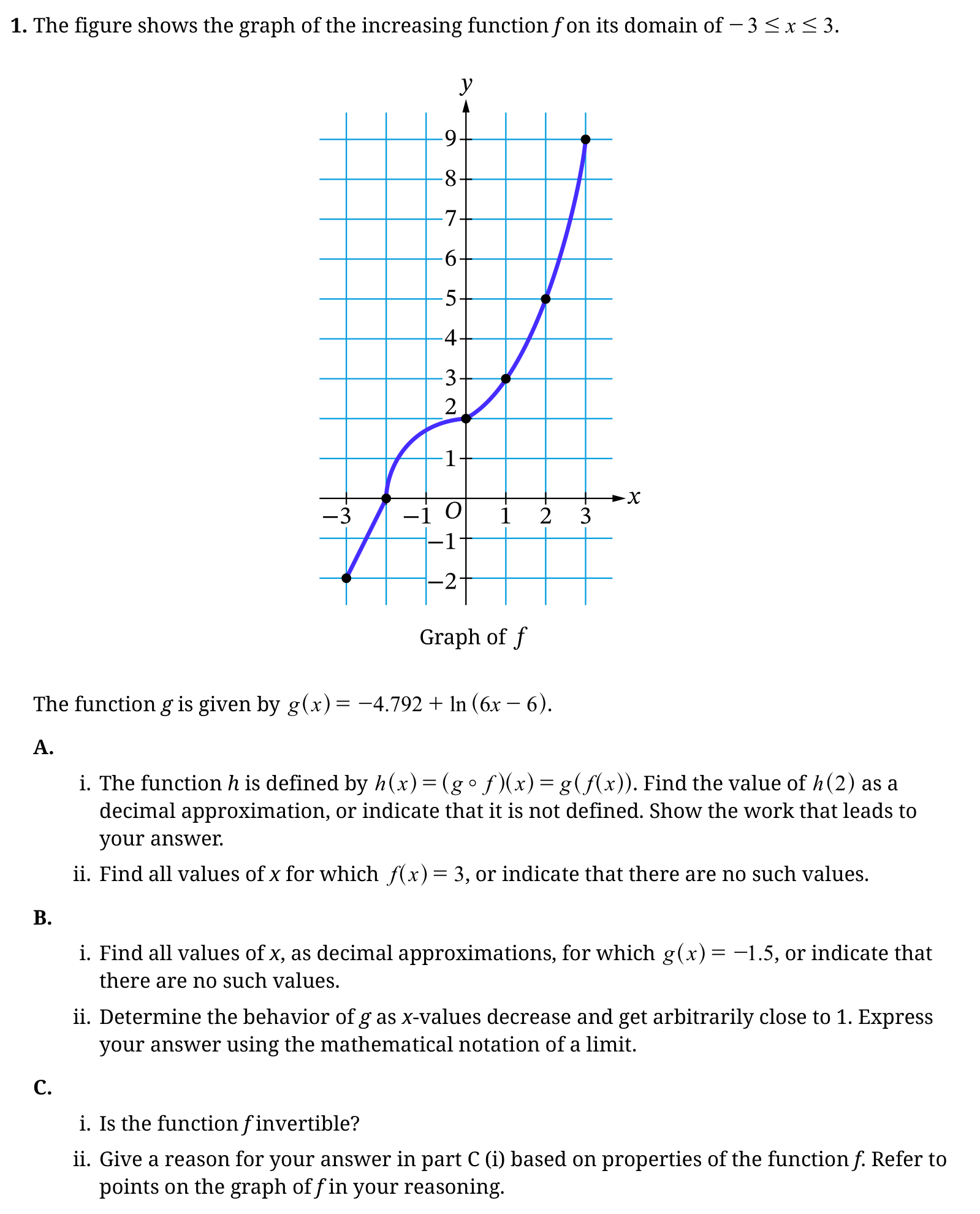
Part A(i)
- Composition means evaluating the inside function first: .
- The plotted point gives , so the input to is 5.
- Substitute into the logarithmic function: .
- The logarithm is defined because its argument is . Evaluating with full precision gives , which rounds to three decimal places.
Credit check: 1 point. Show the graph value or the composition step; the requested supporting work matters.
Part A(ii)
- To solve , find where the graph has vertical coordinate 3.
- The graph contains the point , so the corresponding input is 1.
- The function increases throughout its domain. Therefore, it cannot take the value 3 at a second input.
Credit check: 1 point. Report the input, not the output or a point with the coordinates reversed.
Part B(i)
- First check the logarithm's domain: , so .
- Set the formula equal to the requested output: . Hence .
- Exponentiating gives , so .
- The unrounded result is , which lies in the domain. Since is strictly increasing on , this is its only solution.
Credit check: 1 point. Finish with the requested decimal approximation, not just the exact exponential expression.
Part B(ii)
- The domain is , so inputs decreasing toward 1 approach from the right.
- As , the logarithm's argument satisfies .
- The value of decreases without bound. Subtracting the finite constant 4.792 does not change that behavior.
Credit check: 1 point. Include all four pieces: , , , and .
Part C(i)
- An inverse is a function when each original output corresponds to exactly one original input.
- The given graph increases throughout its domain, so no output occurs at two different inputs.
- Reversing the input-output pairs therefore defines an inverse function.
Credit check: 1 point. State the answer clearly; the detailed graph-based justification belongs in the next part.
Part C(ii)
- For any two graph points and with , the graph's increasing behavior gives .
- For example, the labeled points and exhibit this ordering: the larger input has the larger output. The same strict ordering holds across the entire graph.
- Thus two distinct graph points never share a vertical coordinate. Every output is associated with a unique input, so interchanging the coordinates produces a function.
Credit check: 1 point. Connect the graph points and their output coordinates to invertibility; merely naming the horizontal-line test is insufficient.
Exponential Depreciation and Secant-Line Estimates
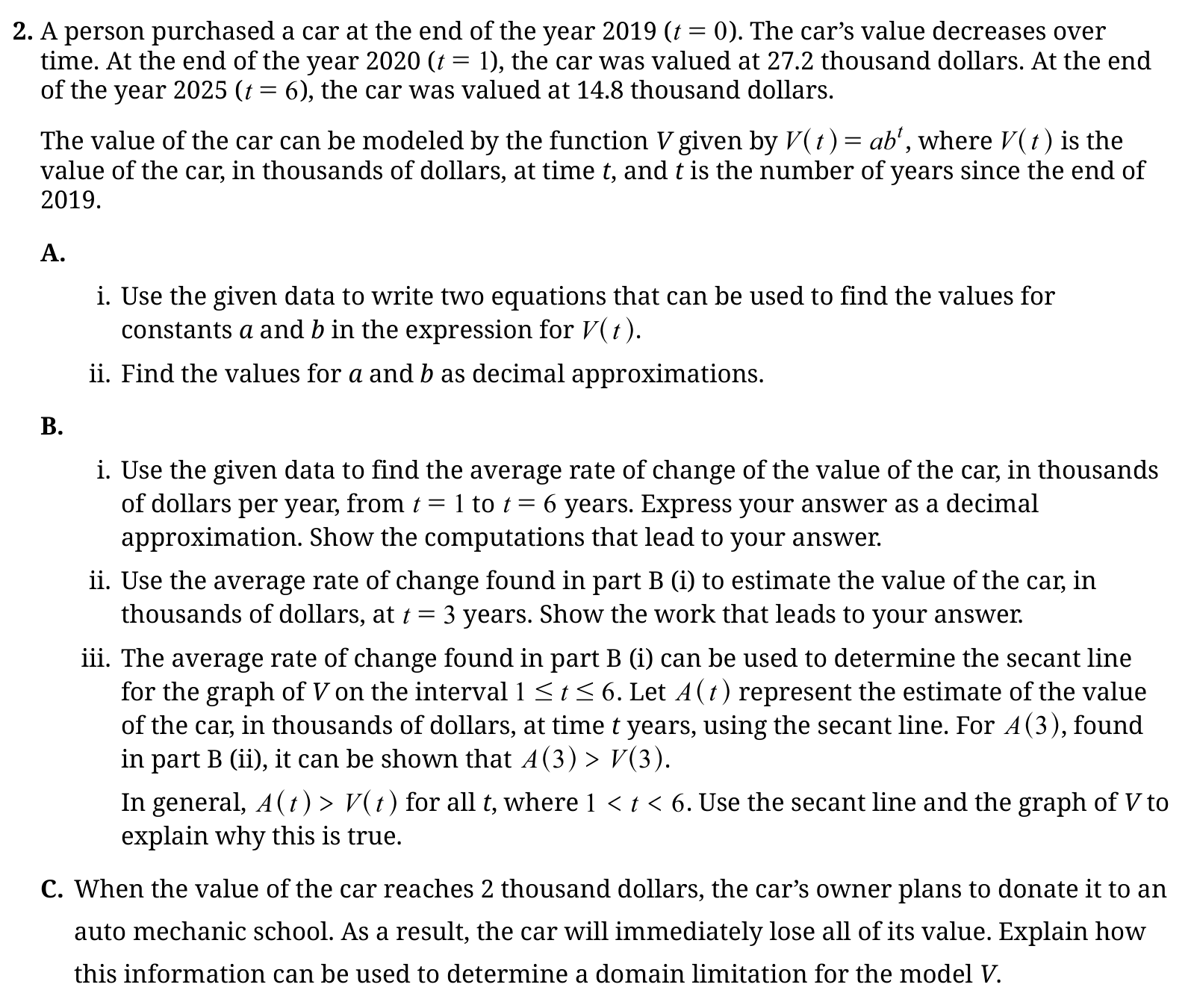
Part A(i)
- The model is , where is measured in thousands of dollars.
- Using the data point gives .
- Using the data point gives .
Credit check: 1 point. Both equations must use the given time-value pairs and the same unit convention.
Part A(ii)
- Divide the second equation by the first to eliminate : , so .
- Take the positive fifth root: .
- From , calculate .
- Round only the reported constants. Retain the unrounded values for later calculations. Equivalently, use , which reproduces both data points exactly.
Credit check: 1 point for both constants. Since , the fitted model correctly describes depreciation.
Part B(i)
- Average rate of change is the change in the car's value divided by the elapsed time.
- Use the given values directly: .
- This simplifies to thousand dollars per year. The negative sign indicates a loss in value.
Credit check: 1 point. Show the quotient. This is an average loss of 2,480 dollars per year over the five-year interval.
Part B(ii)
- Anchor the secant-line estimate at the known point and use slope .
- The line is . From to , exactly two years elapse.
- Therefore, thousand dollars.
Credit check: 1 point. Use the requested average-rate estimate, not the exponential-model value .
Part B(iii)
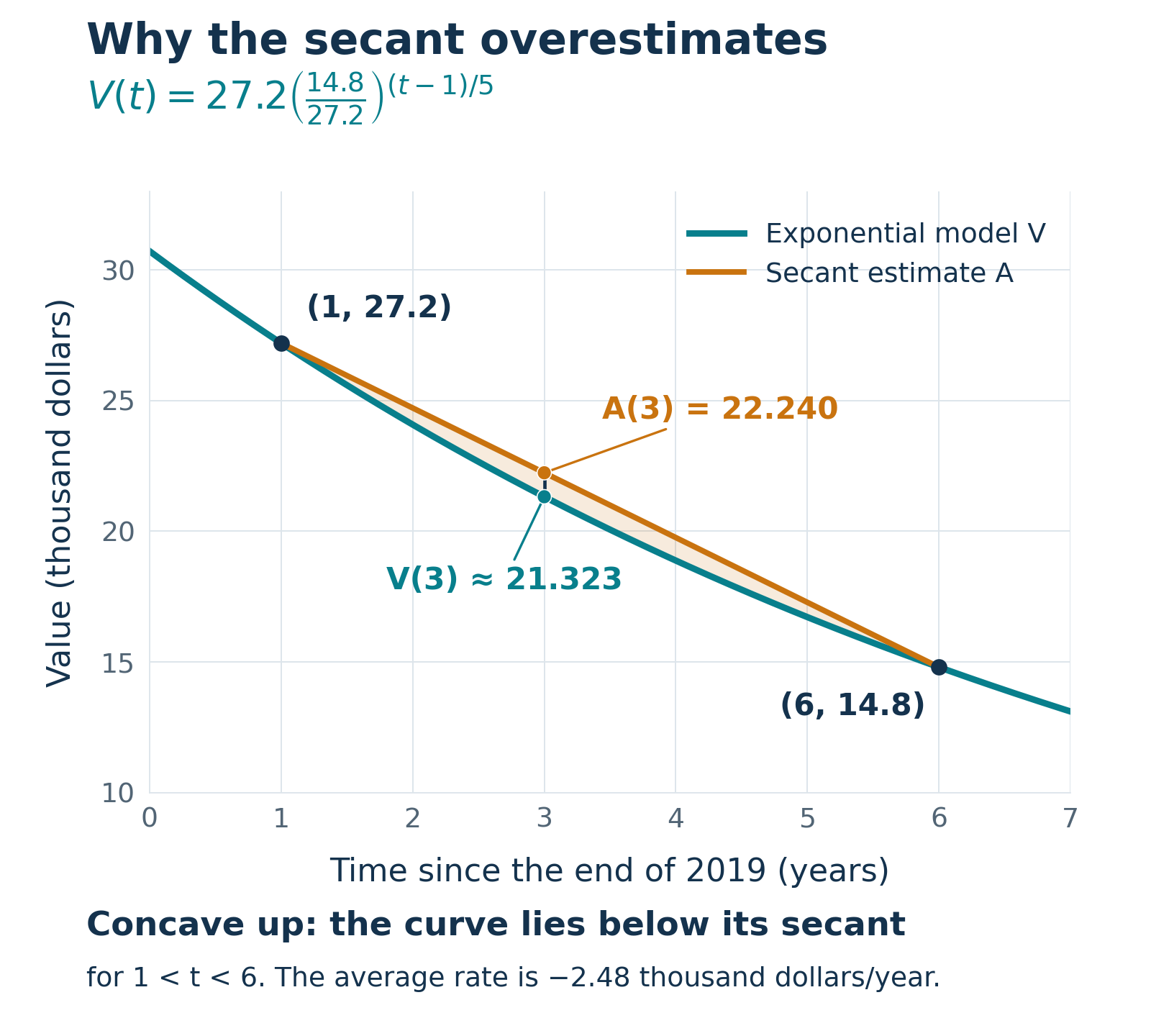
- The graph of this positive exponential-decay model is concave up on : its rate of change becomes less negative over time.
- The secant segment joins and . For a concave-up graph, that segment lies above the curve between its endpoints.
- The segment's output is and the curve's output is , so for every . At and , the values are equal.
Credit check: 1 point. Decreasing values alone do not explain an overestimate; relate concavity to the secant line on the specified interval.
Part C
- Let be the time when the model first reaches 2 thousand dollars. The cutoff is determined by .
- Time starts at purchase, . The depreciation model applies through the donation threshold, giving the contextual domain .
- If a numerical endpoint is desired, use unrounded parameters: years.
- At the threshold the owner donates the car, and its value immediately drops to zero. The positive exponential curve cannot describe the stated value after that transition; the endpoint represents reaching the threshold.
Credit check: 1 point. The official model uses through the threshold event. A correct explanation of the cutoff is sufficient; calculating is optional.
A Sinusoidal Waterwheel Model
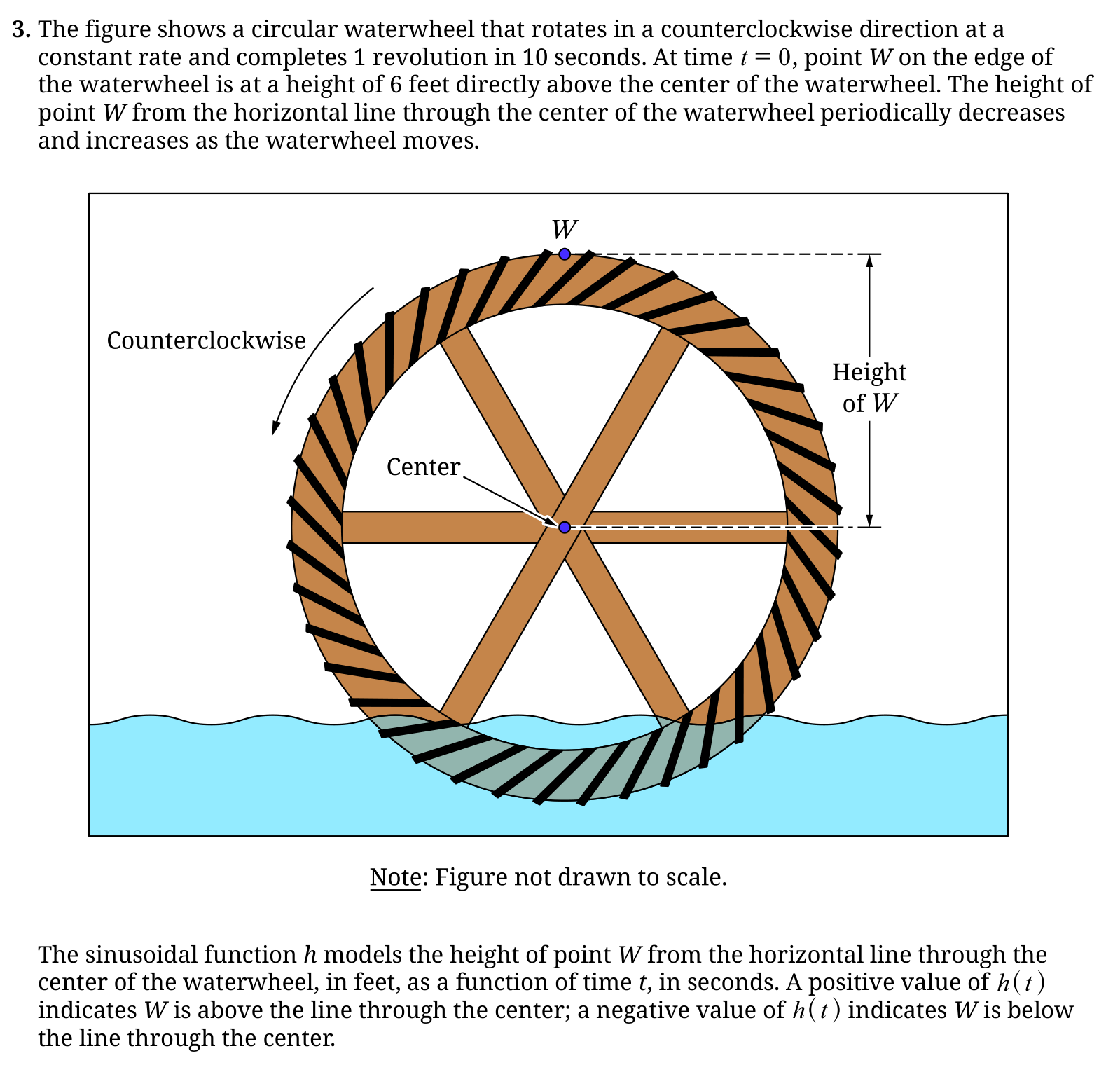
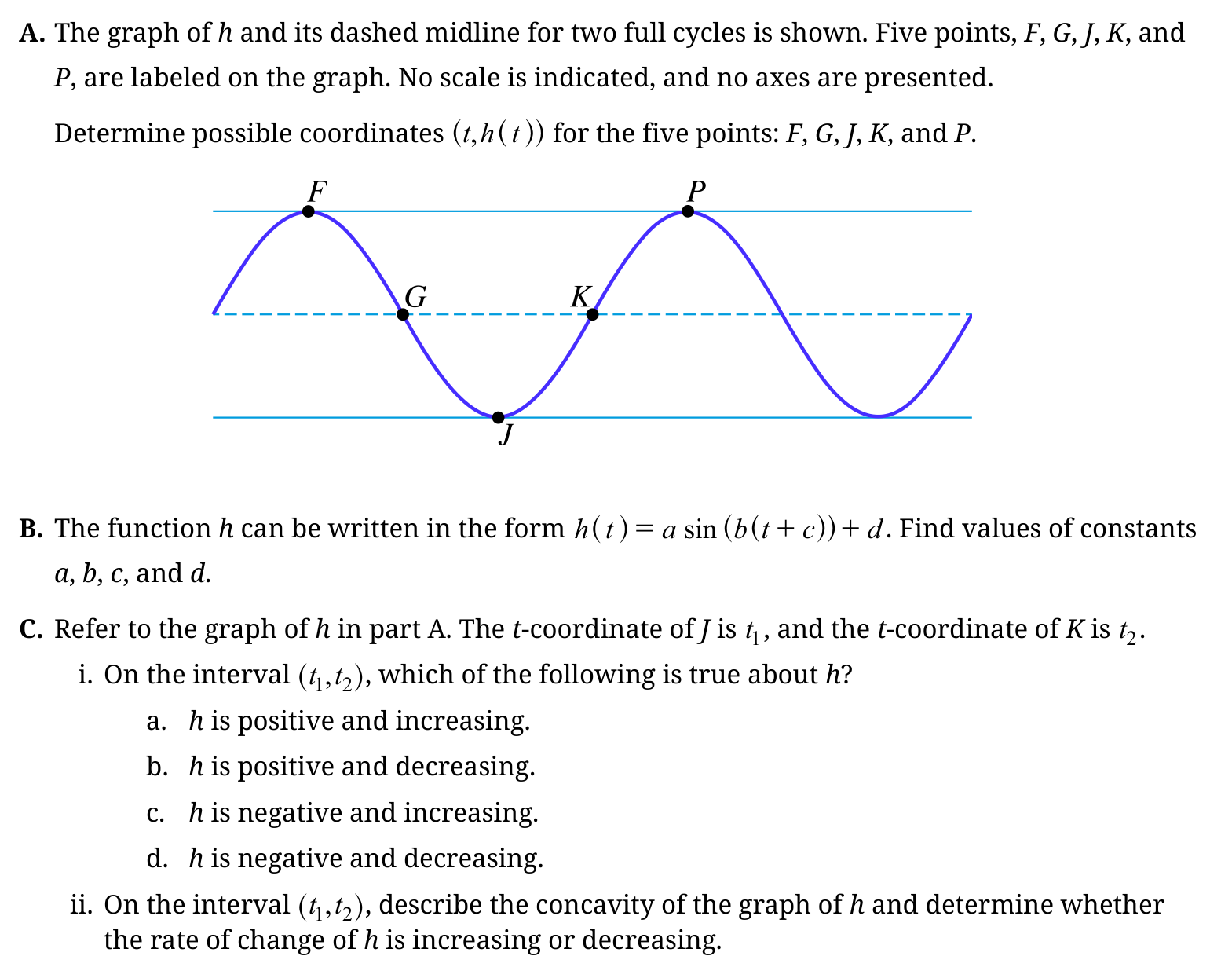
Part A
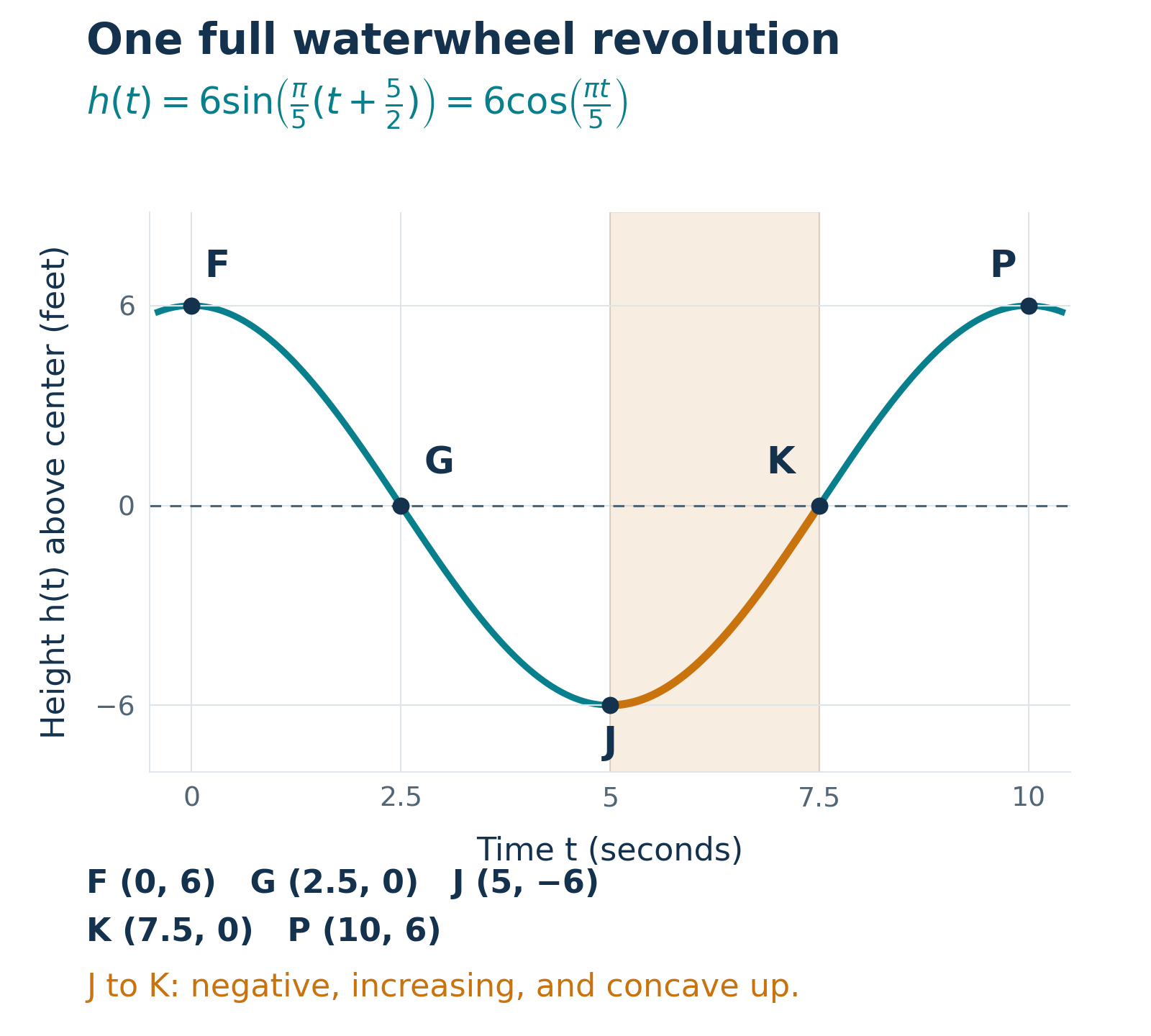
- Height is measured from the wheel's centerline. Thus the midline is 0, the maximum is 6 feet, and the minimum is feet.
- One revolution takes 10 seconds, so consecutive labeled quarter-cycle points are separated by seconds.
- Choose as the initial top position: . After a quarter-turn, the point crosses the centerline downward at .
- After a half-turn it is at the bottom, . After three quarters of a turn it crosses the centerline upward at .
- After a full turn it returns to the top at . Each coordinate pair is ; shifting every time by the same integer multiple of 10 gives another valid cycle.
Credit check: 2 points: one for the five heights, one for the five times. Keep time first and height second.
Part B
- In , choose for the amplitude and for the centerline.
- The period equation is , giving .
- The sine must equal 1 at . Set , which gives .
- The resulting model is . It gives and , matching the top and bottom positions.
Credit check: 2 points: one for and one for . Other phase-equivalent sine models work, but a cosine-only answer does not match the requested form.
Part C(i)
- Point is the minimum and point is the next upward crossing of the centerline.
- Between these points, the graph stays below the midline, so .
- The curve rises throughout the open interval, so is increasing. The zero height at is excluded from the interval.
Credit check: 1 point. Negative describes the position relative to the centerline; increasing describes the direction of change.
Part C(ii)
- From to , the graph bends upward, so it is concave up on .
- Just after the minimum, the upward slope is small; closer to the centerline crossing, the upward slope is steeper.
- The slopes are therefore increasing, meaning the rate of change of is increasing on the interval.
Credit check: 1 point. State both conclusions explicitly; either one alone is incomplete.
Exact Algebraic and Trigonometric Manipulations
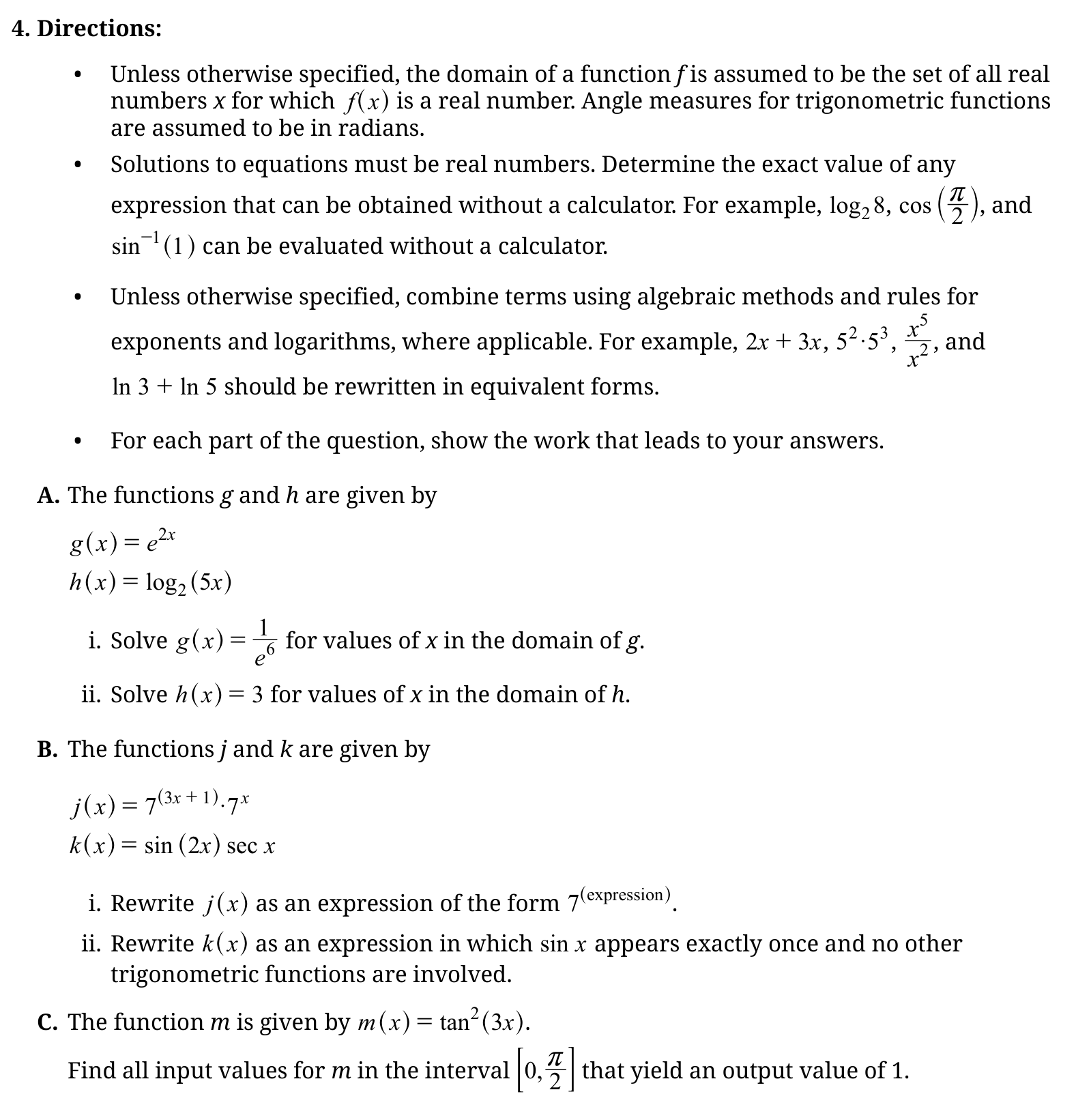
Part A(i)
- Rewrite the reciprocal as a negative power: .
- The equation becomes . Since the exponential is one-to-one, .
- Dividing by 2 gives , which is in the all-real-number domain of .
Credit check: 1 point. Include supporting work and evaluate the exact result rather than leaving an unevaluated logarithm.
Part A(ii)
- The logarithm requires , so the domain is .
- Convert into exponential form: .
- Divide by 5 to obtain . It satisfies , and substitution gives .
Credit check: 1 point. Show the exponential equation and evaluate in the final answer.
Part B(i)
- The factors and have the same base.
- Use the product rule for powers: .
- Combine the like terms in the exponent, .
Credit check: 1 point. Multiplication adds the exponents; it does not multiply them.
Part B(ii)
- Apply the double-angle identity .
- Replace the secant by its reciprocal form: .
- Then , where cancellation is valid because the original domain requires .
- The simplified expression contains exactly once. As an expression for the original function, it retains the excluded inputs for integers .
Credit check: 1 point. Show the identities and cancellation. The domain restriction is not required by the rubric, but simplification does not restore excluded inputs.
Part C
- From , take both square roots: or .
- Transform the interval before listing angles: implies .
- In this angle interval, tangent equals at , , and .
- Divide each by 3 to obtain , , and . Their tangent values are 1, , and 1, so all three give squared value 1.
- The endpoint gives output 0. Tangent is undefined at and , so neither can be added. The three listed values are the complete solution set in the interval.
Credit check: 2 points: one for a correct solution angle or input with work, one for the complete three-value set without extras. Include both signs when taking square roots.
Sources & References
Official question images: © 2026 College Board. Source pages are identified beneath each image. The solutions, explanatory diagrams, and feature artwork are original HeLovesMath materials. AP and Advanced Placement are registered trademarks of College Board. This page is not affiliated with or endorsed by College Board.
- College Board: AP Precalculus past exam questions — the official release index, checked October 11, 2026.
- 2026 AP Precalculus Free-Response Questions — 8-page released question PDF; Questions 1–4 appear on pages 3–4 and 6–8.
- 2026 AP Precalculus Scoring Guidelines — 19-page official rubric used to check every subpart.
At the source check, the 2026 Precalculus index listed one unnumbered free-response set and its scoring guidelines, with no separate 2026 question erratum linked.