
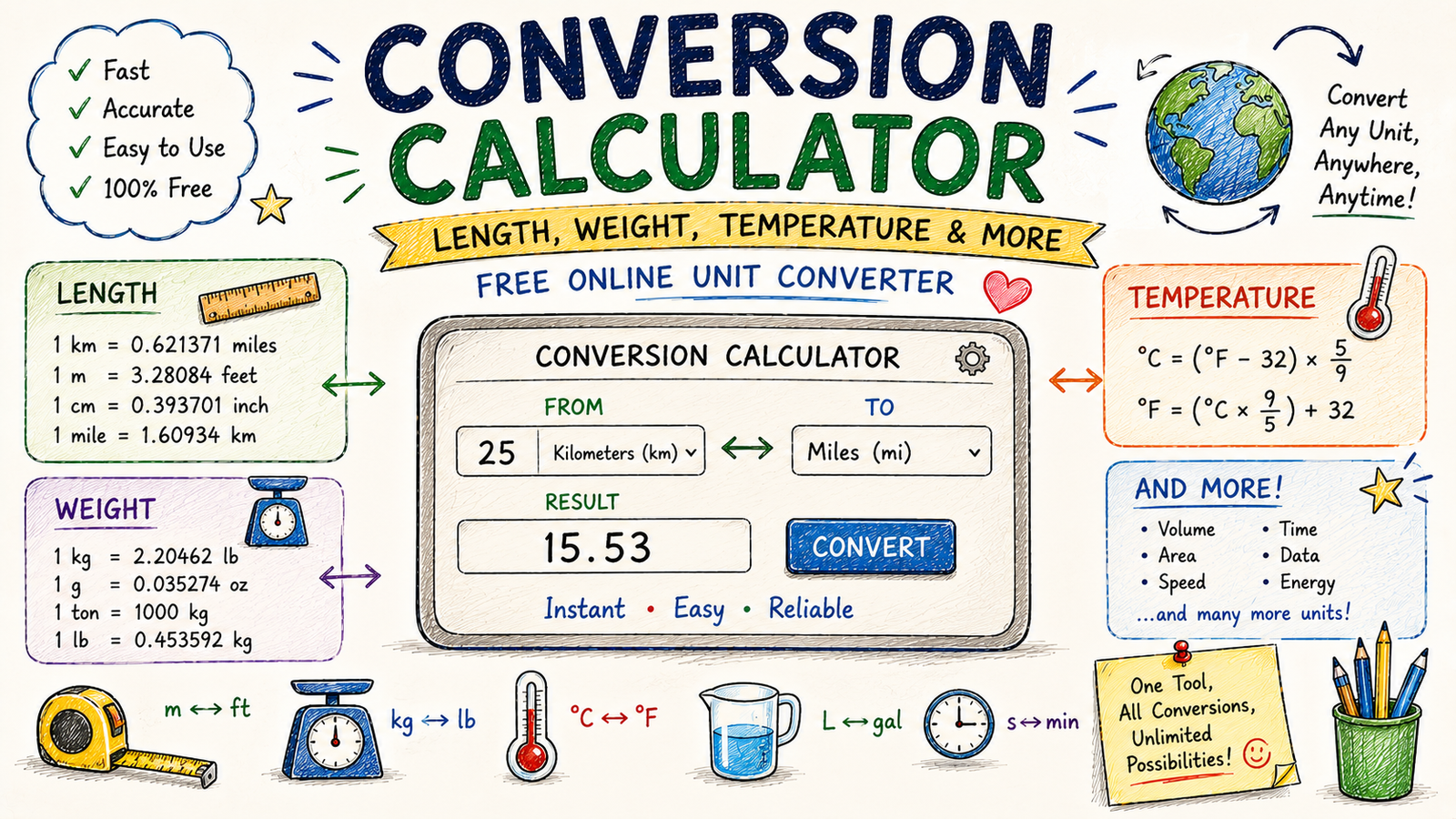
Conversion Calculator
Length · Weight · Temperature · Area · Volume · Speed · Time · Digital Storage — all in one place.
🔄 Universal Unit Converter
Select a category, enter a value, and choose your units
Core Conversion Formulas
Essential Unit Conversion Reference
📏 Length
\(1\text{ km} = 0.621371\text{ mi}\)
\(1\text{ in} = 2.54\text{ cm}\)
⚖️ Weight
\(1\text{ st} = 6.35029\text{ kg}\)
\(1\text{ lb} = 16\text{ oz}\)
🌡️ Temperature
\(°C = (°F - 32) \times \tfrac{5}{9}\)
\(K = °C + 273.15\)
📐 Area
\(1\text{ ha} = 10\,000\text{ m}^2\)
\(1\text{ acre} = 4046.86\text{ m}^2\)
🧪 Volume
\(1\text{ US gal} = 3.78541\text{ L}\)
\(1\text{ fl oz} = 29.5735\text{ mL}\)
⚡ Speed & More
\(1\text{ GB} = 1024\text{ MB}\)
\(1\text{ day} = 86400\text{ s}\)
What Is a Conversion Calculator — and Why Does It Matter?
We live in a world divided by measurement systems. A scientist in Paris publishes results in metres and kilograms. An engineer in Texas works in feet and pounds. A baker in London follows a recipe in cups and ounces. A physicist calculates in Kelvin. A nurse records a patient's temperature in Celsius, while her American colleague uses Fahrenheit. A server administrator thinks in gigabytes and terabytes.
This fragmentation isn't going away. Despite the global adoption of the International System of Units (SI) as the scientific standard, everyday life continues to mix metric and imperial measurements depending on country, profession, age group, and context. The result is a constant, daily need for unit conversion — and a reliable, comprehensive conversion calculator is one of the most practically useful mathematical tools that exists.
Our conversion calculator above handles 8 complete categories: Length, Weight/Mass, Temperature, Area, Volume, Speed, Time, and Digital Storage. Each category covers all the units you're likely to encounter in everyday life, education, science, cooking, travel, fitness, and technology. Below, we explain the mathematics, history, and real-world applications of each category in full detail — over 5,000 words of comprehensive, accurate, up-to-date reference content.
The Mathematics of Unit Conversion
Most unit conversions (except temperature) follow a single mathematical principle: multiplication by a conversion factor. The conversion factor is a ratio that equals 1, because it represents two equal quantities expressed in different units.
The General Conversion Formula
Where each conversion factor expresses the unit in terms of a common base unit.
For example, to convert 5 kilometres to miles, we know that 1 km = 0.621371 miles (or equivalently, 1 mile = 1.60934 km). So:
This technique — multiplying by a conversion factor arranged as a fraction so that unwanted units cancel — is called dimensional analysis or the factor-label method. It is the backbone of all quantitative science and engineering, and is taught in every high school and university physics, chemistry, and engineering curriculum worldwide.
Why Temperature Is Different
Temperature is the only common measurement type where conversion involves both a scale change (multiplication) and a shift (addition or subtraction). This is because Celsius and Fahrenheit have different zero points — 0°C ≠ 0°F. The general form is an affine transformation:
Where \(m\) is the scale factor and \(b\) is the zero-point offset. For °C → °F: \(m = \frac{9}{5}\), \(b = 32\).
Kelvin, however, has the same degree size as Celsius — only the zero point differs. So converting between Celsius and Kelvin requires only addition: \(K = °C + 273.15\). This makes Kelvin a linear (not just affine) scale relative to Celsius — and it's the temperature scale used in all fundamental physics equations.
📏 Length Conversion — A Complete Guide
Length is arguably the most frequently converted measurement. From architecture to athletics, cooking to cosmology, length measurements appear in virtually every human activity. The two dominant systems — the metric system and the imperial/US customary system — coexist globally, making conversion a constant necessity.
The metric system is elegantly decimal: each unit is a power of 10 times the base unit (the metre). The imperial system, by contrast, uses historically-determined ratios: 12 inches = 1 foot, 3 feet = 1 yard, 1760 yards = 1 mile.
The SI Base: The Metre
The metre was originally defined in 1793 as one ten-millionth of the distance from the equator to the North Pole. Since 2019, following the SI redefinition, 1 metre is defined as the distance light travels in a vacuum in exactly \(\frac{1}{299{,}792{,}458}\) of a second — a definition anchored in the fixed value of the speed of light \(c\).
Key Length Conversion Factors
| From | To | Multiply by | Notes |
|---|
Real-World Length References
• A standard door is approximately 2.03 m (6 ft 8 in) tall
• A marathon is exactly 42.195 km (26.219 miles)
• The diameter of a human hair is about 70 micrometres (0.07 mm)
• The distance from Earth to the Moon is about 384,400 km (238,855 miles)
• A light-year is 9.461 × 10¹⁵ metres — the distance light travels in one year
⚖️ Weight (Mass) Conversion — A Complete Guide
Technically, mass and weight are different physical quantities. Mass is the amount of matter in an object (measured in kg) and is constant regardless of location. Weight is the gravitational force acting on that mass (\(W = mg\), where \(g\) is gravitational acceleration, approximately 9.81 m/s² on Earth's surface) and is measured in Newtons. However, in everyday usage, "weight" almost always means mass, and bathroom scales display mass (in kg or lbs) rather than force. Throughout this section we use "weight" in the everyday sense.
The SI Base: The Kilogram
Since May 20, 2019, the kilogram is defined by fixing the numerical value of Planck's constant:
The 1 pound is defined as exactly 0.45359237 kg (International Yard and Pound Agreement, 1959). Therefore: \(1 \text{ kg} = 2.204622622... \text{ lbs}\).
| From | To | Multiply by | Notes |
|---|
🌡️ Temperature Conversion — A Complete Guide
Temperature is unique among measurement categories because its scales have different zero points and different degree sizes (except Celsius and Kelvin, which share the same degree size). The three scales in common use are:
• Celsius (°C) — Freezing at 0°, boiling at 100°. Used in ~195 countries for weather, cooking, medicine.
• Fahrenheit (°F) — Freezing at 32°, boiling at 212°. Used primarily in the USA and a few territories.
• Kelvin (K) — Absolute zero at 0 K (−273.15°C). The SI base unit, used in all scientific and thermodynamic calculations. No negative values possible.
All Six Temperature Conversion Formulas
\[°F = \frac{9}{5} \cdot °C + 32 \qquad °C = \frac{5}{9}(°F - 32)\] \[K = °C + 273.15 \qquad °C = K - 273.15\] \[K = \frac{5}{9}(°F + 459.67) \qquad °F = \frac{9}{5}K - 459.67\]The Special Point: −40° Where F = C
There is exactly one temperature where Fahrenheit and Celsius give the same reading. Setting °F = °C = x and solving:
∴ −40°C = −40°F (the unique intersection of both scales)
📐 Area Conversion — A Complete Guide
Area measures the two-dimensional extent of a surface. Since area is derived from length squared, its conversion factors are the squares of the corresponding length conversion factors. This is a common source of confusion — students often forget that converting square units requires squaring the linear conversion factor.
Two special non-SI area units are widely used in agriculture and land measurement: the hectare (ha = 10,000 m²) and the acre (1 acre = 4,046.86 m² = 43,560 ft²). The hectare is the standard unit for farmland measurement in most countries, while the acre remains common in the UK, USA, and Canada for real estate.
• An A4 sheet of paper = 0.0623 m² (623 cm²)
• A football pitch ≈ 7,140 m² (1.76 acres / 0.714 ha)
• Central Park, New York = 341 hectares (843 acres)
• The total land surface of Earth = 149 million km²
🧪 Volume Conversion — A Complete Guide
Volume measures three-dimensional space. Like area, derived metric volume units follow cubic scaling from length units. The litre — the most practical unit for everyday liquid measurement — is defined as exactly 1 cubic decimetre (1 dm³ = 0.001 m³).
A major source of confusion in volume conversion is the existence of two different gallons: the US liquid gallon (3.78541 L) and the UK imperial gallon (4.54609 L). They differ by about 20%, which can lead to significant errors in cooking, fuel consumption, and industrial applications. Always verify which gallon is being used in any recipe or specification.
| Unit | Litres | Context |
|---|
🚀 Speed Conversion — A Complete Guide
Speed is a derived unit — distance divided by time. The SI unit is metres per second (m/s), but km/h (kilometres per hour) and mph (miles per hour) are the most common units in everyday transport contexts. Aviation and maritime navigation use knots (nautical miles per hour), where 1 nautical mile = 1,852 metres exactly.
• Usain Bolt's world record 100m speed: 10.44 m/s = 37.6 km/h = 23.4 mph
• UK motorway speed limit: 70 mph = 112.65 km/h = 31.3 m/s
• Speed of sound (sea level, 20°C): 343 m/s = 1,235 km/h = 667 knots
• Speed of light: 299,792,458 m/s ≈ 1,079,252,849 km/h
⏱️ Time Conversion — A Complete Guide
The second (s) is the SI base unit of time. It is defined by the cesium-133 atom: 1 second = the duration of exactly 9,192,631,770 periods of radiation corresponding to the transition between two hyperfine levels of the ground state of the cesium-133 atom. This atomic definition gives accuracy of about 1 second in 300 million years.
Time conversion is straightforward — all relationships are exact integers or simple fractions — except for months and years, which have variable lengths. A calendar year can be 365 or 366 days; a month can be 28, 29, 30, or 31 days. Our calculator uses standard average values (1 month ≈ 30.4375 days, 1 year = 365.25 days) for these conversions.
💾 Digital Storage Conversion — A Complete Guide
Digital data is measured in bits and bytes. A bit is the smallest unit of digital information — a 0 or a 1. A byte consists of 8 bits. From here, a naming confusion arises from the coexistence of two prefix systems:
| SI Decimal Prefix | Value (bytes) | Binary Prefix (IEC) | Value (bytes) |
|---|---|---|---|
| Kilobyte (KB) | 1,000 | Kibibyte (KiB) | 1,024 |
| Megabyte (MB) | 1,000,000 | Mebibyte (MiB) | 1,048,576 |
| Gigabyte (GB) | 1,000,000,000 | Gibibyte (GiB) | 1,073,741,824 |
| Terabyte (TB) | 10¹² | Tebibyte (TiB) | 2⁴⁰ = 1,099,511,627,776 |
Hard drive manufacturers use the SI decimal system (1 GB = 10⁹ bytes), while operating systems traditionally use binary (1 GB = 2³⁰ = 1,073,741,824 bytes). This is why a hard drive marketed as "1 TB" shows as approximately 931 GB in Windows — the OS is using binary gigabytes while the drive is measured in decimal. Our calculator uses the widely-adopted base-1024 system consistent with how most operating systems report storage.
The International System of Units (SI) — A Brief History
The International System of Units (SI), from the French Système International d'Unités, is the modern form of the metric system and the world's most widely used system of measurement. It was established by the 11th General Conference on Weights and Measures (CGPM) in 1960 and has been continuously refined since then.
The SI is built on 7 base units, each measuring a fundamentally independent physical quantity. All other units are derived from these 7:
| Quantity | SI Unit | Symbol | Defined by (since 2019) |
|---|---|---|---|
| Length | Metre | m | Fixed value of speed of light \(c\) |
| Mass | Kilogram | kg | Fixed value of Planck's constant \(h\) |
| Time | Second | s | Fixed value of Cs-133 hyperfine transition \(\Delta\nu\) |
| Electric current | Ampere | A | Fixed value of elementary charge \(e\) |
| Temperature | Kelvin | K | Fixed value of Boltzmann's constant \(k\) |
| Amount of substance | Mole | mol | Fixed value of Avogadro's constant \(N_A\) |
| Luminous intensity | Candela | cd | Fixed value of luminous efficacy \(K_{cd}\) |
The groundbreaking 2019 SI redefinition was a watershed moment in measurement science. For the first time in history, all base units are defined in terms of fundamental physical constants of nature — not physical artefacts or arbitrary reference objects. This means the definitions are stable forever, reproducible anywhere in the universe, and immune to physical changes over time.
Unit Conversion in Mathematics Education
Unit conversion is a core topic across all levels of mathematics and science education:
Primary & Key Stage 2: Metric Prefixes and Basic Conversion
Students learn that 1 km = 1000 m, 1 kg = 1000 g, 1 L = 1000 mL. This introduces the decimal nature of the metric system and the concept of multiplication and division by powers of 10.
GCSE / Key Stage 4: Cross-System Conversion and Ratio
Students convert between metric and imperial units (km ↔ miles, kg ↔ lbs, L ↔ pints), apply conversion factors as multiplications, and use ratio and proportion. AQA, Edexcel, and OCR GCSE Mathematics all include unit conversion questions.
A-Level and University: Dimensional Analysis
Advanced students use dimensional analysis to check the correctness of equations (an equation is only physically valid if the dimensions balance), derive conversion factors between complex derived units, and perform calculations across SI and non-SI systems in physics, chemistry, and engineering.
The Dimensional Analysis Method — A Worked Example
Convert 60 miles per hour to metres per second:
📝 Pro Tips for Students & Professionals
Master these principles and you'll never make a conversion error:
✅ Always write out units and cancel them like fractions
If the unit doesn't cancel correctly in dimensional analysis, your conversion is wrong.
✅ Remember: area = length², volume = length³
If 1 m = 100 cm, then 1 m² = 10,000 cm² (not 100!), and 1 m³ = 1,000,000 cm³. Square and cube the linear factor.
✅ Temperature: multiply AND add/subtract — in the right order
°C→°F: multiply first (×1.8), then add 32. °F→°C: subtract 32 first, then multiply (×5/9). Order matters!
✅ Sanity-check your result with known anchor points
1 mile ≈ 1.6 km. 1 kg ≈ 2.2 lbs. 0°C = 32°F. Body temp = 37°C = 98.6°F. If your result is wildly off these landmarks, recheck your work.
Frequently Asked Questions
🌿 Brought to you by HeLovesMath.com
Your trusted resource for math tools, calculators, and step-by-step guides.