
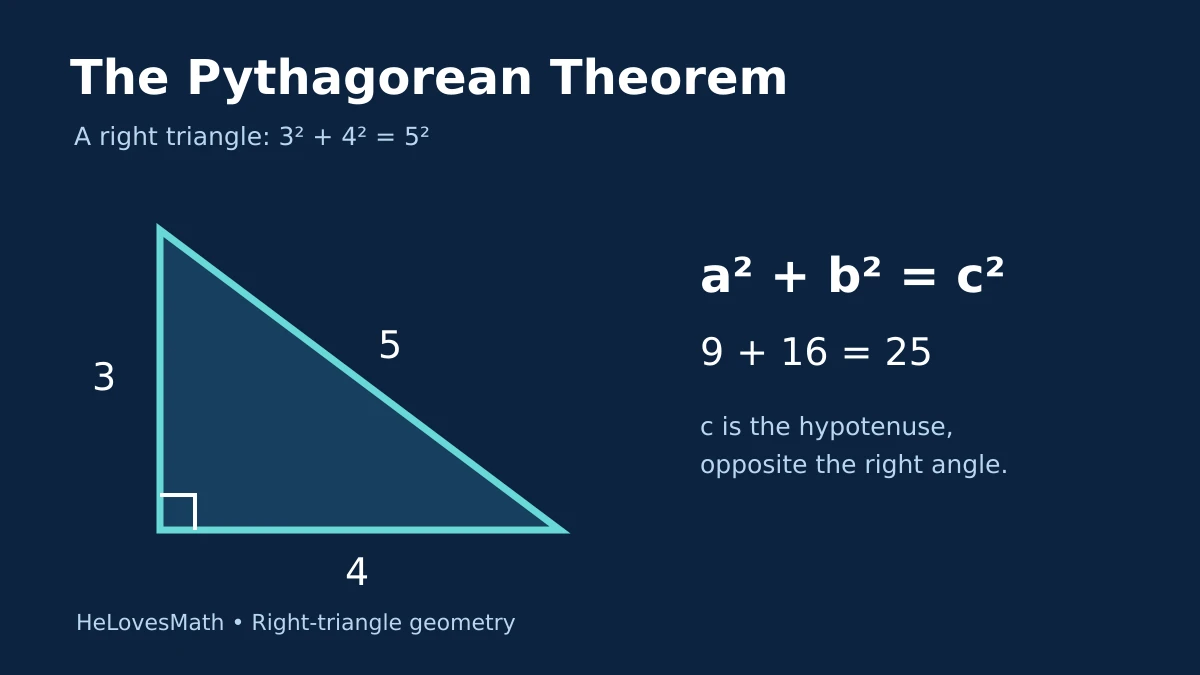
Pythagorean Theorem Interactive Explorer
Side a = 3
Side b = 4
Side c (hypotenuse) = 5
a² + b² = 25
c² = 25
Challenge: Find values of a and b that make c = 5
The Pythagorean Theorem: a² + b² = c²
In a right triangle, the square of the length of the hypotenuse (c) equals the sum of the squares of the other two sides (a and b).
Use the sliders to adjust sides a and b and see how it affects the hypotenuse c. The formula is always true for right triangles!
Try Challenge Mode to test your understanding by finding specific values that produce target hypotenuse lengths.
The Pythagorean Theorem Formula: Understanding and Applying the Mathematical Cornerstone
Introduction
Have you ever wondered how architects design stable structures, how GPS systems calculate distances, or how your smartphone’s compass works? Behind these everyday marvels lies one of mathematics’ most elegant and powerful formulas: the Pythagorean theorem. This seemingly simple equation—a² + b² = c²—has shaped our understanding of space and revolutionized fields from navigation to quantum physics.
Understanding why the formula works connects a routine side-length calculation to geometric reasoning.
In this comprehensive guide, you’ll discover not just how to apply the Pythagorean theorem formula correctly, but also its fascinating history, real-world applications, common pitfalls, and its connections to advanced mathematics. Whether you’re a student tackling geometry for the first time, a professional needing to refresh your knowledge, or simply a curious mind, this exploration will transform how you view this mathematical cornerstone.
Table of Contents
- What Is the Pythagorean Theorem Formula?
- The Historical Journey: From Ancient Civilizations to Pythagoras
- Breaking Down the Formula: Understanding a², b², and c²
- Proving the Pythagorean Theorem: Four Elegant Approaches
- Pythagorean Triples: When the Formula Yields Whole Numbers
- Real-World Applications Across Different Fields
- Step-by-Step Guide to Solving Pythagorean Problems
- Common Mistakes and How to Avoid Them
- Beyond Right Triangles: Extensions of the Theorem
- Interactive Examples and Practice Problems
- FAQs About the Pythagorean Theorem Formula
What Is the Pythagorean Theorem Formula?
The Basic Definition
The Pythagorean theorem formula states that in any right triangle in Euclidean geometry, the square of the length of the hypotenuse (the side opposite the right angle) equals the sum of squares of the other two sides (the legs).
Expressed mathematically: a² + b² = c²
Where:
- a and b are the lengths of the legs (the sides that form the right angle)
- c is the length of the hypotenuse (the longest side, opposite the right angle)
This elegantly simple equation only works for right triangles—those containing exactly one 90-degree angle. The formula completely breaks down for any other type of triangle, which is part of what makes it so special and precise.
Why It’s Fundamental
The Pythagorean theorem is considered a cornerstone of mathematics for several reasons:
- It bridges algebra and geometry: The formula connects numerical relationships (algebra) with spatial relationships (geometry)
- It enables distance calculation: The theorem provides the foundation for calculating distances between points in coordinate systems
- It extends to higher dimensions: The principle generalizes to three-dimensional space and beyond
- It’s universally applicable: The relationship holds true regardless of the size of the right triangle or the units used
Understanding this formula helps connect abstract algebra to measurable distances.
The Historical Journey: From Ancient Civilizations to Pythagoras
Ancient Origins Before Pythagoras
The Old Babylonian tablet YBC 7289, now held at Yale, records an accurate approximation to √2 beside a square-and-diagonals diagram. This is evidence of mathematical knowledge that predates Pythagoras.
Pythagoras and His School
The theorem is traditionally associated with Pythagoras, but its name should not be treated as proof that he first discovered the relationship or supplied its first proof. The surviving historical evidence does not establish that attribution.
Evolution Through Mathematical History
Euclid’s Elements, Book I, Proposition 47, gives a geometric proof. Many different proofs have since been developed, including Garfield’s trapezoid argument. The mathematical result and a historical claim about its discovery are different questions: the result can be proved directly, while historical attribution depends on surviving evidence.
Breaking Down the Formula: Understanding a², b², and c²
Geometric Interpretation
The equation a² + b² = c² has a beautiful geometric interpretation. Each term represents an area:
- a² is the area of a square with side length a
- b² is the area of a square with side length b
- c² is the area of a square with side length c
This means the Pythagorean theorem can be visualized as: “The sum of the areas of squares built on the two legs equals the area of the square built on the hypotenuse.”
Building a square on each side of a right triangle is a useful visual demonstration of the area relationship.
Understanding Square Roots in the Formula
When solving for a side length, we often need to take the square root of a value. For example, to find the hypotenuse length:
c = √(a² + b²)
This operation often introduces irrational numbers—numbers that cannot be expressed as a ratio of two integers and have decimal expansions that continue infinitely without repeating patterns.
For instance, in a right triangle with legs of length 1, the hypotenuse equals √2 ≈ 1.414213… This irrational value cannot be expressed exactly as a ratio of two integers.
Proving the Pythagorean Theorem: Four Elegant Approaches
Hundreds of proofs exist for the Pythagorean theorem, ranging from simple to highly complex. Here are four elegant approaches that showcase different mathematical perspectives:
1. Euclid’s Proof: The Classical Approach
Euclid’s proof from “Elements” (Proposition 47, Book I) involves constructing squares on each side of a right triangle and showing through a series of equal areas that the square on the hypotenuse equals the sum of the squares on the other sides.
2. Algebraic Proof: Using Similar Triangles
By drawing an altitude from the right angle to the hypotenuse, we create three similar triangles. Using the properties of similar triangles:
- The original triangle is similar to the two smaller triangles
- This similarity establishes proportional relationships between sides
- If the altitude divides c into segments p and q adjacent to legs a and b respectively, similarity gives a² = cp and b² = cq. Since p+q = c, adding gives a²+b² = c(p+q) = c²
3. President Garfield’s Trapezoid Proof
In 1876, James A. Garfield published a proof using the area of a trapezoid. Take a right triangle with positive legs a and b and hypotenuse c.
- Arrange two congruent copies so that the trapezoid has parallel sides a and b and perpendicular height a+b.
- The remaining region is a third triangle with two sides of length c. The angle between those sides is 90°, because the two acute angles of the original triangle add to 90°.
- The trapezoid area is (a+b)(a+b)/2 = (a+b)²/2.
- The three triangle areas add to ab/2 + ab/2 + c²/2 = ab + c²/2.
- Equate the areas: (a+b)²/2 = ab + c²/2. Multiply by 2: a²+2ab+b² = 2ab+c².
- Subtract 2ab from both sides to obtain a²+b² = c².
4. Dynamic Proof: Using Transformation
This area proof uses four congruent copies of the right triangle inside a square of side a+b:
- Place one right triangle at each corner of the outer square, with their hypotenuses forming the boundary of the central region.
- The central region is a square of side c: its sides are equal hypotenuses, and each interior angle is 180° minus the two complementary acute angles, hence 90°.
- The outer square consists of four triangles and the central square, so (a+b)² = 4(ab/2)+c².
- Expand and simplify: a²+2ab+b² = 2ab+c².
- Subtract 2ab to obtain a²+b² = c².
Pythagorean Triples: When the Formula Yields Whole Numbers
What Are Pythagorean Triples?
Pythagorean triples are sets of three positive integers that satisfy the Pythagorean equation. The most well-known example is (3, 4, 5), since: 3² + 4² = 5², because 9 + 16 = 25
Other common Pythagorean triples include:
- (5, 12, 13): 5² + 12² = 13² or 25 + 144 = 169
- (8, 15, 17): 8² + 15² = 17² or 64 + 225 = 289
- (7, 24, 25): 7² + 24² = 25² or 49 + 576 = 625
Generating All Pythagorean Triples
Set a = m² – n², b = 2mn, and c = m² + n². These values
form a Pythagorean triple for positive integers m > n. The triple is primitive (its sides have no common factor greater than 1) exactly when m and n are coprime and have opposite parity: one is even and the other is odd. Every primitive triple is obtained this way, allowing the two legs to exchange places. Multiplying a primitive triple by an integer greater than 1 produces a nonprimitive triple. For example, m=2 and n=1 give (3,4,5); multiplying by 2 gives (6,8,10).
Practical Applications of Pythagorean Triples
Pythagorean triples have practical applications in construction and design:
- Creating perfect right angles: The 3-4-5 triple is commonly used by builders to ensure corners are exactly 90 degrees
- Computer graphics: Triples help in creating grid-aligned slopes with exact integer coordinates
- Avoiding rounding errors: Using triples eliminates approximation errors in certain calculations
Builders can use a 3-4-5 triangle to check that a corner is square.
Real-World Applications Across Different Fields
The Pythagorean theorem extends far beyond classroom exercises, serving as a foundational tool in numerous fields:
Architecture and Construction
- Ensuring structural stability: Calculating diagonal bracing lengths for buildings
- Roof design: Determining rafter lengths and roof pitches
- Stair building: Calculating stringer lengths based on rise and run
Navigation and Travel
- Aviation: Estimating local straight-line distances in a flat coordinate model; long routes on Earth require spherical or ellipsoidal geometry
- Marine navigation: Estimating short local distances on a flat chart, with curvature and actual routes considered separately
- GPS systems: Computing Euclidean distances between Cartesian coordinates as one part of a positioning model
Computer Science and Technology
- Computer graphics: Calculating distances in 2D and 3D rendering
- Machine learning: Used in distance metrics for clustering algorithms
- Video game development: Collision detection and movement physics
Scientific Applications
- Physics: Vector component analysis and force calculations
- Astronomy: Calculating celestial distances and positions
- Engineering: Stress analysis in structures and materials
In video games, Euclidean distance calculations help measure separation between objects and analyze movement.
Step-by-Step Guide to Solving Pythagorean Problems
Finding the Hypotenuse
When you know the lengths of both legs (a and b) and need to find the hypotenuse (c):
- Identify the two legs of the right triangle
- Square each leg length
- Add the squared values
- Take the square root of the sum
Example: Find the hypotenuse of a right triangle with legs measuring 5 cm and 12 cm.
- a = 5 cm, b = 12 cm
- a² = 25 cm², b² = 144 cm²
- a² + b² = 25 cm² + 144 cm² = 169 cm²
- c = √(169 cm²) = 13 cm
Finding a Leg
When you know the hypotenuse (c) and one leg (a) and need to find the other leg (b):
- Square the hypotenuse
- Square the known leg
- Subtract the squared leg from the squared hypotenuse
- Take the square root of the difference
Example: Find the unknown leg of a right triangle with hypotenuse 17 cm and one leg measuring 8 cm.
- c = 17 cm, a = 8 cm
- c² = 289 cm², a² = 64 cm²
- b² = c² – a² = 289 cm² – 64 cm² = 225 cm²
- b = √(225 cm²) = 15 cm
Working with Variables and Expressions
Sometimes you’ll need to apply the theorem with algebraic expressions rather than numeric values:
Example: If the legs of a right triangle are represented by (x+2) and (x-2), express the hypotenuse in terms of x.
- a = (x+2), b = (x-2), with x > 2 so both side lengths are positive
- c² = a² + b² = (x+2)² + (x-2)²
- c² = (x² + 4x + 4) + (x² – 4x + 4)
- c² = 2x² + 8
- c = √(2x² + 8)
Using the Theorem in Coordinate Geometry
To find the distance between two points (x₁, y₁) and (x₂, y₂) in a coordinate plane:
- Calculate the horizontal distance: a = |x₂ – x₁|
- Calculate the vertical distance: b = |y₂ – y₁|
- Apply the Pythagorean theorem: d = √[(x₂ – x₁)² + (y₂ – y₁)²]
This formula is the foundation of the distance formula used throughout coordinate geometry.
Common Mistakes and How to Avoid Them
Several common mistakes can arise when applying the theorem:
Mistake 1: Applying the Theorem to Non-Right Triangles
The issue: The Pythagorean theorem only works for right triangles. For other triangles, different formulas apply (like the law of cosines).
Solution: Always verify that the triangle contains a 90° angle before applying the theorem. If no right angle exists, use alternative approaches like the law of cosines: c² = a² + b² – 2ab×cos(C).
Mistake 2: Mixing Up the Sides
The issue: Confusing which side is the hypotenuse (c) and which are the legs (a and b).
Solution: Remember that the hypotenuse is always the longest side and is always opposite the right angle. The legs are the sides that form the right angle.
Mistake 3: Forgetting to Square Root for Final Answer
The issue: Many students calculate c² correctly but forget to take the square root to find c.
Solution: Review your final answer by asking: “Did I solve for the side length or for the square of the side length?” If you need the actual length, don’t forget the square root.
Mistake 4: Unit Errors
The issue: Not maintaining consistent units throughout the calculation.
Solution: Convert all measurements to the same unit before applying the theorem, and ensure your answer includes the appropriate unit.
Mistake 5: Rounding Too Early
The issue: Rounding intermediate values leads to accumulated errors in the final answer.
Solution: Keep exact values (like √2) or use additional decimal places for intermediate steps, only rounding the final answer to the requested precision.
An isosceles triangle can also be right: for example, a 45°–45°–90° triangle. Equal legs alone do not establish a right angle; check the angle condition before using the theorem.
Beyond Right Triangles: Extensions of the Theorem
The Pythagorean relationship extends beyond its basic form in several fascinating ways:
The Law of Cosines: Pythagorean Theorem Generalized
For any Euclidean triangle, with C the angle between sides a and b and opposite side c, the law of cosines is: c² = a² + b² – 2ab×cos(C)
Notice that when C = 90° (a right angle), cos(90°) = 0, and the formula reduces to our familiar a² + b² = c².
The Distance Formula in Three Dimensions
The Pythagorean theorem extends naturally to three-dimensional space. The distance between points (x₁, y₁, z₁) and (x₂, y₂, z₂) is: d = √[(x₂ – x₁)² + (y₂ – y₁)² + (z₂ – z₁)²]
This is simply the Pythagorean theorem applied twice—once to find the horizontal distance, and again to find the spatial distance.
The Theorem in n-Dimensional Space
In n-dimensional Euclidean space, the distance between two points is: d = √[(x₁ – y₁)² + (x₂ – y₂)² + … + (xₙ – yₙ)²]
This fundamental extension enables calculations in higher-dimensional mathematics, including computer science applications like machine learning that work with high-dimensional data points.
The Pythagorean Identity in Trigonometry
The relationship sin²θ + cos²θ = 1 is called the Pythagorean identity because it can be derived from the Pythagorean theorem applied to a right triangle with hypotenuse 1.
These extensions connect elementary geometry to coordinate-based models used in engineering and computing.
Interactive Examples and Practice Problems
Let’s apply the Pythagorean theorem to diverse scenarios. Try solving these yourself before checking the solutions:
Problem 1: Ladder Geometry
As an idealized geometry problem, a 13-foot ladder leans against a vertical wall on level ground. This calculation is not a ladder-safety recommendation. If the bottom of the ladder is 5 feet from the wall, how high up the wall does the ladder reach?
Solution:
- The ground, wall, and ladder form a right triangle
- The ladder is the hypotenuse (c = 13 ft)
- The distance from wall is one leg (a = 5 ft)
- To find the height (b): b² = c² – a² = 13² – 5² = 169 – 25 = 144 ft²; b = √(144 ft²) = 12 ft
- The ladder reaches 12 feet up the wall
Problem 2: Television Screen Size
A television advertised as 55 inches has a height of 27 inches. What is its width?
Solution:
- TV screen dimensions form a right triangle with the diagonal
- The screen size is the diagonal/hypotenuse (c = 55 in)
- The height is one leg (b = 27 in)
- To find the width (a): a² = c² – b² = 55² – 27² = 3025 – 729 = 2296 in²; a = √(2296 in²) ≈ 47.92 in
- The TV is approximately 48 inches wide
Problem 3: Navigation Challenge
In a flat-map approximation, a ship travels 45 miles east and then 60 miles north. How far is the ship from its starting point?
Solution:
- The east-north paths form a right angle
- The eastward distance is one leg (a = 45 mi)
- The northward distance is the other leg (b = 60 mi)
- To find the direct distance (c): c² = a² + b² = 45² + 60² = 2025 + 3600 = 5625 mi²; c = √(5625 mi²) = 75 mi
- The ship is 75 miles from its starting point
Problem 4: Distance Between Cities
On a map with a coordinate grid where each unit represents 10 miles, City A is at position (3,8) and City B is at position (15,20). What is the shortest driving distance between these cities if roads run only along the grid lines?
Solution: This problem needs careful thinking—the Pythagorean theorem gives the straight-line distance, but the question asks for the grid-line distance.
- Horizontal difference: |15 – 3| = 12 units
- Vertical difference: |20 – 8| = 12 units
- Grid-line distance = 12 + 12 = 24 units = 240 miles
This highlights an important distinction: the Pythagorean theorem gives the direct “as the crow flies” distance, while real-world travel often follows a grid pattern (sometimes called “Manhattan distance”).
FAQs About the Pythagorean Theorem Formula
Does the Pythagorean theorem work for all triangles?
No, the Pythagorean theorem (a² + b² = c²) works only for right triangles—triangles with exactly one 90-degree angle. For non-right triangles, you need to use other formulas like the law of cosines.
Who really discovered the Pythagorean relationship?
The relationship was known before Pythagoras, as illustrated by the Babylonian tablet YBC 7289. The surviving evidence does not identify a single discoverer or establish that Pythagoras supplied its first proof.
Are there real-world examples of the Pythagorean theorem I encounter daily?
Examples include calculating a rectangular screen’s diagonal, finding the diagonal of a room, and checking a square corner with a 3-4-5 triangle. Navigation systems also use distance calculations, but curved-Earth routes require additional geometry.
Why is the Pythagorean theorem considered so important in mathematics?
The theorem is fundamental because it:
- Connects algebra and geometry
- Provides the foundation for distance calculations in any dimension
- Extends to numerous areas of mathematics and science
- Underpins coordinate geometry and analytic approaches
- Serves as the basis for trigonometry
How can I remember the Pythagorean theorem easily?
The phrase “The square of the hypotenuse equals the sum of the squares of the other two sides” can be memorized. Alternatively, remembering the equation a² + b² = c² where c is always the hypotenuse (longest side) works well. Some students find it helpful to remember the 3-4-5 triangle as a concrete example.
Conclusion: The Enduring Legacy of a Mathematical Cornerstone
The Pythagorean theorem stands as one of mathematics’ most elegant and useful formulas—a relationship so fundamental that it connects fields as diverse as architecture, navigation, physics, and computer science. From its ancient origins to its modern applications in digital technology, this deceptively simple equation continues to shape how we understand and interact with the physical and virtual worlds.
What I find most beautiful about the Pythagorean theorem is how it represents mathematical truth at its purest: regardless of culture, language, or historical period, the relationship between the sides of a right triangle remains constant. The square of the hypotenuse will always equal the sum of the squares of the other two sides—a fact as true today as it was when ancient civilizations first discovered it thousands of years ago.
As you encounter right triangles in your studies, work, or daily life, I encourage you to pause and appreciate the elegant relationship this theorem describes. Whether you’re calculating distances, building structures, or simply appreciating geometric patterns, the Pythagorean theorem offers a window into the mathematical harmony that underlies our world.
What aspects of the Pythagorean theorem do you find most interesting or useful? Have you encountered unexpected applications of this formula in your own experiences? Share your thoughts in the comments below and continue your exploration of this mathematical cornerstone.
Sources
- Euclid, Elements I.47: the Pythagorean theorem and geometric proof
- Yale: the Babylonian tablet YBC 7289
- Stanford Encyclopedia of Philosophy: Pythagoras and the historical evidence
- HKUST number-theory notes: primitive Pythagorean triples
Featured diagram: original HeLovesMath artwork, showing a correctly proportioned 3–4–5 right triangle.