Primary Resources: Maths: Calculations: Addition and Subtraction

Choose a calculation worksheet and model a regrouping step before moving to written arithmetic.

Quick Answer

Addition combines quantities, while subtraction finds a difference or what remains. One operation can check the other: if 18 − 7 = 11, confirm that 11 + 7 returns 18.

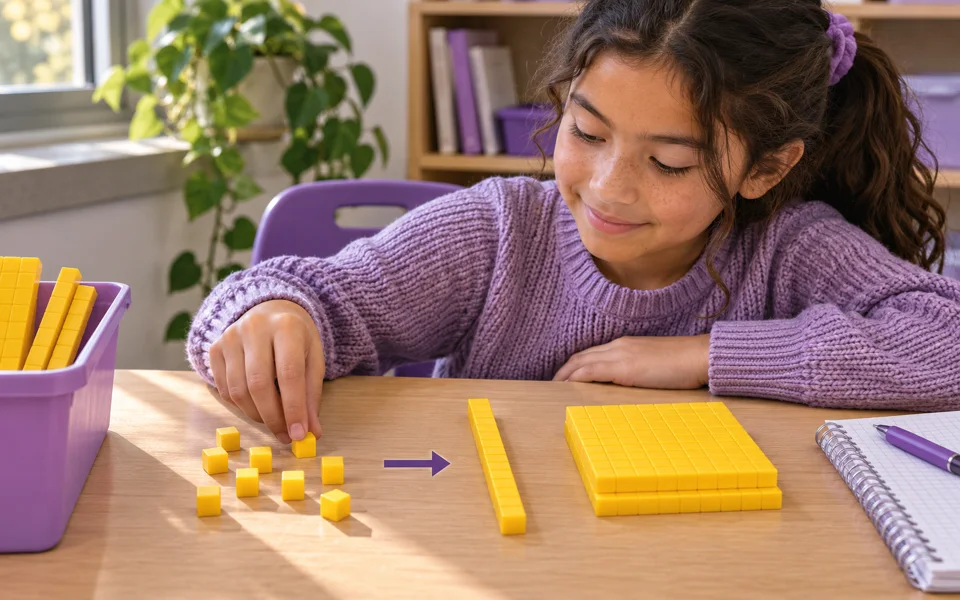
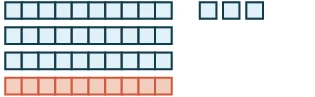
Place-value blocks arranged for regrouping tens and ones
Basic Addition & Subtraction: Mastering the Fundamentals

Basic Addition & Subtraction:

Delve into the foundational concepts of addition and subtraction, explore number bonds and facts, tackle missing numbers, and practice with 50 carefully curated questions suitable for all grade levels.

Basic Addition & Subtraction

Addition and subtraction are the two fundamental operations in arithmetic. They are the building blocks for more complex mathematical concepts and are essential for everyday problem-solving. Use the addition practice games to build fluency adding before working on longer expressions.

Addition

Addition is the process of combining two or more numbers to find their total. The numbers being added are called addends, and the result is known as the sum. Use the addition rules and examples to see what combining two quantities looks like in words and symbols.

Example 1: Basic Addition

Calculate the sum of 7 and 5:

\[ 7 + 5 = 12 \]

In this example, 7 and 5 are the addends, and 12 is the sum.

Subtraction

Subtraction is the process of finding the difference between two numbers. It involves taking one number away from another. The number from which another number is subtracted is called the minuend, the number being subtracted is the subtrahend, and the result is the difference. Use the subtraction methods and examples to compare taking away with finding a difference.

Example 2: Basic Subtraction

Calculate the difference between 15 and 8:

\[ 15 - 8 = 7 \]

Here, 15 is the minuend, 8 is the subtrahend, and 7 is the difference.

Number Bonds & Facts

Number bonds are a visual representation of the relationship between numbers. They show how numbers can be split into parts or combined to form larger numbers. Understanding number bonds is crucial for mastering addition and subtraction. Use the first grade maths worksheets to practise counting and early number operations.

Number Bonds to 5

Number bonds to 5 help students understand how numbers can be combined or separated to make 5. Use the primary counting resources to connect number words with totals using concrete examples.

Example 3: Number Bonds to 5

\[ 2 + 3 = 5 \\ 1 + 4 = 5 \\ 0 + 5 = 5 \]

These bonds show the different ways to make 5 by adding two numbers.

Number Bonds to 10

Extending number bonds to 10 allows for a deeper understanding of addition and subtraction, preparing students for more complex arithmetic.

Example 4: Number Bonds to 10

\[ 6 + 4 = 10 \\ 7 + 3 = 10 \\ 2 + 8 = 10 \]

These bonds demonstrate the various combinations to reach 10.

Number Bonds to 20

Number bonds to 20 further enhance students' numerical fluency, aiding in quick mental calculations and problem-solving.

Example 5: Number Bonds to 20

\[ 12 + 8 = 20 \\ 15 + 5 = 20 \\ 10 + 10 = 20 \]

These bonds show how to make 20 using different pairs of numbers.

Number Bonds Facts

Mastering number bonds is essential for developing strong addition and subtraction facts, enabling students to perform calculations more efficiently.

Example 6: Mastering Number Bonds

Knowing that: \[ 4 + 6 = 10 \quad \text{and} \quad 10 - 6 = 4 \]

helps in both addition and subtraction, reinforcing the inverse relationship between these operations.

Missing Numbers

Missing numbers problems are a great way to enhance logical thinking and understanding of numerical relationships. These problems require students to determine the unknown number in an equation.

Missing Number in Addition

Example 7: Missing Number in Addition

Find the missing number in the equation:

\[ 7 + \_ = 12 \]

Solution:

\[ \_ = 12 - 7 = 5 \]

So, the missing number is 5.

Missing Number in Subtraction

Example 8: Missing Number in Subtraction

Find the missing number in the equation:

\[ 15 - \_ = 9 \]

Solution:

\[ \_ = 15 - 9 = 6 \]

So, the missing number is 6.

Missing Number in Equations

Example 9: Missing Number in Equations

Find the missing number in the equation:

\[ \_ + 8 = 14 \]

Solution:

\[ \_ = 14 - 8 = 6 \]

So, the missing number is 6.

Practice Questions

Enhance your understanding of basic addition and subtraction by practicing the following 50 questions. Each question is accompanied by a detailed solution to aid your learning.

Grade 1

Question 1: What is $3 + 2$?

Solution:

\[ 3 + 2 = 5 \]

Question 2: Subtract 1 from 4.

Solution:

\[ 4 - 1 = 3 \]

Question 3: What number is missing: $2 + \_ = 5$?

Solution:

\[ \_ = 5 - 2 = 3 \]

Question 4: What is $5 - 3$?

Solution:

\[ 5 - 3 = 2 \]

Question 5: Add $4 + 1$.

Solution:

\[ 4 + 1 = 5 \]

Grade 2

Question 6: What is $7 + 5$?

Solution:

\[ 7 + 5 = 12 \]

Question 7: Subtract 6 from 14.

Solution:

\[ 14 - 6 = 8 \]

Question 8: What number is missing: $9 + \_ = 15$?

Solution:

\[ \_ = 15 - 9 = 6 \]

Question 9: What is $12 - 7$?

Solution:

\[ 12 - 7 = 5 \]

Question 10: Add $8 + 6$.

Solution:

\[ 8 + 6 = 14 \]

Grade 3

Question 11: What is $15 + 9$?

Solution:

\[ 15 + 9 = 24 \]

Question 12: Subtract 13 from 25.

Solution:

\[ 25 - 13 = 12 \]

Question 13: What number is missing: $18 + \_ = 30$?

Solution:

\[ \_ = 30 - 18 = 12 \]

Question 14: What is $22 - 14$?

Solution:

\[ 22 - 14 = 8 \]

Question 15: Add $19 + 7$.

Solution:

\[ 19 + 7 = 26 \]

Grade 4

Question 16: What is $27 + 14$?

Solution:

\[ 27 + 14 = 41 \]

Question 17: Subtract 19 from 34.

Solution:

\[ 34 - 19 = 15 \]

Question 18: What number is missing: $23 + \_ = 40$?

Solution:

\[ \_ = 40 - 23 = 17 \]

Question 19: What is $36 - 18$?

Solution:

\[ 36 - 18 = 18 \]

Question 20: Add $25 + 19$.

Solution:

\[ 25 + 19 = 44 \]

Grade 5

Question 21: What is $34 + 28$?

Solution:

\[ 34 + 28 = 62 \]

Question 22: Subtract 27 from 50.

Solution:

\[ 50 - 27 = 23 \]

Question 23: What number is missing: $45 + \_ = 60$?

Solution:

\[ \_ = 60 - 45 = 15 \]

Question 24: What is $52 - 29$?

Solution:

\[ 52 - 29 = 23 \]

Question 25: Add $38 + 47$.

Solution:

\[ 38 + 47 = 85 \]

Grade 6

Question 26: What is $58 + 67$?

Solution:

\[ 58 + 67 = 125 \]

Question 27: Subtract 34 from 89.

Solution:

\[ 89 - 34 = 55 \]

Question 28: What number is missing: $76 + \_ = 100$?

Solution:

\[ \_ = 100 - 76 = 24 \]

Question 29: What is $95 - 47$?

Solution:

\[ 95 - 47 = 48 \]

Question 30: Add $64 + 29$.

Solution:

\[ 64 + 29 = 93 \]

Grade 4-5

Question 31: What is $123 + 87$?

Solution:

\[ 123 + 87 = 210 \]

Question 32: Subtract 56 from 132.

Solution:

\[ 132 - 56 = 76 \]

Question 33: What number is missing: $150 + \_ = 200$?

Solution:

\[ \_ = 200 - 150 = 50 \]

Question 34: What is $180 - 99$?

Solution:

\[ 180 - 99 = 81 \]

Question 35: Add $210 + 190$.

Solution:

\[ 210 + 190 = 400 \]

Grade 6-7

Question 36: What is $345 + 678$?

Solution:

\[ 345 + 678 = 1023 \]

Question 37: Subtract 256 from 789.

Solution:

\[ 789 - 256 = 533 \]

Question 38: What number is missing: $500 + \_ = 750$?

Solution:

\[ \_ = 750 - 500 = 250 \]

Question 39: What is $620 - 315$?

Solution:

\[ 620 - 315 = 305 \]

Question 40: Add $455 + 345$.

Solution:

\[ 455 + 345 = 800 \]

Grade 7-8

Question 41: What is $1,234 + 2,345$?

Solution:

\[ 1,234 + 2,345 = 3,579 \]

Question 42: Subtract 1,567 from 3,000.

Solution:

\[ 3,000 - 1,567 = 1,433 \]

Question 43: What number is missing: $2,500 + \_ = 5,000$?

Solution:

\[ \_ = 5,000 - 2,500 = 2,500 \]

Question 44: What is $4,678 - 2,345$?

Solution:

\[ 4,678 - 2,345 = 2,333 \]

Question 45: Add $3,500 + 4,500$.

Solution:

\[ 3,500 + 4,500 = 8,000 \]

Mixed Grades

Question 46: What is $89 + 76$?

Solution:

\[ 89 + 76 = 165 \]

Question 47: Subtract 58 from 130.

Solution:

\[ 130 - 58 = 72 \]

Question 48: What number is missing: $67 + \_ = 100$?

Solution:

\[ \_ = 100 - 67 = 33 \]

Question 49: What is $150 - 75$?

Solution:

\[ 150 - 75 = 75 \]

Question 50: Add $200 + 300$.

Solution:

\[ 200 + 300 = 500 \]

Word Problems Involving Addition & Subtraction

Problem 1: Calculating Total Items

Sarah buys 8 packs of pencils. Each pack contains 12 pencils. How many pencils does Sarah have in total?

Solution:

To find the total number of pencils, multiply the number of packs by the number of pencils per pack:

\[ 8 \times 12 = 96 \]

Sarah has 96 pencils in total.

Problem 2: Sharing Equally

A teacher has 45 apples and wants to distribute them equally among 9 students. How many apples does each student receive?

Solution:

To determine how many apples each student gets, divide the total number of apples by the number of students:

\[ 45 \div 9 = 5 \]

Each student receives 5 apples.

Problem 3: Combined Operations

A factory produces 150 widgets each day. How many widgets are produced in a week (7 days)?

Solution:

Multiply the number of widgets produced each day by the number of days in a week:

\[ 150 \times 7 = 1050 \]

The factory produces 1,050 widgets in a week.

Problem 4: Fractional Division

If 64 candies are divided equally into 8 bags, how many candies are in each bag?

Solution:

Divide the total number of candies by the number of bags:

\[ 64 \div 8 = 8 \]

Each bag contains 8 candies.

Problem 5: Distributing Resources

There are 100 books to be placed on 5 shelves equally. How many books should be placed on each shelf?

Solution:

Divide the total number of books by the number of shelves:

\[ 100 \div 5 = 20 \]

Each shelf should have 20 books.

Problem 6: Grouping for Events

At a party, there are 48 balloons to be grouped into sets of 6. How many groups will there be?

Solution:

Divide the total number of balloons by the group size:

\[ 48 \div 6 = 8 \]

There will be 8 groups of balloons.

Problem 7: Calculating Perimeter

A rectangle has a length of 7 units and a width of 3 units. Calculate its perimeter using addition and multiplication.

Solution:

The perimeter \( P \) of a rectangle is calculated as:

\[ P = 2 \times (length + width) \]

Substituting the given values:

\[ P = 2 \times (7 + 3) = 2 \times 10 = 20 \text{ units} \]

The perimeter is 20 units.

Problem 8: Scaling Recipes

A recipe requires 3 cups of flour for 4 servings. How much flour is needed for 10 servings?

Solution:

First, find the amount of flour per serving:

\[ \frac{3 \text{ cups}}{4 \text{ servings}} = 0.75 \text{ cups per serving} \]

Then, multiply by the number of servings:

\[ 0.75 \times 10 = 7.5 \text{ cups} \]

7.5 cups of flour are needed for 10 servings.

Problem 9: Dividing Money

Linda has \$120 and wants to divide it equally among 8 friends. How much does each friend receive?

Solution:

Divide the total amount by the number of friends:

\[ 120 \div 8 = 15 \]

Each friend receives \$15.

Problem 10: Distributing Seats

A theater has 360 seats divided equally into 12 rows. How many seats are in each row?

Solution:

Divide the total number of seats by the number of rows:

\[ 360 \div 12 = 30 \]

Each row has 30 seats.

Basic Addition/Subtraction, Number Bonds & Facts:

  • Number Bonds to 5 (Becca) Smart Notebook (zipped) Easiteach
  • Vanishing Squares (Dot Hullah) ActivStudio
  • Number Bonds to 10 (Angie Gore) MS Powerpoint
  • Addition Bonds to 10 (Emma Holliday) Smart Notebook (zipped)
  • Simple Addition and Subtraction (Rebecca James) MS Powerpoint Zipped
  • Number Bonds to 10 (Rory Maclean) PDF
  • Number Bonds to 10 (Laura Davies) DOC
  • Number Bonds (Lynne Hardwidge) PDF
  • Number Search – 20 Bonds (Sheena Florey) PDF
  • Number Search – 9 Bonds (Sheena Florey) PDF
  • Making 20 (Easy addition) (Sheila Daly) PDF
  • Adding to 20 (Clare Shoemark) PDF
  • Making 10 and 20 (Lynne Hardwidge) PDF
  • Benny’s Code Game (Clare Shoemark) PDF
  • Number Grids (Lynne Hardwidge) PDF
  • Game: Three in a Row (Lauren Hately) DOC
  • Game: Rocket Race (Lauren Hately) DOC
  • Take Away Mix (Liz Hazelden) DOC
  • Number Addition & Subtraction (Helen Barrett) PDF
  • Disappearing Man (+/-) (Natasha Brown) MS Powerpoint
  • Addition Worksheet Generator (Campbell Airlie) 
  • Dice Subtraction Games (Vicki Foy) PDF
  • Adding 2 Groups (Jean Simpson) DOC
  • More Than / Less Than (Linda Cook) DOC
  • Number Bonds to 10 Rhyme (Alison Tamlyn) DOC
  • Simple Addition & Subtraction Noughts & Crosses (Gwyneth Pocock)  
  • Bondsai! Game (Gwyneth Pocock)  
  • Number Bonds to 10 Bingo (Rosie Wedderburn) DOC
  • Number Bonds Dominoes (Dawn Ellis)  
  •  Number Bonds Dominoes (up to 5, 6) (Kellie James/Dawn Ellis) DOC
  • Minifigure Number Bonds to 10 MS Powerpoint MS Powerpoint
  • Number Bonds (to 10/20) Game (Doro Thyssen) 
  • Rocket Maths (Laura Coady)  
  • Number Search (Laura Coady)  
  • Bead Number Bonds to 10 and 20 (Leanne Bulman) MS Powerpoint
  • Visualising Number Bonds to 10 and 20 (Leanne Bulman) MS Powerpoint
  • Visualising Number Bonds (Leanne Bulman) MS Powerpoint
  • Number Bonds to 10 (Lindsay Robson) Smart Notebook (zipped)
  • Rub & Reveal Number Bonds (Gareth Monk) ActivStudio Instructions DOC
  • Number Bonds to 20 (B. Hiles) MS Powerpoint
  • Number Bonds to 20 (Jane Shinn) MS Powerpoint
  • Number Bonds to 100 (Rory Maclean) PDF
  • Number Bonds to 10 (Joanne Nalton) DOC
  • Class Quiz: Number Bonds to 20 (Lynne Outhwaite) MS Powerpoint
  • Ladybird Addition (Jane Dovey) PDF
  • Easy Addition & Subtraction (Clare Shoemark) PDF
  • Easy Subtraction 1 (Clare Shoemark) PDF
  • Easy Subtraction 2 (Clare Shoemark) PDF
  • Finding the Difference (Liz Hazelden) DOC
  • Subtraction (Michelle Haskew) PDF
  • Class Quiz: Complements to 100 (Lynne Outhwaite) MS Powerpoint
  • What’s My Number? (Addition) (Lynne Hardwidge) PDF
  • Sums Square Addition (Campbell Airlie) 
  • Addition Squares Worksheet Generator (Campbell Airlie) 
  • Pairs Which Total 100 Game (Vicki Foy) PDF
  • Number Bond Rhymes (Claire Jones) DOC
  • Number Bond Rhymes and Mimes (Natalia Barnard) DOC
  • Number Bonds to 100 (Mrs. Bangee) DOC
  • Subtraction 100 (Colette Palmer) PDF
  • Number Bonds 10 & 20 (Lisa Marshall) DOC
  • Number Bonds to 10 (Strips) (Jean Simpson) DOC
  • Number Bond to 10 Pictures (Shirley Rodgers) DOC
  • Number Bonds Cards (Rachael Cooper) DOC
  • Subtraction Pairs (Gwyneth Pocock)  
  • Dartboard Doubles Game (Gwyneth Pocock)  
  • Numicon Support Gallery (Aaron Laws) Smart Notebook (zipped)
  • Numicon Shapes (Richard Thomas) Smart Notebook (zipped)
  • Numicon 2 digits – 1 digit Subtraction (Laura Coady)  
  • Numicon Subtraction with Exchange (Laura Coady)  
  • Numicon 3 digit Addition Game (Laura Coady)  
  • Number Bonds to 5p Cards (Leanne Bulman) MS Powerpoint
  • Number Bonds to 10p Cards (Leanne Bulman) MS Powerpoint
  • Build with Bonds (Roger Targett) MS Powerpoint
  •  Adding 2 Groups (Gemma Thomas) DOC
  •  Simple Addition & Subtraction (Mrs. Bangee) DOC
  •  Fruit Subtraction (Sarah Pascall) PDF
  •  Number Track Calculations (Jo Cayley) DOC
  •  Animal Addition (up to 10 & 20) (Gemma Lee) DOC
  •  Adding up to 10 (Sarah Pascall) PDF
  •  Number Bonds (5 and 10) (Joanne Worsnop) DOC
  •  Number Line Calculations (Jo Cayley) DOC
  •  Pairs that make 10 (Nick Perry) MS Powerpoint
  •  Making 10 (K. Leeds) MS Powerpoint
  •  Making 10 (v2) (K. Leeds) MS Powerpoint
  •  Find the Difference between 2 Numbers (Sara Zollino) MS Powerpoint
  •  Take Away Teddy Bears (Chloé Goodwin) DOC
  •  Ladybird Subtraction (Helen Broadbent) DOC
  •  Adding in the Garden (Gareth Rein) DOC
  •  Add Up (Gareth Rein) DOC
  •  Adding (<10) (Linda Cook) DOC
  •  Monsters Making 10 (Kieran Larwood) PDF
  •  Making 11 (Elna Strydon) MS Powerpoint
  •  Number Bonds to 10 (Sue Ashby) MS Powerpoint
  •  Adding More (Liz Hazelden) DOC
  •  Taking Away (Easy) (Liz Hazelden) DOC
  •  Little Red Addition (Lisa McIlwaine) DOC
  •  Windy Day Takeaway (Gareth Rein) DOC
  •  Addition in Words (<20) (Linda Cook)
  • Making and Breaking 10  (Shirley Lehmann) Easiteach
  •  Addition Crackers (Fiona Hadden) ActivStudio
  •  Number Bonds to 10 (Hilary Rodley) PDF
  •  Number Bonds to 5 (Lisa Tregellas) ActivStudio
  •  Number Bonds to 10 (Shelley Parsons) MS Powerpoint
  •  Number Bonds to 10 Party Hats (Sally Shrestha) MS Powerpoint
  •  Harold Goes Fishing (Subtraction) (Hayley Williams) MS Powerpoint
  •  Taking Away from Ten Pig Pen (Sarah Hart) Smart Notebook (zipped)
  •  Colour the Fish: Addition (Sandra Miller) DOC
  •  Colour the Fish: Subtraction (Sandra Miller) DOC
  •  Basic Addition Up to 10, 20 (Joanne Gordon) DOC
  •  Domino Number Bonds 0-5 (Natasha Wood) DOC
  •  Number Bonds to 10 Booklet (Venesser Pate) DOC
  •  Prices (Number Bonds) to 10p (Aksa Shaheen) DOC
  •  Number Bonds to 10 (R. Peck)  
  •  Using a Number Line to Add (Laura Roberts) DOC
  •  Simple Take Aways (Laura Roberts) DOC
  •  Flower Number Bonds (Suzanne Walsh) DOC
  •  A Toy Problem (Karen Donaghey) DOC
  •  Caterpillar Calculations (Jan Blanthorn-Hazell) MS Powerpoint v2 MS Powerpoint
  •  Take Away Cupcakes (Jan Blanthorn-Hazell) DOC
  •  Addition to 8, 9 or 10 Generator (Lesley Richmond) 
  •  Addition to 11, 12 or 13 Generator (Lesley Richmond) 
  •  Addition to 14, 15 or 16 Generator (Lesley Richmond) 
  •  Addition to 17, 18, 19 or 20 Generator (Lesley Richmond) 
  •  Adding to 10 (Philomena Shotton) Smart Notebook (zipped)
  •  Teddy Bear Subtraction (Michelle Stone) MS Powerpoint
  •  Ways to Make 20 (Gillian Miller) Smart Notebook (zipped)
  •  Timed Addition (Katie Ward) DOC
  •  Simple Addition and Subtraction (Amalia Dessouki) DOC
  •  Number Bonds to 10 Cards (Antonella Molinelli Esposito) PDF
  •  Simple Addition (to 10) (R. Peck) DOC
  •  Picture Addition (Helen Logan Wood) DOC
  •  Adding Using a Number Line (Emma Mulvey) 
  •  Find the Difference (using a number line) (Laura Roberts) DOC
  •  Difference Between (Alex Glover) DOC
  •  Toy Subtraction (Karen Donaghey) DOC
  •  Number Bonds to 10 Ladybirds (Hazel Boyes) DOC
  •  Pairs that Make 10 (S. Lingard) DOC
  •  Number Bonds to 10 (Emily Murton)  
  •  Empty Box Addition Recording Sheet (Vicki Foy) PDF
  •  Counting the Stars (Counting On) (Venesser Pate) DOC
  •  Subtraction from 10 (Heidi Morris-Duffin) MS Powerpoint
  •  Number Bonds to 10 Ladybirds (Dhipa Begum)  
  •  Using a Number Line to Add (1) (Charlotte Harvey) DOC
  •  Using a Number Line to Add (2) (Charlotte Harvey) DOC
  •  Addition on a 100 Square (Richard Donnell) MS Powerpoint
  •  Subtraction on a 100 Square (Richard Donnell) MS Powerpoint
  •  Number Bonds to 10 (Donna Weeks) MS Powerpoint
  •  Adding Either Order (Sarah Sergeant) MS Powerpoint
  •  Pass the Ball (Steve Manley) PDF
  •  Goalie Throws (Steve Manley) PDF
  •  4 in a row – Addition (Veronica Thomas) PDF
  •  4 in a row – Subtraction (Veronica Thomas) PDF
  •  Monkey in the Jungle Game (Gillian Caine) DOC
  •  Colour Code Addition (to 20) (Emma Davies) DOC
  •  Visual Subtraction (Helen Loganwood) DOC
  •  Subtraction Search (Victoria McKeown) DOC
  •  Subtraction Machines (Jennifer Gibbs) DOC
  •  Number Bonds to 20 (Sabina Common) 
  •  Addition & Subtraction Number Maze (Nick Phillips) DOC
  •  Target 10 (Maisha Stalker) MS Powerpoint
  •  Addition & Subtraction Number Puzzle (Glynis Hood) DOC
  •  Dora (Number Sums to 10) (Lisa Mary McNamee) XLS
  •  Addition Machines (Antoinette Payne) DOC
  •  Number Bonds to 10 (Leah Johnston) PDF
  • Complements to 10, 100 and 1000 (Andrew Woodcock) XLS
  •  Addition/Subtraction Using a Numberline (Colette Hallinan) DOC
  •  Subtracting Multiples of 10 (Jennifer Gibbs) DOC
  •  Making Numbers 6-10 (Riann Gladwish) DOC
  •  Themed Addition & Subtraction: Frozen (Shelley Joanne Lee) DOC
  •  Themed Addition & Subtraction: Turtles (Shelley Joanne Lee) DOC
  •  Pairs that make 10, 100 (J. Gibbs) DOC
  •  Subtraction with 20 Domino Cards (Alison Davis) DOC
  •  Number Bonds to 10 (Sabina Common) 
  •  Number Bonds to 100 (Morag Watson) 
  •  Addition and Subtraction Calculations (Rachael Wilkie) DOC
  •  Adding Date in Tables (Michelle Culliford) PDF
  •  Adding to 100 (Olivia Halls) DOC
  •  Number Bonds to 100 (Ian Harragan)  
  •  Addition Grids Starter (Paula Alty) MS Powerpoint
  •  Number Bonds to 100 (in 10s) (Sharon Soper) DOC
  •  Number Bonds to 10, 20, 30 (Gill Mullin) DOC
  •  Subtraction Grids Starter (Paula Alty) MS Powerpoint
  •  Pairs that Make 100 Word Problems (Sabina Common)  
  •  Pairs that Make 100 Dice Sheet (Sabina Common)  
  •  Subtraction Counter Toss Game (Daniel Winter)  
  •  T1 U12 Addition & Subtraction (& time) (David Arthur) ActivStudio
  •  Number Bonds to 1000 (Mrs. Bangee) DOC
  •  Addition Jigsaw (Peter Barnett) 
  •  Complements to 20, 100 and 1000 (Rosie Morgan) DOC
  •  Number Bonds to 100 (Mrs. Bangee) DOC


Missing Numbers:

  • Missing Numbers (Gareth Pitchford) Downloadable Program
  • Missing Number Subtraction (Liz Hazelden) DOC
  • Unknown Number (3 sheets) (Sheena Florey) PDF
  • Fill in the Blanks (TU totals) (Gareth Rein) DOC
  • What was my Number? (Sukina Jalaf) MS Powerpoint
  • Missing Addition (Bindya Nakeshree) DOC
  • Missing Numbers – 7 sheets (Tony Wilson) PDF
  • Balancing Act (Lisa Heap) PDF
  • Ladybird Mystery Sums (Sandra Irons) DOC
  • Ladybird Spot Addition (Louise Storrar) DOC
  •  Missing Numbers (Philomena Shotton) Smart Notebook (zipped)
  •  Mission Numbers Addition Sheets (Hayley Shortt) DOC
  •  Missing Numbers (Eleanor Spry) DOC
  •  Subtraction from 8, 9 or 10 Generator (Lesley Richmond) 
  •  Subtraction from 11, 12 or 13 Generator (Lesley Richmond) 
  •  Subtraction from 14, 15 or 16 Generator (Lesley Richmond) 
  •  Subtraction from 17, 18, 19 or 20 Generator (Lesley Richmond) 
  •  Missing Number Addition (Liz Hazelden) DOC
  •  Missing Number Addition (Nicola McCrum) DOC
  •  Subtraction Empty Box Problems (Carolyn Turk) MS Powerpoint
  •  Subtraction from 10 Generator (Lesley Richmond) 
  •  Subtraction from 11 Generator (Lesley Richmond) 
  •  Subtraction from 12 Generator (Lesley Richmond) 
  •  Missing Number Addition totalling 10 Generator (Lesley Richmond) 
  •  Missing Number Addition (LA) (Liz Hazelden) DOC
  •  Missing Numbers: Addition & Subtraction (Dhipa Begum) DOC
  •  Unknown Numbers (David-Guy Parkin) DOC
  •  Balancing Act (LA) (Pauline Davies) DOC
  •  Balancing Equations (Megan Heys) DOC
  •  Missing Numbers (inverse using + and -) (Pauline Davies)  
  •  Smudged Calculations (Subtraction) (Helen Telford) DOC – Answers DOC

Explain why exchanging a hundred helps

To subtract 178 from 402, exchange one hundred for ten tens. Exchange one of those tens for ten ones. The number is now three hundreds, nine tens and twelve ones. Take away eight ones, seven tens and one hundred to leave two hundreds, two tens and four ones. Add 178 to 224 to check that the exchanges preserved the starting value.

Model Addition of Whole Numbers

Addition is really just counting. We will model addition with base-10 blocks. Remember, a block represents 1 and a rod represents 10. Let’s start by modeling the addition expression we just considered, 3+4.
Each addend is less than 10, so we can use ones blocks.
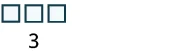
We start by modeling the first number with 3 blocks. CNX_BMath_Figure_01_02_019_img-02.png
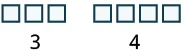
Then we model the second number with 4 blocks. CNX_BMath_Figure_01_02_019_img-03.png
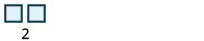
Count the total number of blocks. CNX_BMath_Figure_01_02_019_img-04.png
There are 7 blocks in all. We use an equal sign (=) to show the sum. A math sentence that shows that two expressions are equal is called an equation. We have shown that. 3+4=7.
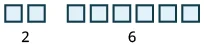
Model the addition 2+6.
Solution

Solution

2+6 means the sum of 2 and 6
Each addend is less than 10, so we can use ones blocks.
Model the first number with 2 blocks. CNX_BMath_Figure_01_02_016_img-02.png
Model the second number with 6 blocks. CNX_BMath_Figure_01_02_016_img-03.png
Count the total number of blocks CNX_BMath_Figure_01_02_016_img-04.pngThere are 8 blocks in all, so 2+6=8.
When the result is 10 or more ones blocks, we will exchange the 10 blocks for one rod.
Model the addition 5+8.
Solution

Solution

5+8 means the sum of 5 and 8.
Each addend is less than 10, se we can use ones blocks.
Model the first number with 5 blocks. CNX_BMath_Figure_01_02_017_img-02.png
Model the second number with 8 blocks. CNX_BMath_Figure_01_02_017_img-03.png
Count the result. There are more than 10 blocks so we exchange 10 ones blocks for 1 tens rod. CNX_BMath_Figure_01_02_017_img-04.png
Now we have 1 ten and 3 ones, which is 13. 5 + 8 = 13
Notice that we can describe the models as ones blocks and tens rods, or we can simply say ones and tens. From now on, we will use the shorter version but keep in mind that they mean the same thing.
Next we will model adding two digit numbers.
Model the addition: 17+26.
Solution

Solution

17+26 means the sum of 17 and 26.
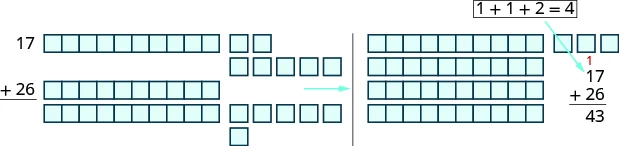
Model the 17. 1 ten and 7 ones CNX_BMath_Figure_01_02_018_img-02.png
Model the 26. 2 tens and 6 ones CNX_BMath_Figure_01_02_018_img-03.png
Combine. 3 tens and 13 ones CNX_BMath_Figure_01_02_018_img-04.png
Exchange 10 ones for 1 ten. 4 tens and 3 ones 40+3=43 CNX_BMath_Figure_01_02_018_img-05.png
We have shown that 17+26=43

Add Whole Numbers Without Models

Now that we have used models to add numbers, we can move on to adding without models. Before we do that, make sure you know all the one digit addition facts. You will need to use these number facts when you add larger numbers.
Imagine filling in table by adding each row number along the left side to each column number across the top. Make sure that you get each sum shown. If you have trouble, model it. It is important that you memorize any number facts you do not already know so that you can quickly and reliably use the number facts when you add larger numbers.
+ 0 1 2 3 4 5 6 7 8 9
0 0 1 2 3 4 5 6 7 8 9
1 1 2 3 4 5 6 7 8 9 10
2 2 3 4 5 6 7 8 9 10 11
3 3 4 5 6 7 8 9 10 11 12
4 4 5 6 7 8 9 10 11 12 13
5 5 6 7 8 9 10 11 12 13 14
6 6 7 8 9 10 11 12 13 14 15
7 7 8 9 10 11 12 13 14 15 16
8 8 9 10 11 12 13 14 15 16 17
9 9 10 11 12 13 14 15 16 17 18
Did you notice what happens when you add zero to a number? The sum of any number and zero is the number itself. We call this the Identity Property of Addition. Zero is called the additive identity.
Find each sum:
  1. ⓐ 0+11
  2. ⓑ 42+0
Solution

Solution

ⓐ The first addend is zero. The sum of any number and zero is the number. 0+11=11
ⓑ The second addend is zero. The sum of any number and zero is the number. 42+0=42
Look at the pairs of sums.
2+3=5 3+2=5
4+7=11 7+4=11
8+9=17 9+8=17
Notice that when the order of the addends is reversed, the sum does not change. This property is called the Commutative Property of Addition, which states that changing the order of the addends does not change their sum.
Add:
  1. ⓐ 8+7
  2. ⓑ 7+8
Solution

Solution

  • ⓐ
    Add. 8+7
    15
  • ⓑ
    Add. 7+8
    15
Did you notice that changing the order of the addends did not change their sum? We could have immediately known the sum from part ⓑ just by recognizing that the addends were the same as in part ⓐ , but in the reverse order. As a result, both sums are the same.
Add: 28+61.
Solution

Solution

To add numbers with more than one digit, it is often easier to write the numbers vertically in columns.
Write the numbers so the ones and tens digits line up vertically. 28 +61____
Then add the digits in each place value. Add the ones: 8+1=9Add the tens: 2+6=8 28 +61____89
In the previous example, the sum of the ones and the sum of the tens were both less than 10. But what happens if the sum is 10 or more? Let’s use our base-10 model to find out. diagram shows the addition of 17 and 26 again.
An image containing two groups of items. The left group includes 1 horizontal rod with 10 blocks and 7 individual blocks 2 horizontal rods with 10 blocks each and 6 individual blocks. The label to the left of this group of items is “17 + 26 =”. The right group contains two items. Four horizontal rods containing 10 blocks each. Then, 3 individual blocks. The label for this group is “17 + 26 = 43”.
When we add the ones, 7+6, we get 13 ones. Because we have more than 10 ones, we can exchange 10 of the ones for 1 ten. Now we have 4 tens and 3 ones. Without using the model, we show this as a small red 1 above the digits in the tens place.
When the sum in a place value column is greater than 9, we carry over to the next column to the left. Carrying is the same as regrouping by exchanging. For example, 10 ones for 1 ten or 10 tens for 1 hundred.
Add: 43+69.
Solution

Solution

Write the numbers so the digits line up vertically. 43 +69____
Add the digits in each place.Add the ones: 3+9=12
Write the 2 in the ones place in the sum.Add the 1 ten to the tens place. 413 +69____2
Now add the tens: 1+4+6=11Write the 11 in the sum. 413 +69____112
Add: 324+586.
Solution

Solution

Write the numbers so the digits line up vertically. ...
Add the digits in each place value.Add the ones: 4+6=10Write the 0 in the ones place in the sum and carry the 1 ten to the tens place. ...
Add the tens: 1+2+8=11Write the 1 in the tens place in the sum and carry the 1 hundred to the hundreds ...
Add the hundreds: 1+3+5=9Write the 9 in the hundreds place. ...
Add: 1,683+479.
Solution

Solution

Write the numbers so the digits line up vertically. 1,683 +479______
Add the digits in each place value.
Add the ones: 3+9=12.Write the 2 in the ones place of the sum and carry the 1 ten to the tens place. 1,6813 +479______2
Add the tens: 1+7+8=16Write the 6 in the tens place and carry the 1 hundred to the hundreds place. 1,61813 +479______62
Add the hundreds: 1+6+4=11Write the 1 in the hundreds place and carry the 1 thousand to the thousands place. 1,61813 +479______162
Add the thousands 1+1=2. Write the 2 in the thousands place of the sum. 1,161813 +479______2,162
When the addends have different numbers of digits, be careful to line up the corresponding place values starting with the ones and moving toward the left.
Add: 21,357+861+8,596.
Solution

Solution

Write the numbers so the place values line up vertically. 21,357 861 +8,596_______
Add the digits in each place value.
Add the ones: 7+1+6=14Write the 4 in the ones place of the sum and carry the 1 to the tens place. 21,3517 861 +8,596_______ 4
Add the tens: 1+5+6+9=21Write the 1 in the tens place and carry the 2 to the hundreds place. 21,32517 861 +8,596_______ 14
Add the hundreds: 2+3+8+5=18Write the 8 in the hundreds place and carry the 1 to the thousands place. 21,132517 861 +8,596_______ 814
Add the thousands 1+1+8=10. Write the 0 in the thousands place and carry the 1 to the ten thousands place. 211,132517 861 +8,596_______ 0814
Add the ten-thousands 1+2=3. Write the 3 in the ten thousands place in the sum. 211,132517 861 +8,596_______ 30,814
This example had three addends. We can add any number of addends using the same process as long as we are careful to line up the place values correctly.

Translate Word Phrases to Math Notation

Earlier in this section, we translated math notation into words. Now we’ll reverse the process. We’ll translate word phrases into math notation. Some of the word phrases that indicate addition are listed in table.
Operation Words Example Expression
Addition plussumincreased bymore thantotal ofadded to 1 plus 2the sum of 3 and 45 increased by 68 more than 7the total of 9 and 56 added to 4 1+23+45+67+89+54+6
Translate and simplify: the sum of 19 and 23.
Solution

Solution

The word sum tells us to add. The words of 19 and 23 tell us the addends.
The sum of 19 and 23
Translate. 19+23
Add. 42
The sum of 19 and 23 is 42.
Translate and simplify: 28 increased by 31.
Solution

Solution

The words increased by tell us to add. The numbers given are the addends.
28 increased by 31.
Translate. 28+31
Add. 59
So 28 increased by 31 is 59.

Add Whole Numbers in Applications

Now that we have practiced adding whole numbers, let’s use what we’ve learned to solve real-world problems. We’ll start by outlining a plan. First, we need to read the problem to determine what we are looking for. Then we write a word phrase that gives the information to find it. Next we translate the word phrase into math notation and then simplify. Finally, we write a sentence to answer the question.
Hao earned grades of 87,93,68,95,and89 on the five tests of the semester. What is the total number of points he earned on the five tests?
Solution

Solution

We are asked to find the total number of points on the tests.
Write a phrase. the sum of points on the tests
Translate to math notation. 87+93+68+95+89
Then we simplify by adding.
Since there are several numbers, we will write them vertically. 837936895+89____432
Write a sentence to answer the question. Hao earned a total of 432 points.
Notice that we added points, so the sum is 432 points. It is important to include the appropriate units in all answers to applications problems.
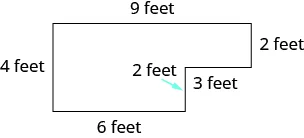
Some application problems involve shapes. For example, a person might need to know the distance around a garden to put up a fence or around a picture to frame it. The perimeter is the distance around a geometric figure. The perimeter of a figure is the sum of the lengths of its sides.
Find the perimeter of the patio shown.
This is an image of a perimeter of a patio. There are six sides. The far left side is labeled 4 feet, the top side is labeled 9 feet, the right side is short and labeled 2 feet, then extends across to the left and is labeled 3 feet. From here, the side extends down and is labeled 2 feet. Finally, the base is labeled 6 feet.
Solution

Solution

We are asked to find the perimeter.
Write a phrase. the sum of the sides
Translate to math notation. 4+6+2+3+2+9
Simplify by adding. 26
Write a sentence to answer the question.
We added feet, so the sum is 26 feet. The perimeter of the patio is 26 feet.

Model Subtraction of Whole Numbers

A model can help us visualize the process of subtraction much as it did with addition. Again, we will use base-10 blocks. Remember a block represents 1 and a rod represents 10. Let’s start by modeling the subtraction expression we just considered, 7−3.
We start by modeling the first number, 7. CNX_BMath_Figure_01_03_018_img-02.png
Now take away the second number, 3. We'll circle 3 blocks to show that we are taking them away. CNX_BMath_Figure_01_03_018_img-03.png
Count the number of blocks remaining. CNX_BMath_Figure_01_03_018_img-04.png
There are 4 ones blocks left. We have shown that 7−3=4.
Model the subtraction: 8−2.
Solution

Solution

8−2 means the difference of 8 and 2.
Model the first, 8. CNX_BMath_Figure_01_03_019_img-02.png
Take away the second number, 2. CNX_BMath_Figure_01_03_019_img-03.png
Count the number of blocks remaining. CNX_BMath_Figure_01_03_019_img-04.png
There are 6 ones blocks left. We have shown that 8−2=6.
Model the subtraction: 13−8.
Solution

Solution

Model the first number, 13. We use 1 ten and 3 ones. CNX_BMath_Figure_01_03_020_img-02.png
Take away the second number, 8. However, there are not 8 ones, so we will exchange the 1 ten for 10 ones. CNX_BMath_Figure_01_03_020_img-03.png
Now we can take away 8 ones. CNX_BMath_Figure_01_03_020_img-04.png
Count the blocks remaining. CNX_BMath_Figure_01_03_020_img-05.png
There are five ones left. We have shown that 13−8=5.
As we did with addition, we can describe the models as ones blocks and tens rods, or we can simply say ones and tens.
Model the subtraction: 43−26.
Solution

Solution

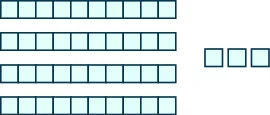
Because 43−26 means 43 take away 26, we begin by modeling the 43. An image containing two items. The first item is 4 horizontal rods containing 10 blocks each. The second item is 3 individual blocks.
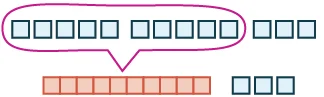
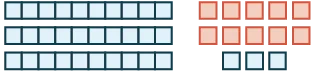
Now, we need to take away 26, which is 2 tens and 6 ones. We cannot take away 6 ones from 3 ones. So, we exchange 1 ten for 10 ones. This figure contains two groups. The first group on the left includes 3 rows of blue base 10 blocks and 1 red row of 10 blocks. This is labeled 4 tens. Alongside the first row of ten blocks are 3 individual blocks. This is labeled 3 ones. An arrow points to the right to the second group in which there are three rows of 10 base blocks labeled 3 tens. Next to this is a row of 3 blue individual blocks and two rows each with five individual blocks in red. This is labeled 13 ones.
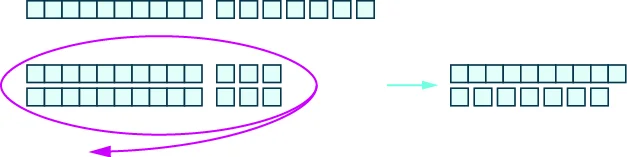
Now we can take away 2 tens and 6 ones. This image includes one row of base ten blocks at the top of the image; Next to it are seven individual blocks. Below this, is a group of two rows of base ten blocks, and two rows of 3 individual blocks with a circle around all. The arrow points to the right and shows one row of ten blocks and seven individual blocks underneath.
Count the number of blocks remaining. There is 1 ten and 7 ones, which is 17.
43−26=17

Subtract Whole Numbers

Addition and subtraction are inverse operations. Addition undoes subtraction, and subtraction undoes addition.
We know 7−3=4 because 4+3=7. Knowing all the addition number facts will help with subtraction. Then we can check subtraction by adding. In the examples above, our subtractions can be checked by addition.
7−3=4because4+3=713−8=5because5+8=1343−26=17because17+26=43
Subtract and then check by adding:
  1. ⓐ 9−7
  2. ⓑ 8−3.
Solution

Solution

ⓐ
9−7
Subtract 7 from 9. 2
Check with addition.2+7=9✓
ⓑ
8−3
Subtract 3 from 8. 5
Check with addition.5+3=8✓
To subtract numbers with more than one digit, it is usually easier to write the numbers vertically in columns just as we did for addition. Align the digits by place value, and then subtract each column starting with the ones and then working to the left.
Subtract and then check by adding: 89−61.
Solution

Solution

Write the numbers so the ones and tens digits line up vertically. 89 −61____
Subtract the digits in each place value.Subtract the ones: 9-1=8Subtract the tens: 8-6=2 89 −61____ 28
Check using addition. 28 +61____ 89
Our answer is correct.
When we modeled subtracting 26 from 43, we exchanged 1 ten for 10 ones. When we do this without the model, we say we borrow 1 from the tens place and add 10 to the ones place.
Subtract: 43−26.
Solution

Solution

Write the numbers so each place value lines up vertically. ..
Subtract the ones. We cannot subtract 6 from 3, so we borrow 1 ten. This makes 3 tens and 13 ones. We write these numbers above each place and cross out the original digits. ..
Now we can subtract the ones. 13−6=7. We write the 7 in the ones place in the difference. ..
Now we subtract the tens. 3−2=1. We write the 1 in the tens place in the difference. ..
Check by adding... Our answer is correct.
Subtract and then check by adding: 207−64.
Solution

Solution

Write the numbers so each place value lines up vertically. ..
Subtract the ones. 7−4=3. Write the 3 in the ones place in the difference. ..
Subtract the tens. We cannot subtract 6 from 0 so we borrow 1 hundred and add 10 tens to the 0 tens we had. This makes a total of 10 tens. We write 10 above the tens place and cross out the 0. Then we cross out the 2 in the hundreds place and write 1 above it. ..
Now we subtract the tens. 10−6=4. We write the 4 in the tens place in the difference. ..
Finally, subtract the hundreds. There is no digit in the hundreds place in the bottom number so we can imagine a 0 in that place. Since 1−0=1, we write 1 in the hundreds place in the difference...
Check by adding. ..Our answer is correct.
Subtract and then check by adding: 910−586.
Solution

Solution

Write the numbers so each place value lines up vertically. ..
Subtract the ones. We cannot subtract 6 from 0, so we borrow 1 ten and add 10 ones to the 0 ones we had. This makes 10 ones. We write a 0 above the tens place and cross out the 1. We write the 10 above the ones place and cross out the 0. Now we can subtract the ones. 10−6=4...
Write the 4 in the ones place of the difference. ..
Subtract the tens. We cannot subtract 8 from 0, so we borrow 1 hundred and add 10 tens to the 0 tens we had, which gives us 10 tens. Write 8 above the hundreds place and cross out the 9. Write 10 above the tens place. ..
Now we can subtract the tens. 10−8=2. ..
Subtract the hundreds place. 8−5=3 Write the 3 in the hundreds place in the difference. ..
Check by adding. ...Our answer is correct.
Subtract and then check by adding: 2,162−479.
Solution

Solution

Write the numbers so each place value lines up vertically. CNX_BMath_Figure_01_03_028_img-02.png
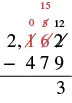
Subtract the ones. Since we cannot subtract 9 from 2, borrow 1 ten and add 10 ones to the 2 ones to make 12 ones. Write 5 above the tens place and cross out the 6. Write 12 above the ones place and cross out the 2. CNX_BMath_Figure_01_03_028_img-03.png
Now we can subtract the ones. 12−9=3
Write 3 in the ones place in the difference. CNX_BMath_Figure_01_03_028_img-04.png
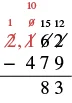
Subtract the tens. Since we cannot subtract 7 from 5, borrow 1 hundred and add 10 tens to the 5 tens to make 15 tens. Write 0 above the hundreds place and cross out the 1. Write 15 above the tens place.CNX_BMath_Figure_01_03_028_img-06.png
Now we can subtract the tens.15−7=8
Write 8 in the tens place in the difference.CNX_BMath_Figure_01_03_028_img-05.png
Now we can subtract the hundreds.CNX_BMath_Figure_01_03_028_img-07.png
Write 6 in the hundreds place in the difference.CNX_BMath_Figure_01_03_028_img-08.png
Subtract the thousands. There is no digit in the thousands place of the bottom number, so we imagine a 0. 1−0=1. Write 1 in the thousands place of the difference.CNX_BMath_Figure_01_03_028_img-09.png
Check by adding.11,61813+479______2,162✓
Our answer is correct.

Translate Word Phrases to Math Notation

As with addition, word phrases can tell us to operate on two numbers using subtraction. To translate from a word phrase to math notation, we look for key words that indicate subtraction. Some of the words that indicate subtraction are listed in table.
Operation Word Phrase Example Expression
Subtraction minus 5 minus 1 5−1
difference the difference of 9 and 4 9−4
decreased by 7 decreased by 3 7−3
less than 5 less than 8 8−5
subtracted from 1 subtracted from 6 6−1
Translate and then simplify:
  1. ⓐ the difference of 13 and 8
  2. ⓑ subtract 24 from 43
Solution

Solution

  • ⓐ
    The word difference tells us to subtract the two numbers. The numbers stay in the same order as in the phrase.
    the difference of 13 and 8
    Translate. 13−8
    Simplify. 5
  • ⓑ
    The words subtract from tells us to take the first number away from the second. We must be careful to get the order correct.
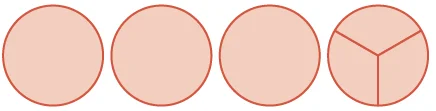
    subtract 24 from 43
    Translate. 43−24
    Simplify. 19

Subtract Whole Numbers in Applications

To solve applications with subtraction, we will use the same plan that we used with addition. First, we need to determine what we are asked to find. Then we write a phrase that gives the information to find it. We translate the phrase into math notation and then simplify to get the answer. Finally, we write a sentence to answer the question, using the appropriate units.
The temperature in Chicago one morning was 73 degrees Fahrenheit. A cold front arrived and by noon the temperature was 27 degrees Fahrenheit. What was the difference between the temperature in the morning and the temperature at noon?
Solution

Solution

We are asked to find the difference between the morning temperature and the noon temperature.
Write a phrase. the difference of 73 and 27
Translate to math notation. Difference tells us to subtract. 73−27
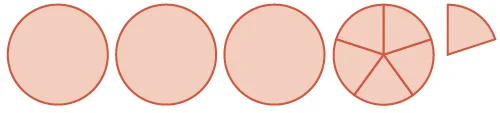
Then we do the subtraction. ...
Write a sentence to answer the question. The difference in temperatures was 46 degrees Fahrenheit.
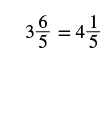
A washing machine is on sale for $399. Its regular price is $588. What is the difference between the regular price and the sale price?
Solution

Solution

We are asked to find the difference between the regular price and the sale price.
Write a phrase. the difference between 588 and 399
Translate to math notation. 588−399
Subtract. ..
Write a sentence to answer the question. The difference between the regular price and the sale price is $189.

Add and Subtract Decimals

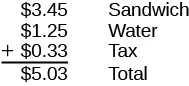
Let’s take one more look at the lunch order from the start of Decimals, this time noticing how the numbers were added together.
A vertical addition problem is shown. The top line shows $3.45 for a sandwich, the next line shows $1.25 for water, and the last line shows $0.33 for tax. The total is shown to be $5.03.
All three items (sandwich, water, tax) were priced in dollars and cents, so we lined up the dollars under the dollars and the cents under the cents, with the decimal points lined up between them. Then we just added each column, as if we were adding whole numbers. By lining up decimals this way, we can add or subtract the corresponding place values just as we did with whole numbers.
Add: 3.7+12.4.
Solution

Solution

3.7+12.4
Write the numbers vertically so the decimal points line up. 3.7 +12.4_____
Place holders are not needed since both numbers have the same number of decimal places.
Add the numbers as if they were whole numbers. Then place the decimal in the answer under the decimal points in the given numbers. 31.7 +12.4_____ 16.1
Add: 23.5+41.38.
Solution

Solution

23.5+41.38
Write the numbers vertically so the decimal points line up. .
Place 0 as a place holder after the 5 in 23.5, so that both numbers have two decimal places. .
Add the numbers as if they were whole numbers. Then place the decimal in the answer under the decimal points in the given numbers. .
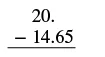
How much change would you get if you handed the cashier a $20 bill for a $14.65 purchase? We will show the steps to calculate this in the next example.
Subtract: 20−14.65.
Solution

Solution

20−14.65
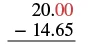
Write the numbers vertically so the decimal points line up. Remember 20 is a whole number, so place the decimal point after the 0. .
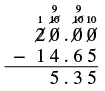
Place two zeros after the decimal point in 20, as place holders so that both numbers have two decimal places. .
Subtract the numbers as if they were whole numbers. Then place the decimal in the answer under the decimal points in the given numbers. .
Subtract: 2.51−7.4.
Solution

Solution

If we subtract 7.4 from 2.51, the answer will be negative since 7.4>2.51. To subtract easily, we can subtract 2.51 from 7.4. Then we will place the negative sign in the result.
2.51−7.4
Write the numbers vertically so the decimal points line up. .
Place zero after the 4 in 7.4 as a place holder, so that both numbers have two decimal places. .
Subtract and place the decimal in the answer. .
Remember that we are really subtracting 2.51−7.4 so the answer is negative. 2.51−7.4=−4.89

Use Decimals in Money Applications

We often apply decimals in real life, and most of the applications involving money. The Strategy for Applications we used in The Language of Algebra gives us a plan to follow to help find the answer. Take a moment to review that strategy now.
Paul received $50 for his birthday. He spent $31.64 on a video game. How much of Paul’s birthday money was left?
Solution

Solution

What are you asked to find? How much did Paul have left?
Write a phrase. $50 less $31.64
Translate. 50−31.64
Simplify. 18.36
Write a sentence. Paul has $18.36 left.
Jessie put 8 gallons of gas in her car. One gallon of gas costs $3.529. How much does Jessie owe for the gas? (Round the answer to the nearest cent.)
Solution

Solution

What are you asked to find? How much did Jessie owe for all the gas?
Write a phrase. 8 times the cost of one gallon of gas
Translate. 8($3.529)
Simplify. $28.232
Round to the nearest cent. $28.23
Write a sentence. Jessie owes $28.23 for her gas purchase.
Four friends went out for dinner. They shared a large pizza and a pitcher of soda. The total cost of their dinner was $31.76. If they divide the cost equally, how much should each friend pay?
Solution

Solution

What are you asked to find? How much should each friend pay?
Write a phrase. $31.76 divided equally among the four friends.
Translate to an expression. $31.76÷4
Simplify. $7.94
Write a sentence. Each friend should pay $7.94 for his share of the dinner.
Be careful to follow the order of operations in the next example. Remember to multiply before you add.
Marla buys 6 bananas that cost $0.22 each and 4 oranges that cost $0.49 each. How much is the total cost of the fruit?
Solution

Solution

What are you asked to find? How much is the total cost of the fruit?
Write a phrase. 6 times the cost of each banana plus 4 times the cost of each orange
Translate to an expression. 6($0.22)+4($0.49)
Simplify. $1.32+$1.96
Add. $3.28
Write a sentence. Marla's total cost for the fruit is $3.28.

Model Addition of Mixed Numbers with a Common Denominator

So far, we’ve added and subtracted proper and improper fractions, but not mixed numbers. Let’s begin by thinking about addition of mixed numbers using money.
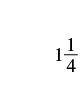
If Ron has 1 dollar and 1 quarter, he has 114 dollars.
If Don has 2 dollars and 1 quarter, he has 214 dollars.
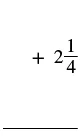
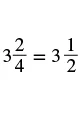
What if Ron and Don put their money together? They would have 3 dollars and 2 quarters. They add the dollars and add the quarters. This makes 324 dollars. Because two quarters is half a dollar, they would have 3 and a half dollars, or 312 dollars.
114+214________324=312
When you added the dollars and then added the quarters, you were adding the whole numbers and then adding the fractions.
114+214
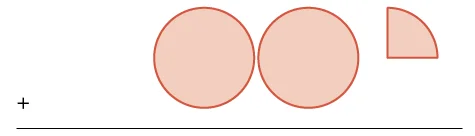
We can use fraction circles to model this same example:
114+214
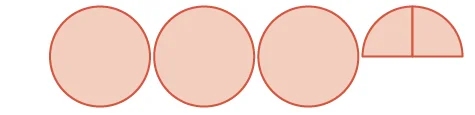
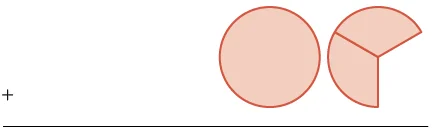
Start with 114. one whole and one 14 pieces . .
Add 214 more. two wholes and one 14 pieces . .
The sum is: three wholes and two 14's . .
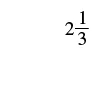
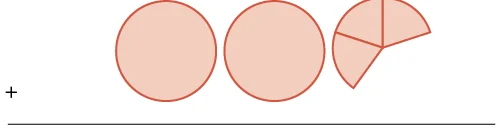
Model 213+123 and give the sum.
Solution

Solution

We will use fraction circles, whole circles for the whole numbers and 13 pieces for the fractions.
two wholes and one 13 . .
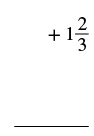
plus one whole and two 13s . .
sum is three wholes and three 13s . .
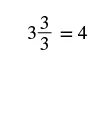
This is the same as 4 wholes. So, 213+123=4.
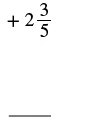
Model 135+235 and give the sum as a mixed number.
Solution

Solution

We will use fraction circles, whole circles for the whole numbers and 15 pieces for the fractions.
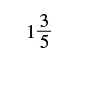
one whole and three 15s . .
plus two wholes and three 15s. . .
sum is three wholes and six 15s . .
Adding the whole circles and fifth pieces, we got a sum of 365. We can see that 65 is equivalent to 115, so we add that to the 3 to get 415.

Add Mixed Numbers

Modeling with fraction circles helps illustrate the process for adding mixed numbers: We add the whole numbers and add the fractions, and then we simplify the result, if possible.
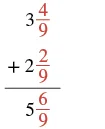
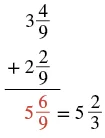
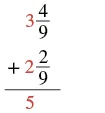
Add: 349+229.
Solution

Solution

349+229
Add the whole numbers. .
Add the fractions. .
Simplify the fraction. .
In worked example, the sum of the fractions was a proper fraction. Now we will work through an example where the sum is an improper fraction.
Find the sum: 959+579.
Solution

Solution

959+579
Add the whole numbers and then add the fractions. 959 +579_____ 14129
Rewrite 129 as a mixed number. 14+139
Add. 1539
Simplify. 1513
An alternate method for adding mixed numbers is to convert the mixed numbers to improper fractions and then add the improper fractions. This method is usually written horizontally.
Add by converting the mixed numbers to improper fractions: 378+438.
Solution

Solution

378+438
Convert to improper fractions. 318+358
Add the fractions. 31+358
Simplify the numerator. 668
Rewrite as a mixed number. 828
Simplify the fraction. 814
Since the problem was given in mixed number form, we will write the sum as a mixed number.
table compares the two methods of addition, using the expression 325+645 as an example. Which way do you prefer?
Mixed Numbers Improper Fractions
325+6459659+659+1151015 325+645175+3455151015

Conclusion

After solving a question, describe which quantity was unknown. For a missing starting amount, reverse the change to recover it. Cross-check a written subtraction by adding the difference back to the amount subtracted. If the result differs, return to the first column where a regrouping took place.