Search
Menu

GCSE 9-1 Practice Papers

Filter the resources by board and subject, then use the matching mark scheme to diagnose a missed question.

Quick Answer

Choose GCSE practice papers by exam board, subject and tier. Mark a timed attempt with the matching scheme and use the breakdown to choose a topic for revision before repeating a full paper.
A practice paper, timer and geometry ruler

Papers

Higher Set A Paper 1 – Non Calculator

Higher Set A Paper 2 – Calculator

Higher Set A Paper 3 – Calculator

Higher Set B Paper 1 – Non Calculator

Higher Set B Paper 2 – Calculator

Higher Set B Paper 3 – Calculator

Higher Set C Paper 1 – Non Calculator

Higher Set C Paper 2 – Calculator

Higher Set C Paper 3 – Calculator

Higher Set D Paper 1 – Non Calculator

Higher Set D Paper 2 – Calculator

Higher Set D Paper 3 – Calculator

Model Solutions

Higher Set A Paper 1 – Non Calculator Model Solutions

Higher Set A Paper 2 – Calculator Model Solutions

Higher Set A Paper 3 – Calculator Model Solutions

Higher Set B Paper 1 – Non Calculator Model Solutions

Higher Set B Paper 2 – Calculator Model Solutions

Higher Set B Paper 3 – Calculator Model Solutions

Higher Set C Paper 1 – Non Calculator Model Solutions

Higher Set C Paper 2 – Calculator Model Solutions

Higher Set C Paper 3 – Calculator Model Solutions

Higher Set D Paper 1 – Non Calculator Model Solutions

Higher Set D Paper 2 – Calculator Model Solutions

Higher Set D Paper 3 – Calculator Model Solutions

Foundation Papers

Papers

Foundation Set A Paper 1 – Non Calculator

Foundation Set A Paper 2 – Calculator

Foundation Set A Paper 3 – Calculator

Foundation Set B Paper 1 – Non Calculator

Foundation Set B Paper 2 – Calculator

Foundation Set B Paper 3 – Calculator

Foundation Set C Paper 1 – Non Calculator

Foundation Set C Paper 2 – Calculator

Foundation Set C Paper 3 – Calculator

Foundation Set D Paper 1 – Non Calculator

Foundation Set D Paper 2 – Calculator

Foundation Set D Paper 3 – Calculator

Model Solutions

Foundation Set A Paper 1 – Non Calculator Model Solutions

Foundation Set A Paper 2 – Calculator Model Solutions

Foundation Set A Paper 3 – Calculator Model Solutions

Foundation Set B Paper 1 – Non Calculator Model Solutions

Foundation Set B Paper 2 – Calculator Model Solutions

Foundation Set B Paper 3 – Calculator Model Solutions

Foundation Set C Paper 1 – Non Calculator Model Solutions

Foundation Set C Paper 2 – Calculator Model Solutions

Foundation Set C Paper 3 – Calculator Model Solutions

Foundation Set D Paper 1 – Non Calculator Model Solutions

Foundation Set D Paper 2 – Calculator Model Solutions

Foundation Set D Paper 3 – Calculator Model Solutions

GCSE Practice Paper Hub

GCSE Practice Paper Resource Finder

Select your exam board and subject to find suggested resources for practice papers.

Select your exam board and subject, then click "Find Resources".

Why Use GCSE Practice Papers?

What are the benefits of using GCSE practice papers?

Using GCSE practice papers (also called past papers or specimen papers) is one of the most effective revision strategies. Here's why:

  • Familiarisation with Exam Format: You get used to the structure of the exam, the types of questions asked, the wording, and the time allocated for each section.
  • Identifying Knowledge Gaps: Attempting papers helps you pinpoint topics or areas where your understanding is weak and needs more focus.
  • Improving Time Management: Practicing under timed conditions helps you learn to pace yourself and allocate enough time for each question.
  • Understanding Mark Schemes: Reviewing mark schemes after attempting a paper shows you exactly what examiners are looking for and how marks are awarded. This can be invaluable.
  • Reducing Exam Anxiety: The more familiar you are with the exam format and what to expect, the less anxious you're likely to feel on the actual exam day.
  • Developing Exam Technique: You learn how to interpret questions correctly, structure your answers effectively, and avoid common pitfalls.
  • Reinforcing Learning: Actively retrieving information to answer questions helps solidify it in your memory.

Where to Find GCSE Practice Papers (General Advice)

Where can I find GCSE practice papers (free and paid)?

There are several excellent sources for GCSE practice papers:

  • Official Exam Board Websites: This is the BEST place to start. Exam boards provide a range of past papers, specimen papers (for new specifications), and mark schemes for free.
    • AQA: Search "AQA past papers [subject]"
    • Edexcel (Pearson): Search "Edexcel past papers [subject]"
    • OCR: Search "OCR past papers [subject]"
    • Eduqas (WJEC): Search "Eduqas past papers [subject]"
    • CCEA: Search "CCEA past papers [subject]"
  • School Resources: Your teachers will likely have access to past papers and may provide them as part of your revision. Some schools subscribe to platforms that offer practice materials.
  • Revision Websites and Platforms: Many websites offer free or subscription-based access to practice papers and revision resources. Examples include:
    • BBC Bitesize: Often has links to exam board materials and its own revision content.
    • Physics & Maths Tutor: A popular free resource with a vast collection of papers for Maths and Sciences, and increasingly other subjects.
    • Maths Genie: Excellent for Maths practice papers and topic-based questions.
    • Seneca Learning: Offers interactive courses and often incorporates past paper style questions.
    • Other subject-specific sites may exist.
  • Revision Books and Workbooks (Paid): Companies like CGP, Collins, Letts, and others publish books containing practice papers and exam-style questions. These often come with answers and sometimes detailed mark schemes or explanations.
    • These are useful for additional practice beyond what's on exam board websites.
    • Ensure they are for the correct exam board and specification (e.g., 9-1 GCSEs).
  • Online Marketplaces (for older or specific papers): Sometimes older papers or specific sets (e.g., "AQA GCSE Maths 9 1 practice papers set 2") might be found through online sellers, but always prioritize official sources first.

Important: Always try to use papers that are relevant to your current specification (e.g., the 9-1 grading system for most GCSEs in England).

Are there practice papers for specific tiers (e.g., Maths Foundation)?

Yes. For subjects that are tiered, like GCSE Mathematics (Foundation and Higher tiers), exam boards provide separate practice papers for each tier.

  • Foundation Tier: Designed for students aiming for grades 1-5.
  • Higher Tier: Designed for students aiming for grades 4-9.

When searching on exam board websites or looking at revision books, make sure you are accessing papers for the correct tier you are entered for. Using papers for the wrong tier will not be an effective use of your revision time.

What about practice papers for specific years or sets (e.g., "AQA GCSE Maths 2018", "Edexcel Set 1")?

Exam boards release past papers from previous exam series. These are actual papers sat by students in years like 2017, 2018, 2019, etc. (though availability might be affected by events like the pandemic years).

They also often release "specimen papers" or "practice sets" (e.g., Set 1, Set 2, Set 3, Set 4) when a new specification is introduced to give teachers and students an idea of the new exam format. These are valuable resources.

While specific papers from a certain year (e.g., "AQA GCSE Maths Practice Papers 2015") might be from an older specification if the course has changed significantly, they can still sometimes be useful for practicing general skills. However, always prioritize papers from the most current specification you are studying.

Using Practice Papers Effectively

How should I use GCSE practice papers effectively?
  • Start Early, But Not Too Early: Begin using practice papers once you have covered a significant portion of the course content. Don't jump in before you've learned the material.
  • Attempt Under Timed Conditions: This simulates the real exam environment and helps you practice time management.
  • Work in a Quiet Environment: Minimize distractions, just like in an exam hall.
  • Don't Look at the Mark Scheme First: Attempt the paper to the best of your ability without looking at the answers or mark scheme.
  • Mark Your Work Honestly: Use the official mark scheme to grade your paper. Be critical and identify where you lost marks.
  • Analyse Your Mistakes: This is the most crucial step.
    • Why did you get a question wrong? Was it a lack of knowledge, a misinterpretation of the question, a calculation error, or poor exam technique?
    • Make notes on areas you need to revise or skills you need to improve.
  • Review Topics You Struggled With: Go back to your notes, textbook, or online resources to strengthen your understanding of weak areas.
  • Don't Just Do Papers – Learn From Them: The goal isn't just to complete lots of papers, but to actively learn and improve from each one.
  • Vary the Papers: Use a mix of recent past papers, specimen papers, and potentially papers from different sets if available.
  • Discuss with Teachers: If you're unsure about why you lost marks or how to improve, ask your teacher for guidance.

Always check the exam board and specification! Ensure the practice papers you are using match the exam board (e.g., AQA, Edexcel) and the specific course code/specification your school is following, especially with the 9-1 grading system.

Information about grade boundaries for specific past papers can usually be found on the exam board websites alongside the papers and mark schemes, often in a separate "grade boundaries" document for that exam series.

Separate the mathematical model from an arithmetic slip

A rectangular garden has perimeter thirty metres and width six metres. If an answer gives eighteen metres for the length, inspect the setup before marking the arithmetic. The perimeter counts two lengths and two widths. Subtracting twelve from thirty leaves eighteen metres for both lengths together. The single length is nine metres. Substituting nine and six into twice their sum returns thirty. When reviewing a paper, record whether the error came from the model, the rearrangement or the final arithmetic. Each cause suggests a different practice question.

Identifying Triangles
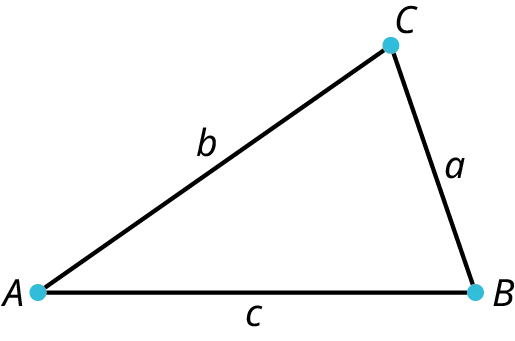
Joining any three noncollinear points with line segments produces a triangle. For example, given points A, B, and C, connected by the line segments AB¯,BC,¯ and AC¯, we have a triangle, as shown in diagram.
A triangle with points A, B, and C, and sides a, b, and c.
Triangle
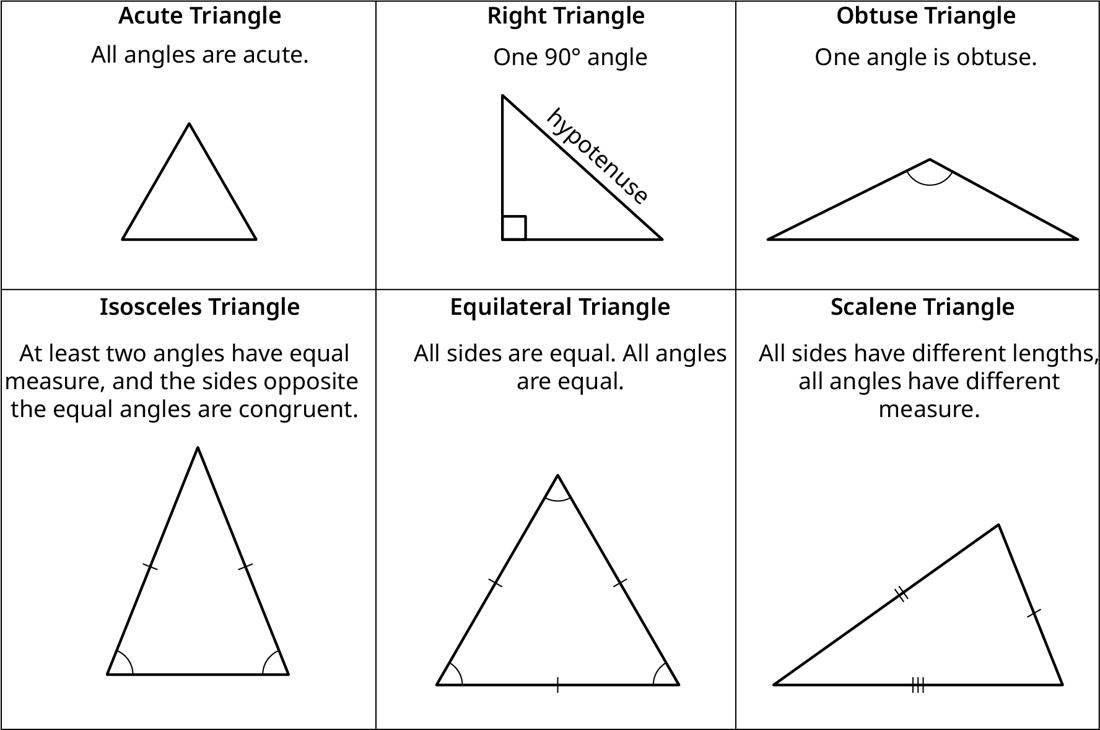
Triangles are classified by their angles and their sides. All angles in an acute triangle measure <90∘. One of the angles in a right triangle measures 90∘, symbolized by □. One angle in an obtuse triangle measures between 90∘ and 180∘. Sides that have equal length are indicated by the same hash marks. diagram illustrates the shapes of the basic triangles, their names, and their properties.
A few other facts to remember as we move forward:
  • The points where the line segments meet are called the vertices (plural for vertex).
  • We often refer to sides of a triangle by the angle they are opposite. In other words, side a is opposite angle A, side b is opposite angle B, and side c is opposite angle C.
Six triangles. An acute triangle. A right triangle. An obtuse triangle. An isosceles triangle has two equal sides and two equal angles. An equilateral triangle has all three sides equal and all three angles are equal. A scalene triangle. All three sides are unequal.
Types of Triangles
We want to add a special note about right triangles here, as they are referred to more than any other triangle. The side opposite the right angle is its longest side and is called the hypotenuse, and the sides adjacent to the right angle are called the legs.
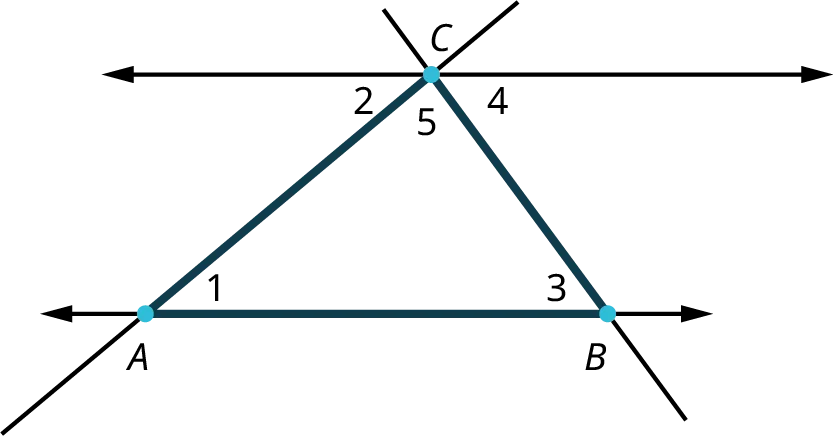
One of the most important properties of triangles is that the sum of the interior angles equals 180∘. Euclid discovered and proved this property using parallel lines. The completed sketch is shown in diagram.
Two horizontal lines intersected by two transversals. The first transversal makes four angles with the bottom line. Two angles are unknown. One of the interior angles is marked 1 and one of the exterior angles is marked A. The second transversal makes four angles with the bottom line. Two angles are unknown. One of the interior angles is marked 3 and one of the exterior angles is marked B. The two transversals meet at a point on the line at the top. Six angles are formed around this intersection point. The interior angles are labeled 2, 5, and 4. Two exterior angles are unknown and the third angle is marked C.
Sum of Interior Angles
This is how the proof goes:
Step 1: Start with a straight line AB↔ and a point C not on the line.
Step 2: Draw a line through point C parallel to the line AB↔.
Step 3: Construct two transversals (a line crossing the parallel lines), one angled to the right and one angled to the left, to intersect the parallel lines.
Step 4: Because of the property that alternate interior angles inside parallel lines are equal, we have that
m∡2=m∢1andm∡3=m∡4.
Step 5: Notice that m∡2+m∡5+m∡4=180∘ by the straight angle property.
Step 6: Therefore, by substitution, m∡1=m∡2, and m∡3=m∡4, we have that
m∡1+m∡3+m∢5=180∘.
Therefore, the sum of the interior angles of a triangle=180∘.

Finding Measures of Angles Inside a Triangle
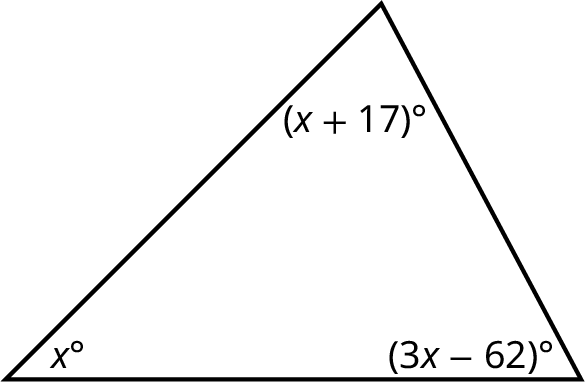
Find the measure of each angle in the triangle shown (diagram). We know that the sum of the angles must equal 180∘.
A triangle with its angles marked x degrees, (x plus 17) degrees, and (3 x minus 62)
Solution
Step 1: As the sum of the interior angles equals 180∘, we can use algebra to find the measures:
x+(x+17)+(3x−62)=1805x−45=1805x=225x=2255=45
Step 2: Now that we have the value of x, we can substitute 45 into the other two expressions to find the measure of those angles:
(x+17)=45+17=62∘(3x−62)=3(45)−62=135−62=73∘
Step 3: Then, m∡x=45∘, m∡(x+17)=62∘, and m∡(3x−62)=73∘.

Finding Angle Measures

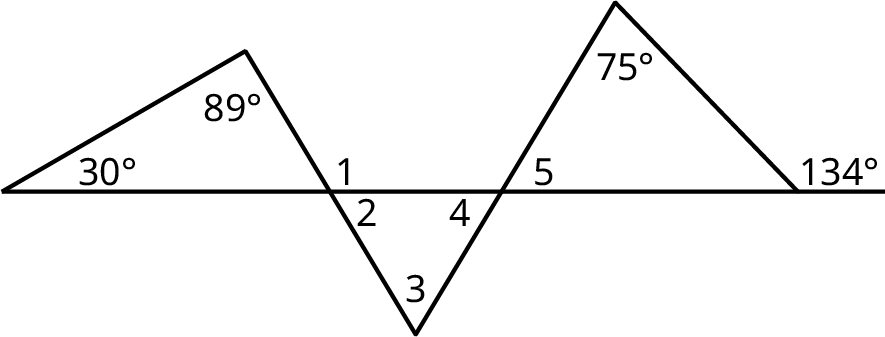
Find the measure of angles numbered 1–5 in diagram.
Three triangles lie on a horizontal line. The first and third triangles lie above the line and the second triangle lies below the line. The interior angles of the first triangle measure 30 degrees, 89 degrees, and unknown. The exterior angle made by this triangle with the line is labeled 1. The interior angles of the second triangle measure 2, 3, and 4. The interior angles of the third triangle are labeled 5, 75 degrees, and unknown. The exterior angle made by this triangle with the line is labeled 134 degrees.
Solution
The m∡1=119∘ because it is supplementary with the unknown angle of the adjacent triangle. The unknown angle measures 61∘. The m∡2=61∘ because of vertical angles. The m∡5=59∘ because the angle that is supplementary to the 134∘ measures 46∘, and angle 5 is the unknown angle in that triangle. The m∡4=59∘ by vertical angles. Finally, m∡3=60∘, as it is the third angle in the triangle with angles measuring 59∘ and 61∘.

Congruence

If two triangles have equal angles and their sides lengths are equal, the triangles are congruent. In other words, if you can pick up one triangle and place it on top of the other triangle and they coincide, even if you have to rotate one, they are congruent.

Determining If Triangles Are Congruent
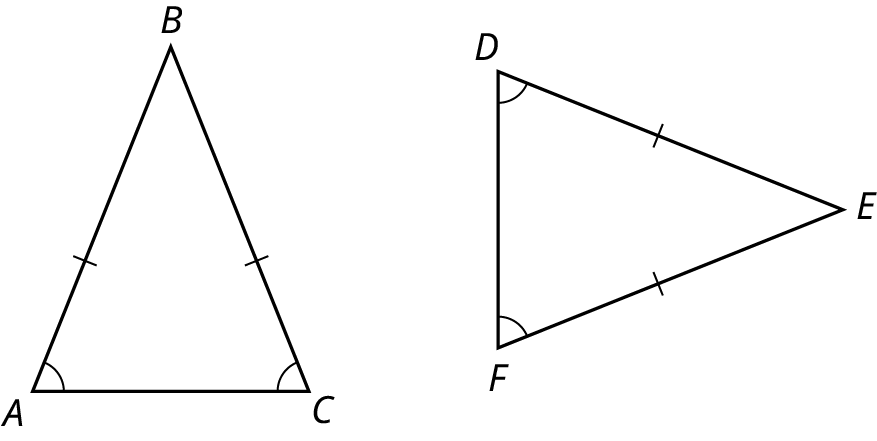
In diagram, is the triangle ABC congruent to triangle DEF?
Two triangles, A B C and D E F. Angles A and C are equal and congruent to angles D and F. The sides, A B and B C are equal. The side, A B is congruent to the side, D E. The sides, D E and E F are equal. The side, B C is congruent to the side, E F.
Solution
Triangle ABC is congruent to triangle DEF. Angles A and C are congruent to angles D and F, which implies that angle B is congruent to angle E. Side AB is congruent to side DE, and side CB is congruent to side FE, which implies that side AC is congruent to side DF.

The Congruence Theorems

The following theorems are tools you can use to prove that two triangles are congruent. We use the symbol ≅ to define congruence. For example, ΔABC≅ΔDEF.
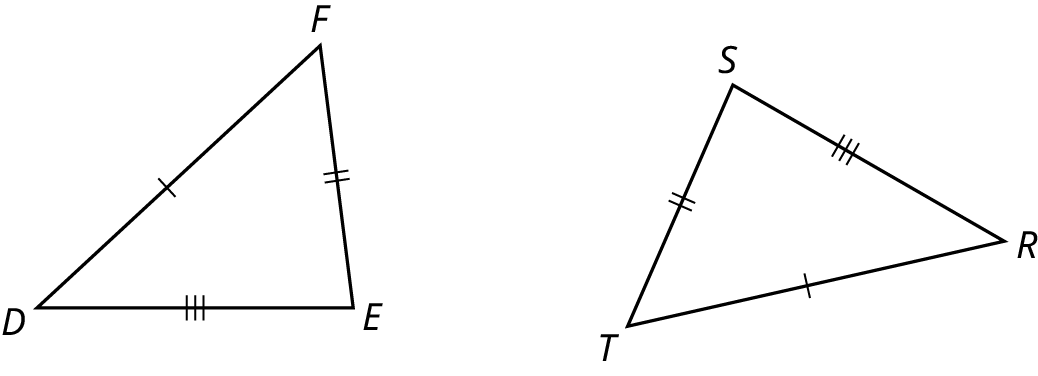
Side-Side-Side (SSS). If three sides of one triangle are equal to the corresponding sides of the second triangle, then the triangles are congruent. See diagram.
Two triangles, D E F and R S T. The side, D F is congruent to the side, R T. The side, E F is congruent to the side, S T. The side, D E is congruent to the side, R S.
Side-Side-Side (SSS)
We have that DF¯≅RT¯, EF¯≅ST¯, and DE¯≅RS¯, then ΔDEF≅ΔRST.
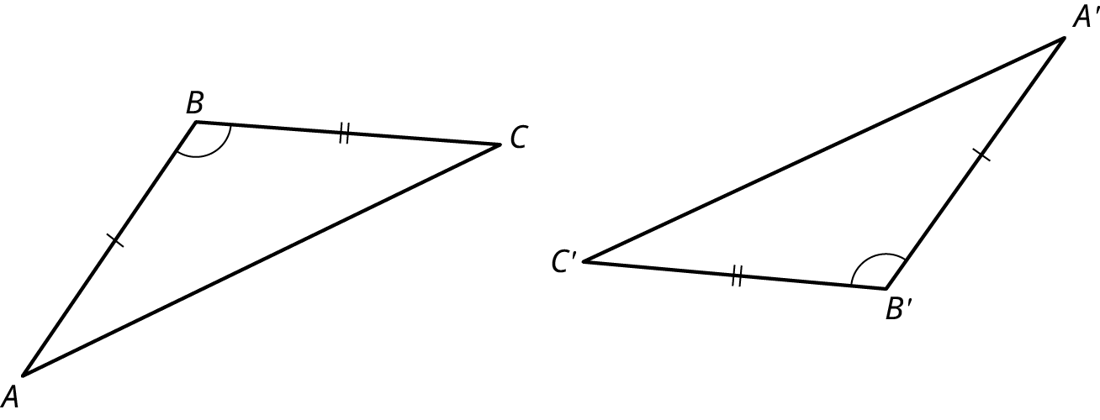
Side-Angle-Side (SAS). If two sides of a triangle and the angle between them are equal to the corresponding two sides and included angle of the second triangle, then the triangles are congruent. See diagram. We see that AB¯≅A′B′¯ and BC¯≅B′C′¯, m∡B=m∡B′, then ΔABC≅ΔA′B′C′.
Two triangles, A B C and A prime B prime C prime. The angles, B and B prime are congruent. The side, A B is congruent to the side, A prime B prime. The side, B C is congruent to the side, B prime C prime.
Side-Angle-Side (SAS)
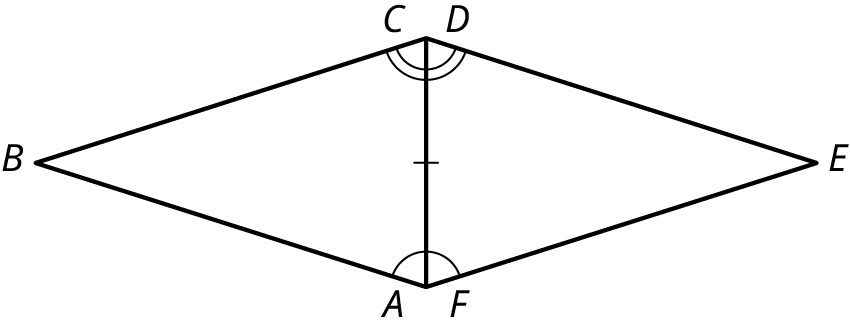
Angle-Side-Angle (ASA). If two angles and the side between them in one triangle are congruent to the two corresponding angles and the side between them in a second triangle, then the two triangles are congruent. See diagram. Notice that m∡A≅m∡F, and m∡C≅m∡D, AC¯≅DF¯, then ΔABC≅ΔDEF.
Two triangles, A B C and D E F. The sides, C A and D F rest on the same line. The sides, C A and D F are equal. The angles, A and F are congruent. The angles, C and D are congruent.
Angle-Side-Angle (ASA)
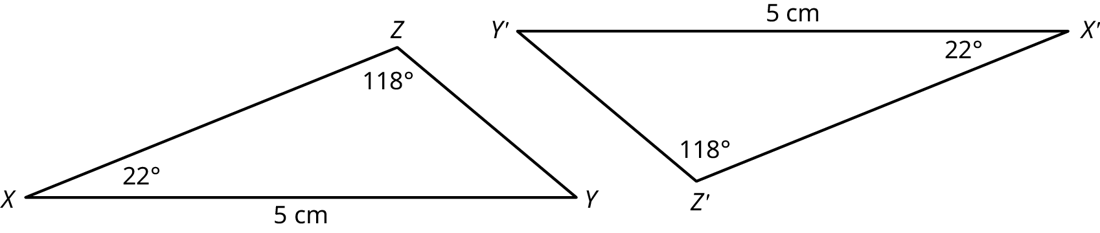
Angle-Angle-Side (AAS). If two angles and a nonincluded side of one triangle are congruent to two angles and the nonincluded corresponding side of a second triangle, then the triangles are congruent.
See diagram. We see that m∡X≅mX′, m∡Z≅m∡Z′, and XY¯≅X′Y′¯, then ΔXYZ≅ΔX′Y′Z′.
Two triangles, X Y Z and X prime Y prime Z prime. In the triangle X Y Z, the side X Y measures 5 centimeters, and the angles X and Z measure 22 degrees and 118 degrees. In the triangle, X prime Y prime Z prime, the side X prime Y prime measures 5 centimeters, and the angles X prime ad Z prime measure 22 degrees and 118 degrees.
Angle-Angle-Side (AAS)

Identifying Congruence Theorems

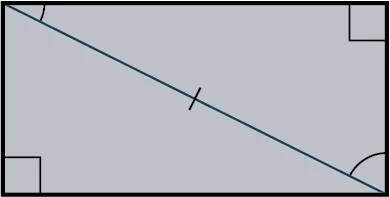
What congruence theorem is illustrated in diagram?
A rectangle is formed by joining two right triangles. The hypotenuses of both the triangles share the same side. The top-left and bottom-right angles of the rectangle are equal.
Solution
AAS: Two angles and a non-included side in one triangle are congruent to the corresponding angles and side in the second triangle.

Determining the Congruence Theorem

What congruence theorem is illustrated in diagram?
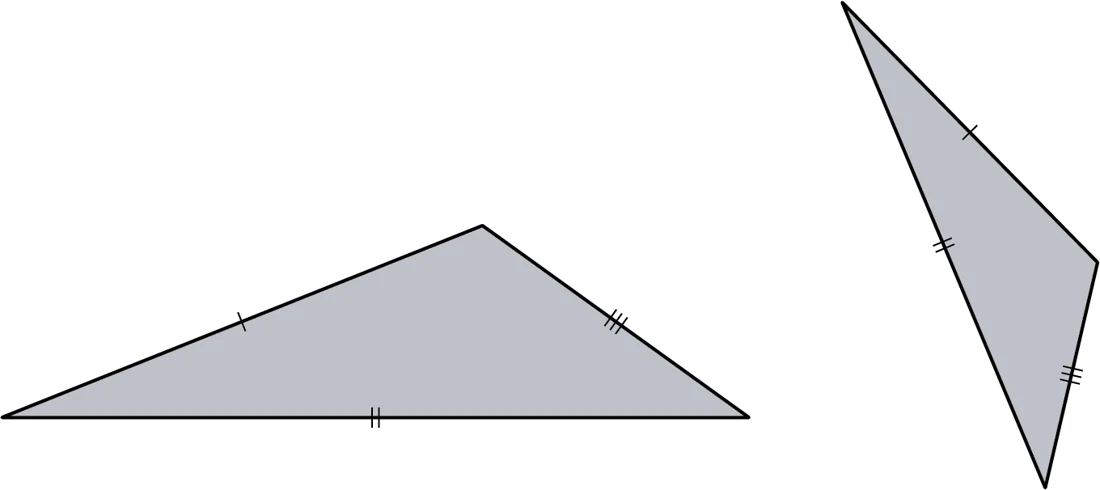
Two triangles. All three sides of each triangle are of different lengths.
Solution
The SSS theorem.

Similarity

If two triangles have the same angle measurements and are the same shape but differ in size, the two triangles are similar. The lengths of the sides of one triangle will be proportional to the corresponding sides of the second triangle. Note that a single fraction ab is called a ratio, but two fractions equal to each other is called a proportion, such as ab=cd.
This rule of similarity applies to all shapes as well as triangles. Another way to view similarity is by applying a scaling factor, which is the ratio of corresponding measurements between an object or representation of the object, to an image that produces the second, similar image.
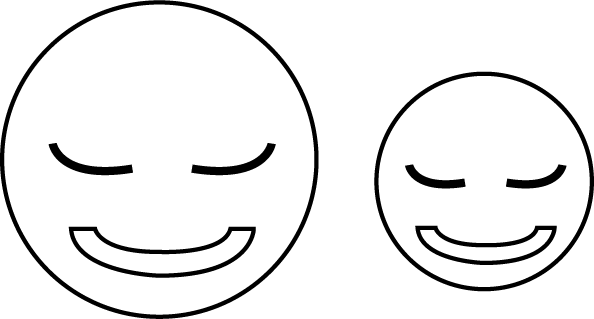
For example, why are the two images in diagram are similar? These two images have the same proportions between elements. Therefore, they are similar.
Two smiley faces. The first one is bigger and the second one is smaller.
Similarity

Determining If Triangles Are Similar
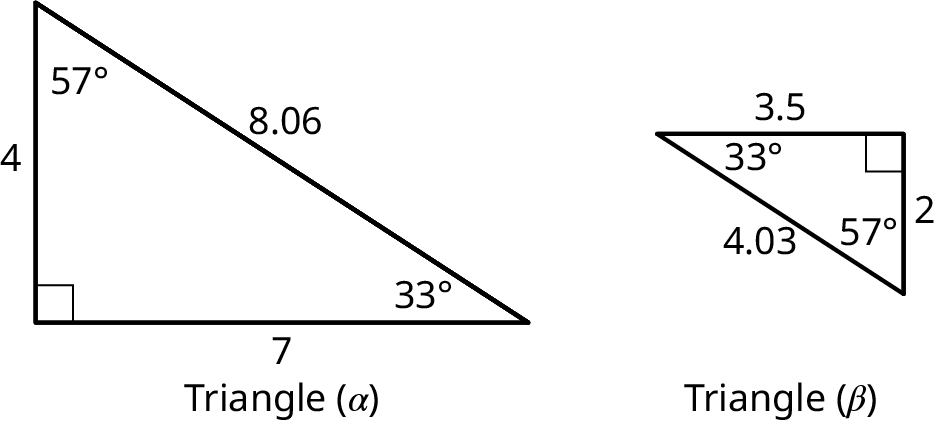
Are the two triangles shown in diagram similar?
Two right triangles. In the first triangle, the legs measure 4 and 7. The hypotenuse measures 8.06. The top, bottom-left, and bottom-right angles measure 57 degrees, 90 degrees, and 33 degrees. The triangle is labeled alpha. In the second triangle, the legs measure 3.5 and 2. The hypotenuse measures 4.03. The bottom, top-left, and top-right angles measure 57 degrees, 33 degrees, and 90 degrees. The triangle is labeled beta.
Solution
Step 1: We will look at the proportions within each triangle. In triangle α (alpha), the side opposite the 57∘ angle measures 7, and the side opposite the 33∘ angle measures 4. Then, the measures of the corresponding sides in triangle β (beta) measures 3.5 and 2, respectively. We have
47=0.571423.5=0.5714.
This is the proportion 47=23.5. The scaling factor is 0.5714.
Step 2: Let’s try another correspondence. In triangle α, the hypotenuse measures 8.06 and the side opposite the 57∘ angle measures 7. In triangle β, the hypotenuse measure 4.03 and the side opposite the 57∘ angle measures 3.5. We have
78.06=0.86853.54.03=0.8685.
Step 3: Now, let’s look at the proportions between triangle α and triangle β. The side measuring 2 in triangle β corresponds to the side measuring 4 in triangle α, the side measuring 3.5 in triangle β corresponds to the side measuring 7 in triangle α, and the hypotenuse in triangle β corresponds to the hypotenuse in triangle α. We have
24=0.53.57=0.54.038.06=0.5
Thus, the corresponding angles are equal and the proportions between each pair of corresponding sides equals 0.5. In other words, the scaling factor is 0.5. Therefore, the triangles are similar.

Proving Similarity

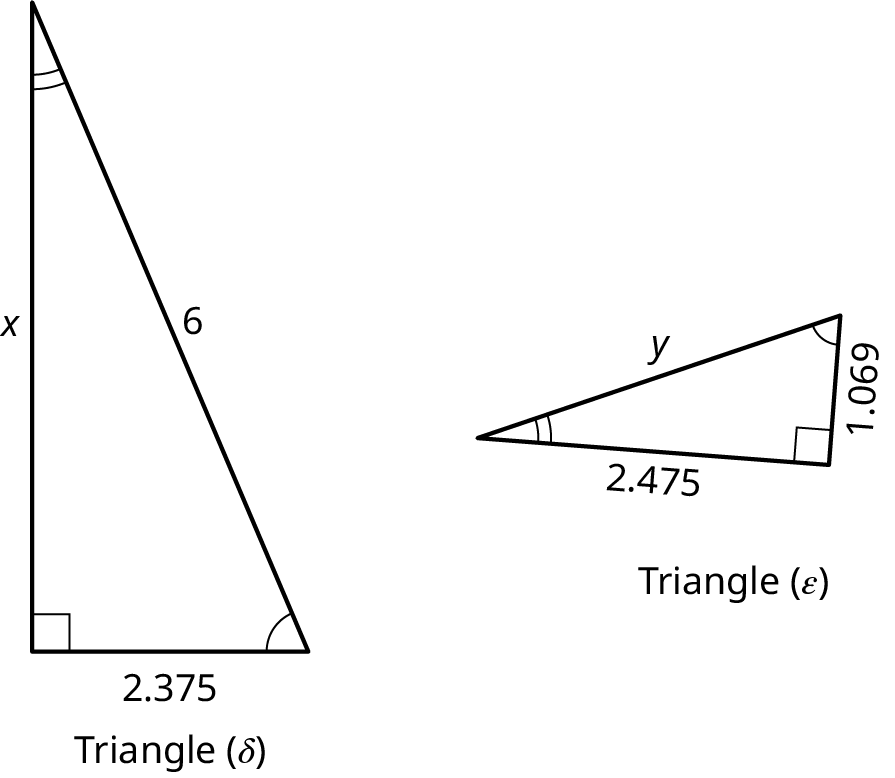
In diagram, is triangle δ (delta) similar to triangle ε (epsilon)? Find the lengths of sides x and y as part of your answer.
Two right triangles are labeled delta and epsilon. In the first triangle, the legs measure x and 2.375. The hypotenuse measures 6. In the second triangle, the legs measure 2.475 and 1.069. The hypotenuse measures y. The angles in both the triangles are congruent.
Solution
We can see that all three angles in triangle δ are equal to the corresponding angles in triangle ε. That is enough to determine similarity. However, we want to find the values of x and y to prove similarity.
Step 1: We have to do is set up the proportions between the corresponding sides. We have the side that measures 2.375 in triangle δ corresponding to the side measuring 1.069 in triangle ε. We have the hypotenuse/side in triangle δ measuring 6 corresponding to the hypotenuse/side labeled y in triangle ε. And, finally, the side labeled x in triangle δ corresponds to the side measuring 2.475 in triangle ε.
Each proportion should be equal. We start with the proportion of the shorter sides. Thus
1.0692.375=0.45
Step 2: We solve for y using the first proportion. Set the two ratios equal to each other, cross-multiply, and solve for y. We have:
1.0692.375=y6(6)(1.069)=(2.375)(y)6.414=2.375y6.4142.375=2.7=y
So, y=2.7.
Step 3: Checking that length in the proportion factor of 0.45, we have:
y6=2.76=0.45
Step 4: Solving for x, we will use the same proportion we used to solve for y. We have:
1.0692.375=2.475x1.069(x)=2.475(2.375)1.069(x)=5.878x=5.8781.069=5.52.475x=2.4755.5=0.45
Step 5: We test the proportions. We have the following:
2.76=2.4755.5=1.0692.375=0.45
The proportions are all equal. Therefore, we have proven the property of similarity between triangle δ and triangle ε.

Applying Similar Triangles

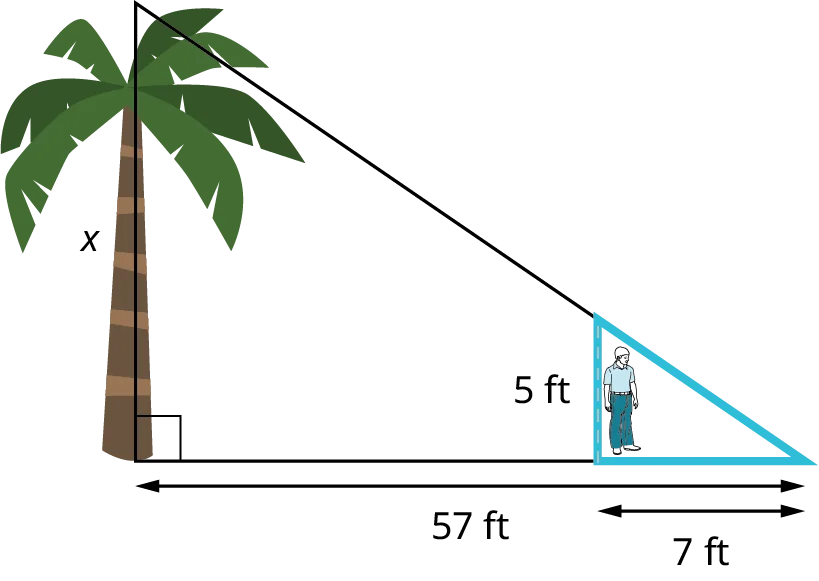
A person who is 5 feet tall is standing 50 feet away from the base of a tree (diagram). The tree casts a 57-foot shadow. The person casts a 7-foot shadow. What is the height of the tree?
An illustration of a palm tree and stick figure person shows a right triangle. The vertical leg shows a tree and it measures x. The hypotenuse is unknown. The horizontal leg measures 57 feet. A boy who is 5 feet tall is standing 50 feet away from the base of the tree. The boy casts a shadow of 7 feet.
Solution
The bigger triangle includes a tree at side x and the smaller triangle includes the person at the side labeled 5 ft. These two triangles are similar because the smaller triangle fits inside the larger triangle at the smallest angle. It would fit inside the larger triangle at either of the other two angles as well. That all angles are equal is one of the criteria for similar triangles, so we can solve using proportions:
57=x575(57)=7x2857=x=40.7
The tree is 40.7 feet tall.

Finding Missing Lengths

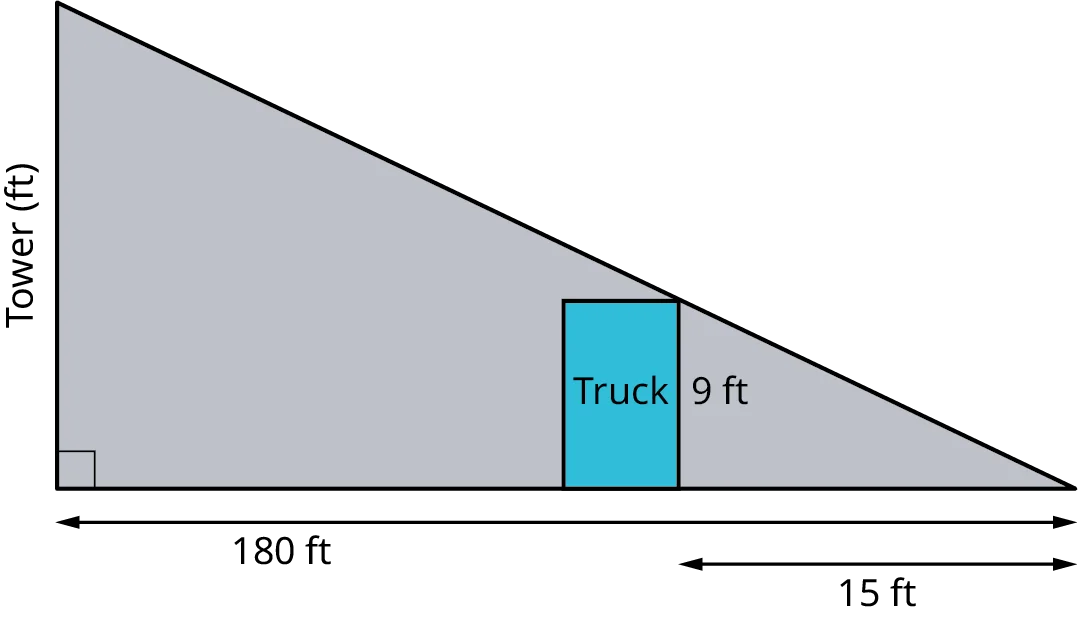
At a certain time of day, a radio tower casts a shadow 180 feet long (diagram). At the same time, a 9-foot truck casts a shadow 15 feet long. What is the height of the tower?
An illustration shows a right triangle. The vertical leg resembles a tower of x feet high. The horizontal leg measures 180 feet. A truck of 9 feet casts a shadow of 15 feet. The truck lies 15 feet to the left from the bottom-right of the triangle.
Solution
These are similar triangles and the problem can be solved by using proportions:
x180=9159(180)=15x1620=15x108=x
The height of the tower is 108 ft.

Check Your Understanding

Algebraic Expressions and Equations

Xavier and Yasenia have the same birthday, but they were born in different years. This year Xavier is 20 years old and Yasenia is 23, so Yasenia is three years older than Xavier. When Xavier was 15, Yasenia was 18. When Xavier will be 33, Yasenia will be 36. No matter what Xavier’s age is, Yasenia’s age will always be 3 years more.
In the language of algebra, we say that Xavier's age and Yasenia's age are variable and the 3 is a constant. The ages change, or vary, so age is a variable. The 3 years between them always stays the same or has the same value, so the age difference is the constant. In algebra, letters of the alphabet are used to represent variables. The letters most often used for variables are x, y, z, a, b, and c. Suppose we call Xavier's age x. Then we could use x+3 to represent Yasenia's age, as shown in the table below.
Xavier’s Age Yasenia’s Age
15 18
20 23
33 36
x x+3
To write algebraically, we need some symbols as well as numbers and variables. The symbols for the four basic arithmetic operations: addition, subtraction, multiplication, and division are summarized in table, along with words we use for the operations and the result.
Symbols for Operations
Operation Notation Say: The result is…
Addition a+b a plus b The sum of a and b
Subtraction a − b a minus b The difference of a and b
Multiplication a • b, (a)(b), (a)b, a(b), ab, ba a times b The product of a and b
Division a ÷ b, a/b a divided by b The quotient of a and b
We perform these operations on two numbers. When translating from symbolic form to words, or from words to symbolic form, pay attention to the words of or and to help you find the numbers.
  • The sum of 5 and 3 means add 5 plus 3, which we write as 5+3.
  • The difference of 9 and 2 means subtract 9 minus 2, which we write as 9−2.
  • The product of 4 and 8 means multiply 4 times 8, which we can write as 4•8.
  • The quotient of 20 and 5 means divide 20 by 5, which we can write as 20÷5.

Translating from Algebra to Words

Translate the following algebraic expressions from algebra into words.
  1. 12+14
  2. (30)(5)
  3. 64÷8
  4. x−y
Solution
  1. According to table, this could be translated as 12 plus 14 OR the sum of 12 and 14.
  2. According to table, this could be translated as 30 times 5 OR the product of 30 and 5.
  3. According to table, this could be translated as 64 divided by 8 OR the quotient of 64 and 8.
  4. According to table, this could be translated as x minus y OR the difference of x and y.

Translating from Words to Algebra

Translate the following phrases from words into algebraic expressions.
  1. The difference of 47 and 19
  2. 72 divided by 9
  3. The sum of m and n
  4. 13 times 7
Solution
  1. According to table, these words could be translated as 47−19.
  2. According to table, these words could be translated as 72÷9.
  3. According to table, these words could be translated as m+n.
  4. According to table, these words could be translated as (13)(7).
What is the difference in English between a phrase and a sentence? A phrase expresses a single thought that is incomplete by itself, but a sentence makes a complete statement. “Running very fast” is a phrase, but “The football player was running very fast” is a sentence. A sentence has a subject and a verb. In algebra, we have expressions and equations. worked example and worked example used expressions. An expression is like an English phrase. Notice that the English phrases do not form a complete sentence because the phrase does not have a verb. The following table has examples of expressions, which are numbers, variables, or combinations of numbers and variables using operation symbols.
Expression Words English Phrase
3+5 3 plus 5 The sum of three and five
n−1 n minus one The difference of n and one
6•7 6 times 7 The product of six and seven
x÷y x divided by y The quotient of x and y

Translating from an English Phrase to an Expression

Translate the following phrases from words into algebraic expressions.
  1. Seven more than a number n.
  2. A number n times itself.
  3. Six times a number n, plus two more.
  4. The cost of postage is a flat rate of 10 cents for every parcel, plus 34 cents per ounce x.
Solution
  1. n+7
  2. n•n or n2
  3. 6n+2
  4. 10+34x
An equation is two expressions linked with an equal sign (the symbol =). When two quantities have the same value, we say they are equal and connect them with an equal sign. When you read the words the symbols represent in an equation, you have a complete sentence in English. The equal sign gives the verb. So, a = b is read “a is equal to b.” The following table has some examples of equations.
Equation English Sentence
3+5=8 The sum of three and five is equal to eight.
n−1=14 n minus one equals fourteen.
6•7=42 The product of six and seven is equal to forty-two.
x=53 x is equal to fifty-three.
y+9=2y−3 y plus nine is equal to two times y minus three.

Translating from an English Sentence to an Equation

Translate the following sentences from words into algebraic equations.
  1. Two times x is 6.
  2. n plus 2 is equal to n times 3.
  3. The quotient of 35 and 7 is 5.
  4. Sixty-seven minus x is 56.
Solution
  1. 2x=6
  2. n+2=3n
  3. 35÷7=5
  4. 67−x=56