
Bra Size Calculator
Use this Bra Size Calculator to estimate a starting US bra size from your snug underbust and full bust measurements. It also shows an alternate traditional estimate, your approximate cup difference, nearby sister sizes, and practical fit notes. All formulas are displayed in proper math style with MathJax.
Calculate Your Starting Bra Size
Enter your snug underbust and fullest bust measurement. This tool returns a useful starting estimate, not a final guarantee.
Your Bra Size Estimate
Review the starting size, alternate estimate, sister sizes, and fit guidance.
Formula Snapshot
This calculator converts your measurements to inches, rounds the underbust to a starting band estimate, and uses the bust-minus-band difference to estimate cup size.
How to read the result
The first output is your most practical starting size. The alternate size uses a more traditional band method. The sister sizes help when the cups feel right but the band feels too tight or too loose. Move down a band and up a cup, or up a band and down a cup, to keep roughly similar cup volume.
What Is a Bra Size Calculator?
A bra size calculator is a measurement-based tool that estimates a likely starting bra size from two key body measurements: the circumference of the ribcage directly under the bust and the circumference around the fullest part of the bust. At first glance, that sounds like a simple clothing-size problem. In reality, it is more complex because bras are engineered garments. They depend not only on circumference but also on support, tension, shape, cup volume, wire geometry, strap placement, stretch, and brand-specific grading. That is why a bra size calculator should be treated as a smart starting point rather than a final verdict carved in stone.
This page is designed to do more than print a number. It helps users understand how the estimate is produced, how the band and cup interact, what sister sizes mean, why brand variation is real, and how to use the result when shopping online or comparing styles. That educational layer matters because many people do not trust calculators that behave like black boxes. They want to know why a result changes when one measurement changes, why a 34C is not simply “bigger” than every other B or A size, and why one bra in the same labeled size can feel excellent while another feels completely wrong.
A strong calculator page therefore has two jobs. First, it gives a useful estimate quickly. Second, it teaches users how to interpret that estimate. That is the approach used here. The tool returns a starting US bra size, an alternate traditional estimate, cup difference, nearby sister sizes, and practical fit notes. The long-form guide then explains the logic in plain language so the user can move from measurement to confident decision-making.
Why Bra Sizing Feels Confusing
Bra sizing is confusing because the size label is made from two separate dimensions that interact with each other: the band size and the cup size. The band is the number, such as 32, 34, or 36. The cup is the letter, such as A, B, C, D, DD, or beyond. Many people assume the cup letter alone tells you how large the cup is. That is only partly true. In reality, a cup letter is meaningful only relative to its band. A 32D and a 38D are not the same cup volume. The letter is attached to the band, not floating independently in space.
This is exactly why sister sizing exists. When the band changes, the cup usually has to change with it if you want similar volume. A smaller band with the same printed cup letter is not the same fit. A larger band with the same printed cup letter is not the same fit either. Once users understand that, bra sizing becomes less mysterious. The number and the letter are a system, not two unrelated tags.
Another reason bra sizing feels inconsistent is that different brands construct bras differently. Some bras have taller cups, wider wires, more projected shapes, stretchier bands, firmer bands, more closed necklines, lower gores, side support panels, molded foam, or unlined fabric. Even two bras with the same printed size can behave differently on the body because they are built differently. That is why the calculator on this page deliberately calls its output a starting size estimate.
The Two Core Measurements
Most size estimates begin with two measurements:
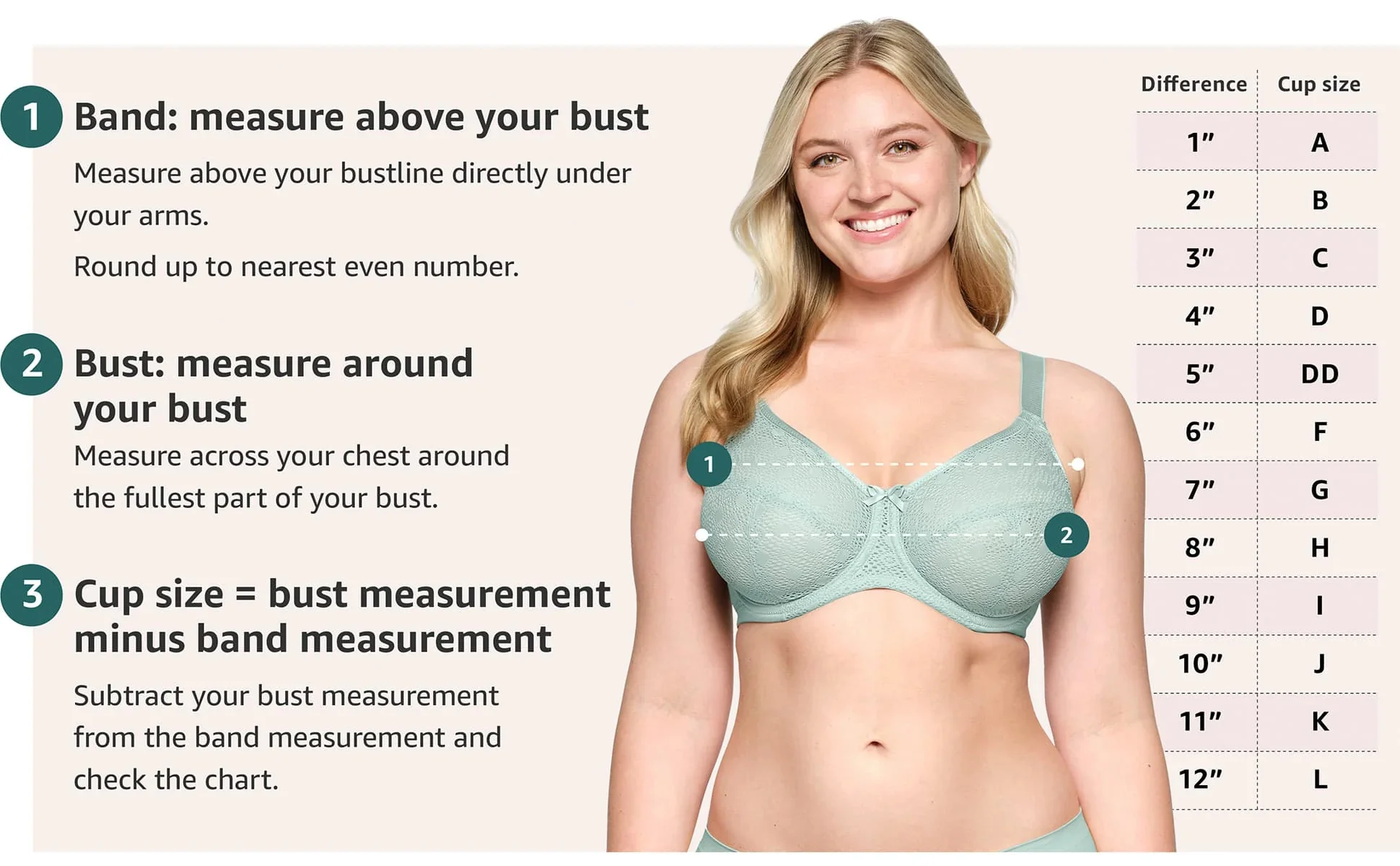
- Snug underbust: the tape is wrapped firmly around the ribcage directly under the bust.
- Full bust: the tape is wrapped around the fullest part of the bust while staying level around the body.
The underbust helps estimate the band. The difference between the bust measurement and the band estimate helps approximate the cup. That is the core logic behind many basic bra-size systems. However, there are multiple band-sizing traditions. Some modern fitters prefer a snugger direct-underbust approach. Some older systems use added inches. Some brands quietly fit more like one method than another. That is why this calculator shows both a main estimate and an alternate traditional estimate.
Main sizing idea
The simplest sizing logic can be described like this:
Where:
- \(B\) = fullest bust measurement
- \(\text{Band}\) = estimated band size
Once the cup difference is known, the calculator maps that difference to a cup letter. In a simple US-style progression, a difference near 1 inch corresponds roughly to A, 2 inches to B, 3 inches to C, 4 inches to D, and so on. The exact naming beyond D varies by market and brand, which is another reason sizing can feel inconsistent.
Band estimate idea
A modern starting estimate often uses a direct underbust approach:
This is not universal law. It is a practical starting approach that many people find more realistic for firm band support than older add-inches methods.
Why the Band Matters So Much
Many people focus first on the cup because the cup letter feels more visible and more emotionally loaded. In practice, the band is often the real anchor of support. A well-fitting bra usually gets most of its support from the band rather than the straps. If the band is too loose, the straps are forced to work too hard, the center may not tack well, the cups may shift, and the whole garment may feel unstable. If the band is too tight, the bra may feel restrictive, painful, or difficult to wear for long periods.
This is why the calculator includes a band preference input. Some users prefer a firmer band because they want more locked-in support. Others prefer a slightly more relaxed feel for softer daily wear or more forgiving fabrics. Neither preference is morally right or wrong. It is a practical choice based on comfort, tissue softness, activity, and style type.
A sports bra, for example, often benefits from a more secure feeling than a lounge bralette. A strapless bra also tends to rely heavily on band security because there are no straps to assist. That is why bra type matters. The exact same body measurements may point to slightly different best-fit decisions depending on what kind of bra the user is shopping for.
How Cup Sizing Works
Once the band estimate is chosen, the calculator compares the full bust measurement with that band estimate. The difference becomes the cup estimate. In a simplified US progression, the mapping often looks like this:
- 0 inches difference ≈ AA
- 1 inch difference ≈ A
- 2 inches difference ≈ B
- 3 inches difference ≈ C
- 4 inches difference ≈ D
- 5 inches difference ≈ DD/E
- 6 inches difference ≈ DDD/F
Beyond that point, different markets use different naming systems. Some brands continue with G, H, I, J. Others use double letters in different ways. UK notation also diverges after D, using sequences like DD, E, F, FF, G, GG, and so on. This page keeps the calculator output focused on a practical US-style starting estimate while also showing a UK-style label version for quick comparison.
Cup index approximation
This is an approximation step. Real fit can shift because some people are between cup steps, some bras run shallow or projected, and some fabrics stretch more than others.
What Sister Sizes Mean
Sister sizes are one of the most useful concepts in bra fitting. They help explain why “the cups feel right but the band feels wrong” is actually fixable without starting from zero. If the band is too tight but the cups feel close, you can often go up one band and down one cup. If the band is too loose but the cups feel close, you can often go down one band and up one cup.
For example, if 34B feels close in cup volume but the band feels too loose, 32C may be worth trying. If 34B feels close in cup volume but the band feels too tight, 36A may be worth trying. Those are sister sizes. They are not identical in every construction detail, but they aim for roughly similar cup volume while changing band tension.
Sister sizing rule
This concept saves time when shopping online. Instead of assuming the first estimate failed, the user can make a structured adjustment. It also helps when one brand runs tight in the band and another runs loose. Sister sizing is not guesswork; it is one of the most practical fitting tools available.
Why Final Fit Can Still Change by Brand
Even a good calculator cannot see the exact shape of the cups, the softness of the tissue, the root width of the breast, the height of the wires, or the stretch of the band fabric. That is why brand variation matters. A molded T-shirt bra may feel different from an unlined balconette in the same labeled size. A plunge can position tissue differently from a full-cup style. A soft lace bra may feel more forgiving than a rigid cup. None of those differences mean the calculator failed. They simply reflect how real bra design works.
This is also why experienced shoppers often keep a small size range rather than one rigid label in mind. Someone might fit well in 34C in one style, 32D in another, and 36B in a softer style depending on the band tension and cup cut. The core task of a calculator is to narrow the search intelligently. It is not to pretend the human body or garment construction can always be reduced to one perfect number-letter pair.
How to Measure Correctly
- Use a soft tape measure and stand naturally.
- For the underbust, wrap the tape around the ribcage directly under the bust. Keep it level and snug.
- For the full bust, measure around the fullest part of the bust while keeping the tape parallel to the floor.
- Do not let the tape slip upward at the back.
- Record the numbers without inflating the chest or over-tightening the bust measurement.
If you are between measurements, do not panic. That is normal. Bodies are not manufactured objects. The calculator rounds the estimate to give a workable starting point. If you know your body fluctuates during the month, or if you have noticeable asymmetry, the fit notes help you interpret the result more realistically.
Tip for asymmetry
If one breast is somewhat larger than the other, it is usually more practical to fit the larger side first and then adjust the smaller side with strap tuning or removable inserts if needed. That approach tends to be more comfortable than forcing the larger side into a cup that is too small.
Modern Band Estimate vs Traditional Alternate Estimate
One reason online bra calculators often disagree is that they are not all using the same band method. Some use a more modern direct-underbust logic. Others follow an older add-inches method. Instead of hiding that difference, this page makes it visible by showing both a main estimate and a traditional alternate estimate.
The modern-style estimate is usually more useful when the goal is firm support and current fit logic. The traditional alternate can still be helpful because some brands and fit systems behave closer to that older method. Showing both helps the user understand why they may have seen different size suggestions on different websites.
This is not a contradiction. It is transparency. A calculator becomes more trustworthy when it acknowledges that sizing systems have history and variation.
How to Use the Result for Online Shopping
If you are buying online, treat the main result as your anchor and the sister sizes as your first adjustment path. Start with the recommended size. Then think through likely issues:
- If the band rides up, it may be too loose.
- If the straps dig in but the band feels loose, the band may be doing too little.
- If the cups gap, the cup may be too large or the shape may be mismatched.
- If tissue spills out, the cup may be too small or the neckline may be too closed.
- If the band feels almost right but not quite, try a sister size before abandoning the whole estimate.
This is especially useful for first-time shoppers, because many returns happen not because the calculator was wildly wrong, but because the user did not know what the next logical adjustment should be.
Common Fit Problems and What They Usually Mean
Cup gaping can mean the cup is too large, but not always. It can also happen when the cup shape is too tall or too open for the breast shape. Spillage often means the cup is too small, but sometimes it means the bra style is too closed at the top edge. Band riding up usually points to a band that is too loose. Painful underwire can mean a cup issue, a wire-width mismatch, a shape problem, or simply an unhelpful bra design.
This is why the calculator’s fit note output is phrased carefully. It gives directional guidance, not absolute diagnosis. Fit issues are pattern-recognition problems. The measurement gives a starting coordinate; the body in the actual bra gives the final answer.
Why This Calculator Uses US Sizes
Bra-size naming systems differ across regions. US, UK, and EU systems do not label advanced cup sizes identically. That can make a multi-system calculator look more comprehensive while actually becoming more confusing for the average user. This page therefore centers the result on a clear US starting size while also giving a quick UK-style label comparison for convenience.
That keeps the calculator readable and usable, especially for general consumers who mostly need a practical shopping starting point rather than a full international lingerie-standard conversion engine.
What This Calculator Does Not Do
This calculator does not claim to replace a professional fitting, a try-on session, or brand-specific fitting advice. It does not measure breast root width, wire tolerance, tissue softness, projection depth, top fullness, bottom fullness, or spacing. It does not determine whether you personally prefer more compression or more ease beyond the simple preference selector. It also does not guarantee that every 34C across every brand will fit the same, because that would not be true.
What it does do well is give you a rational starting point based on real measurements and fitting logic. That is exactly what a good calculator should do.
Who Should Use a Bra Size Calculator?
This tool is useful for people shopping online, people whose bodies have changed due to weight fluctuation, pregnancy, postpartum changes, training, or age-related changes, and anyone who has been wearing the same size for a long time without knowing whether it still makes sense. It is also useful for content readers who want to understand bra math clearly before buying anything at all.
For many users, the most valuable benefit is not just the size itself. It is confidence. Instead of guessing randomly between 34B, 36A, 34C, and 32D, the user gets a structured starting point and a small decision tree for what to try next.
Practical Example
Suppose your snug underbust is 32 inches and your full bust is 36 inches. A modern starting band estimate might round that underbust to a 32 band or 34 band depending on preference and exact measurement context. If the chosen starting band is 34, then:
A difference of 2 inches maps to about a B cup in a simple US progression, leading to a starting estimate of 34B. If the band later feels too loose but the cup volume feels close, a sister size such as 32C may be worth trying. If the band feels too tight but the cup feels close, 36A may be worth exploring.
That example shows why the main result and sister sizes belong together. The calculator is most useful when it helps users adapt the result intelligently.
Frequently Asked Questions
How does this bra size calculator work?
It uses your snug underbust and full bust measurements, converts them into a starting band estimate, calculates the difference between bust and band, and maps that difference to an approximate cup size.
Is the result my exact bra size?
No. It is a strong starting estimate. Final fit can change by brand, bra style, fabric stretch, cup shape, and personal comfort preference.
What are sister sizes?
Sister sizes are nearby sizes with roughly similar cup volume. If you go down one band, you usually go up one cup. If you go up one band, you usually go down one cup.
Why do different bra calculators give different answers?
They may use different band methods, different rounding rules, different cup progressions, or different market conventions such as US versus UK sizing.
Can I use centimeters instead of inches?
Yes. This calculator accepts centimeters and converts them internally so the size estimate still works.
What should I do if one breast is larger than the other?
As a starting strategy, fit the larger side first, then use strap adjustment or removable padding on the smaller side if needed for better symmetry.
Why does the calculator show an alternate traditional estimate?
Because some brands and older sizing systems still behave closer to add-inches methods. Seeing both estimates helps explain why different websites can suggest different sizes.
Final Thoughts
A good bra size calculator should do three things well: simplify the math, explain the logic, and respect the reality that bra fit is not fully universal. That is the purpose of this page. It gives users a starting US bra size, a traditional alternate, sister sizes, and fitting guidance in one clear interface.
For SEO, that combination matters too. A strong search page is not just a thin widget with two inputs. It is a genuinely helpful resource that answers the main query, explains the terms users are confused by, and helps them move from search intent to action. In this case, the action is finding a practical starting bra size and understanding what to try next.
Use the calculator, note the result, compare the sister sizes, and then let actual comfort confirm the final choice. That is a far better approach than random guessing, and it is exactly why a well-built bra size calculator belongs on a useful educational website.