Pair each Year 6 practice booklet with the correct materials and review the reasoning behind lost marks.
Quick Answer
Download free KS2 Year 6 SATs papers for English Reading, SPaG and Maths in one organised resource hub.
KS2 Year 6 SATs Papers
Download free KS2 Year 6 SATs papers for English Reading, SPaG and Maths in one organised resource hub. This page brings together past papers, reading answer booklets, spelling transcripts, mark schemes and scaled score thresholds so parents, pupils and tutors can revise with confidence.
If you are looking for Year 6 SATs past papers by subject and year, this page helps you quickly find the right paper, open the PDF in a popup viewer and move between English, grammar, punctuation, spelling and maths resources without leaving the page.
These KS2 Year 6 SATs papers are useful for home study, classroom revision, tuition sessions and timed practice. Instead of searching through separate sources for papers, answers and mark schemes, you can use the subject tabs below to find the exact document you need.
English Reading: reading booklets, answer booklets, marking schemes and score thresholds.
SPaG: grammar, punctuation and spelling papers, spelling transcripts, marking schemes and thresholds.
Maths: arithmetic and reasoning papers, mark schemes and scaled score thresholds.
Popup PDF viewer: click a paper link to preview it in a popup screen, with a direct open button as backup.
Quick filtering: search by year or keyword such as 2024, reasoning, spelling, mark scheme or thresholds.
KS2 English Reading Year 6 SATs Past Papers
22 exam years and 88 linked resources including papers, answer booklets, spelling transcripts, mark schemes and scaled score thresholds.
Note: External PDFs are hosted on third-party websites and all outbound links should remain nofollow. Older links in the uploaded source that used http were normalised to https in this code to reduce mixed-content issues on a secure page.
How to use Year 6 SATs papers effectively
Start with one recent paper in your chosen subject, complete it in timed conditions, then use the mark scheme to check performance and find weak areas. For maths, separate arithmetic from reasoning practice so pupils improve both speed and problem solving. For English, use reading papers to build comprehension accuracy, then use SPaG resources to strengthen punctuation, grammar knowledge and spelling habits.
Scaled score thresholds are also useful because they help families and tutors understand how raw marks may translate into reported performance bands. This makes revision more targeted and more realistic.
Revision tips for parents, tutors and pupils
Use one paper at a time and review mistakes immediately after marking.
Alternate between Reading, SPaG and Maths to build balanced preparation.
Practise recent years first, then use older years for extra repetition.
Keep mark schemes nearby so feedback is fast and consistent.
Use thresholds as a guide, not as the only measure of progress.
KS2 Year 6 SATs Papers FAQ
These quick answers support the structured data on the page and help users understand what is included.
What does this KS2 Year 6 SATs papers page include?
This page includes Year 6 KS2 SATs papers for English Reading, SPaG and Maths, plus answer booklets, spelling transcripts, mark schemes and scaled score thresholds where available.
Which years are covered on this page?
The collection covers Year 6 KS2 SATs resources from 2000 up to 2025, depending on subject availability in the uploaded source file.
Can I open the SATs PDFs without leaving the page?
Yes. The page uses a popup PDF viewer so you can preview most linked papers directly on the page, with a fallback button to open the file in a new tab if embedding is blocked by the source website.
Are these SATs papers useful for revision?
Yes. Past papers help pupils and parents practise arithmetic, reasoning, reading comprehension, spelling, grammar and punctuation under realistic exam-style conditions.
Do all years include mark schemes and score thresholds?
Many years do, but not every year includes every file type. Where a resource is not available, the page shows it as N/A.
Why are some old papers from external websites?
The files listed on this page point to publicly accessible external PDF resources. Those outbound links should be marked nofollow, and the page should make clear that the documents are hosted externally.
If the preview is blocked by the external host, use Open in new tab.
Review a two-step arithmetic question
A school buys seven packs containing twelve pencils each and shares the pencils equally among four classes. Find the total first: seven groups of twelve give eighty-four. Dividing by four gives twenty-one per class. A child who divides twelve by four first can also be correct: each class receives three pencils from every pack, giving seven times three. Comparing the two solutions helps identify valid alternative reasoning during marking. If the child answers three, ask what that number measures. It describes one class’s share from a single pack and leaves the seven packs unaccounted for.
Model Division of Whole Numbers
As we did with multiplication, we will model division using counters. The operation of division helps us organize items into equal groups as we start with the number of items in the dividend and subtract the number in the divisor repeatedly.
Model the division:
Solution
Solution
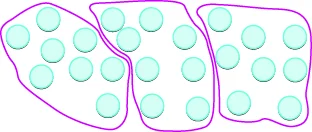
To find the quotient we want to know how many groups of are in
Model the dividend. Start with counters.
The divisor tell us the number of counters we want in each group. Form groups of counters.
Count the number of groups. There are groups.
Divide Whole Numbers in Applications
We will use the same strategy we used in previous sections to solve applications. First, we determine what we are looking for. Then we write a phrase that gives the information to find it. We then translate the phrase into math notation and simplify it to get the answer. Finally, we write a sentence to answer the question.
Cecelia bought a box of oatmeal at the big box store. She wants to divide the ounces of oatmeal into servings. She will put each serving into a plastic bag so she can take one bag to work each day. How many servings will she get from the big box?
Solution
Solution
We are asked to find the how many servings she will get from the big box.
Write a phrase.
160 ounces divided by 8 ounces
Translate to math notation.
Simplify by dividing.
Write a sentence to answer the question.
Cecelia will get 20 servings from the big box.
Find the Least Common Denominator
In the previous section, we explained how to add and subtract fractions with a common denominator. But how can we add and subtract fractions with unlike denominators?
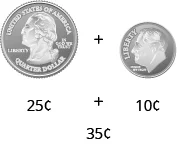
Let’s think about coins again. Can you add one quarter and one dime? You could say there are two coins, but that’s not very useful. To find the total value of one quarter plus one dime, you change them to the same kind of unit—cents. One quarter equals cents and one dime equals cents, so the sum is cents. See diagram.
Together, a quarter and a dime are worth cents, or of a dollar.
Similarly, when we add fractions with different denominators we have to convert them to equivalent fractions with a common denominator. With the coins, when we convert to cents, the denominator is Since there are cents in one dollar, cents is and cents is So we add to get which is cents.
You have practiced adding and subtracting fractions with common denominators. Now let’s see what you need to do with fractions that have different denominators.
First, we will use fraction tiles to model finding the common denominator of and
We’ll start with one tile and tile. We want to find a common fraction tile that we can use to match both and exactly.
If we try the pieces, of them exactly match the piece, but they do not exactly match the piece.
If we try the pieces, they do not exactly cover the piece or the piece.
If we try the pieces, we see that exactly of them cover the piece, and exactly of them cover the piece.
If we were to try the pieces, they would also work.
Even smaller tiles, such as and would also exactly cover the piece and the piece.
The denominator of the largest piece that covers both fractions is the least common denominator (LCD) of the two fractions. So, the least common denominator of and is
Notice that all of the tiles that cover and have something in common: Their denominators are common multiples of and the denominators of and The least common multiple (LCM) of the denominators is and so we say that is the least common denominator (LCD) of the fractions and
To find the LCD of two fractions, we will find the LCM of their denominators. We follow the procedure we used earlier to find the LCM of two numbers. We only use the denominators of the fractions, not the numerators, when finding the LCD.
Find the LCD for the fractions and
Solution
Solution
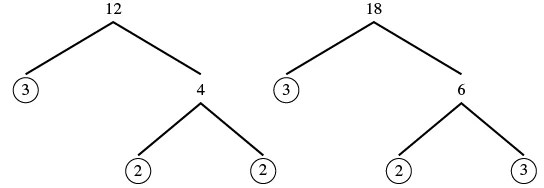
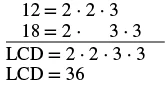
Factor each denominator into its primes.
List the primes of 12 and the primes of 18 lining them up in columns when possible.
Bring down the columns.
Multiply the factors. The product is the LCM.
LCM
The LCM of 12 and 18 is 36, so the LCD of and is 36.
LCD of and is 36.
To find the LCD of two fractions, find the LCM of their denominators. Notice how the steps shown below are similar to the steps we took to find the LCM.
Find the least common denominator for the fractions and
Solution
Solution
To find the LCD, we find the LCM of the denominators.
Find the LCM of and
The LCM of and is So, the LCD of and is
Add and Subtract Fractions with Different Denominators
Once we have converted two fractions to equivalent forms with common denominators, we can add or subtract them by adding or subtracting the numerators.
Add:
Solution
Solution
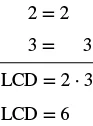
Find the LCD of 2, 3.
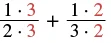
Change into equivalent fractions with the LCD 6.
Simplify the numerators and denominators.
Add.
Remember, always check to see if the answer can be simplified. Since and have no common factors, the fraction cannot be reduced.
Subtract:
Solution
Solution
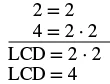
Find the LCD of 2 and 4.
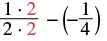
Rewrite as equivalent fractions using the LCD 4.
Simplify the first fraction.
Subtract.
Simplify.
One of the fractions already had the least common denominator, so we only had to convert the other fraction.
Add:
Solution
Solution
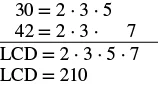
Find the LCD of 12 and 18.
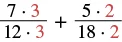
Rewrite as equivalent fractions with the LCD.
Simplify the numerators and denominators.
Add.
Because is a prime number, it has no factors in common with The answer is simplified.
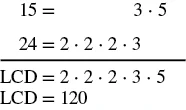
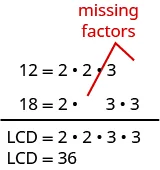
When we use the Equivalent Fractions Property, there is a quick way to find the number you need to multiply by to get the LCD. Write the factors of the denominators and the LCD just as you did to find the LCD. The “missing” factors of each denominator are the numbers you need.
The LCD, has factors of and factors of
Twelve has two factors of but only one of —so it is ‘missing‘ one We multiplied the numerator and denominator of by to get an equivalent fraction with denominator
Eighteen is missing one factor of —so you multiply the numerator and denominator by to get an equivalent fraction with denominator We will apply this method as we subtract the fractions in the next example.
Subtract:
Solution
Solution
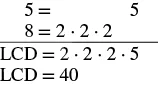
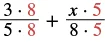
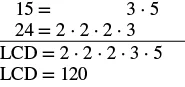
Find the LCD.15 is 'missing' three factors of 224 is 'missing' a factor of 5
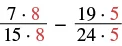
Rewrite as equivalent fractions with the LCD.
Simplify each numerator and denominator.
Subtract.
Rewrite showing the common factor of 3.
Remove the common factor to simplify.
Add:
Solution
Solution
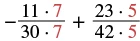
Find the LCD.
Rewrite as equivalent fractions with the LCD.
Simplify each numerator and denominator.
Add.
Rewrite showing the common factor of 2.
Remove the common factor to simplify.
In the next example, one of the fractions has a variable in its numerator. We follow the same steps as when both numerators are numbers.
Add:
Solution
Solution
The fractions have different denominators.
Find the LCD.
Rewrite as equivalent fractions with the LCD.
Simplify the numerators and denominators.
Add.
We cannot add and since they are not like terms, so we cannot simplify the expression any further.
Calculate the Total, Percent, or Part
The word “of” is used to indicate multiplication using fractions, as in “one-fourth of 56.” To find “one-fourth of 56” we would multiply 56 by one-fourth. We can think of percents as fractions with a specific denominator—100. So, to calculate “25% of 52,” we multiply 52 by 25%. But, first we need to convert the percent to either fractional form (25/100) or decimal form. Using the decimal form of 25% we have 0.25 × 52, which equals 13.
In this problem, 52 is the total or base, 25 is the percentage, and 13 is the percentage of 52, or the part of 52. This is sometimes referred to as the amount.
Knowing any two of the values in our formula allows us to calculate the third value. In the following example, we know the total and the percent, and are asked to find the percentage of the total.
Finding the Percent of a Total
Determine 70% of 3,500
Determine 156% of 720
Solution
The total is = 3,500, and the percent is = 70. The decimal form of 70% is 0.70. To find the part, or percent of the total, substitute those values into the formula and calculate.
From this, we say that 70% of 3,500 is 2,450.
The total is = 720, and the percent is = 156. The decimal form of 156% is 1.56. To find the part, or percent of the total, substitute those values into the formula and calculate.
From this, we say that 156% of 720 is 1,123.2.
In the previous example, we knew the total and the percent and found the part using our formula. We may instead know the percent and the part, but not the total. We can use our formula again to solve for the total.
Finding the Total from the Percent and the Part
What is the total if 35% of the total is 70?
What is the total if 10% of the total is 4,000?
Solution
Step 1: The percent is 35, which in decimal form is 0.35. We were given that 35% of the total is 70, so the part is 70. We are to find the total. Substituting into the formula, we have
Step 2: To find the total, we solve the equation for the total.
From this we see that 200 is the total, or, that 35% of 200 is 70.
Step 1: The percent is 10, which in decimal form is 0.1. We were given that 10% of the total is 4,000, so the part is 4,000. Substituting into the formula, we have
Step 2: To find the total, we solve the equation for the total.
From this we see that 40,000 is the total, or that 10% of 40,000 is 4,000.
Similarly, the percent can be found if the total and the percent of the total (the part) are known. This will result in the decimal form of the percent, so it must be converted to percent form.
Finding the Percent from the Total and the Part
What percent of 500 is 175?
What percent of 228 is 155?
Solution
Step 1: The total is 500, the percent of the total is 175. Substituting into the formula, we have
Step 2: To find the percent, we solve the equation for the percent.
We see the percent in decimal form is 0.35. Converting from the decimal form yields 35%. We say that 175 is 35% of 500.
Step 1: The total is 228, the percent of the total is 155. Substituting into the formula, we have
Step 2: To find the percent, we solve the equation for the percent.
We see the percent is 0.6798 (rounded to four decimal places). Converting from the decimal form yields 67.98%. We say that 155 is 67.98% of 228.
Solve Application Problems Involving Percents
Percents are frequently used in finance, research, science experiments, and even casual conversation. Understanding these types of values helps when consuming media or discussing finances, for instance. Effectively working with and interpreting numbers and percents will help you become an informed consumer of this information.
In most cases, working through what is presented requires you to identify that you are indeed working with a question of percents, which two of the three values that are related through percents are known, and which of the three values you need to find.
Retention Rate at College
Justine applies to a medium size university outside her hometown and finds out that the retention rate (percent of students who return for their sophomore year) for the 2021 academic year at the university was 84%. During a visit to the registrar’s office, she finds out that 1,350 people had enrolled in academic year 2021. How many students from the academic year 2021 are returning for the 2022 academic year?
Solution
The percent of students who will return for the 2022 academic year (the retention rate) is 84%. The total number of students who enrolled in the 2021 academic year was 1,350. This means the percent is known and the total is known. From this, we can determine the number of students who will return (percent of the total) for the 2022 academic year using the formula . Substituting into the formula and calculating, we find that the number of students that are returning is
So 1,134 students will return for the 2022 academic year.
Percent of Chemistry Majors
Cameron enrolls in a calculus class. In this class of 45 students, there are 18 chemistry majors. What percent of the class are chemistry majors?
Solution
In this situation, the percent is to be determined. We know the total number of students, 45, and the part of the students that are chemistry majors, 18. Using that information and the formula , the percent can be found. Substituting and solving, we have
Converting the 0.4 from decimal form, we find that 40% of the students in the calculus class are chemistry majors.
Total Sales and Commission
Mariel makes a 20% commission on every sale she makes. One week, her commission check is for $153.00. What were her total sales that week?
Solution
In this problem, Mariel’s total sales is to be determined. We know the percent she earns is 20%. We also know that her sales commission was $153.00, which is the percent of the total. Using this information and the formula we can find Mariel’s total sales. The decimal form of 20% is 0.2. The part, or percent of the total, is 153. Substituting and solving, we obtain
Mariel’s total sales were $765.00.
Area of Triangles
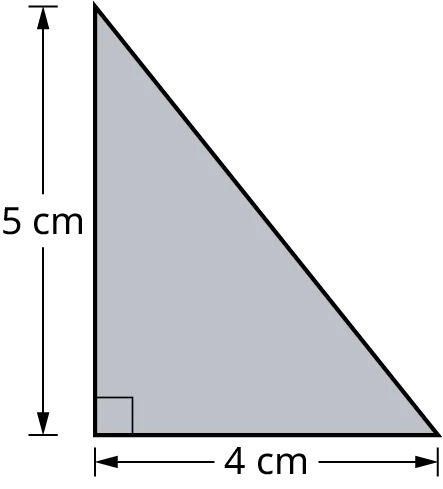
The formula for the area of a triangle is given as follows.
The base measures 4 cm and the height measures 5 cm. Using the formula, we can calculate the area:
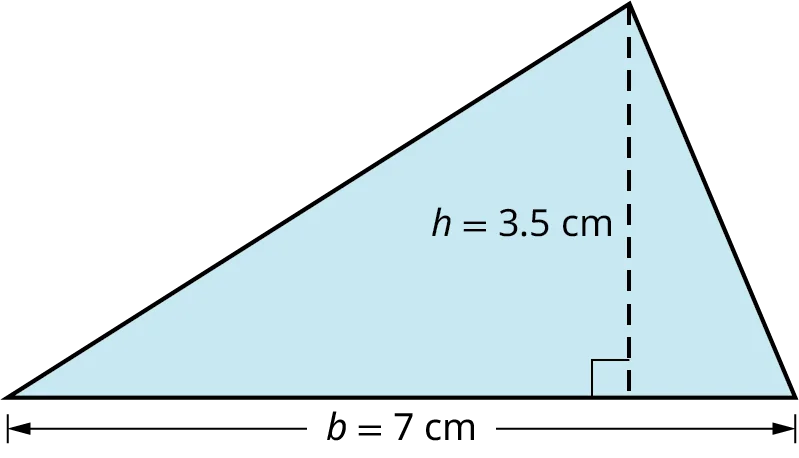
In diagram, the triangle has a base equal to 7 cm and a height equal to 3.5 cm. Notice that we can only find the height by dropping a perpendicular to the base. The area is then
Triangle 2
Finding the Area of a Triangle
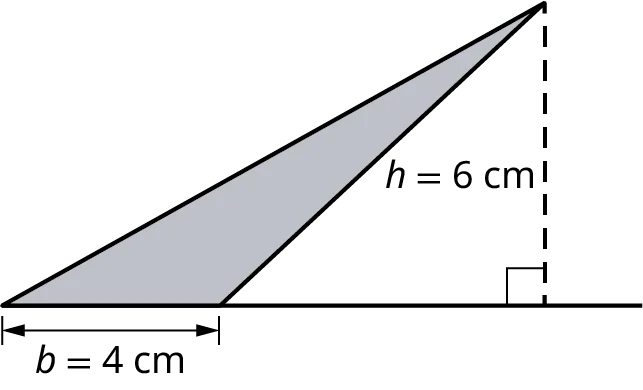
Find the area of this triangle that has a base of 4 cm and the height is 6 cm (diagram).
Solution
Using the formula, we have
Simplifying and Evaluating Algebraic Expressions
To simplify an expression means to do all the math possible. For example, to simplify we would first multiply to get 8 and then add 1 to get 9. We have introduced most of the symbols and notation used in algebra, but now we need to clarify the order of operations. Otherwise, expressions may have different meanings, and they may result in different values. Consider . Do you add first or multiply first? Do you get different answers?
Add first:
Multiply first:
Which one is correct?
Early on, mathematicians realized the need to establish some guidelines when performing arithmetic operations to ensure that everyone would get the same answer. Those guidelines are called the order of operations and are listed in the table below.
Step 1: Parentheses and Other Grouping Symbols
Simplify all expressions inside the parentheses or other grouping symbols, working on the innermost parentheses first.
Step 2: Exponents
Simplify all expressions with exponents.
Step 3: Multiplication and Division
Perform all multiplication and division in order from left to right. These operations have equal priority.
Step 4: Addition and Subtraction
Perform all addition and subtraction in order from left to right. These operations have equal priority.
Making a Numerical Equation True Using the Order of Operations
Use parentheses to make the following statements true.
Solution
Add the parentheses around the . Then you have .
Add the parentheses around the . Then you have .
Add the parentheses around the . Then you have .
Add the parentheses around the . Then you have .
In the last example, we simplified expressions using the order of operations. Now we'll evaluate some expressions—again following the order of operations. To evaluate an expression means to find the value of the expression when the variable is replaced by a given number.
Evaluating and Simplifying an Expression
Evaluate when .
Evaluate when .
Solution
To evaluate, let in the expression, and then simplify: .
To evaluate, let in the expression, and then simplify: .
Convert Between Percent, Decimal, and Fractional Values
When any calculation with a percent is to be performed, the form of the percent must be changed, either to its fractional form or its decimal form. We can change a percent into decimal form by dividing the percent by 100 and representing the result as a decimal.
Converting a Percent to Decimal Form
Convert the following percents to decimal form:
17%
7%
18.45%
Solution
To convert 17% to its decimal form, divide 17 by 100. This moves the decimal two places to the left, resulting in 0.17. The decimal form of 17% is 0.17.
To convert 7% to its decimal form, divide 7 by 100. This moves the decimal two places to the left, resulting in 0.07. The decimal form of 7% is 0.07.
To convert 18.45% to its decimal form, divide 18.45 by 100. This moves the decimal two places to the left, resulting in 0.1845. The decimal form of 18.45% is 0.1845.
You should notice that, to convert from percent to decimal form, you can simply move the decimal two places to the left without performing the division.
Converting the Decimal Form of a Percent to Percent
Convert each of the following to percent:
0.34
4.15
0.0391
Solution
Using the formula and = 0.34, we calculate , which gives us 34%.
Using the formula and = 4.15, we calculate , which gives us 415%.
Using the formula and = 0.0391, we calculate , which gives us 3.91%.
You should notice that, to convert from decimal form to percent form, you can simply move the decimal two places to the right without performing the multiplication.









 15 is 'missing' three factors of 224 is 'missing' a factor of 5