
Properties & Mixed Operations: Distributive Property, PEMDAS, and Order of Operations
Compare the grouping of two expressions before evaluating multiplication, division, addition and subtraction.
Quick Answer
Without the right order, 6 + 2 × 3 could be 24 OR 12... and only one is correct.
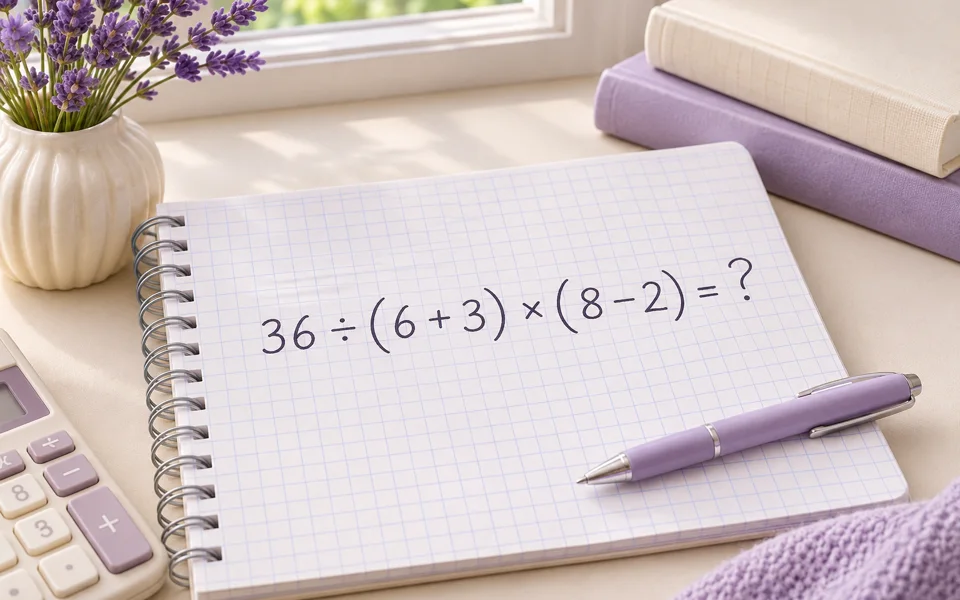
Read operations at the same level from left to right
Consider thirty-six divided by three times two. Multiplication and division have equal precedence, so evaluate from left to right. Thirty-six divided by three is twelve and twelve times two is twenty-four. If parentheses instead group three times two, the denominator becomes six and the value is six. Both results are consistent with the rules because the grouping differs. Read a fraction bar as a grouping device too: everything printed below it belongs to the denominator. Writing one complete intermediate expression per line helps preserve that grouping.
Simplify Expressions Using Order of Operations
The order in which mathematical operations is performed is a convention that makes it easier for anyone to correctly calculate. They follow the acronym EMDAS:
| E | Exponents |
| M/D | Multiplication and division |
| A/S | Addition and Subtraction |
So, what does EMDAS tell us to do? In an equation, moving left to right, we begin by calculating all the exponents first. Once the exponents have been calculated, we again move left to right, calculating the multiplications and divisions, one at a time. Multiplication and division hold the same position in the ordering, so when you encounter one or the other at this step, do it. Once the multiplications and divisions have been calculated, we again move left to right, calculating the additions and subtractions, one at a time. Additions and subtractions hold the same position in the ordering, so when you encounter one or the other at this step, do it. (You may have previously learned the order of operations as PEMDAS, with parentheses first; we will add that aspect later on.) We’ll explore this as we work an example.
Using Two Order of Operations
Calculate .
Solution
There are no exponents in this expression, so the next operations to check are multiplication and division.
Step 1: Moving left to right, the first multiplication encountered is 4 multiplied by 13. We perform that operation first.
Step 2: The only operation remaining is the subtraction.
.
So, .
Using Two Order of Operations
Calculate .
Solution
Step 1: Moving left to right, we see there is an exponent. We calculate the exponent first.
Step 2: The only operation remaining is the multiplication.
So, .
Using Three Order of Operations
Calculate .
Solution
Step 1: To calculate this, move left to right, and compute all the exponents first. The only exponent we see is the squaring of the 3, so that is calculated first.
Step 2: Since the exponents are all calculated, now calculate all the multiplications and divisions moving left to right. The only multiplication or division present is 9 times 4.
Step 3: Moving left to right, perform the additions and subtractions. There is only one such operation, 2 plus 36.
So, .
Even if the expression being calculated gets more complicated, we perform the operations in the order: EMDAS.
Using Eight Order of Operations
Correctly apply the order of operations to compute the following:
.
Solution
Step 1: To do so, calculate the exponents first, moving left to right. There are two occurrences of exponents in the expression, 3 squared and 2 cubed.
Step 2: Now that the exponents are calculated, perform the multiplication and division, moving left to right. The first is the product of 25 and 6.
Step 3: Next is the 150 divided by 10.
Step 4: Next is 15 multiplied by 9.
Step 5: Finally, multiply the 7 and 8.
As all the multiplications and divisions have been calculated, the additions and subtractions are performed, moving left to right.
The computed value is −75.
Using Six Order of Operations
Correctly apply the rules for the order of operations to accurately compute the following:
.
Solution
Step 1: Calculate exponents first, moving left to right:
Step 2: Multiply and divide, moving left to right:
Step 3: Add and subtract, moving left to right:
Using Order of Operations
Correctly apply the rules for the order of operations to accurately compute the following:
.
Solution
Step 1: Calculate the exponents first, moving left to right:
Step 2: Multiply and divide, moving left to right:
Step 3: Add and subtract, moving left to right:
Using the Order of Operations Involving Grouping Symbols
We have examined how to use the order of operations, denoted by EMDAS, to correctly calculate expressions. However, there may be expressions where a multiplication should happen before an exponent, or a subtraction before a division. To indicate an operation should be performed out of order, the operation is placed inside parentheses. When parentheses are present, the operations inside the parentheses are performed first. Adding the parentheses to our list, we now have PEMDAS, as shown below.
| P | Parentheses | |
| E | Exponents | |
| M/D | Multiplication and division | (division is just the multiplication by the reciprocal) |
| A/S | Addition and subtraction | (subtraction is just the addition of the negative) |
As said previously, parentheses indicate that some operation or operations will be performed outside the standard order of operation rules. For instance, perhaps you want to multiply 4 and 7 before squaring. To indicate that the multiplication happens before the exponent, the multiplication is placed inside parentheses: .
This means operations inside the parentheses take precedence, or happen before other operations. Now, the first step in calculating arithmetic expressions using the order of operations is to perform operations inside parentheses first. Inside the parentheses, you follow the order of operation rules EMDAS.
Prioritizing Parentheses in the Order of Operations
Correctly apply the rules for the order of operations to accurately compute the following:
.
Solution
Step 1: Perform all calculations within the parentheses before all other operations.
Step 2: Since all parentheses have been cleared, move left to right, and compute all the exponents next.
Step 3: Perform all multiplications and divisions moving left to right.
Be aware that there can be more than one set of parentheses, and parentheses within parentheses. When one set of parentheses is inside another set, do the innermost set first, and then work outward.
Working Innermost Parentheses in the Order of Operations
Correctly apply the rules for order of operations to accurately compute the following:
.
Solution
Step 1: Perform all calculations within the parentheses before other operations. Evaluate the innermost parentheses first. We can work separate parentheses expressions at the same time. The innermost set of parentheses has the 2 + 5 inside. The 3 + 8 is in a separate set of parentheses, so that addition can occur at the same time as the 2 + 5.
Step 2: Now that those parentheses have been handled, move on to the next set of parentheses. Applying the order of operation rules inside that set of parentheses, the exponent is evaluated first, then the multiplication, and then the addition.
Step 3: Since all parentheses have been cleared, apply the EMDAS rules to finish the calculation.
Check Your Understanding
Videos
- Order of Operations 1
- Order of Operations 2
- Order of Operations 3
- Order of Operations 4
Algebraic Expressions and Equations
Xavier and Yasenia have the same birthday, but they were born in different years. This year Xavier is 20 years old and Yasenia is 23, so Yasenia is three years older than Xavier. When Xavier was 15, Yasenia was 18. When Xavier will be 33, Yasenia will be 36. No matter what Xavier’s age is, Yasenia’s age will always be 3 years more.
In the language of algebra, we say that Xavier's age and Yasenia's age are variable and the 3 is a constant. The ages change, or vary, so age is a variable. The 3 years between them always stays the same or has the same value, so the age difference is the constant. In algebra, letters of the alphabet are used to represent variables. The letters most often used for variables are , , , , , and . Suppose we call Xavier's age . Then we could use to represent Yasenia's age, as shown in the table below.
| Xavier’s Age | Yasenia’s Age |
| 15 | 18 |
| 20 | 23 |
| 33 | 36 |
To write algebraically, we need some symbols as well as numbers and variables. The symbols for the four basic arithmetic operations: addition, subtraction, multiplication, and division are summarized in table, along with words we use for the operations and the result.
| Operation | Notation | Say: | The result is… |
| Addition | plus | The sum of and | |
| Subtraction | − | minus | The difference of and |
| Multiplication | • , ()(), (), (), , | times | The product of and |
| Division | ÷ , / | divided by | The quotient of and |
We perform these operations on two numbers. When translating from symbolic form to words, or from words to symbolic form, pay attention to the words of or and to help you find the numbers.
- The sum of 5 and 3 means add 5 plus 3, which we write as .
- The difference of 9 and 2 means subtract 9 minus 2, which we write as .
- The product of 4 and 8 means multiply 4 times 8, which we can write as .
- The quotient of 20 and 5 means divide 20 by 5, which we can write as .
Translating from Algebra to Words
Translate the following algebraic expressions from algebra into words.
Solution
- According to table, this could be translated as 12 plus 14 OR the sum of 12 and 14.
- According to table, this could be translated as 30 times 5 OR the product of 30 and 5.
- According to table, this could be translated as 64 divided by 8 OR the quotient of 64 and 8.
- According to table, this could be translated as minus OR the difference of and
Translating from Words to Algebra
Translate the following phrases from words into algebraic expressions.
- The difference of 47 and 19
- 72 divided by 9
- The sum of and
- 13 times 7
What is the difference in English between a phrase and a sentence? A phrase expresses a single thought that is incomplete by itself, but a sentence makes a complete statement. “Running very fast” is a phrase, but “The football player was running very fast” is a sentence. A sentence has a subject and a verb. In algebra, we have expressions and equations. worked example and worked example used expressions. An expression is like an English phrase. Notice that the English phrases do not form a complete sentence because the phrase does not have a verb. The following table has examples of expressions, which are numbers, variables, or combinations of numbers and variables using operation symbols.
| Expression | Words | English Phrase |
| 3 plus 5 | The sum of three and five | |
| minus one | The difference of and one | |
| 6 times 7 | The product of six and seven | |
| divided by | The quotient of and |
Translating from an English Phrase to an Expression
Translate the following phrases from words into algebraic expressions.
- Seven more than a number .
- A number times itself.
- Six times a number , plus two more.
- The cost of postage is a flat rate of 10 cents for every parcel, plus 34 cents per ounce .
Solution
- or
An equation is two expressions linked with an equal sign (the symbol =). When two quantities have the same value, we say they are equal and connect them with an equal sign. When you read the words the symbols represent in an equation, you have a complete sentence in English. The equal sign gives the verb. So, is read “ is equal to .” The following table has some examples of equations.
| Equation | English Sentence |
| The sum of three and five is equal to eight. | |
| minus one equals fourteen. | |
| The product of six and seven is equal to forty-two. | |
| is equal to fifty-three. | |
| plus nine is equal to two times minus three. |
Translating from an English Sentence to an Equation
Translate the following sentences from words into algebraic equations.
- Two times is 6.
- plus 2 is equal to times 3.
- The quotient of 35 and 7 is 5.
- Sixty-seven minus is 56.
Solution
Simplifying and Evaluating Algebraic Expressions
To simplify an expression means to do all the math possible. For example, to simplify we would first multiply to get 8 and then add 1 to get 9. We have introduced most of the symbols and notation used in algebra, but now we need to clarify the order of operations. Otherwise, expressions may have different meanings, and they may result in different values. Consider . Do you add first or multiply first? Do you get different answers?
| Add first: | Multiply first: | Which one is correct? |
Early on, mathematicians realized the need to establish some guidelines when performing arithmetic operations to ensure that everyone would get the same answer. Those guidelines are called the order of operations and are listed in the table below.
| Step 1: Parentheses and Other Grouping Symbols | Simplify all expressions inside the parentheses or other grouping symbols, working on the innermost parentheses first. |
| Step 2: Exponents | Simplify all expressions with exponents. |
| Step 3: Multiplication and Division | Perform all multiplication and division in order from left to right. These operations have equal priority. |
| Step 4: Addition and Subtraction | Perform all addition and subtraction in order from left to right. These operations have equal priority. |
Making a Numerical Equation True Using the Order of Operations
Use parentheses to make the following statements true.
Solution
- Add the parentheses around the . Then you have .
- Add the parentheses around the . Then you have .
- Add the parentheses around the . Then you have .
- Add the parentheses around the . Then you have .
In the last example, we simplified expressions using the order of operations. Now we'll evaluate some expressions—again following the order of operations. To evaluate an expression means to find the value of the expression when the variable is replaced by a given number.
Evaluating and Simplifying an Expression
- Evaluate when .
- Evaluate when .
Solution
- To evaluate, let in the expression, and then simplify: .
- To evaluate, let in the expression, and then simplify: .
Operations of Algebraic Expressions
Algebraic expressions are made up of terms. A term is a constant or the product of a constant and one or more variables. Examples of terms are 7, , 5, 9, and . The constant that multiplies the variable is called the coefficient. Think of the coefficient as the number in front of the variable. Consider the algebraic expressions 5, which has a coefficient of 5, and 9, which has a coefficient of 9. If there is no number listed in front of the variable, then the coefficient is 1 since .
Some terms share common traits. When two terms are constants or have the same variable and exponent, we say they are like terms. If there are like terms in an expression, you can simplify the expression by combining the like terms. We add the coefficients and keep the same variable.
Adding Algebraic Expressions
Add .
Solution
Step 1: Add the terms in any order and get the same result (think: ) and drop the parentheses:
Step 2: Group like terms together:
Step 3: Combine the like terms:
Subtracting Algebraic Expressions
Subtract .
Solution
Step 1: Distribute the negative inside the parentheses (think: , which is the correct answer). You cannot just drop the parentheses (for example, , which is not correct as we have already verified the answer is 3):
Step 2: Group like terms together:
Step 3: Combine the like terms:
Before looking at multiplying algebraic expressions we look at the Distributive Property, which says that to multiply a sum, first you multiply each term in the sum and then you add the products. For example, can also be solved as . If we use a variable, then .
We can extended this example to , which can also be solved as . If we use variables, then .
Simplifying an Expression Using the Order of Operations
Simplify each expression.
Solution
Multiplying Algebraic Expressions
Multiply .
Solution
Step 1: Use the Distributive Property:
Step 2: Multiply:
Step 3: Combine the like terms:
Dividing Algebraic Expressions
Divide .
Solution
Divide EACH term by 4:
In 2012, Andrew Hacker wrote an opinion piece in the New York Times Magazine suggesting that teaching algebra in high school was a waste of time. Keith Devlin, a British mathematician, was asked to comment on Hacker's article by his students in his Stanford University Continuing Studies course "Mathematics: Making the Invisible Visible" on iTunes University. Devlin concludes that Hacker was displaying his ignorance of what algebra is.
Check Your Understanding
Videos
- Q&A: Why We Teach Algebra
Formulas
- Distributive Property:
Use Multiplication Notation
Suppose you were asked to count all these pennies shown in diagram.

Would you count the pennies individually? Or would you count the number of pennies in each row and add that number times.
Multiplication is a way to represent repeated addition. So instead of adding three times, we could write a multiplication expression.
We call each number being multiplied a factor and the result the product. We read as three times eight, and the result as the product of three and eight.
There are several symbols that represent multiplication. These include the symbol as well as the dot, , and parentheses
Translate from math notation to words:
- ⓐ
- ⓑ
- ⓒ
Solution
Solution
- ⓐ We read this as seven times six and the result is the product of seven and six.
- ⓑ We read this as twelve times fourteen and the result is the product of twelve and fourteen.
- ⓒ We read this as six times thirteen and the result is the product of six and thirteen.