
Square Footage Calculator – Calculate Area & Convert Sq Ft to Sq Meters | Free Tool
Use a side length to find square area and reverse the calculation when the area is known.
Quick Answer
Measure and calculate the square footage of each section separately using Length × Width, then add all the sections together.
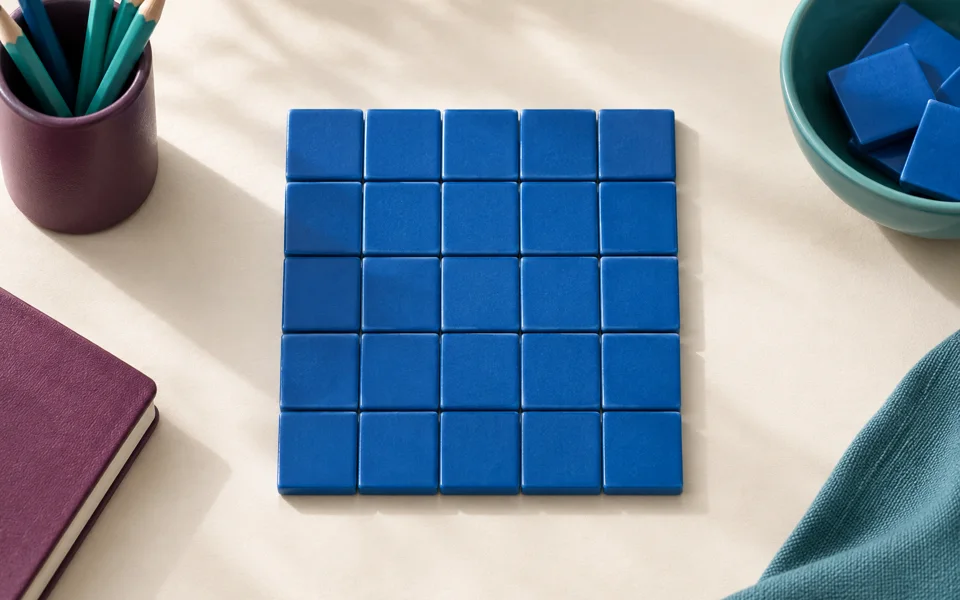
Separate a change in side length from a change in area
A square tile has sides of 24 centimetres and covers 576 square centimetres. A larger tile in the same shape has sides of 30 centimetres. Its linear scale factor is 30 divided by 24, or 1.25. The new area is 900 square centimetres. Divide 900 by 576 to get 1.5625, the square of the linear scale factor. A twenty-five percent increase in side length produces a 56.25 percent increase in area. The perimeter, however, increases by the same twenty-five percent as each side.
Reasonable Values for Area
Because area is determined by multiplying two lengths, the magnitude of difference between different square units is exponential. In other words, while a meter is 100 times greater in length than a centimeter, a square meter is times greater in area than a square centimeter . The relationships between benchmark metric area units are shown in the following table.
| Units | Relationship | Conversion Rate |
| to | ||
| to | ||
| to |
An essential understanding of metric area is to identify reasonable values for area. When testing for reasonableness you should assess both the unit and the unit value. Only by examining both can you determine whether the given area is reasonable for the situation.
Determining Reasonable Units for Area
Which unit of measure is most reasonable to describe the area of a sheet of paper: , , or ?
Solution
In the U.S. Customary System of Measurement, the length and width of paper is usually measured in inches. In the metric system centimeters are used for measures usually expressed in inches. Thus, the most reasonable unit of measure to describe the area of a sheet of paper is square centimeters. Square kilometers is too large a unit and square millimeters is too small a unit.
Determining Reasonable Values for Area
You want to paint your bedroom walls. Which represents a reasonable value for the area of the walls: 100 cm2, 100 m2, or 100 km2?
Solution
An area of 100 cm2 is equivalent to a surface of which is much too small for the walls of a bedroom. An area of 100 km2 is equivalent to a surface of which is much too large for the walls of a bedroom. So, a reasonable value for the area of the walls is 100 m2.
Explaining Reasonable Values for Area
A landscaper is hired to resod a school’s football field. After measuring the length and width of the field they determine that the area of the football field is 5,350 km2. Does their calculation make sense? Explain your answer.
Solution
No, kilometers are used to determine longer distances, such as the distance between two points when driving. A football field is less than 1 kilometer long, so a more reasonable unit of value would be m2. An area of 5,350 km2 can be calculated using the dimensions 53.5 by 100, which are reasonable dimensions for the length and width of a football field. So, a more reasonable value for the area of the football field is 5,350 m2.
Converting Units of Measures for Area
Just like converting units of measure for distance, you can convert units of measure for area. However, the conversion factor, or the number used to multiply or divide to convert from one area unit to another, is not the same as the conversion factor for metric distance units. Recall that the conversion factor for area is exponentially relative to the conversion factor for distance. The most frequently used conversion factors are shown in diagram.
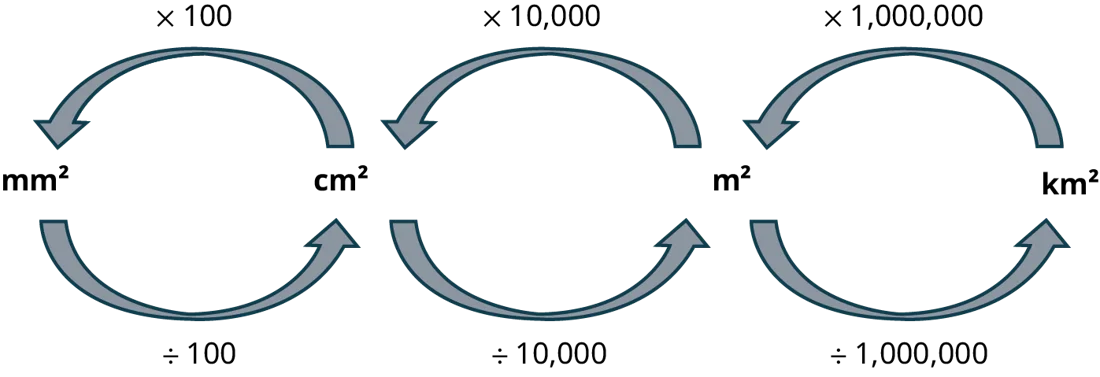
Converting Units of Measure for Area Using Division
A plot of land has an area of 237,500,000 m2. What is the area in square kilometers?
Solution
Use division to convert from a smaller metric area unit to a larger metric area unit. To convert from m2 to km2, divide the value of the area by 1,000,000.
The plot of land has an area of 237.5 km2.
Converting Units of Measure for Area Using Multiplication
A plot of land has an area of 0.004046 km2. What is the area of the land in square meters?
Solution
Use multiplication to convert from a larger metric area unit to a smaller metric area unit. To convert from km2 to m2, multiply the value of the area by 1,000,000.
The plot of land has an area of 4,046 m2.
Determining Area by Converting Units of Measure for Length First
A computer chip measures 10 mm by 15 mm. How many square centimeters is the computer chip?
Solution
Step 1: Convert the measures of the computer chip into centimeters
Step 2: Use the area formula to determine the area of the chip.
The computer chip has an area of .
Solving Application Problems Involving Area
While it may seem that solving area problems is as simple as multiplying two numbers, often determining area requires more complex calculations. For example, when measuring the area of surfaces, you may need to account for portions of the surface that are not relevant to your calculation.
Solving for the Area of Complex Surfaces
One side of a commercial building is 12 meters long by 9 meters high. There is a rolling door on this side of the building that is 4 meters wide by 3 meters high. You want to refinish the side of the building, but not the door, with aluminum siding. How many square meters of aluminum siding are required to cover this side of the building?
Solution
Step 1: Determine the area of the side of the building.
Step 2: Determine the area of the door.
Step 3: Subtract the area of the door from the area of the side of the building.
So, you need to purchase of aluminum siding.
When calculating area, you must ensure that both distance measurements are expressed in terms of the same distance units. Sometimes you must convert one measurement before using the area formula.
Solving for Area with Distance Measurements of Different Units
A national park has a land area in the shape of a rectangle. The park measures 2.2 kilometers long by 1,250 meters wide. What is the area of the park in square kilometers?
Solution
Step 1: Use a conversion fraction to convert the information given in meters to kilometers.
Step 2: Multiply to find the area.
The park has an area of 2.75 km2.
When calculating area, you may need to use multiple steps, such as converting units and subtracting areas that are not relevant.
Solving for Area Using Multiple Steps
A kitchen floor has an area of 15 m2. The floor in the kitchen pantry is 100 cm by 200 cm. You want to tile the kitchen and pantry floors using the same tile. How many square meters of tile do you need to buy?
Solution
Step 1: Determine the area of the pantry floor in square centimeters.
Step 2: Divide the area in cm2 by the conversion factor to determine the area in m2 since the other measurement for the kitchen floor is in m2.
The area of the kitchen pantry floor is 2 m2.
Step 3: Add the two areas of the pantry and the kitchen floors together.
So, you need to buy 17 m2 of tile.
Area of Triangles
The formula for the area of a triangle is given as follows.
For example, consider the triangle in diagram.
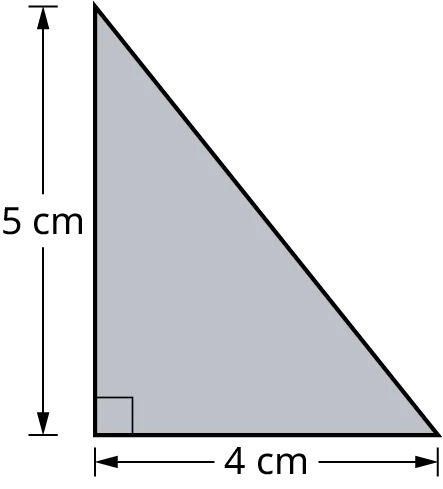
The base measures 4 cm and the height measures 5 cm. Using the formula, we can calculate the area:
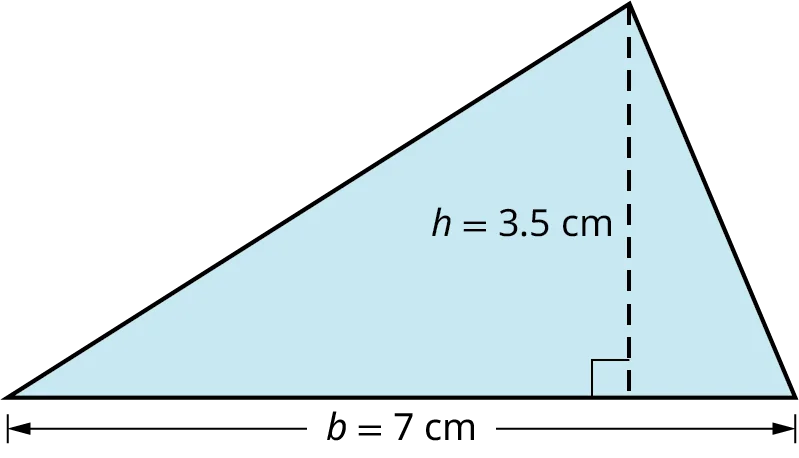
In diagram, the triangle has a base equal to 7 cm and a height equal to 3.5 cm. Notice that we can only find the height by dropping a perpendicular to the base. The area is then
Finding the Area of a Triangle
Find the area of this triangle that has a base of 4 cm and the height is 6 cm (diagram).
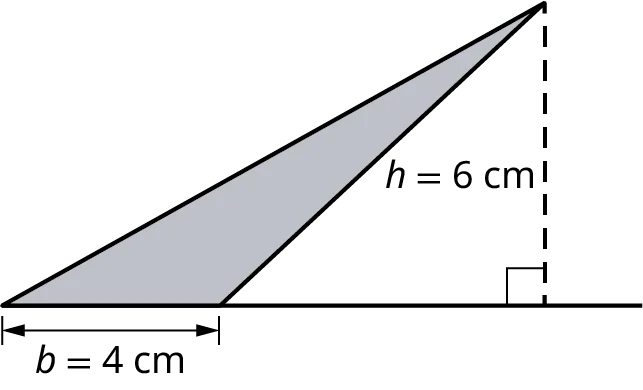
Solution
Using the formula, we have
Area of Quadrilaterals
A quadrilateral is a four-sided polygon with four vertices. Some quadrilaterals have either one or two sets of parallel sides. The set of quadrilaterals include the square, the rectangle, the parallelogram, the trapezoid, and the rhombus. The most common quadrilaterals are the square and the rectangle.
Square
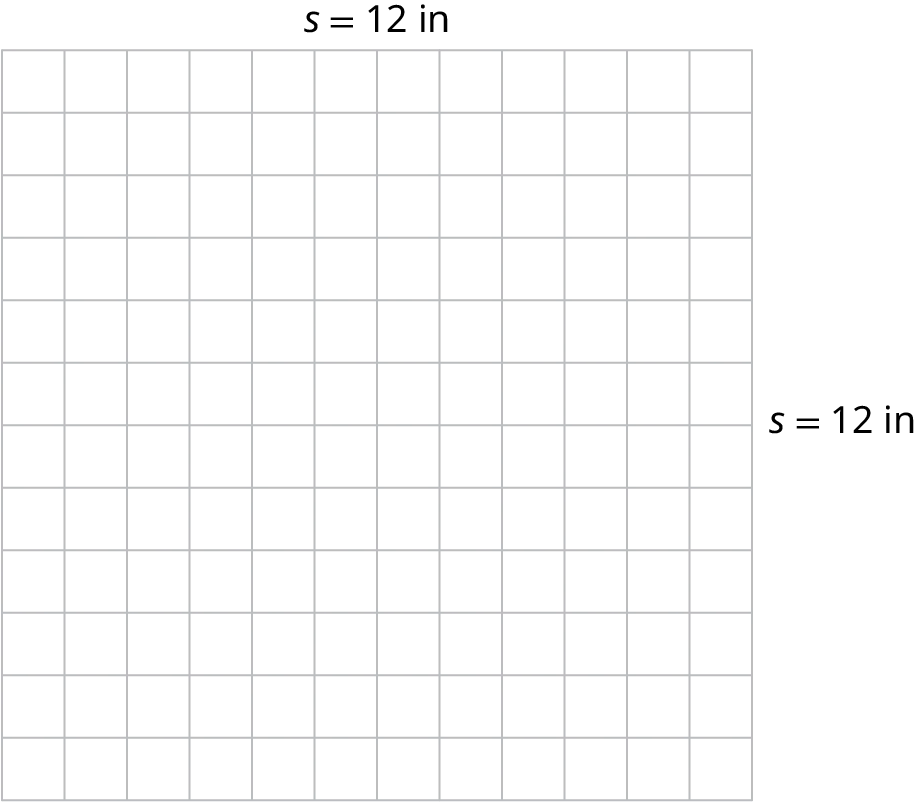
In diagram, a grid is represented with twelve squares across each row, and twelve squares down each column. If you count the little squares, the sum equals 144 squares. Of course, you do not have to count little squares to find area—we have a formula. Thus, the formula for the area of a square, where , is . The area of the square in diagram is
Rectangle
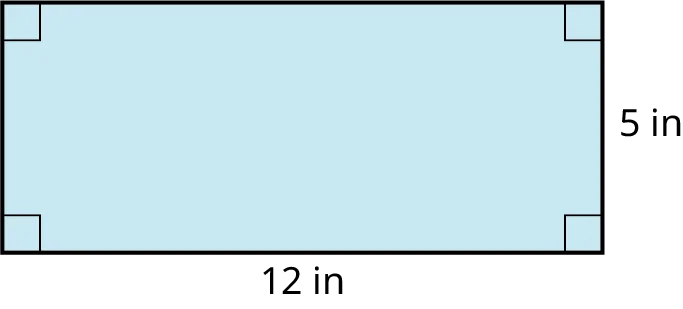
Similarly, the area for a rectangle is found by multiplying length times width. The rectangle in diagram has width equal to 5 in and length equal to 12 in. The area is
Many everyday applications require the use of the perimeter and area formulas. Suppose you are remodeling your home and you want to replace all the flooring. You need to know how to calculate the area of the floor to purchase the correct amount of tile, or hardwood, or carpet. If you want to paint the rooms, you need to calculate the area of the walls and the ceiling to know how much paint to buy, and the list goes on. Can you think of other situations where you might need to calculate area?
Finding the Area of a Rectangle
You have a garden with an area of 196 square feet. How wide can the garden be if the length is 28 feet?
Solution
The area of a rectangular region is Letting the width equal :
Determining the Cost of Floor Tile
Jennifer is planning to install vinyl floor tile in her rectangular-shaped basement, which measures 29 ft by 16 ft. How many boxes of floor tile should she buy and how much will it cost if one box costs $50 and covers
Solution
The area of the basement floor is We will divide this area by Thus, Therefore, Jennifer will have to buy 24 boxes of tile at a cost $1,200.
Parallelogram
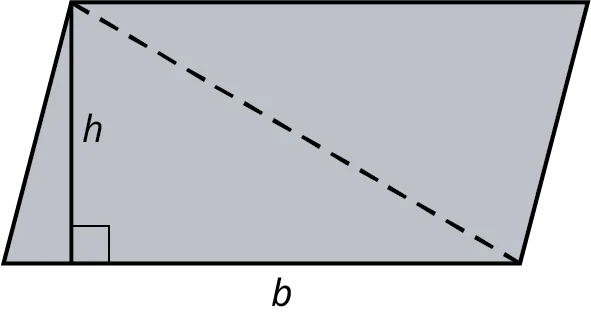
The area of a parallelogram can be found using the formula for the area of a triangle. Notice in diagram, if we cut a diagonal across the parallelogram from one vertex to the opposite vertex, we have two triangles. If we multiply the area of a triangle by 2, we have the area of a parallelogram:
For example, if we have a parallelogram with the base be equal to 10 inches and the height equal to 5 inches, the area will be
Finding the Area of a Parallelogram
In the parallelogram (diagram), if find the exact area of the parallelogram.
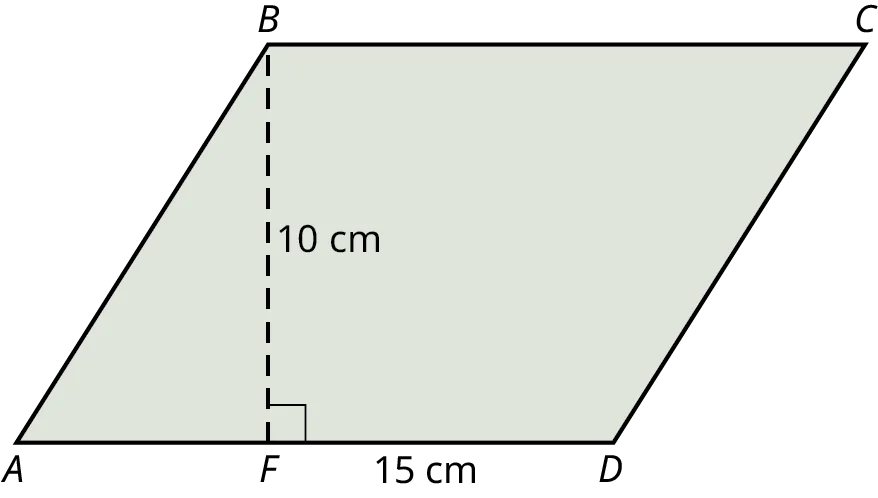
Solution
Using the formula of we have
Finding the Area of a Parallelogram Park
The boundaries of a city park form a parallelogram (diagram). The park takes up one city block, which is contained by two sets of parallel streets. Each street measures 55 yd long. The perpendicular distance between streets is 39 yd. How much sod, sold by the square foot, should the city purchase to cover the entire park and how much will it cost? The sod is sold for $0.50 per square foot, installation is $1.50 per square foot, and the cost of the equipment for the day is $100.
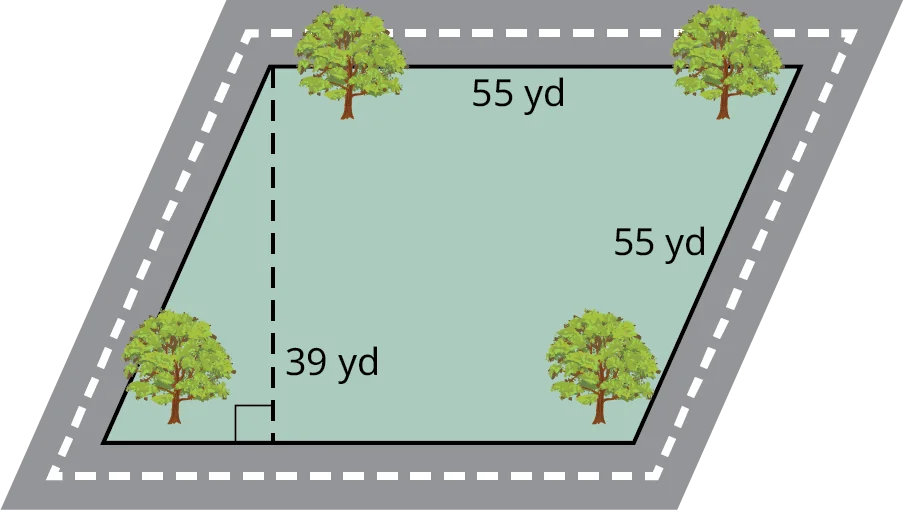
Solution
Step 1: As sod is sold by the square foot, the first thing we have to do is translate the measurements of the park from yards to feet. There are 3 ft to a yard, so 55 yd is equal to 165 ft, and 39 yd is equal to 117 ft.
Step 2: The park has the shape of a parallelogram, and the formula for the area is :
Step 3: The city needs to purchase of sod. The cost will be $0.50 per square foot for the sod and $1.50 per square foot for installation, plus $100 for equipment:
Trapezoid
Another quadrilateral is the trapezoid. A trapezoid has one set of parallel sides or bases. The formula for the area of a trapezoid with parallel bases and and height is given here.
For example, find the area of the trapezoid in diagram that has base equal to 8 cm, base equal to 6 cm, and height equal to 6 cm.
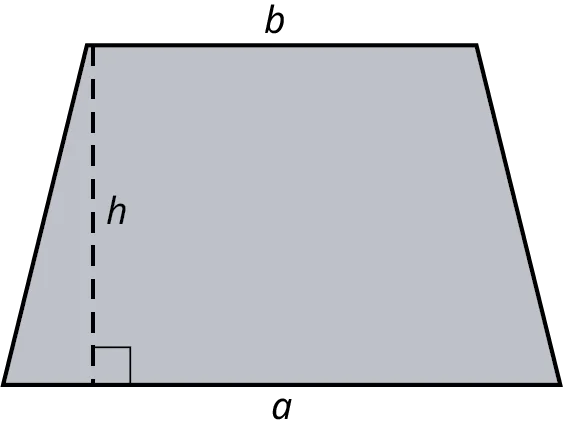
The area is .
Finding the Area of a Trapezoid
(diagram) is a regular trapezoid with Find the exact perimeter of , and then find the area.
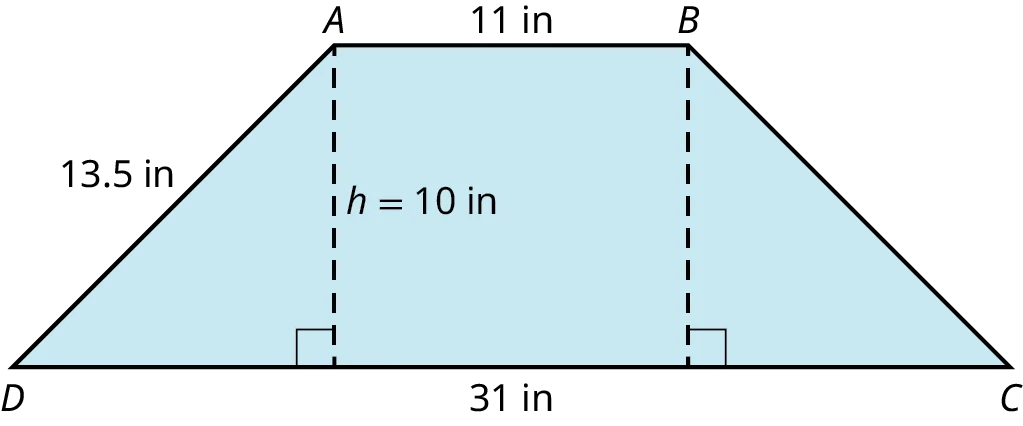
Solution
The perimeter is the measure of the boundary of the shape, so we just add up the lengths of the sides. We have Then, the area of the trapezoid using the formula is .
Rhombus
The rhombus has two sets of parallel sides. To find the area of a rhombus, there are two formulas we can use. One involves determining the measurement of the diagonals.
For our purposes here, we will use the formula that uses diagonals. For example, if the area of a rhombus is and the measure of find the measure of To solve this problem, we input the known values into the formula and solve for the unknown. See diagram.
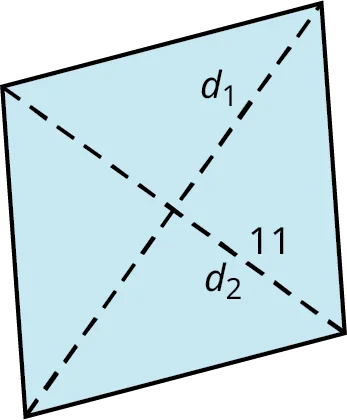
We have that
Finding the Area of a Rhombus
Find the measurement of the diagonal if the area of the rhombus is and the measure of
Solution
Use the formula with the known values:
Finding the Area of a Rhombus
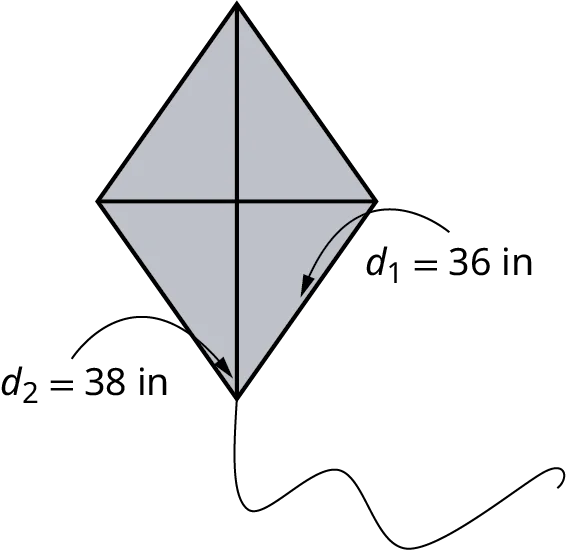
You notice a child flying a rhombus-shaped kite on the beach. When it falls to the ground, it falls on a beach towel measuring by You notice that one of the diagonals of the kite is the same length as the width of the towel. The second diagonal appears to be 2 in longer. What is the area of the kite (diagram)?
Solution
Using the formula, we have: