
Search
Menu

Further Maths Worksheets

Search the Further Maths resources by topic and check an answer with a second mathematical representation.

Quick Answer

Pick a Further Maths worksheet for a specific skill beyond the standard course, such as more advanced algebra or calculus. Compare complete methods where answers are provided, since an algebraic step can matter even if the final number is right.
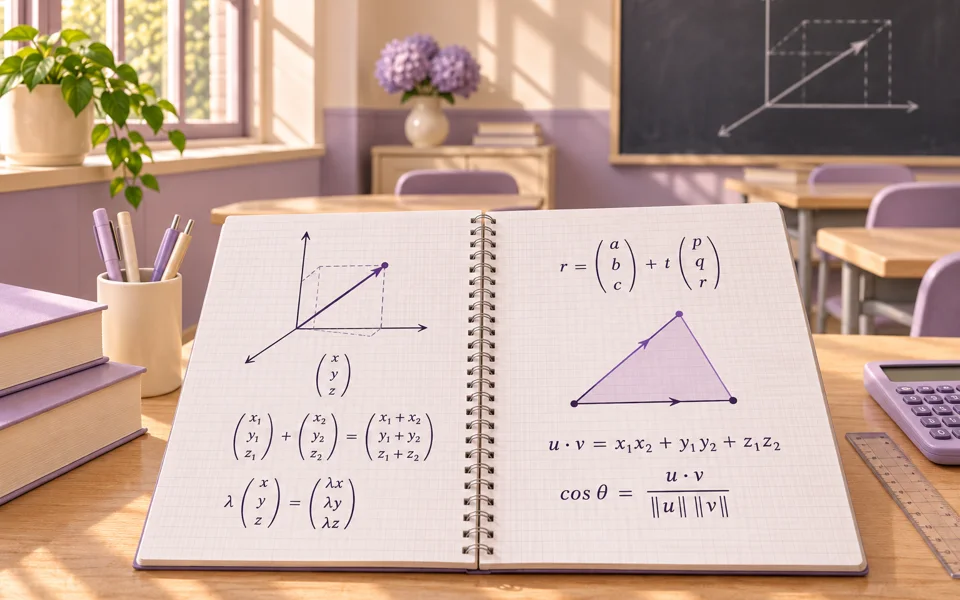
A further mathematics notebook beside a three-dimensional vector model

Mathematics has long been celebrated as the cornerstone of logical reasoning and problem-solving skills. For students aiming to excel academically and prepare for a future in STEM (Science, Technology, Engineering, and Mathematics) fields, Further Maths offers an invaluable opportunity to deepen their mathematical understanding. In this comprehensive guide, we explore what Further Maths entails, its benefits, career prospects, and strategies to excel in this challenging yet rewarding subject.

January

1st January      Further Maths      Answers

2nd January    Further Maths      Answers

3rd January    Further Maths      Answers

4th January    Further Maths      Answers

5th January     Further Maths      Answers

6th January    Further Maths       Answers

7th January      Further Maths      Answers

8th January      Further Maths      Answers

9th January      Further Maths      Answers

10th January    Further Maths      Answers

11th January     Further Maths      Answers

12th January      Further Maths      Answers

13th January      Further Maths      Answers

14th January      Further Maths      Answers

15th January      Further Maths      Answers

16th January       Further Maths      Answers

17th January      Further Maths      Answers

18th January      Further Maths      Answers

19th January      Further Maths      Answers

20th January      Further Maths      Answers

21st January      Further Maths      Answers

22nd January    Further Maths      Answers

23rd January      Further Maths     Answers

24th January      Further Maths     Answers

25th January      Further Maths     Answers

26th January      Further Maths     Answers

27th January      Further Maths     Answers

28th January      Further Maths     Answers

29th January      Further Maths    Answers

30th January      Further Maths    Answers

31st January      Further Maths    Answers

Whole Month Download – Answers

February

1st February        Further Maths    Answers

2nd February      Further Maths    Answers

3rd February      Further Maths    Answers

4th February      Further Maths    Answers

5th February      Further Maths    Answers

6th February      Further Maths    Answers

7th February      Further Maths    Answers

8th February      Further Maths    Answers

9th February      Further Maths    Answers

10th February      Further Maths    Answers

11th February      Further Maths    Answers

12th February      Further Maths    Answers

13th February      Further Maths    Answers

14th February      Further Maths    Answers

15th February      Further Maths    Answers

16th February      Further Maths    Answers

17th February      Further Maths    Answers

18th February      Further Maths    Answers

19th February      Further Maths    Answers

20th February      Further Maths    Answers

21st February       Further Maths    Answers

22nd February     Further Maths    Answers

23rd February      Further Maths    Answers

24th February      Further Maths    Answers

25th February      Further Maths    Answers

26th February      Further Maths    Answers

27th February      Further Maths    Answers

28th February      Further Maths    Answers

29th February      Further Maths    Answers

Whole Month Download   –   Answers

March

1st March      Further Maths     Answers

2nd March     Further Maths    Answers

3rd March      Further Maths    Answers

4th March      Further Maths    Answers

5th March      Further Maths    Answers

6th March      Further Maths    Answers

7th March      Further Maths    Answers

8th March      Further Maths    Answers

9th March      Further Maths     Answers

10th March     Further Maths    Answers

11th March      Further Maths    Answers

12th March      Further Maths    Answers

13th March      Further Maths    Answers

14th March      Further Maths    Answers

15th March      Further Maths    Answers

16th March      Further Maths    Answers

17th March      Further Maths    Answers

18th March      Further Maths    Answers

19th March      Further Maths    Answers

20th March      Further Maths    Answers

21st March       Further Maths     Answers

22nd March     Further Maths     Answers

23rd March      Further Maths     Answers

24th March      Further Maths     Answers

25th March      Further Maths    Answers

26th March      Further Maths    Answers

27th March      Further Maths    Answers

28th March      Further Maths    Answers

29th March      Further Maths    Answers

30th March     Further Maths     Answers

31st March      Further Maths    Answers

Whole Month Download –  Answers

April

1st April      Further Maths      Answers

2nd April     Further Maths    Answers

3rd April      Further Maths    Answers

4th April      Further Maths    Answers

5th April      Further Maths    Answers

6th April      Further Maths    Answers

7th April      Further Maths    Answers

8th April      Further Maths    Answers

9th April      Further Maths    Answers

10th April      Further Maths    Answers

11th April      Further Maths    Answers

12th April      Further Maths   Answers

13th April      Further Maths    Answers

14th April      Further Maths    Answers

15th April      Further Maths    Answers

16th April      Further Maths    Answers

17th April      Further Maths    Answers

18th April      Further Maths    Answers

19th April      Further Maths     Answers

20th April      Further Maths     Answers

21st April      Further Maths     Answers

22nd April     Further Maths    Answers

23rd April      Further Maths    Answers

24th April      Further Maths    Answers

25th April      Further Maths    Answers

26th April      Further Maths    Answers

27th April      Further Maths    Answers

28th April      Further Maths    Answers

29th April      Further Maths    Answers

30th April      Further Maths    Answers

Whole Month Download – Answers

May

1st May       Further Maths    Answers

2nd May      Further Maths    Answers

3rd May      Further Maths    Answers

4th May      Further Maths    Answers

5th May      Further Maths    Answers

6th May      Further Maths     Answers

7th May      Further Maths     Answers

8th May      Further Maths    Answers

9th May      Further Maths    Answers

10th May     Further Maths    Answers

11th May      Further Maths    Answers

12th May      Further Maths    Answers

13th May      Further Maths    Answers

14th May      Further Maths    Answers

15th May      Further Maths    Answers

16th May      Further Maths    Answers

17th May      Further Maths    Answers

18th May      Further Maths    Answers

19th May      Further Maths    Answers

20th May      Further Maths    Answers

21st May      Further Maths    Answers

22nd May      Further Maths    Answers

23rd May      Further Maths    Answers

24th May      Further Maths    Answers

25th May      Further Maths    Answers

26th May       Further Maths    Answers

27th May      Further Maths    Answers

28th May      Further Maths    Answers

29th May      Further Maths    Answers

30th May      Further Maths    Answers

31st May      Further Maths    Answers

Whole Month Download – Answers

June

1st June      Further Maths    Answers

2nd June      Further Maths    Answers

3rd June      Further Maths    Answers

4th June      Further Maths    Answers

5th June      Further Maths    Answers

6th June      Further Maths    Answers

7th June      Further Maths    Answers

8th June      Further Maths    Answers

9th June      Further Maths    Answers

10th June      Further Maths    Answers

11th June      Further Maths    Answers

12th June      Further Maths    Answers

13th June      Further Maths    Answers

14th June      Further Maths    Answers

15th June      Further Maths    Answers

16th June      Further Maths    Answers

17th June      Further Maths    Answers

18th June      Further Maths    Answers

19th June      Further Maths    Answers

20th June      Further Maths    Answers

21st June      Further Maths    Answers

22nd June      Further Maths    Answers

23rd June      Further Maths    Answers

24th June      Further Maths    Answers

25th June      Further Maths    Answers

26th June      Further Maths    Answers

27th June      Further Maths    Answers

28th June      Further Maths    Answers

29th June      Further Maths    Answers

30th June      Further Maths    Answers

Whole Month Download – Answers

July

1st July      Further Maths    Answers

2nd July      Further Maths    Answers

3rd July      Further Maths    Answers

4th July      Further Maths    Answers

5th July      Further Maths    Answers

6th July      Further Maths    Answers

7th July      Further Maths    Answers

8th July       Further Maths    Answers

9th July       Further Maths    Answers

10th July      Further Maths    Answers

11th July      Further Maths    Answers

12th July      Further Maths    Answers

13th July      Further Maths    Answers

14th July      Further Maths    Answers

15th July      Further Maths    Answers

16th July      Further Maths    Answers

17th July      Further Maths    Answers

18th July      Further Maths    Answers

19th July      Further Maths    Answers

20th July      Further Maths    Answers

21st July      Further Maths    Answers

22nd July      Further Maths    Answers

23rd July      Further Maths    Answers

24th July      Further Maths    Answers

25th July      Further Maths    Answers

26th July      Further Maths    Answers

27th July      Further Maths    Answers

28th July      Further Maths    Answers

29th July      Further Maths    Answers

30th July      Further Maths    Answers

31st July      Further Maths    Answers

Whole Month Download – Answers

August

1st August      Further Maths    Answers

2nd August      Further Maths    Answers

3rd August       Further Maths    Answers

4th August       Further Maths    Answers

5th August      Further Maths    Answers

6th August      Further Maths    Answers

7th August      Further Maths    Answers

8th August      Further Maths    Answers

9th August      Further Maths    Answers

10th August      Further Maths    Answers

11th August      Further Maths    Answers

12th August      Further Maths    Answers

13th August      Further Maths    Answers

14th August      Further Maths    Answers

15th August      Further Maths    Answers

16th August      Further Maths    Answers

17th August      Further Maths    Answers

18th August      Further Maths    Answers

19th August      Further Maths    Answers

20th August      Further Maths    Answers

21st August      Further Maths    Answers

22nd August      Further Maths    Answers

23rd August      Further Maths    Answers

24th August      Further Maths    Answers

25th August      Further Maths    Answers

26th August      Further Maths    Answers

27th August      Further Maths    Answers

28th August      Further Maths    Answers

29th August      Further Maths    Answers

30th August      Further Maths    Answers

31st August      Further Maths    Answers

Whole Month Download – Answers

September

1st September      Further Maths    Answers

2nd September    Further Maths    Answers

3rd September     Further Maths    Answers

4th September      Further Maths    Answers

5th September      Further Maths    Answers

6th September      Further Maths    Answers

7th September      Further Maths    Answers

8th September      Further Maths    Answers

9th September       Further Maths    Answers

10th September     Further Maths    Answers

11th September      Further Maths    Answers

12th September      Further Maths    Answers

13th September      Further Maths    Answers

14th September      Further Maths    Answers

15th September      Further Maths    Answers

16th September      Further Maths    Answers

17th September      Further Maths    Answers

18th September      Further Maths    Answers

19th September      Further Maths    Answers

20th September      Further Maths    Answers

21st September      Further Maths    Answers

22nd September     Further Maths    Answers

23rd September      Further Maths    Answers

24th September      Further Maths    Answers

25th September      Further Maths    Answers

26th September      Further Maths    Answers

27th September      Further Maths    Answers

28th September      Further Maths    Answers

29th September      Further Maths    Answers

30th September      Further Maths    Answers

Whole Month Download   – Answers 

October

1st October      Further Maths    Answers

2nd October      Further Maths    Answers

3rd October      Further Maths    Answers

4th October      Further Maths    Answers

5th October      Further Maths    Answers

6th October      Further Maths    Answers

7th October      Further Maths    Answers

8th October      Further Maths    Answers

9th October      Further Maths    Answers

10th October      Further Maths    Answers

11th October      Further Maths    Answers

12th October      Further Maths    Answers

13th October      Further Maths    Answers

14th October      Further Maths    Answers

15th October      Further Maths    Answers

16th October      Further Maths    Answers

17th October      Further Maths    Answers

18th October      Further Maths     Answers

19th October      Further Maths     Answers

20th October      Further Maths     Answers

21st October      Further Maths    Answers

22nd October      Further Maths    Answers

23rd October      Further Maths    Answers

24th October      Further Maths    Answers

25th October      Further Maths    Answers

26th October      Further Maths    Answers

27th October      Further Maths    Answers

28th October      Further Maths    Answers

29th October      Further Maths    Answers

30th October      Further Maths    Answers

31st October        Further Maths    Answers

Whole Month Download – Answers    

November

1st November       Further Maths    Answers

2nd November     Further Maths    Answers

3rd November      Further Maths    Answers

4th November       Further Maths    Answers

5th November      Further Maths    Answers

6th November      Further Maths    Answers

7th November      Further Maths    Answers

8th November      Further Maths    Answers

9th November       Further Maths    Answers

10th November      Further Maths    Answers

11th November       Further Maths    Answers

12th November      Further Maths    Answers

13th November      Further Maths    Answers

14th November      Further Maths    Answers

15th November      Further Maths    Answers

16th November      Further Maths    Answers

17th November      Further Maths    Answers

18th November      Further Maths    Answers

19th November      Further Maths    Answers

20th November      Further Maths    Answers

21st November      Further Maths    Answers

22nd November     Further Maths    Answers

23rd November      Further Maths    Answers

24th November      Further Maths    Answers

25th November      Further Maths    Answers

26th November      Further Maths    Answers

27th November      Further Maths    Answers

28th November       Further Maths    Answers

29th November      Further Maths    Answers

30th November      Further Maths    Answers

Whole Month Download – Answers    

December

1st December       Further Maths    Answers

2nd December      Further Maths    Answers

3rd December      Further Maths    Answers

4th December      Further Maths    Answers

5th December        Further Maths    Answers

6th December      Further Maths    Answers

7th December      Further Maths    Answers

8th December      Further Maths    Answers

9th December        Further Maths    Answers

10th December      Further Maths    Answers

11th December       Further Maths    Answers

12th December      Further Maths    Answers

13th December      Further Maths    Answers

14th December      Further Maths    Answers

15th December      Further Maths    Answers

16th December      Further Maths    Answers

17th December      Further Maths    Answers

18th December      Further Maths    Answers

19th December      Further Maths    Answers

20th December      Further Maths    Answers

21st December      Further Maths    Answers

22nd December      Further Maths    Answers

23rd December       Further Maths    Answers

24th December      Further Maths    Answers

25th December      Further Maths    Answers

26th December      Further Maths    Answers

27th December      Further Maths    Answers

28th December      Further Maths    Answers

29th December      Further Maths    Answers

30th December      Further Maths    Answers

31st December      Further Maths    Answers

Whole Month Download – Answers


What is Further Maths?

Further Maths is an advanced level mathematics course that extends the standard curriculum, typically offered to high-achieving students in the UK and other education systems following a similar structure. While A-Level Maths covers fundamental topics, Further Maths delves deeper into complex areas, providing a more rigorous and comprehensive understanding of mathematical concepts.

Key Components of Further Maths

  1. Pure Mathematics: Advanced topics such as complex numbers, matrices, further calculus, and differential equations.
  2. Mechanics: Enhanced study of forces, motion, and energy, building on foundational physics principles.
  3. Statistics: In-depth analysis of probability, distributions, hypothesis testing, and data interpretation.
  4. Decision Mathematics: Focus on algorithms, graph theory, and optimization techniques.

Why Choose Further Maths?

Opting for Further Maths can significantly enhance a student’s academic profile and open doors to a myriad of career opportunities. Here are some compelling reasons to pursue Further Maths:

1. Enhanced Problem-Solving Skills

Further Maths challenges students with complex problems that require creative and analytical thinking. This cultivates a strong problem-solving mindset, beneficial not only in academics but also in real-world scenarios.

2. Preparation for STEM Careers

Many prestigious universities and competitive STEM programs prefer or even require Further Maths for admission. It provides a solid foundation for careers in engineering, computer science, economics, and the physical sciences.

3. Boosted Academic Performance

Studying Further Maths can improve overall academic performance. The rigorous training in logical reasoning and analytical skills often translates into better grades across other subjects.

4. Competitive Edge in University Applications

A-Level Further Maths is highly regarded by top-tier universities. It demonstrates a student’s commitment, capability, and passion for mathematics, making their application stand out.

Benefits of Further Maths

1. Deepened Mathematical Understanding

Further Maths covers advanced topics that provide a deeper understanding of mathematics, enabling students to tackle more complex and abstract concepts with ease.

2. Improved Logical Reasoning

The subject enhances logical reasoning abilities, which are essential for problem-solving and critical thinking in various disciplines and everyday life.

3. Greater Flexibility in Higher Education

With Further Maths, students have greater flexibility in choosing university courses. It opens up opportunities in a wide range of fields, from pure mathematics to applied sciences and beyond.

4. Increased Confidence

Mastering challenging mathematical concepts builds confidence, encouraging students to take on even more complex subjects and projects in the future.

Career Paths Enabled by Further Maths

Further Maths serves as a gateway to numerous career paths, particularly in STEM fields. Here are some prominent career options:

1. Engineering

Mechanical, electrical, civil, and aerospace engineering all require a strong mathematical foundation to design, analyze, and innovate.

2. Computer Science

From software development to artificial intelligence, computer science relies heavily on algorithms, data structures, and mathematical logic.

3. Economics and Finance

Quantitative analysis, risk management, and economic modeling are integral to careers in economics and finance, all of which require advanced mathematical skills.

4. Physical Sciences

Physics, chemistry, and environmental science utilize mathematical models to understand and predict natural phenomena.

5. Data Science and Analytics

Data scientists use statistical methods and algorithms to interpret complex data, making informed decisions in various industries.

6. Actuarial Science

Actuaries use mathematics, statistics, and financial theory to study uncertain future events, primarily in the insurance and finance sectors.

How to Excel in Further Maths

1. Build a Strong Foundation

Ensure you have a solid understanding of A-Level Maths before embarking on Further Maths. Mastering fundamental concepts is crucial for tackling advanced topics.

2. Stay Consistent with Study

Regular study and practice are essential. Allocate dedicated time each day to work through problems and revise concepts.

3. Utilize Quality Resources

Invest in reputable textbooks, online courses, and study guides. Websites like Khan Academy, Coursera, and specific Further Maths resources can be highly beneficial.

4. Practice Past Papers

Working through past exam papers helps you familiarize yourself with the question formats and time management, essential for performing well in exams.

5. Seek Help When Needed

Don’t hesitate to ask for help from teachers, tutors, or peers if you encounter challenging topics. Study groups can also provide support and diverse problem-solving approaches.

6. Stay Curious and Engaged

Maintain a genuine interest in the subject. Exploring real-world applications of mathematical concepts can make learning more enjoyable and meaningful.

Conclusion

Further Maths is more than just an advanced level subject; it’s a transformative journey that equips students with critical thinking, analytical prowess, and a robust mathematical foundation. Whether aiming for a career in engineering, computer science, finance, or any other STEM field, Further Maths offers the tools and knowledge necessary to excel. By embracing the challenges and opportunities it presents, students can unlock their full potential and pave the way for a successful and fulfilling academic and professional future.

Express the same vector in two ways

A displacement carries a point from (2, 5) to (8, 1). Subtract the starting coordinates from the ending coordinates to obtain the vector (6, −4). Its length is the square root of fifty-two, or two times the square root of thirteen. A parallel vector with half the length is (3, −2). That shorter vector gives the direction but would land at (5, 3) if you started at the original point. Label whether a question requests a displacement, a distance or a direction before comparing answers.

Introduction to Systems of Equations

In order to investigate situations such as that of the skateboard manufacturer, we need to recognize that we are dealing with more than one variable and likely more than one equation. A system of linear equations consists of two or more linear equations made up of two or more variables such that all equations in the system are considered simultaneously. To find the unique solution to a system of linear equations, we must find a numerical value for each variable in the system that will satisfy all equations in the system at the same time. Some linear systems may not have a solution and others may have an infinite number of solutions. In order for a linear system to have a unique solution, there must be at least as many equations as there are variables. Even so, this does not guarantee a unique solution.
In this section, we will look at systems of linear equations in two variables, which consist of two equations that contain two different variables. For example, consider the following system of linear equations in two variables.
2x+y=15 3x–y=5
The solution to a system of linear equations in two variables is any ordered pair that satisfies each equation independently. In this example, the ordered pair (4, 7) is the solution to the system of linear equations. We can verify the solution by substituting the values into each equation to see if the ordered pair satisfies both equations. Shortly we will investigate methods of finding such a solution if it exists.
2(4)+(7)=15True 3(4)−(7)=5True
In addition to considering the number of equations and variables, we can categorize systems of linear equations by the number of solutions. A consistent system of equations has at least one solution. A consistent system is considered to be an independent system if it has a single solution, such as the example we just explored. The two lines have different slopes and intersect at one point in the plane. A consistent system is considered to be a dependent system if the equations have the same slope and the same y-intercepts. In other words, the lines coincide so the equations represent the same line. Every point on the line represents a coordinate pair that satisfies the system. Thus, there are an infinite number of solutions.
Another type of system of linear equations is an inconsistent system, which is one in which the equations represent two parallel lines. The lines have the same slope and different y-intercepts. There are no points common to both lines; hence, there is no solution to the system.

Determining Whether an Ordered Pair Is a Solution to a System of Equations

Determine whether the ordered pair ( 5,1 ) is a solution to the given system of equations.
x+3y=8 2x−9=y
Solution
Substitute the ordered pair ( 5,1 ) into both equations.
(5)+3(1)=8 8=8 True 2(5)−9=(1) 1=1 True
The ordered pair ( 5,1 ) satisfies both equations, so it is the solution to the system.

Solving Systems of Equations by Graphing

There are multiple methods of solving systems of linear equations. For a system of linear equations in two variables, we can determine both the type of system and the solution by graphing the system of equations on the same set of axes.

Solving a System of Equations in Two Variables by Graphing
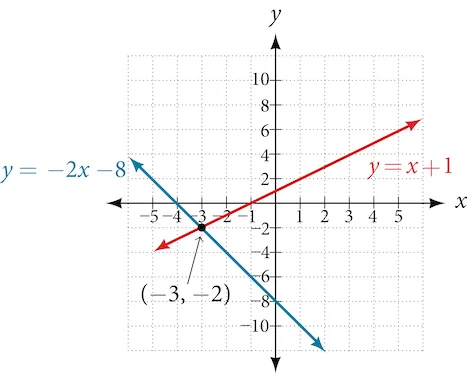
Solve the following system of equations by graphing. Identify the type of system.
2x+y=−8 x−y=−1
Solution
Solve the first equation for y.
2x+y=−8 y=−2x−8
Solve the second equation for y.
x−y=−1 y=x+1
Graph both equations on the same set of axes as in diagram.
The lines appear to intersect at the point ( −3,−2 ). We can check to make sure that this is the solution to the system by substituting the ordered pair into both equations.
2(−3)+(−2)=−8 −8=−8 True (−3)−(−2)=−1 −1=−1 True
The solution to the system is the ordered pair ( −3,−2 ), so the system is independent.

Solving Systems of Equations by Substitution

Solving a linear system in two variables by graphing works well when the solution consists of integer values, but if our solution contains decimals or fractions, it is not the most precise method. We will consider two more methods of solving a system of linear equations that are more precise than graphing. One such method is solving a system of equations by the substitution method, in which we solve one of the equations for one variable and then substitute the result into the second equation to solve for the second variable. Recall that we can solve for only one variable at a time, which is the reason the substitution method is both valuable and practical.

Solving a System of Equations in Two Variables by Substitution

Solve the following system of equations by substitution.
−x+y=−5 2x−5y=1
Solution
First, we will solve the first equation for y.
−x+y=−5 y=x−5
Now we can substitute the expression x−5 for y in the second equation.
2x−5y=1 2x−5(x−5)=1 2x−5x+25=1 −3x=−24 x=8
Now, we substitute x=8 into the first equation and solve for y.
−(8)+y=−5 y=3
Our solution is ( 8,3 ).
Check the solution by substituting ( 8,3 ) into both equations.
−x+y=−5 −(8)+(3)=−5 True 2x−5y=1 2(8)−5(3)=1 True

Solving Systems of Equations in Two Variables by the Addition Method

A third method of solving systems of linear equations is the addition method. In this method, we add two terms with the same variable, but opposite coefficients, so that the sum is zero. Of course, not all systems are set up with the two terms of one variable having opposite coefficients. Often we must adjust one or both of the equations by multiplication so that one variable will be eliminated by addition.

Solving a System by the Addition Method

Solve the given system of equations by addition.
x+2y=−1 −x+y=3
Solution
Both equations are already set equal to a constant. Notice that the coefficient of x in the second equation, –1, is the opposite of the coefficient of x in the first equation, 1. We can add the two equations to eliminate x without needing to multiply by a constant.
x+2y=−1 −x+y=3 3y=2
Now that we have eliminated x, we can solve the resulting equation for y.
3y=2 y= 2 3
Then, we substitute this value for y into one of the original equations and solve for x.
−x+y=3 −x+ 2 3 =3 −x=3− 2 3 −x= 7 3 x=− 7 3
The solution to this system is ( − 7 3 , 2 3 ).
Check the solution in the first equation.
x+2y=−1 ( − 7 3 )+2( 2 3 )= − 7 3 + 4 3 = − 3 3 = −1=−1 True

Using the Addition Method When Multiplication of One Equation Is Required
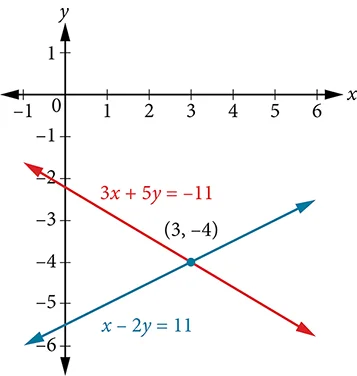
Solve the given system of equations by the addition method.
3x+5y=−11 x−2y=11
Solution
Adding these equations as presented will not eliminate a variable. However, we see that the first equation has 3x in it and the second equation has x. So if we multiply the second equation by −3, the x-terms will add to zero.
x−2y=11 −3(x−2y)=−3(11) Multiply both sides by −3. −3x+6y=−33 Use the distributive property.
Now, let’s add them.
  3x+5y=−11 −3x+6y=−33 _______________         11y=−44             y=−4
For the last step, we substitute y=−4 into one of the original equations and solve for x.
3x+5y=−11 3x+5(−4)=−11 3x−20=−11 3x=9 x=3
Our solution is the ordered pair ( 3,−4 ). See diagram. Check the solution in the original second equation.
x−2y=11 (3)−2(−4)=3+8 11=11 True

Using the Addition Method When Multiplication of Both Equations Is Required
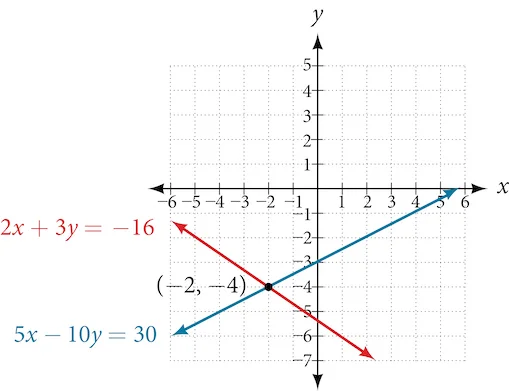
Solve the given system of equations in two variables by addition.
2x+3y=−16 5x−10y=30
Solution
One equation has 2x and the other has 5x. The least common multiple is 10x so we will have to multiply both equations by a constant in order to eliminate one variable. Let’s eliminate x by multiplying the first equation by −5 and the second equation by 2.
 −5(2x+3y)=−5(−16)    −10x−15y=80      2(5x−10y)=2(30)         10x−20y=60
Then, we add the two equations together.
−10x−15y=80   10x−20y=60 ________________ −35y=140 y=−4
Substitute y=−4 into the original first equation.
2x+3(−4)=−16 2x−12=−16 2x=−4 x=−2
The solution is ( −2,−4 ). Check it in the other equation.
         5x−10y=30 5(−2)−10(−4)=30         −10+40=30                    30=30
See diagram.

Using the Addition Method in Systems of Equations Containing Fractions

Solve the given system of equations in two variables by addition.
x 3 + y 6 =3 x 2 − y 4 =​1
Solution
First clear each equation of fractions by multiplying both sides of the equation by the least common denominator.
6( x 3 + y 6 )=6(3)    2x+y=18 4( x 2 − y 4 )=4(1)    2x−y=4
Now multiply the second equation by −1 so that we can eliminate the x-variable.
−1(2x−y)=−1(4)    −2x+y=−4
Add the two equations to eliminate the x-variable and solve the resulting equation.
2x+y=18 −2x+y=−4 _____________ 2y=14 y=7
Substitute y=7 into the first equation.
2x+(7)=18         2x=11           x= 11 2             =5.5
The solution is ( 11 2 ,7 ). Check it in the other equation.
x 2 − y 4 =1 11 2 2 − 7 4 =1 11 4 − 7 4 =1 4 4 =1

Identifying Inconsistent Systems of Equations Containing Two Variables

Now that we have several methods for solving systems of equations, we can use the methods to identify inconsistent systems. Recall that an inconsistent system consists of parallel lines that have the same slope but different y -intercepts. They will never intersect. When searching for a solution to an inconsistent system, we will come up with a false statement, such as 12=0.

Solving an Inconsistent System of Equations

Solve the following system of equations.
x=9−2y x+2y=13
Solution
We can approach this problem in two ways. Because one equation is already solved for x, the most obvious step is to use substitution.
x+2y=13 (9−2y)+2y=13 9+0y=13 9=13
Clearly, this statement is a contradiction because 9≠13. Therefore, the system has no solution.
The second approach would be to first manipulate the equations so that they are both in slope-intercept form. We manipulate the first equation as follows.
x=9−2y 2y=−x+9 y=− 1 2 x+ 9 2
We then convert the second equation expressed to slope-intercept form.
x+2y=13 2y=−x+13 y=− 1 2 x+ 13 2
Comparing the equations, we see that they have the same slope but different y-intercepts. Therefore, the lines are parallel and do not intersect.
y=− 1 2 x+ 9 2 y=− 1 2 x+ 13 2

Expressing the Solution of a System of Dependent Equations Containing Two Variables

Recall that a dependent system of equations in two variables is a system in which the two equations represent the same line. Dependent systems have an infinite number of solutions because all of the points on one line are also on the other line. After using substitution or addition, the resulting equation will be an identity, such as 0=0.

Finding a Solution to a Dependent System of Linear Equations

Find a solution to the system of equations using the addition method.
x+3y=2 3x+9y=6
Solution
With the addition method, we want to eliminate one of the variables by adding the equations. In this case, let’s focus on eliminating x. If we multiply both sides of the first equation by −3, then we will be able to eliminate the x -variable.
x+3y=2   (−3)(x+3y)=(−3)(2) −3x−9y=−6
Now add the equations.
−3x−9y =−6 +3x+9y =6 ______________ 0 =0
We can see that there will be an infinite number of solutions that satisfy both equations.

Using Systems of Equations to Investigate Profits
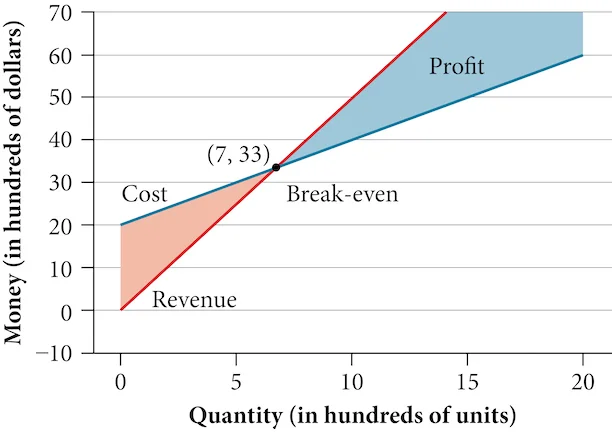
Using what we have learned about systems of equations, we can return to the skateboard manufacturing problem at the beginning of the section. The skateboard manufacturer’s revenue function is the function used to calculate the amount of money that comes into the business. It can be represented by the equation R=xp, where x= quantity and p= price. The revenue function is shown in orange in diagram.
The cost function is the function used to calculate the costs of doing business. It includes fixed costs, such as rent and salaries, and variable costs, such as utilities. The cost function is shown in blue in diagram. The x -axis represents quantity in hundreds of units. The y-axis represents either cost or revenue in hundreds of dollars.
The point at which the two lines intersect is called the break-even point. We can see from the graph that if 700 units are produced, the cost is $3,300 and the revenue is also $3,300. In other words, the company breaks even if they produce and sell 700 units. They neither make money nor lose money.
The shaded region to the right of the break-even point represents quantities for which the company makes a profit. The shaded region to the left represents quantities for which the company suffers a loss. The profit function is the revenue function minus the cost function, written as P(x)=R(x)−C(x). Clearly, knowing the quantity for which the cost equals the revenue is of great importance to businesses.

Finding the Break-Even Point and the Profit Function Using Substitution

Given the cost function C(x)=0.85x+35,000 and the revenue function R(x)=1.55x, find the break-even point and the profit function.
Solution
Write the system of equations using y to replace function notation.
y=0.85x+35,000 y=1.55x
Substitute the expression 0.85x+35,000 from the first equation into the second equation and solve for x.
0.85x+35,000=1.55x 35,000=0.7x 50,000=x
Then, we substitute x=50,000 into either the cost function or the revenue function.
1.55( 50,000 )=77,500
The break-even point is ( 50,000,77,500 ).
The profit function is found using the formula P(x)=R(x)−C(x).
P(x)=1.55x−(0.85x+35,000)        =0.7x−35,000
The profit function is P(x)=0.7x−35,000.

Writing and Solving a System of Equations in Two Variables

The cost of a ticket to the circus is $25.00 for children and $50.00 for adults. On a certain day, attendance at the circus is 2,000 and the total gate revenue is $70,000. How many children and how many adults bought tickets?
Solution
Let c = the number of children and a = the number of adults in attendance.
The total number of people is 2,000. We can use this to write an equation for the number of people at the circus that day.
c+a=2,000
The revenue from all children can be found by multiplying $25.00 by the number of children, 25c. The revenue from all adults can be found by multiplying $50.00 by the number of adults, 50a. The total revenue is $70,000. We can use this to write an equation for the revenue.
25c+50a=70,000
We now have a system of linear equations in two variables.
c+a=2,000 25c+50a=70,000
In the first equation, the coefficient of both variables is 1. We can quickly solve the first equation for either c or a. We will solve for a.
c+a=2,000 a=2,000−c
Substitute the expression 2,000−c in the second equation for a and solve for c.
25c+50(2,000−c)=70,000 25c+100,000−50c=70,000 −25c=−30,000 c=1,200
Substitute c=1,200 into the first equation to solve for a.
1,200+a=2,000 a=800
We find that 1,200 children and 800 adults bought tickets to the circus that day.