Search
Menu

Body Shape Calculator | What Body Type Are You?

Explore how measurement ratios and chart thresholds affect a descriptive garment-fitting category.

Quick Answer

Body-shape comparisons commonly use the relative sizes of shoulders, bust, waist and hips. Use consistent measurement points and treat the resulting category as a clothing-fit guide, not a health measurement.

Dressmaker’s mannequin, measuring tape and garment patterns
Free Body Measurement Tool

Body Shape Calculator

Use this Body Shape Calculator to estimate your likely body type from bust or chest, waist, hips, and optional shoulder measurements. The calculator compares proportions, waist-to-hip ratio, waist-to-bust ratio, hip-to-bust balance, and shoulder-to-hip balance to classify common body shapes such as hourglass, pear, rectangle, inverted triangle, and apple.

Calculate Your Body Shape

Enter body measurements using a soft measuring tape. For best accuracy, keep the tape level, snug, and not compressed into the skin.

Respect note: body-shape labels are proportion categories, not value judgments. The same body can look different depending on posture, muscle, body composition, clothing cut, and measurement method.

What Is a Body Shape Calculator?

A Body Shape Calculator is a measurement-based tool that estimates body-shape category from relative body proportions. Instead of judging body size, it compares how the bust or chest, waist, hips, and optional shoulders relate to each other. The result is a practical proportion label such as hourglass, pear, rectangle, inverted triangle, or apple. Use the body fat estimate to compare the estimated proportion of weight that comes from fat.

Body-shape calculators are commonly used for clothing fit, style planning, size awareness, online shopping, sewing, tailoring, fashion education, costume design, and general body-measurement learning. A person may know their clothing size but still struggle to understand why certain cuts fit differently. Body shape focuses on proportion. Two people can wear a similar size and still have different body shapes because their shoulders, bust, waist, and hips are distributed differently. Use the lean body mass calculator to estimate the mass of the body excluding fat.

This calculator uses simple ratio logic. It does not scan the body and does not diagnose health. It uses entered measurements and compares differences between major measurement points. If the bust and hips are similar and the waist is clearly smaller, the calculator may classify the result as hourglass. If hips are noticeably larger than bust or shoulders, it may classify the result as pear. If shoulders or bust are noticeably larger than hips, it may classify the result as inverted triangle. If waist, bust, and hips are relatively close, it may classify the result as rectangle. If the waist is relatively fuller compared with bust and hips, it may classify the result as apple.

The result should be treated as an estimate. Human bodies are more varied than five labels. Measurements can change with posture, breathing, bloating, muscle development, pregnancy, age, weight fluctuation, tape placement, and the type of clothing worn during measurement. The purpose is to provide a helpful starting point for proportion awareness, not a fixed identity or a health judgment.

How to Use the Body Shape Calculator

Choose your measurement unit first. The calculator supports inches and centimeters. Use the same unit for all body measurements. Mixing inches and centimeters in the same calculation will produce incorrect results.

Next, enter shoulder circumference if you have it. This field is optional but helpful because shoulder width can affect whether the body looks more balanced, pear-shaped, or inverted-triangle-shaped. Shoulder circumference is usually measured around the body at the widest point of the shoulders. If you do not have this value, the calculator can still classify shape from bust or chest, waist, and hips.

Enter bust or chest measurement at the fullest part. The tape should be level around the body and parallel to the floor. Then enter the natural waist measurement, usually the narrowest part of the torso or the point where the body bends side-to-side. Finally, enter the hip measurement at the fullest part of the hips and seat.

Height and weight are optional. They do not determine body shape in this calculator because body shape is based on proportions, not total size. Height and weight can influence clothing fit and body mass index, but two people with different heights and weights can still share the same body-shape category. Click calculate to see the estimated shape, key ratios, measurement differences, and a simple visual proportion guide. Use the body mass index calculator to compare weight relative to height with a composition estimate.

Body Shape Calculator Formulas

The calculator uses proportion formulas rather than absolute size alone. The first important ratio is waist-to-hip ratio:

Waist-to-hip ratio
\[WHR=\frac{\text{Waist}}{\text{Hips}}\]

The waist-to-bust or waist-to-chest ratio is:

Waist-to-bust ratio
\[WBR=\frac{\text{Waist}}{\text{Bust or Chest}}\]

Hip-to-bust difference measures whether the lower body is larger than the upper body:

Hip and bust percentage difference
\[D_{HB}=\frac{\text{Hips}-\text{Bust}}{\text{Bust}}\times100\]

Shoulder-to-hip difference is useful when shoulder measurement is available:

Shoulder and hip percentage difference
\[D_{SH}=\frac{\text{Shoulders}-\text{Hips}}{\text{Hips}}\times100\]

Waist definition measures how much smaller the waist is compared with the larger of bust and hips:

Waist definition percentage
\[WD=\left(1-\frac{\text{Waist}}{\max(\text{Bust},\text{Hips})}\right)\times100\]

The calculator then applies a rule-based classification. A simplified version is:

Body shape classification logic
\[\text{Shape}=f(WHR,WBR,D_{HB},D_{SH},WD)\]

Body Shape Types Explained

Hourglass generally means the bust and hips are fairly balanced while the waist is noticeably smaller. The key idea is not a specific size, but a visible waist-to-bust and waist-to-hip difference. Clothing often fits best when it follows the waist instead of hanging straight from the bust or hips.

Pear, sometimes called triangle, generally means the hips are noticeably larger than the bust or shoulders. This can affect pants, skirts, dresses, and fitted clothing because the lower body may need more room than the upper body. A pear result does not mean anything negative; it simply describes a lower-body-dominant proportion.

Inverted triangle generally means shoulders or bust are noticeably larger than hips. In clothing, the upper body may need more room than the lower body. Tailoring may focus on balancing shoulder fit, chest fit, and hip fit.

Rectangle generally means bust, waist, and hips are relatively close in measurement. The waist may not be much smaller than bust or hips. Many straight-cut garments fit rectangles easily, while fitted-waist garments may need styling or tailoring depending on preference.

Apple generally means the waist measurement is relatively fuller compared with bust and hips. This shape can happen at many body sizes. From a clothing perspective, comfort around the waist, rise, fabric stretch, and garment structure may matter more than the label itself.

Body ShapeCommon Measurement PatternCalculator Clue
HourglassBust and hips balanced; waist clearly smallerWaist definition is high and bust/hips are close
Pear / TriangleHips larger than bust or shouldersHip difference is strongly positive
Inverted TriangleShoulders or bust larger than hipsShoulder-to-hip or bust-to-hip difference is high
RectangleBust, waist, and hips are relatively closeWaist definition is lower
AppleWaist is fuller relative to bust and hipsWaist-to-hip and waist-to-bust ratios are high

How to Measure Correctly

Accurate measurement is the most important part of the result. Use a flexible measuring tape. Stand upright in a relaxed posture. Do not pull the tape so tight that it compresses the body, and do not leave it so loose that it slips. The tape should sit level around the body.

For shoulders, wrap the tape around the widest part of the shoulders. This can be easier with help from another person. For bust or chest, measure around the fullest point. For waist, measure the natural waist, often the narrowest part of the torso or the point where the body bends. For hips, measure around the fullest part of the hips and seat.

Measure over thin clothing or directly over the body for consistency. Heavy clothing can add measurement error. Take each measurement twice. If the two values differ, measure again and use the most consistent number. Record the same unit for all inputs.

Do not hold your breath or intentionally change posture. A calculator result is most useful when the measurements reflect normal standing posture. Since bodies naturally fluctuate, it is normal for measurements to change slightly across the day or month.

Body Ratios Explained

Body ratios help compare proportions without focusing only on size. A waist-to-hip ratio of 0.75 means the waist is 75% of the hip measurement. A waist-to-bust ratio of 0.79 means the waist is 79% of the bust or chest measurement. A hip-to-bust difference of 8% means the hips are 8% larger than the bust.

These ratios are useful for classification because they scale across different sizes. A person with a 30-inch waist and 40-inch hips has the same waist-to-hip ratio as a person with a 75 cm waist and 100 cm hips. The units are different, but the proportion is the same.

Ratios also explain why body shape is not the same as body size. A small person and a larger person can both be hourglass, rectangle, pear, apple, or inverted triangle if their relative proportions match. The label is about the relationship between measurements, not whether the measurements are high or low.

Body Shape Calculation Examples

Example 1: bust 38 inches, waist 30 inches, hips 40 inches. The waist-to-hip ratio is:

Example waist-to-hip ratio
\[WHR=\frac{30}{40}=0.75\]

The hips are slightly larger than the bust:

Example hip-bust difference
\[D_{HB}=\frac{40-38}{38}\times100\approx5.26\%\]

If the waist is clearly smaller and bust and hips are close, the result may be close to hourglass or soft pear depending on the thresholds.

Example 2: bust 36 inches, waist 34 inches, hips 37 inches. The waist is not much smaller than bust or hips, so the calculator may classify the result as rectangle or apple depending on exact ratios.

Example 3: shoulders 43 inches, bust 40 inches, waist 32 inches, hips 36 inches. The shoulders and bust are larger than hips, so the result is likely inverted triangle.

Using Body Shape for Clothing Fit

Body-shape results can help explain fit issues. For example, if hips are larger than bust, dresses may fit the upper body but feel tight around the hips. If shoulders are broader than hips, tops may need more room while lower garments may fit differently. If the waist is very defined, garments without waist shaping may feel loose or boxy. If the waist is fuller, rigid waistbands may be less comfortable than flexible or structured alternatives.

For online shopping, compare garment size charts with your actual measurements. Do not rely only on body-shape labels. A label can suggest a pattern, but the garment’s measurements, fabric stretch, cut, rise, length, and brand sizing matter more. Tailoring can also change how clothing fits.

For sewing or tailoring, body-shape measurement is a starting point. Pattern adjustments may be needed for shoulder slope, bust depth, torso length, hip curve, rise, posture, and ease preference. A calculator cannot replace a fitting, but it can make the first measurement analysis easier.

Body Shape Calculator FAQs

What does a body shape calculator do?

It estimates body-shape category by comparing bust or chest, waist, hips, and optional shoulder measurements.

What measurements do I need?

The main measurements are bust or chest, waist, and hips. Shoulder measurement is optional but improves upper-body comparison.

Is body shape the same as clothing size?

No. Clothing size is a brand-specific sizing label. Body shape describes relative proportions between measurements.

Can my body shape change?

Yes. Body shape can change with muscle development, weight change, age, pregnancy, posture, and measurement method.

Is this calculator medical advice?

No. It is a general measurement and proportion tool. It does not diagnose health, fitness, or body composition.

Why did I get a mixed or borderline result?

Many bodies fall between categories. A borderline result means your proportions share features from more than one common body-shape label.

Important Note

This Body Shape Calculator is for educational, fashion, measurement, and general planning use only. It is not medical advice, a health diagnosis, a body-value judgment, or a substitute for professional tailoring, clinical assessment, or body-composition testing. Use the result as a flexible guide, not a fixed label.


Check a ratio before interpreting the label

Suppose two garment-planning measurements are 72 and 96 centimetres. Dividing the first by the second gives 0.75. Converting both to inches first leaves the ratio unchanged because the same conversion factor appears in numerator and denominator. Changing just the first measurement to 74 gives about 0.771. A category with a boundary between those values could change after a small measurement difference. A fitting label describes how a chart groups measurements; it cannot establish a person's health or worth.

Constructing Ratios to Express Comparison of Two Quantities

Note there are three different ways to write a ratio, which is a comparison of two numbers that can be written as: a to b OR a:b OR the fraction a/b. Which method you use often depends upon the situation. For the most part, we will want to write our ratios using the fraction notation. Note that, while all ratios are fractions, not all fractions are ratios. Ratios make part to part, part to whole, and whole to part comparisons. Fractions make part to whole comparisons only.

Expressing the Relationship between Two Currencies as a Ratio

The Euro (€) is the most common currency used in Europe. Twenty-two nations, including Italy, France, Germany, Spain, Portugal, and the Netherlands use it. On June 9, 2021, 1 U.S. dollar was worth 0.82 Euros. Write this comparison as a ratio.
Solution
Using the definition of ratio, let a=1 U.S. dollar and let b=0.82 Euros. Then the ratio can be written as either 1 to 0.82; or 1:0.82; or 10.82.

Expressing the Relationship between Two Weights as a Ratio

The gravitational pull on various planetary bodies in our solar system varies. Because weight is the force of gravity acting upon a mass, the weights of objects is different on various planetary bodies than they are on Earth. For example, a person who weighs 200 pounds on Earth would weigh only 33 pounds on the moon! Write this comparison as a ratio.
Solution
Using the definition of ratio, let a=200 pounds on Earth and let b=33 pounds on the moon. Then the ratio can be written as either 200 to 33; or 200:33; or 20033.

Using and Applying Proportional Relationships to Solve Problems

Using proportions to solve problems is a very useful method. It is usually used when you know three parts of the proportion, and one part is unknown. Proportions are often solved by setting up like ratios. If ab and cd are two ratios such that ab=cd, then the fractions are said to be proportional. Also, two fractions ab and cd are proportional (ab=cd) if and only if a×d=b×c.

Solving a Proportion Involving Two Currencies

You are going to take a trip to France. You have $520 U.S. dollars that you wish to convert to Euros. You know that 1 U.S. dollar is worth 0.82 Euros. How much money in Euros can you get in exchange for $520?
Solution
Step 1: Set up the two ratios into a proportion; let x be the variable that represents the unknown. Notice that U.S. dollar amounts are in both numerators and Euro amounts are in both denominators.
10.82=520x
Step 2: Cross multiply, since the ratios ab and cd are proportional, then a×d=b×c.
520(0.82)=1(x) 426.4=x
You should receive 426.4 Euros (426.4€).

Solving a Proportion Involving Weights on Different Planets

A person who weighs 170 pounds on Earth would weigh 64 pounds on Mars. How much would a typical racehorse (1,000 pounds) weigh on Mars? Round your answer to the nearest tenth.
Solution
Step 1: Set up the two ratios into a proportion. Notice the Earth weights are both in the numerator and the Mars weights are both in the denominator.
17064=1,000x
Step 2: Cross multiply, and then divide to solve.
170x=1,000(64) 170x=64,000 170x170=64,000170 x=376.5
So the 1,000-pound horse would weigh about 376.5 pounds on Mars.

Solving a Proportion Involving Baking

A cookie recipe needs 214 cups of flour to make 60 cookies. Jackie is baking cookies for a large fundraiser; she is told she needs to bake 1,020 cookies! How many cups of flour will she need?
Solution
Step 1: Set up the two ratios into a proportion. Notice that the cups of flour are both in the numerator and the amounts of cookies are both in the denominator. To make the calculations more efficient, the cups of flour (214) is converted to a decimal number (2.25).
2.2560=x1020
Step 2: Cross multiply, and then simplify to solve.
2.25(1,020)=60x2,295=60x 38.25=x
Jackie will need 38.25, or 3814, cups of flour to bake 1,020 cookies.

Determining and Applying a Constant of Proportionality

In the last example, we were given that 214 cups of flour could make 60 cookies; we then calculated that 3814 cups of flour would make 1,020 cookies, and 720 cookies could be made from 27 cups of flour. Each of those three ratios is written as a fraction below (with the fractions converted to decimals). What happens if you divide the numerator by the denominator in each?
2.2560=0.037538.251,020=0.037527720=0.0375.
The quotients in each are exactly the same! This number, determined from the ratio of cups of flour to cookies, is called the constant of proportionality. If the values a and b are related by the equality ab=k, then k is the constant of proportionality between a and b. Note since ab=k, then b=ak. and b=ak.
One piece of information that we can derive from the constant of proportionality is a unit rate. In our example (cups of flour divided by cookies), the constant of proportionality is telling us that it takes 0.0375 cups of flour to make one cookie. What if we had performed the calculation the other way (cookies divided by cups of flour)?
602.25=26.66666...1,02038.25=26.66666...72027=26.66666...
In this case, the constant of proportionality (26.66666…=2623) is telling us that 2623 cookies can be made with one cup of flour. Notice in both cases, the "one" unit is associated with the denominator. The constant of proportionality is also useful in calculations if you only know one part of the ratio and wish to find the other.

Finding a Constant of Proportionality

Isabelle has a part-time job. She kept track of her pay and the number of hours she worked on four different days, and recorded it in the table below. What is the constant of proportionality, or pay divided by hours? What does the constant of proportionality tell you in this situation?
Pay $87.50 $50.00 $37.50 $100.00
Hours 7 4 3 8
Solution
To find the constant of proportionality, divide the pay by hours using the information from any of the four columns. For example, 87.57=12.5. The constant of proportionality is 12.5, or $12.50. This tells you Isabelle's hourly pay: For every hour she works, she gets paid $12.50.

Applying a Constant of Proportionality: Running mph

Zac runs at a constant speed: 4 miles per hour (mph). One day, Zac left his house at exactly noon (12:00 PM) to begin running; when he returned, his clock said 4:30 PM. How many miles did he run?
Solution
The constant of proportionality in this problem is 4 miles per hour (or 4 miles in 1 hour). Since ab=k, where k is the constant of proportionality, we have
amilesbhours=k
a4.5=4 (30 minutes is ½, or 0.5, hours)
a=4(4.5), since from the definition we know a=kb
a=18
Zac ran 18 miles.

Applying a Constant of Proportionality: Filling Buckets

Joe had a job where every time he filled a bucket with dirt, he was paid $2.50. One day Joe was paid $337.50. How many buckets did he fill that day?
Solution
The constant of proportionality in this situation is $2.50 per bucket (or $2.50 for 1 bucket). Since ab=k, where k is the constant of proportionality, we have
adollarsbbuckets=k337.50b=2.50
Since we are solving for b, and we know from the definition that b=ak:
b=337.502.50b=135
Joe filled 135 buckets.

Applying a Constant of Proportionality: Miles vs. Kilometers

While driving in Canada, Mabel quickly noticed the distances on the road signs were in kilometers, not miles. She knew the constant of proportionality for converting kilometers to miles was about 0.62—that is, there are about 0.62 miles in 1 kilometer. If the last road sign she saw stated that Montreal is 104 kilometers away, about how many more miles does Mabel have to drive? Round your answer to the nearest tenth.
Solution
The constant of proportionality in this situation is 0.62 miles per 1 kilometer. Since ab=k, where k is the constant of proportionality, we have
amilesbkilometers=ka104=0.62a=0.62(104)a=64.48
Rounding the answer to the nearest tenth, Mabel has to drive 64.5 miles.

Using Proportions to Solve Scaling Problems

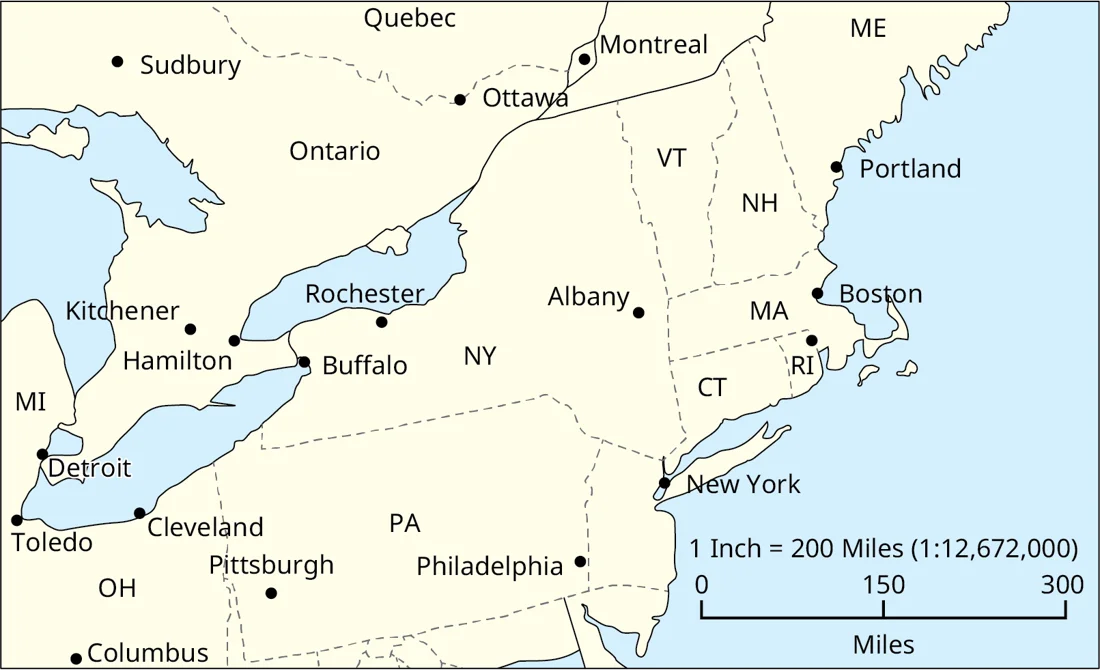
A map shows the northeastern part of the United States. The following cities are labeled: Portland, Maine; Boston, Massachusetts; Albany, New York; Buffalo, New York; Rochester, New York; New York City, New York; Philadelphia, Pennsylvania; Pittsburgh, Pennsylvania; Columbus, Ohio; Cleveland, Ohio; Toledo, Ohio; Detroit, Michigan; Hamilton, Ontario; Kitchener, Ontario; Sudbury, Ontario; Ottawa, Ontario; Montreal, Quebec. A scale reads, 1 Inch = 200 Miles (1 to 12,672,000).
A map of the northeastern United States
Ratio and proportions are used to solve problems involving scale. One common place you see a scale is on a map (as represented in diagram). In this image, 1 inch is equal to 200 miles. This is the scale. This means that 1 inch on the map corresponds to 200 miles on the surface of Earth. Another place where scales are used is with models: model cars, trucks, airplanes, trains, and so on. A common ratio given for model cars is 1:24—that means that 1 inch in length on the model car is equal to 24 inches (2 feet) on an actual automobile. Although these are two common places that scale is used, it is used in a variety of other ways as well.

Solving a Scaling Problem Involving Maps

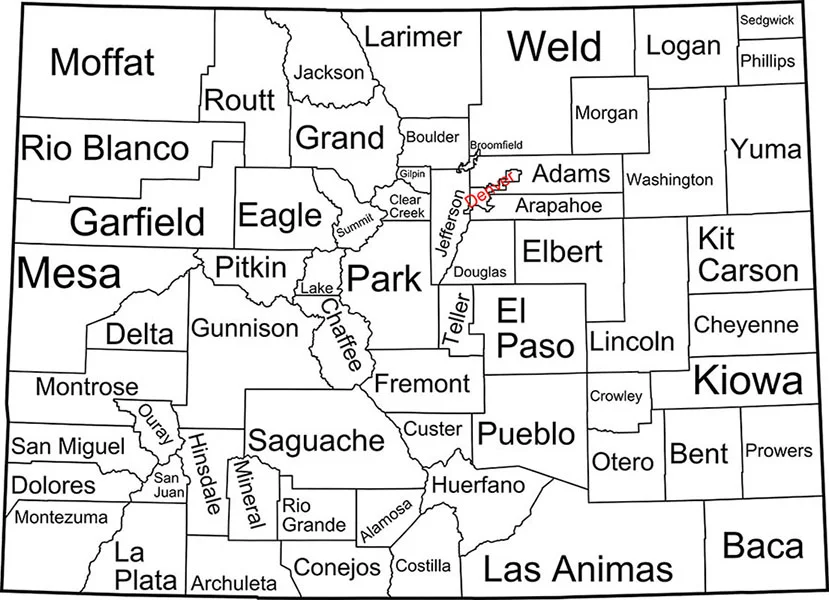
diagram is an outline map of the state of Colorado and its counties. If the distance of the southern border is 380 miles, determine the scale (i.e., 1 inch = how many miles). Then use that scale to determine the approximate lengths of the other borders of the state of Colorado.
An outline map of Colorado's counties.
Outline Map of Colorado (credit: "Map of Colorado Counties" by David Benbennick/Wikimedia Commons, Public Domain)
Solution
When the southern border is measured with a ruler, the length is 4 inches. Since the length of the border in real life is 380 miles, our scale is 1 inch =95 miles.
The eastern and western borders both measure 3 inches, so their lengths are about 285 miles. The northern border measures the same as the southern border, so it has a length of 380 miles.

Solving a Scaling Problem Involving Model Cars

Die-cast NASCAR model cars are said to be built on a scale of 1:24 when compared to the actual car. If a model car is 9 inches long, how long is a real NASCAR automobile? Write your answer in feet.
Solution
The scale tells us that 1 inch of the model car is equal to 24 inches (2 feet) on the real automobile. So set up the two ratios into a proportion. Notice that the model lengths are both in the numerator and the NASCAR automobile lengths are both in the denominator.
124=9x 24(9)=x216=x
This amount (216) is in inches. To convert to feet, divide by 12, because there are 12 inches in a foot (this conversion from inches to feet is really another proportion!). The final answer is:
21612=18
The NASCAR automobile is 18 feet long.